Page 65 of 457

Here are some tips on getting the most out of your child
restraint:
•Before buying any restraint system, make sure that it
has a label certifying that it meets all applicable Safety
Standards. We also recommend that you make sure
that you can install the child restraint in the vehicle
where you will use it, before you buy it.
•The restraint must be appropriate for your child’s
weight and height. Check the label on the restraint for
weight and height limits.
•Carefully follow the instructions that come with the
restraint. If you install the restraint improperly, it may
not work when you need it.
The seat belts in the passenger seating positions are
equipped with either an Automatic Locking Retractor
(ALR) or a cinching latch plate or both. Both types of
seatbelts are designed to keep the lap portion of the
seat belt tight around the child restraint so that it is notnecessary to use a locking clip. The ALR will make a
ratcheting noise if you extract the entire belt from the
retractor and then allow the belt to retract into the
retractor. For additional information on ALR, refer to
“Automatic Locking Mode”.
•In the rear seat, you may have trouble tightening the
lap/shoulder belt on the child restraint because the
buckle or latch plate is too close to the belt path
opening on the restraint. Disconnect the latch plate
from the buckle and twist the short buckle end of the
belt several times to shorten it. Insert the latch plate
into the buckle with the release button facing out.
•If the belt still can’t be tightened, or if pulling and
pushing on the restraint loosens the belt, disconnect
the latch plate from the buckle, turn the latch plate
around, and insert the latch plate into the buckle
again. If you still can’t make the child restraint secure,
try a different seating position.
THINGS TO KNOW BEFORE STARTING YOUR VEHICLE 63
2
Page 74 of 457

�Voice Recognition System (VR) —
If Equipped........................... 109
▫Voice Recognition System (VR) Operation . . . 109
▫Commands..........................111
▫Voice Training....................... 114
�Seats............................... 114
▫Front Seat Adjustment................. 114
▫Manual Seat Height Adjustment —
If Equipped......................... 115
▫Manual Lumbar — If Equipped.......... 116
▫Driver’s Seatback Recline............... 116
▫Adjustable Head Restraints.............. 117
▫Heated Seats — If Equipped............. 117
▫Fold-Flat Front Passenger Seat........... 119▫Folding Rear Seat.................... 120
�To Open And Close The Hood............. 121
�Lights.............................. 123
▫Multifunction Lever................... 123
▫Headlights, Parking Lights And Instrument
Panel Lights........................ 123
▫Lights-On Reminder.................. 124
▫Fog Lights — If Equipped.............. 124
▫Daytime Running Lights (DRL) —
If Equipped......................... 125
▫Turn Signals........................ 126
▫High Beam/Low Beam Select Switch....... 126
▫Flash-To-Pass....................... 127
▫Off-Road Lights — If Equipped.......... 127
72 UNDERSTANDING THE FEATURES OF YOUR VEHICLE
Page 117 of 457
Using body pressure, move forward and rearward on the
seat to be sure the seat adjusters have latched.
WARNING!
•Adjusting a seat while the vehicle is moving is
dangerous. The sudden movement of the seat
could cause you to lose control. The seat belt might
not be properly adjusted and you could be injured.
Adjust the seat only while the vehicle is parked.
•Do not ride with the seatback reclined so that the
shoulder belt is no longer resting against your
chest. In a collision you could slide under the seat
belt and be seriously or even fatally injured. Use
the recliner only when the vehicle is parked.
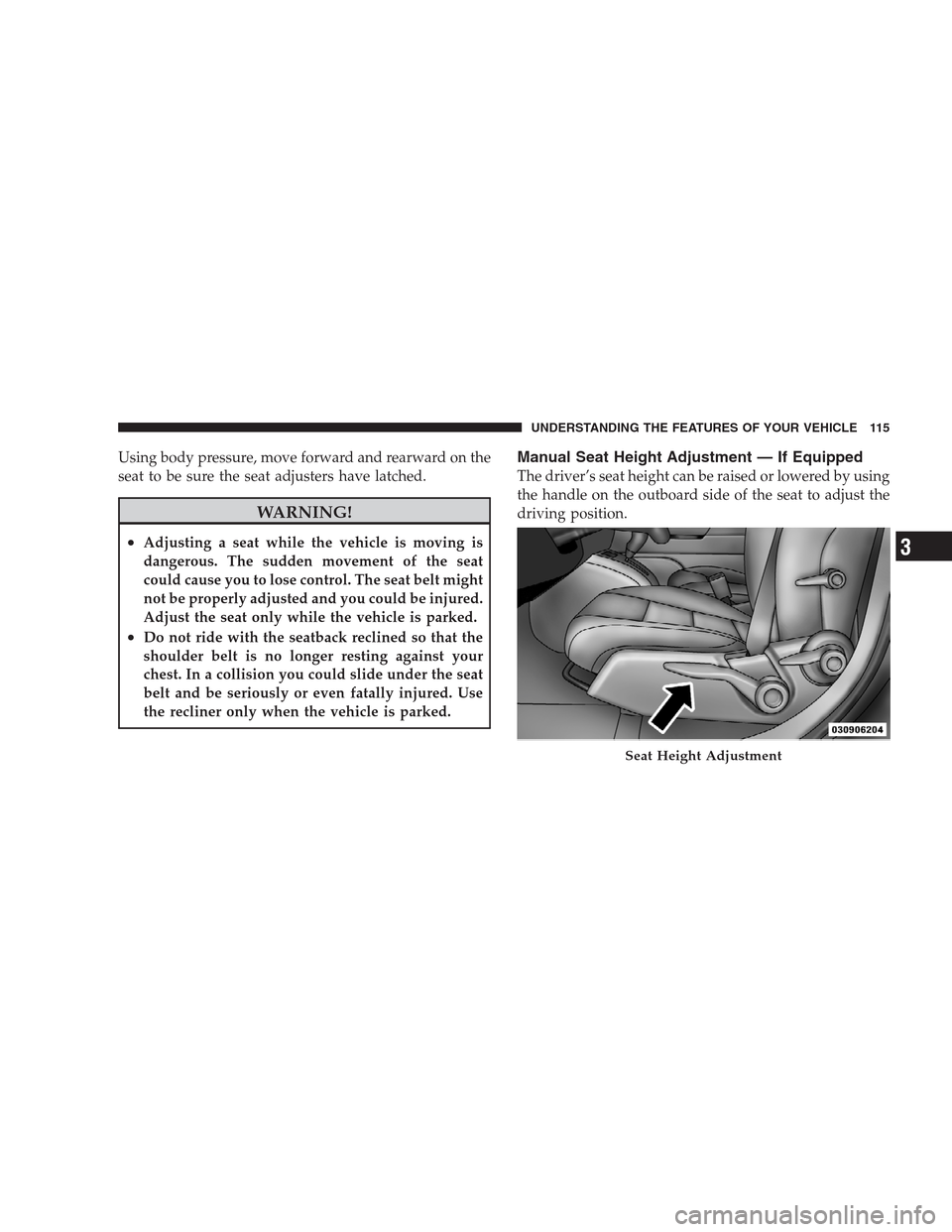
Manual Seat Height Adjustment — If Equipped
The driver’s seat height can be raised or lowered by using
the handle on the outboard side of the seat to adjust the
driving position.
Seat Height Adjustment
UNDERSTANDING THE FEATURES OF YOUR VEHICLE 115
3
Page 304 of 457
Tire Sizing Chart
EXAMPLE:
Size Designation:
P= Passenger car tire size based on U.S. design standards
�....blank....�= Passenger car tire based on European design standards
LT= Light truck tire based on U.S. design standards
T= Temporary spare tire
31= Overall diameter in inches (in)
215= Section width in millimeters (mm)
65= Aspect ratio in percent (%)
— Ratio of section height to section width of tire
10.5= Section width in inches (in)
R= Construction code
—�R�means radial construction
—�D�means diagonal or bias construction
15= Rim diameter in inches (in)
302 STARTING AND OPERATING
Page 340 of 457
WARNING!
It is important that you do not exceed the maximum
front or rear GAWR. A dangerous driving condition
can result if either rating is exceeded. You could lose
control of the vehicle and have an accident.
Tongue Weight (TW)
The tongue weight is the downward force exerted on the
hitch ball by the trailer. In most cases it should not be less
than 10% or more than 15% of the trailer load. You must
consider this as part of the load on your vehicle.
Frontal Area
The frontal area is the maximum height and maximum
width of the front of a trailer.
Trailer Sway Control
The trailer sway control is a telescoping link that can be
installed between the hitch receiver and the trailer tonguethat typically provides adjustable friction associated with
the telescoping motion to dampen any unwanted trailer
swaying motions while traveling.
Weight-Carrying Hitch
A weight-carrying hitch supports the trailer tongue
weight, just as if it were luggage located at a hitch ball or
some other connecting point of the vehicle. These kind of
hitches are the most popular on the market today and
they’re commonly used to tow small- and medium-sized
trailers.
Weight-Distributing Hitch
A weight-distributing system works by applying lever-
age through spring (load) bars. They are typically used
for heavier loads, to distribute trailer tongue weight to
the tow vehicle’s front axle and the trailer axle(s). When
used in accordance with the manufacturers’ directions, it
provides for a more level ride, offering more consistent
steering and brake control, thereby enhancing towing
338 STARTING AND OPERATING