Page 179 of 457

the key is in the ON/RUN position before engine start. If
the light does not come on when turning the key from
OFF to ON/RUN, have the condition checked promptly.
Certain conditions such as a loose or missing gas cap,
poor fuel quality, etc., may illuminate the light after
engine start. The vehicle should be serviced if the light
stays on through several of your typical driving cycles. In
most situations the vehicle will drive normally and will
not require towing.
If the MIL flashes when the engine is running, serious
conditions may exist that could lead to immediate loss of
power or severe catalytic converter damage. The vehicle
should be serviced as soon as possible if this occurs.
27. Hill Descent Indicator — If Equipped
The symbol illuminates (is armed) when the
4WD Lock switch is activated and the trans-
mission range indicator is in LOW or REVERSE
position (Off-Road Mode).28. Front Fog Light Indicator — If Equipped
This light shows when the front fog lights are on.
29. Electronic Stability Program (ESP) Indicator
Light/Traction Control System (TCS) Indicator Light
If this indicator light flashes during accelera-
tion, apply as little throttle as possible. While
driving, ease up on the accelerator. Adapt your
speed and driving to the prevailing road con-
ditions, and do not switch off the Electronic Stability
Program (ESP), or Traction Control System (TCS).
30. Electronic Stability Program (ESP) Indicator Light
The malfunction lamp for the Electronic Stabil-
ity Program (ESP) is combined with Brake
Assist System (BAS). The yellow “ESP/BAS
Warning Lamp” comes on when the ignition
switch is turned to the “ON” position. They should go
out with the engine running. If the “ESP/BAS Warning
UNDERSTANDING YOUR INSTRUMENT PANEL 177
4
Page 256 of 457

�Tire Chains.......................... 318
�Snow Tires.......................... 318
�Tire Rotation Recommendations............ 318
�Tire Pressure Monitoring System (TPMS)..... 319
▫Base System........................ 322
▫Premium System — If Equipped.......... 324
▫General Information................... 328
�Fuel Requirements..................... 328
▫Reformulated Gasoline................. 329
▫Gasoline/Oxygenate Blends............. 329
▫E-85 Usage In Non-Flex Fuel Vehicles...... 329
▫MMT In Gasoline.................... 330
▫Materials Added To Fuel............... 331▫Fuel System Cautions.................. 331
▫Carbon Monoxide Warnings............. 332
�Adding Fuel......................... 332
▫Fuel Filler Cap (Gas Cap)............... 332
▫Loose Fuel Filler Cap Message........... 334
�Vehicle Loading....................... 335
▫Vehicle Certification Label.............. 335
�Trailer Towing........................ 337
▫Common Towing Definitions............ 337
▫Trailer Hitch Classification.............. 339
▫Trailer Towing Weights (Maximum Trailer
Weight Ratings)...................... 340
254 STARTING AND OPERATING
Page 323 of 457

CAUTION!
•The TPMS has been optimized for the original
equipment tires and wheels. TPMS pressures and
warnings have been established for the tire size
equipped on your vehicle. Undesirable system
operation or sensor damage may result when us-
ing replacement equipment that is not of the same
size, type, and/or style. Aftermarket wheels can
cause sensor damage. Do not use aftermarket tire
sealants or balance beads if your vehicle is
equipped with a TPMS, as damage to the sensors
may result.
•After inspecting or adjusting the tire pressure,
always reinstall the valve stem cap. This will
prevent moisture and dirt from entering the valve
stem, which could damage the Tire Pressure Moni-
toring Sensor.NOTE:
•The TPMS is not intended to replace normal tire care
and maintenance or to provide warning of a tire failure
or condition.
•The TPMS should not be used as a tire pressure gauge
while adjusting your tire pressure.
•Driving on a significantly under-inflated tire causes
the tire to overheat and can lead to tire failure.
Under-inflation also reduces fuel efficiency and tire
tread life, and may affect the vehicle’s handling and
stopping ability.
•The TPMS is not a substitute for proper tire mainte-
nance, and it is the driver ’s responsibility to maintain
correct tire pressure using an accurate tire gauge, even
if under-inflation has not reached the level to trigger
illumination of the Tire Pressure Monitoring Telltale
light.
STARTING AND OPERATING 321
5
Page 334 of 457

Carbon Monoxide Warnings
WARNING!
Carbon monoxide (CO) in exhaust gases is deadly.
Follow the precautions below to prevent carbon
monoxide poisoning:
•Do not inhale exhaust gases. They contain carbon
monoxide, a colorless and odorless gas which can kill.
Never run the engine in a closed area, such as a
garage, and never sit in a parked vehicle with the
engine running for an extended period of time. If the
vehicle is stopped in an open area with the engine
running for more than a short period, adjust the
ventilation system to force fresh, outside air into the
vehicle.
•Guard against carbon monoxide with proper mainte-
nance. Have the exhaust system inspected every time
the vehicle is raised. Have any abnormal conditions
repaired promptly. Until repaired, drive with all side
windows fully open.
•Keep the liftgate closed when driving your vehicle to
prevent carbon monoxide and other poisonous ex-
haust gases from entering the vehicle.
ADDING FUEL
Fuel Filler Cap (Gas Cap)
The gas cap is behind the fuel filler door, on the left side
of the vehicle. If the gas cap is lost or damaged, be sure
the replacement cap is for use with this vehicle.
332 STARTING AND OPERATING
Page 335 of 457
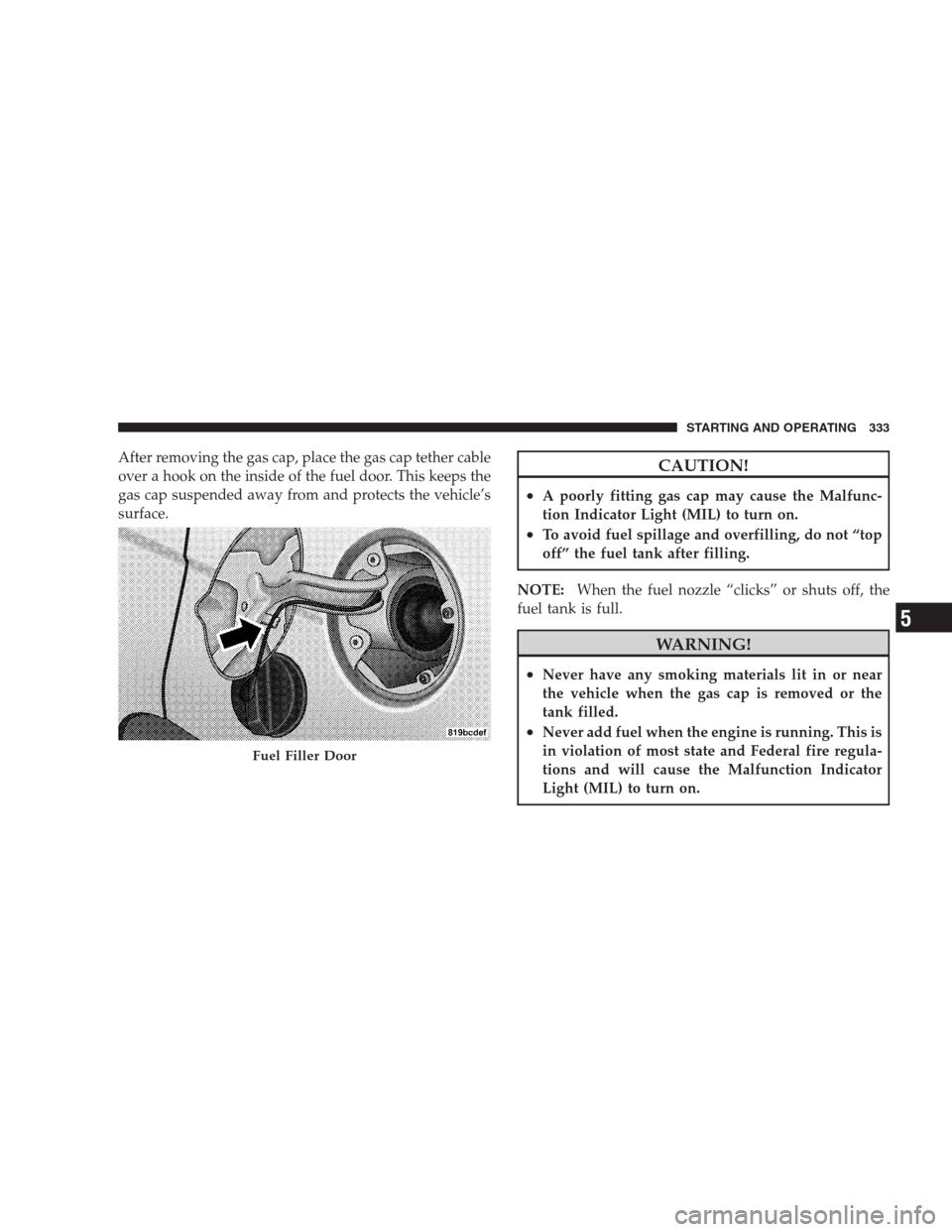
After removing the gas cap, place the gas cap tether cable
over a hook on the inside of the fuel door. This keeps the
gas cap suspended away from and protects the vehicle’s
surface.CAUTION!
•A poorly fitting gas cap may cause the Malfunc-
tion Indicator Light (MIL) to turn on.
•To avoid fuel spillage and overfilling, do not “top
off” the fuel tank after filling.
NOTE:When the fuel nozzle “clicks” or shuts off, the
fuel tank is full.
WARNING!
•Never have any smoking materials lit in or near
the vehicle when the gas cap is removed or the
tank filled.
•Never add fuel when the engine is running. This is
in violation of most state and Federal fire regula-
tions and will cause the Malfunction Indicator
Light (MIL) to turn on.
Fuel Filler Door
STARTING AND OPERATING 333
5
Page 336 of 457

NOTE:Tighten the gas cap about 1/4 turn until you
hear one click. This is an indication that cap is properly
tightened.
If the gas cap is not tighten properly, the MIL will come
on. Be sure the gas cap is tightened every time the vehicle
is refueled.
WARNING!
A fire may result if gasoline is pumped into a
portable container that is inside of a vehicle. You
could be burned. Always place gas containers on the
ground while filling.
Loose Fuel Filler Cap Message
If the vehicle diagnostic system determines that the fuel
filler cap is loose or improperly installed, a “gASCAP”
message will be displayed in the Odometer/Trip Odom-
eter in the instrument cluster. Refer to “InstrumentCluster Description” in Section 4 of this manual. Tighten
the fuel filler cap properly and press the odometer/trip
odometer RESET button to turn the message off. If the
problem continues, the message will appear the next time
the vehicle is started. Refer to “Onboard Diagnostic
System — OBD II” in Section 7 of this manual for more
information.
CAUTION!
Damage to the fuel system or emission control sys-
tem could result from using an improper fuel tank
filler cap (gas cap). A poorly fitting cap could let
impurities into the fuel system.
334 STARTING AND OPERATING
Page 338 of 457
Curb Weight
The curb weight of a vehicle is defined as the total weight
of the vehicle with all fluids, including vehicle fuel, at full
capacity conditions, and with no occupants or cargo
loaded into the vehicle. The front and rear curb weight
values are determined by weighing your vehicle on a
commercial scale before any occupants or cargo are
added.
Overloading
The load carrying components (springs, tires, wheels,
etc.) of your vehicle will provide satisfactory service as
long as you do not exceed the GVWR.
The best way to figure out the total weight of your
vehicle is to weigh it when it is fully loaded and ready for
operation. Weigh it on a commercial scale to ensure that
it is not over the GVWR.Overloading can cause potential safety hazards and
shorten useful service life. Heavier suspension compo-
nents do not necessarily increase the vehicle’s GVWR.
Loading
To load your vehicle properly, first figure out its empty
weight. Store heavier items down low and be sure you
distribute their weight as evenly as possible. Stow all
loose items securely before driving. Improper weight
distribution can have an adverse effect on the way your
vehicle steers and handles, and the way the brakes
operate.
CAUTION!
Do not load your vehicle any heavier than the
GVWR. If you do, parts on your vehicle can break, or
it can change the way your vehicle handles. This
could cause you to lose control. Also, overloading can
shorten the life of your vehicle.
336 STARTING AND OPERATING
Page 365 of 457
MAINTAINING YOUR VEHICLE
CONTENTS
�Engine Compartment — 2.0L/2.4L.......... 365
�Onboard Diagnostic System — OBD II....... 366
▫Loose Fuel Filler Cap Message........... 366
�Emissions Inspection And Maintenance
Programs............................ 367
�Replacement Parts..................... 368
�Dealer Service........................ 369
�Maintenance Procedures................. 369
▫Engine Oil......................... 369▫Engine Oil Filter..................... 372
▫Engine Air Cleaner Filter............... 372
▫Maintenance-Free Battery............... 373
▫Air Conditioner Maintenance............ 374
▫Body Lubrication..................... 375
▫Windshield Wiper Blades............... 375
▫Adding Washer Fluid.................. 376
▫Exhaust System...................... 376
▫Cooling System...................... 378
7