Page 31 of 506
DOOR LOCKS
Manual Door Locks
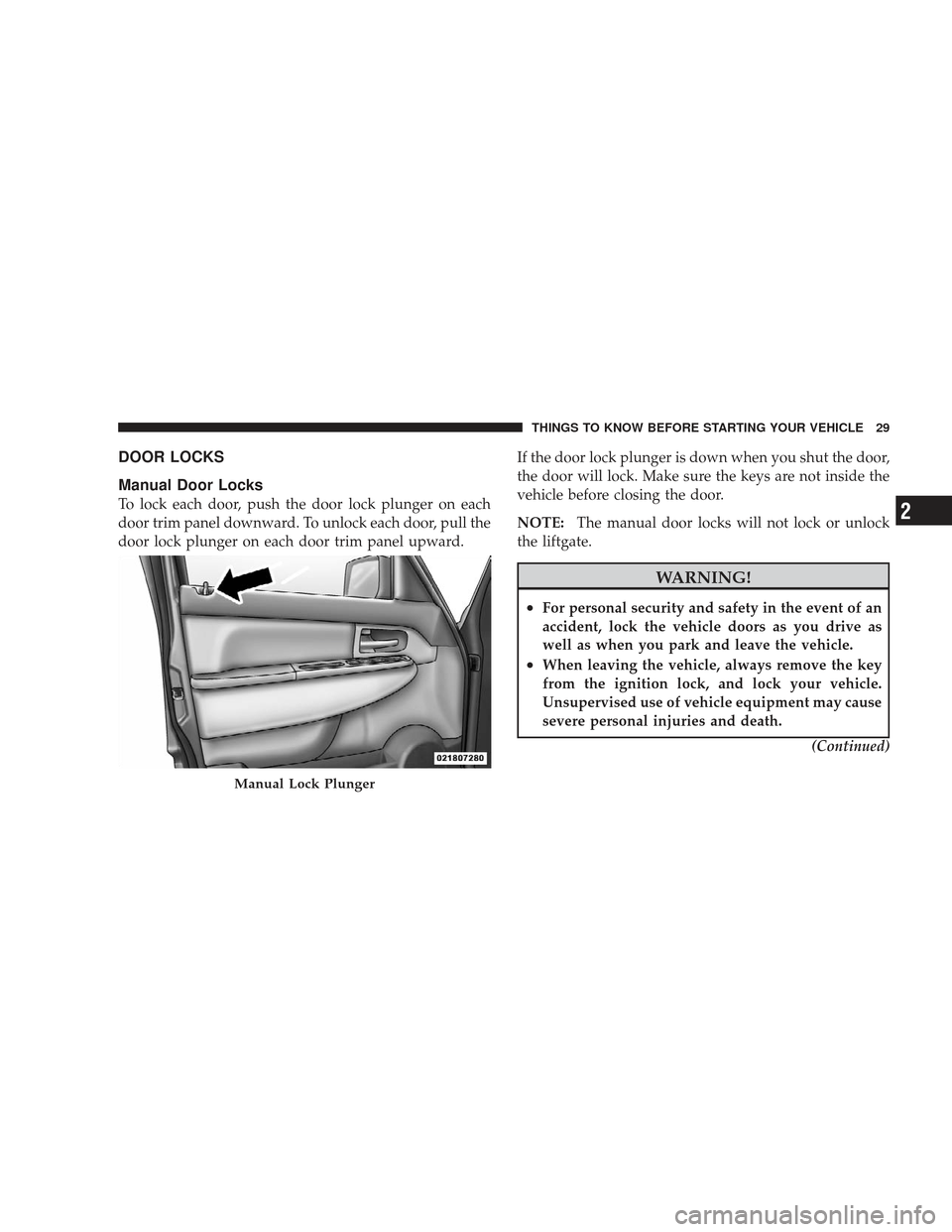
To lock each door, push the door lock plunger on each
door trim panel downward. To unlock each door, pull the
door lock plunger on each door trim panel upward.If the door lock plunger is down when you shut the door,
the door will lock. Make sure the keys are not inside the
vehicle before closing the door.
NOTE:
The manual door locks will not lock or unlock
the liftgate.
WARNING!
•For personal security and safety in the event of an
accident, lock the vehicle doors as you drive as
well as when you park and leave the vehicle.
•When leaving the vehicle, always remove the key
from the ignition lock, and lock your vehicle.
Unsupervised use of vehicle equipment may cause
severe personal injuries and death.
(Continued)
Manual Lock Plunger
THINGS TO KNOW BEFORE STARTING YOUR VEHICLE 29
2
Page 32 of 506
WARNING! (Continued)
•Never leave children alone in a vehicle. Leaving
unattended children in a vehicle is dangerous for a
number of reasons. A child or others could be
seriously or fatally injured. Don’t leave the key in
the ignition. A child could operate power win-
dows, other controls, or move the vehicle.
Power Door Locks
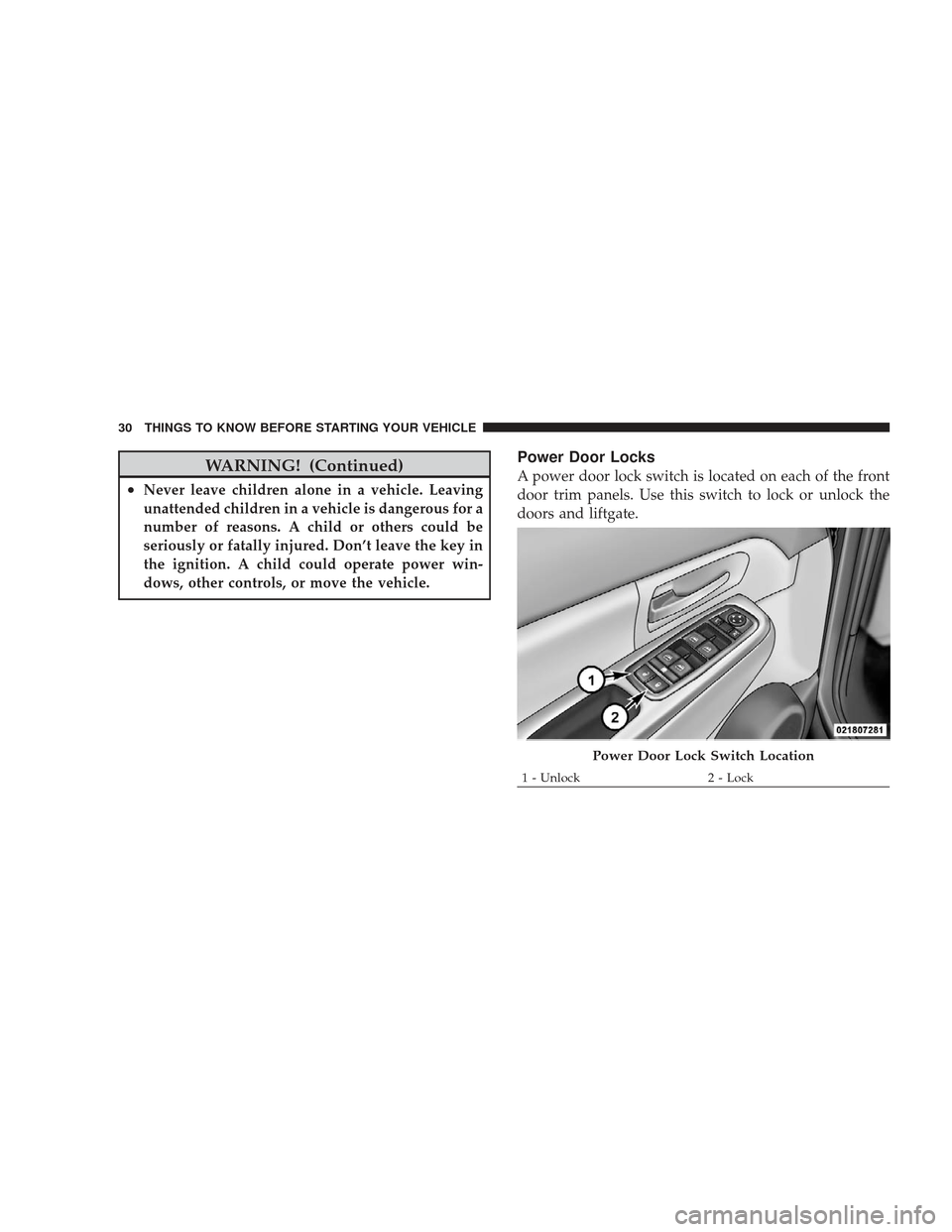
A power door lock switch is located on each of the front
door trim panels. Use this switch to lock or unlock the
doors and liftgate.
Power Door Lock Switch Location
1 - Unlock2 - Lock
30 THINGS TO KNOW BEFORE STARTING YOUR VEHICLE
Page 36 of 506
WARNING!
Avoid trapping anyone in a vehicle in a collision.
Remember that the rear doors can only be opened
from the outside when the child protection locks are
engaged.
NOTE:
•After engaging the Child Protection Door Lock sys-
tem, always test the door from the inside to make
certain it is in the desired position.
•For emergency exit with the system engaged, move
the lock plunger up (unlocked position), roll down the
window, and open the door with the outside door
handle.
To Disengage the Child Protection Door Lock
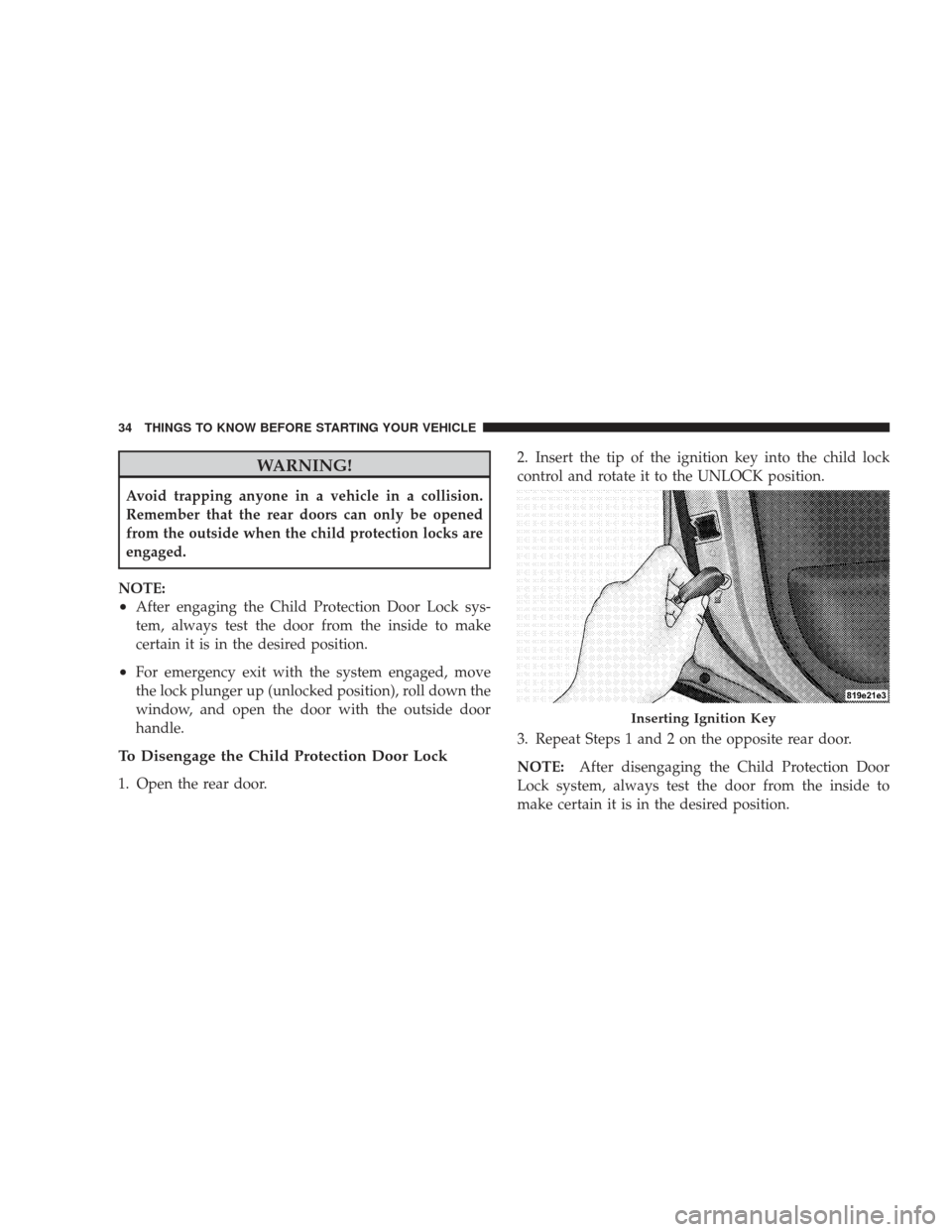
1. Open the rear door. 2. Insert the tip of the ignition key into the child lock
control and rotate it to the UNLOCK position.
3. Repeat Steps 1 and 2 on the opposite rear door.
NOTE:
After disengaging the Child Protection Door
Lock system, always test the door from the inside to
make certain it is in the desired position.
Inserting Ignition Key
34 THINGS TO KNOW BEFORE STARTING YOUR VEHICLE
Page 37 of 506
WINDOWS
Power Windows
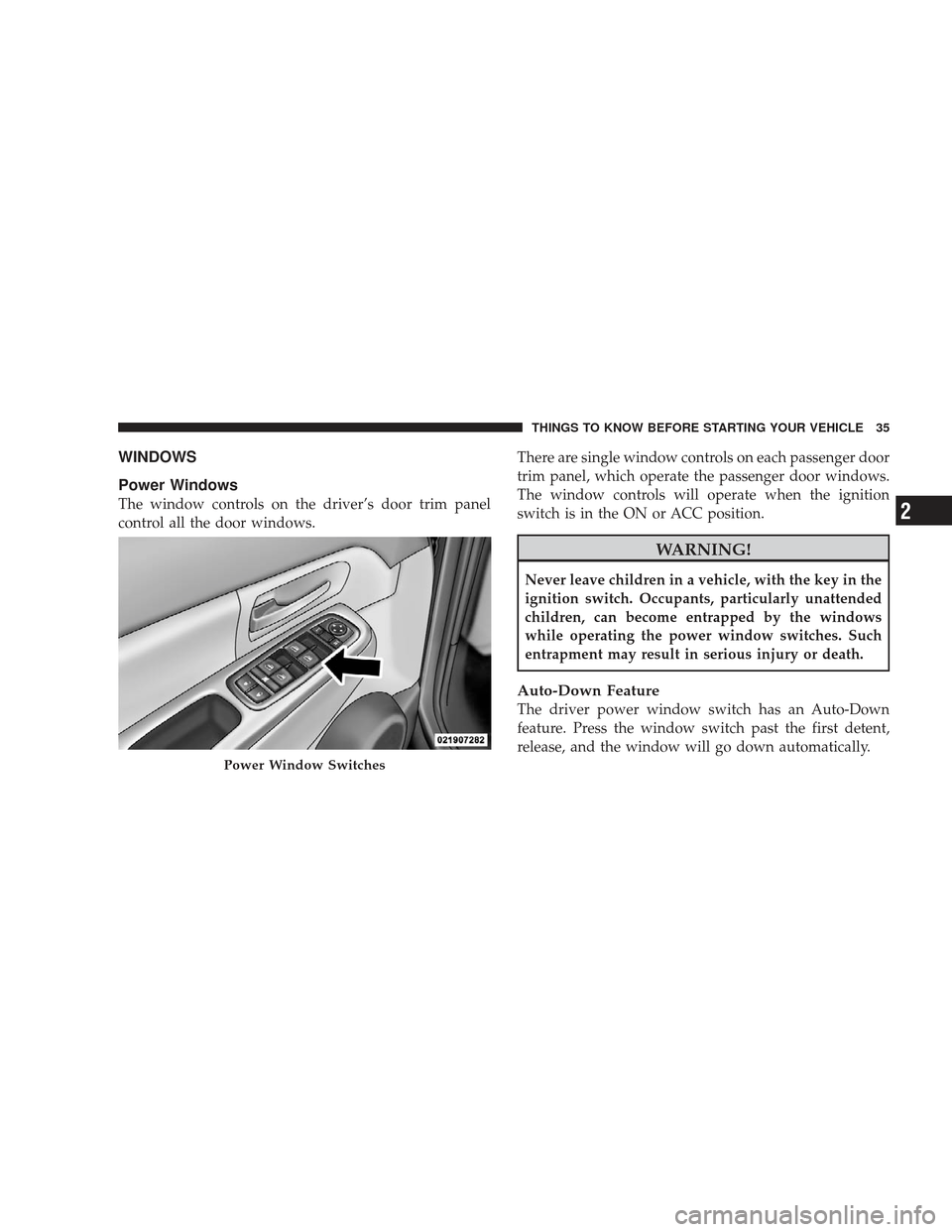
The window controls on the driver’s door trim panel
control all the door windows.There are single window controls on each passenger door
trim panel, which operate the passenger door windows.
The window controls will operate when the ignition
switch is in the ON or ACC position.
WARNING!
Never leave children in a vehicle, with the key in the
ignition switch. Occupants, particularly unattended
children, can become entrapped by the windows
while operating the power window switches. Such
entrapment may result in serious injury or death.
Auto-Down Feature
The driver power window switch has an Auto-Down
feature. Press the window switch past the first detent,
release, and the window will go down automatically.
Power Window Switches
THINGS TO KNOW BEFORE STARTING YOUR VEHICLE 35
2
Page 39 of 506
For vehicles not equipped with the Electronic Vehicle
Information Center (EVIC), the power window switches
will remain active for 45 seconds after the ignition switch
is turned to the LOCK position. Opening either front
door will cancel this feature.
For vehicles equipped with the EVIC, the power window
switches will remain active for up to 10 minutes after the
ignition switch is turned to the LOCK position. Opening
either front door will cancel this feature. The time is
programmable. For details, refer to “Delay Power Off to
Accessories Until Exit,” under “Personal Settings
(Customer-Programmable Features)” in the “Electronic
Vehicle Information Center (EVIC),” in Section 4 of this
manual.NOTE:
•If the window runs into any obstacle during auto-
closure, it will reverse direction and then go back
down. Remove the obstacle and use the window
switch again to close the window.
•Any impact due to rough road conditions may trigger
the auto reverse function unexpectedly during auto-
closure. If this happens, pull the switch lightly to the
first detent and hold to close window manually.
WARNING!
There is no anti-pinch protection when the window
is almost closed. Be sure to clear all objects from the
window before closing.
THINGS TO KNOW BEFORE STARTING YOUR VEHICLE 37
2
Page 42 of 506
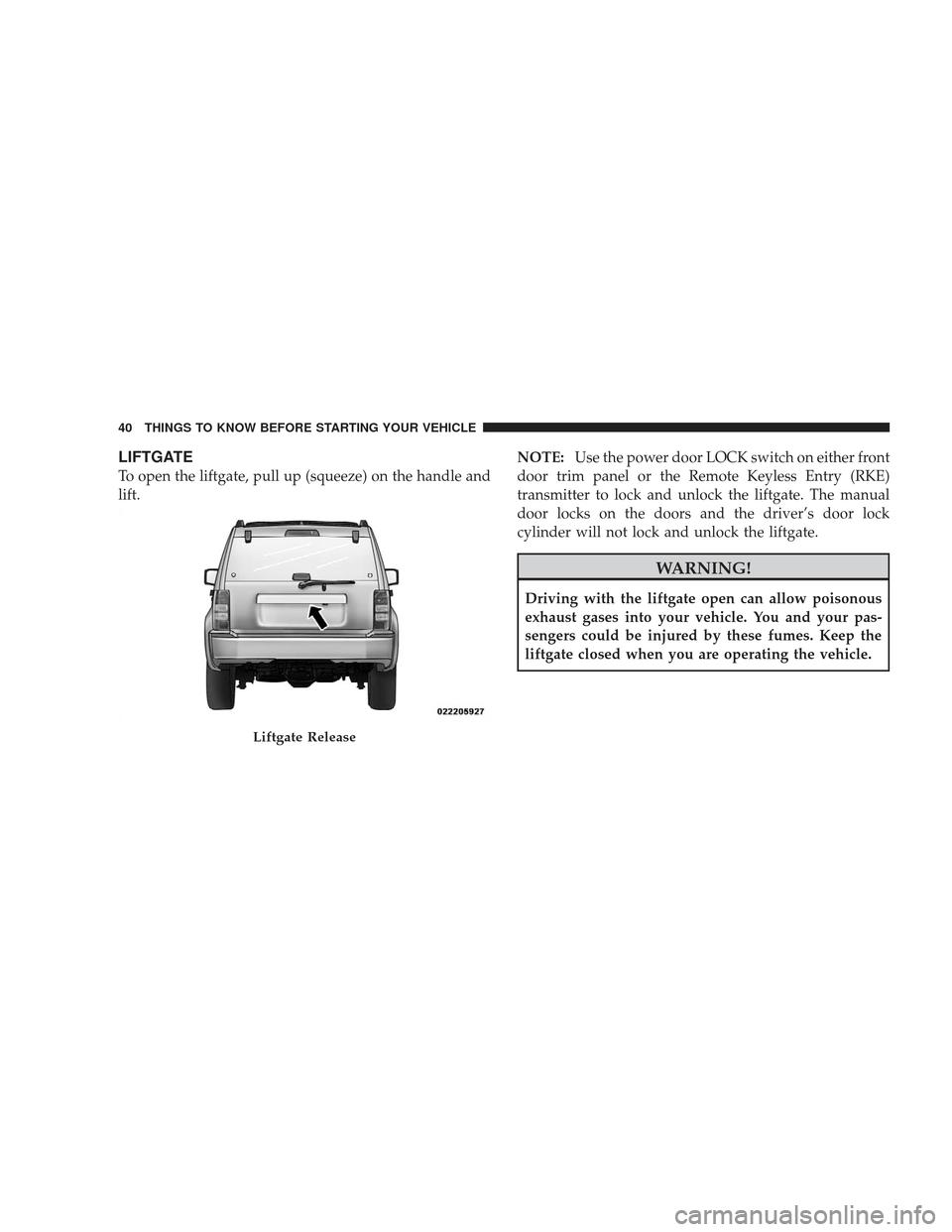
LIFTGATE
To open the liftgate, pull up (squeeze) on the handle and
lift.NOTE:
Use the power door LOCK switch on either front
door trim panel or the Remote Keyless Entry (RKE)
transmitter to lock and unlock the liftgate. The manual
door locks on the doors and the driver’s door lock
cylinder will not lock and unlock the liftgate.
WARNING!
Driving with the liftgate open can allow poisonous
exhaust gases into your vehicle. You and your pas-
sengers could be injured by these fumes. Keep the
liftgate closed when you are operating the vehicle.
Liftgate Release
40 THINGS TO KNOW BEFORE STARTING YOUR VEHICLE
Page 43 of 506
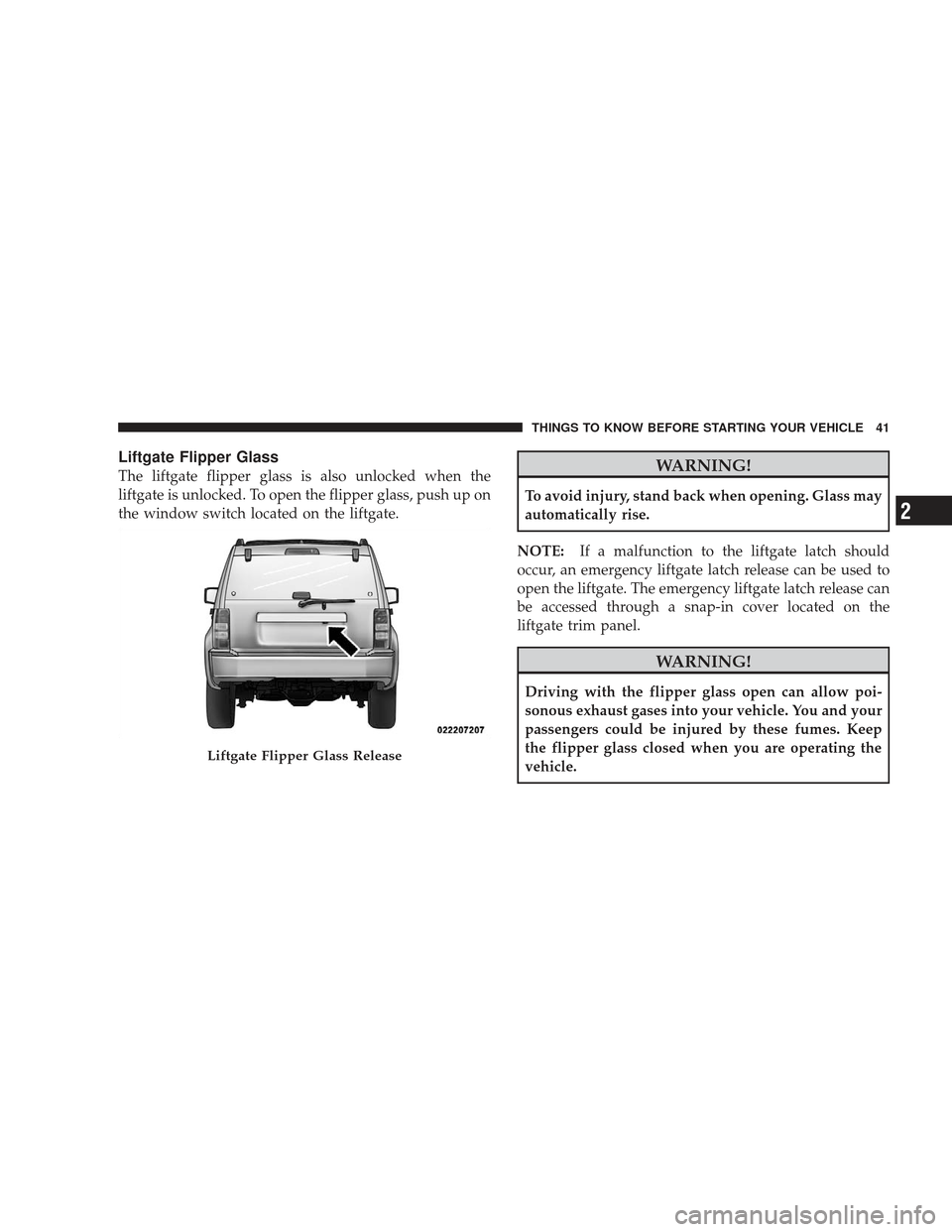
Liftgate Flipper Glass
The liftgate flipper glass is also unlocked when the
liftgate is unlocked. To open the flipper glass, push up on
the window switch located on the liftgate.WARNING!
To avoid injury, stand back when opening. Glass may
automatically rise.
NOTE: If a malfunction to the liftgate latch should
occur, an emergency liftgate latch release can be used to
open the liftgate. The emergency liftgate latch release can
be accessed through a snap-in cover located on the
liftgate trim panel.
WARNING!
Driving with the flipper glass open can allow poi-
sonous exhaust gases into your vehicle. You and your
passengers could be injured by these fumes. Keep
the flipper glass closed when you are operating the
vehicle.
Liftgate Flipper Glass Release
THINGS TO KNOW BEFORE STARTING YOUR VEHICLE 41
2
Page 44 of 506
OCCUPANT RESTRAINTS
Some of the most important safety features in your
vehicle are the restraint systems. These include the front
and rear seat belts for the driver and all passengers, front
airbags for both the driver and front passenger, and side
curtain airbags for the driver and passengers seated next
to a window. If you will be carrying children too small for
adult-sized belts, your seat belts also can be used to hold
infant and child restraint systems.
Please pay close attention to the information in this
section. It tells you how to use your restraint system
properly, to keep you and your passengers as safe as
possible.WARNING!
In a collision, you and your passengers can suffer
injuries, including fatalities, if you are not properly
buckled up. You can strike the interior of your
vehicle or other passengers, or you can be thrown out
of the vehicle. Always be sure you and others in your
vehicle are buckled up properly.
Buckle up even though you are an excellent driver, even
on short trips. Someone on the road may be a poor driver
and cause a collision that includes you. This can happen
far away from home or on your own street.
Research has shown that seat belts save lives, and they
can reduce the seriousness of injuries in a collision. Some
of the worst injuries happen when people are thrown
from the vehicle. Seat belts reduce the possibility of
ejection and the risk of injury caused by striking the
42 THINGS TO KNOW BEFORE STARTING YOUR VEHICLE