Page 300 of 506
WARNING! (Continued)
•It is dangerous to move the shift lever out of PARK
or NEUTRAL if the engine speed is higher than
idle speed. If your foot is not firmly on the brake
pedal, the vehicle could accelerate quickly forward
or in reverse. You could lose control of the vehicle
and hit someone or something. Only shift into
gear when the engine is idling normally and when
your right foot is firmly on the brake pedal.
REVERSE
This range is for moving the vehicle rearward. Use this
range only after the vehicle has come to a complete stop.
NEUTRAL
This range is used when the vehicle is standing for
prolonged periods with the engine running. The engine
may be started in this range. Set the parking brake if you
must leave the vehicle. NOTE:
Towing the vehicle, coasting, or driving for any
other reason with shift lever in NEUTRAL can result in
severe transmission damage. Refer to “Recreational Tow-
ing” in Section 5 and “Towing a Disabled Vehicle” in
Section 6 of this manual.
DRIVE
This range is used for most city and highway driving.
2 (Second)
This range is used for moderate grades and to assist
braking on dry pavement or in mud and snow. Begins at
a stop in low gear with automatic upshift to 2nd gear.
Will not shift to 3rd gear.
1 (First)
This range is used for hard pulling at low speeds in mud,
sand, snow, or on steep grades. Begins and stays in low
gear with no upshift. Provides engine compression brak-
ing at low speeds.
298 STARTING AND OPERATING
Page 305 of 506
CAUTION! (Continued)
•The 4WD LOCK position and 4WD LOW position
are intended for loose or slippery road surfaces
only. Driving in these positions on dry hard-
surfaced roads may cause increased tire wear and
damage to the driveline components.
•When operating your vehicle in 4WD LOW, the
engine speed is approximately three times that of
the 2WD position or 4WD LOCK position at a
given road speed. Take care not to over-speed the
engine and do not exceed 25 mph (40 km/h).
•Proper operation of four-wheel drive vehicles de-
pends on tires of equal size, type, and circumfer-
ence on each wheel. Any difference in tire size can
cause damage to the transfer case.
WARNING!
•You or others could be injured if you leave the
vehicle unattended with the transfer case in the
NEUTRAL position without first fully engaging
the parking brake. The transfer case NEUTRAL
position disengages both the front driveshaft and
rear driveshaft from the powertrain and it will
allow the vehicle to move even if the transmission
is in PARK. The parking brake should always be
applied when the driver is not in the vehicle.
•Always engage the parking brake when powering
down the vehicle if the “SERV 4WD Warning
Light” is illuminated. Not engaging the parking
brake may allow the vehicle to roll, which may
cause personal injury.(Continued)
STARTING AND OPERATING 303
5
Page 311 of 506
CAUTION! (Continued)
•When operating your vehicle in 4WD LOW, the
engine speed is approximately three times that of
the 2WD position or 4WD AUTO position at a
given road speed. Take care not to over-speed the
engine and do not exceed 25 mph (40 km/h).
•Proper operation of four-wheel drive vehicles de-
pends on tires of equal size, type, and circumfer-
ence on each wheel. Any difference in tire size can
cause damage to the transfer case.
WARNING!
•You or others could be injured if you leave the
vehicle unattended with the transfer case in the
NEUTRAL position without first fully engaging
the parking brake. The transfer case NEUTRAL
position disengages both the front driveshaft and
rear driveshaft from the powertrain and it will
allow the vehicle to move despite the transmission
position. The parking brake should always be
applied when the driver is not in the vehicle.
•Always engage the parking brake when powering
down the vehicle if the “SERV 4WD Warning
Light” is illuminated. Not engaging the parking
brake may allow the vehicle to roll, which may
cause personal injury.(Continued)
STARTING AND OPERATING 309
5
Page 320 of 506
WARNING!
Abrasive material in any part of the brakes may cause
excessive wear or unpredictable braking. You might
not have full braking power when you need it to
prevent an accident. If you have been operating your
vehicle in dirty conditions, get your brakes checked
and cleaned as necessary.
•If you experience unusual vibration after driving in
mud, slush, or similar conditions, check the wheels for
impacted material. Impacted material can cause a
wheel imbalance and freeing the wheels of it will
correct the situation.
POWER STEERING
The standard power steering system will give you good
vehicle response and increased ease of maneuverability
in tight spaces. The system will provide mechanical
steering capability if power assist is lost.
If for some reason the power assist is interrupted, it will
still be possible to steer your vehicle. Under these condi-
tions, you will observe a substantial increase in steering
effort, especially at very low vehicle speeds and during
parking maneuvers.
NOTE:Increased noise levels at the end of the steering
wheel travel are considered normal and do not indicate
that there is a problem with the power steering system.
Upon initial start-up in cold weather, the power steering
pump may make noise for a short amount of time. This is
due to the cold, thick fluid in the steering system. This
noise should be considered normal, and it does not in any
way damage the steering system.
318 STARTING AND OPERATING
Page 322 of 506
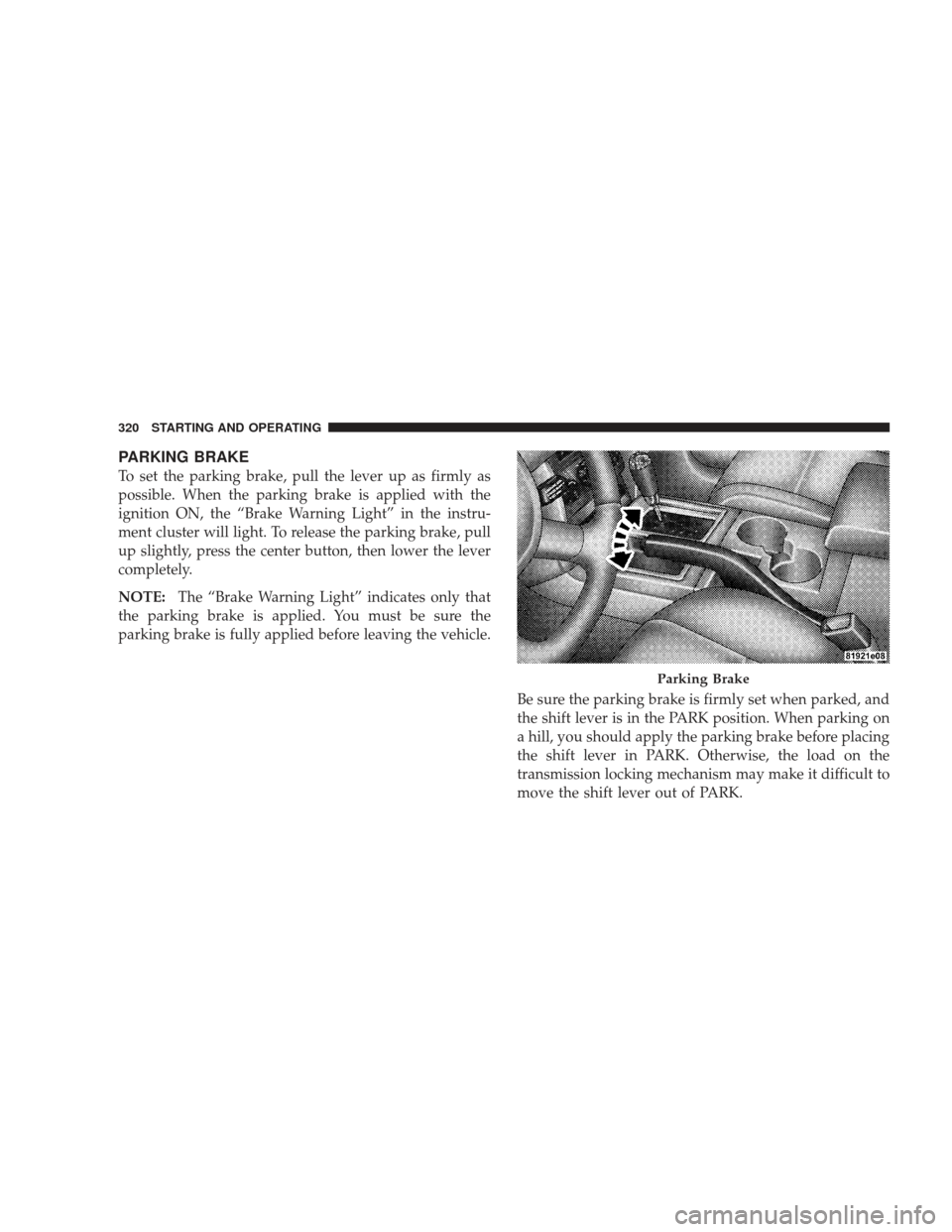
PARKING BRAKE
To set the parking brake, pull the lever up as firmly as
possible. When the parking brake is applied with the
ignition ON, the “Brake Warning Light” in the instru-
ment cluster will light. To release the parking brake, pull
up slightly, press the center button, then lower the lever
completely.
NOTE:The “Brake Warning Light” indicates only that
the parking brake is applied. You must be sure the
parking brake is fully applied before leaving the vehicle.
Be sure the parking brake is firmly set when parked, and
the shift lever is in the PARK position. When parking on
a hill, you should apply the parking brake before placing
the shift lever in PARK. Otherwise, the load on the
transmission locking mechanism may make it difficult to
move the shift lever out of PARK.
Parking Brake
320 STARTING AND OPERATING
Page 323 of 506
WARNING!
•Always apply the parking brake fully when leav-
ing your vehicle or it may roll and cause damage or
injury. Also, be certain to leave the transmission in
the PARK position. Failure to do so may allow the
vehicle to roll and cause damage or injury.
•Leaving unattended children in a vehicle is dan-
gerous for a number of reasons. A child or others
could be injured. Do not leave the keys in the
ignition. A child could operate power windows,
other controls, or move the vehicle.
•Be sure the parking brake is fully disengaged
before driving, failure to do so can lead to brake
problems due to excessive heating of the rear
brakes.When parking on a hill, turn the front wheels toward the
curb on a downhill grade and away from the curb on an
uphill grade.
The parking brake should always be applied whenever
the driver is not in the vehicle.
ANTI-LOCK BRAKE SYSTEM
The Anti-Lock Brake System (ABS) is designed to aid the
driver in maintaining vehicle control under adverse
braking conditions. The system operates with a separate
computer to modulate hydraulic pressure, to prevent
wheel lock-up and help avoid skidding on slippery
surfaces.
All vehicle wheels and tires must be the same size and
type, and tires must be properly inflated, to produce
accurate signals for the computer.
STARTING AND OPERATING 321
5
Page 325 of 506
WARNING! (Continued)
•The capabilities of an ABS equipped vehicle must
never be exploited in a reckless or dangerous
manner, which could jeopardize the user’s safety
or the safety of others.
CAUTION!
The ABS is subject to possible detrimental effects of
electronic interference caused by improperly in-
stalled aftermarket radios or telephones.
NOTE: During severe braking conditions, a pulsing
sensation may occur and a clicking noise will be heard.
This is normal, indicating that the ABS is functioning.
•Do not “ride” the brakes by resting your foot on the
pedal. This could overheat the brakes and result in
unpredictable braking action, longer stopping dis-
tances, or brake damage.
•When descending mountains or hills, repeated brak-
ing can cause brake fade with loss of braking control.
Avoid repeated heavy braking by downshifting the
transmission or locking out overdrive whenever pos-
sible.
•Engines may idle at higher speeds during warm-up,
which could cause rear wheels to spin and result in
loss of vehicle control. Be especially careful while
driving on slippery roads, in close-quarter maneuver-
ing, parking, or stopping.
•Do not drive too fast for road conditions, especially
when roads are wet or slushy. A wedge of water can
STARTING AND OPERATING 323
5
Page 331 of 506
WARNING!
There may be situations where the Hill Start Assist
(HSA) will not activate and slight rolling may occur,
such as on minor hills (i.e., less than 7%), or with a
loaded vehicle, or while pulling a trailer. HSA is not
a substitute for active driving involvement. It is
always the driver ’s responsibility to be attentive to
distance to other vehicles, people, and objects, and
most importantly brake operation to ensure safe
operation of the vehicle under all road conditions.
Your complete attention is always required while
driving to maintain safe control of your vehicle.
Failure to follow these warnings can result in an
accident or serious personal injury.
Towing with HSA
HSA will provide assistance during acceleration on an
incline while towing a trailer.
WARNING!
•If you use a trailer brake controller with your
trailer, the trailer brakes may be activated and
deactivated with the brake switch. If so, there may
not be enough brake pressure to hold both the
vehicle and the trailer on a hill when the brake
pedal is released. In order to avoid rolling down
an incline while resuming acceleration, manually
activate the trailer brake or apply more vehicle
brake pressure prior to releasing the brake pedal.
•HSA is not a parking brake. Always apply the
parking brake fully when leaving your vehicle.
Also, be certain to leave the transmission in PARK.
•Failure to follow these warnings can result in an
accident or serious personal injury.
STARTING AND OPERATING 329
5