Page 375 of 506
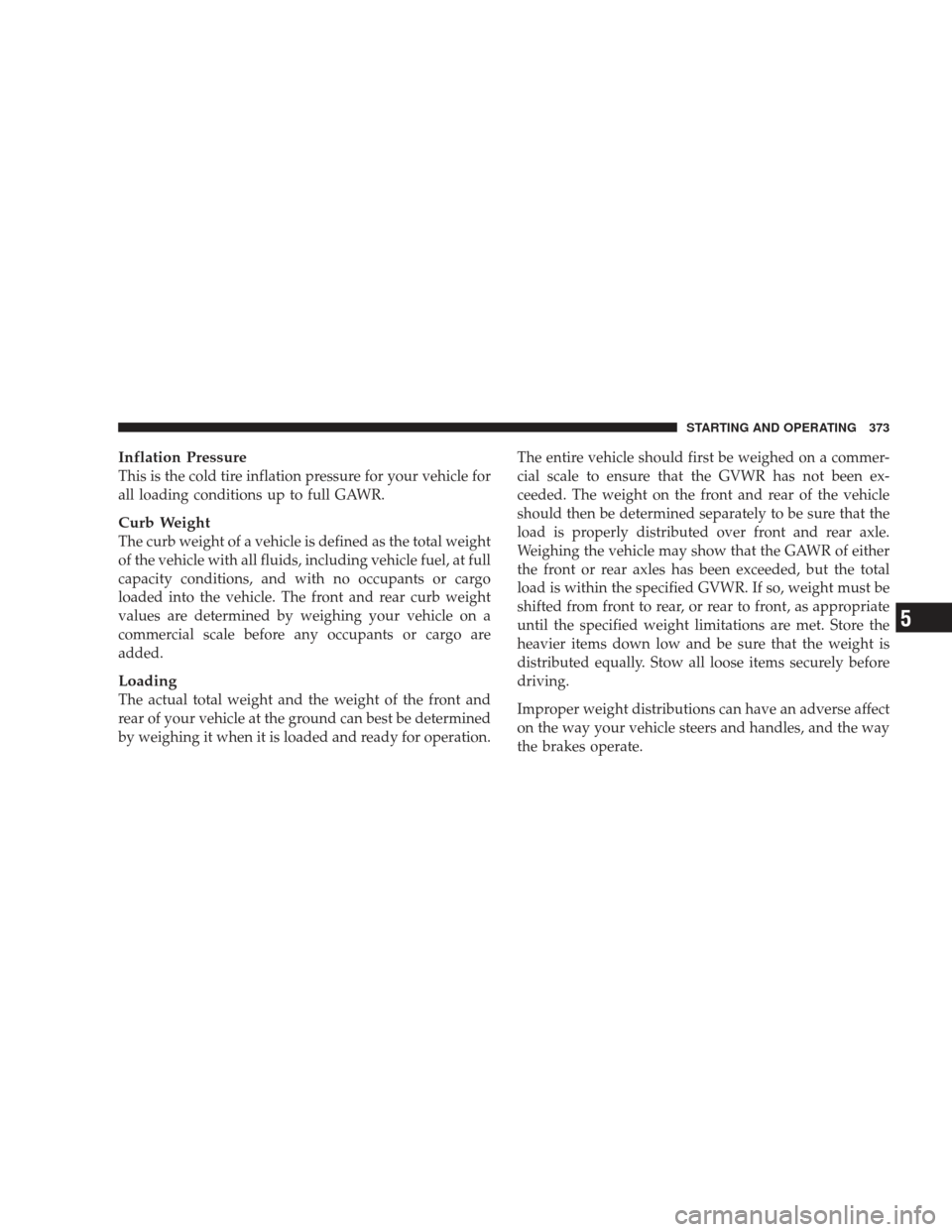
Inflation Pressure
This is the cold tire inflation pressure for your vehicle for
all loading conditions up to full GAWR.
Curb Weight
The curb weight of a vehicle is defined as the total weight
of the vehicle with all fluids, including vehicle fuel, at full
capacity conditions, and with no occupants or cargo
loaded into the vehicle. The front and rear curb weight
values are determined by weighing your vehicle on a
commercial scale before any occupants or cargo are
added.
Loading
The actual total weight and the weight of the front and
rear of your vehicle at the ground can best be determined
by weighing it when it is loaded and ready for operation.The entire vehicle should first be weighed on a commer-
cial scale to ensure that the GVWR has not been ex-
ceeded. The weight on the front and rear of the vehicle
should then be determined separately to be sure that the
load is properly distributed over front and rear axle.
Weighing the vehicle may show that the GAWR of either
the front or rear axles has been exceeded, but the total
load is within the specified GVWR. If so, weight must be
shifted from front to rear, or rear to front, as appropriate
until the specified weight limitations are met. Store the
heavier items down low and be sure that the weight is
distributed equally. Stow all loose items securely before
driving.
Improper weight distributions can have an adverse affect
on the way your vehicle steers and handles, and the way
the brakes operate.
STARTING AND OPERATING 373
5
Page 409 of 506
MAINTAINING YOUR VEHICLE
CONTENTS
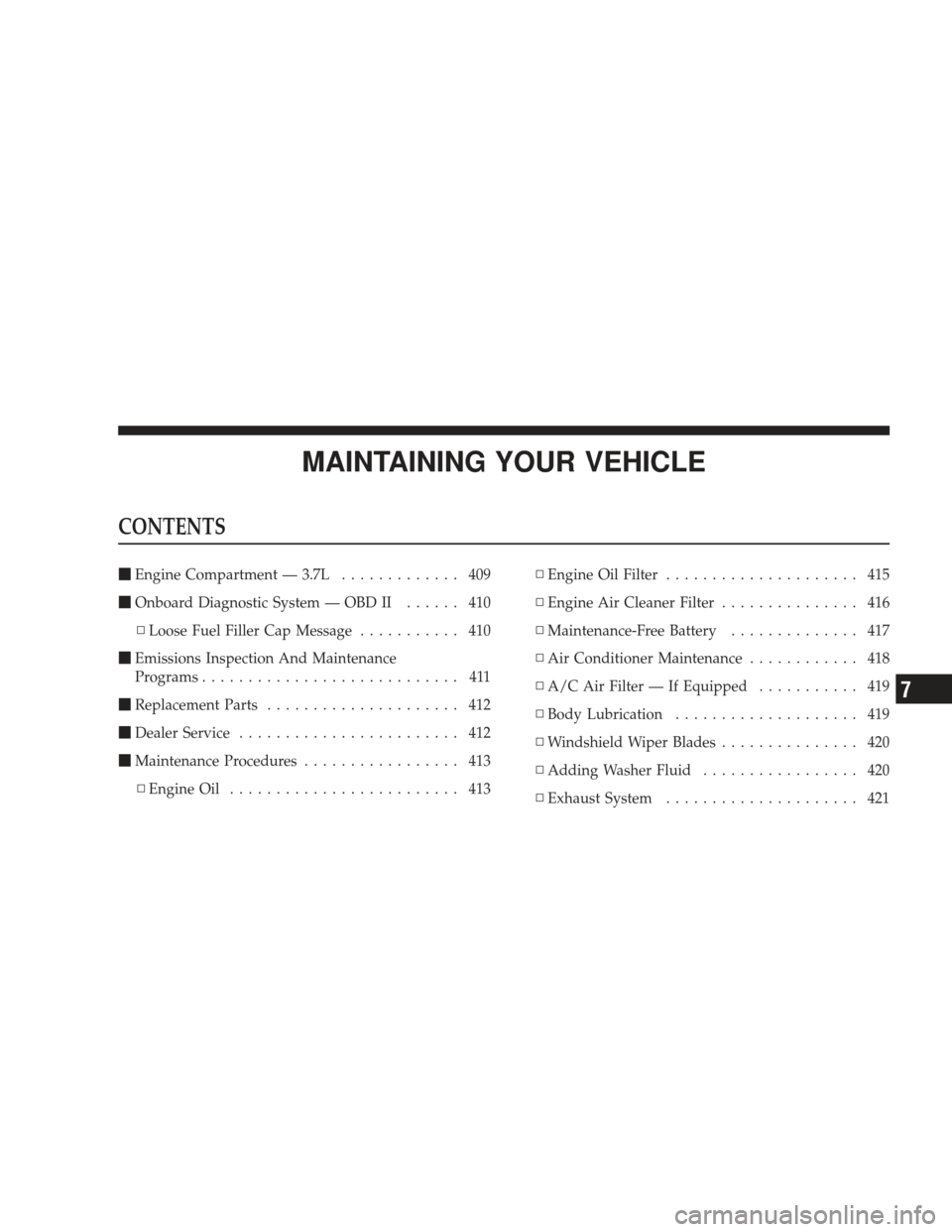
�Engine Compartment — 3.7L ............. 409
� Onboard Diagnostic System — OBD II ...... 410
▫ Loose Fuel Filler Cap Message ........... 410
� Emissions Inspection And Maintenance
Programs ............................ 411
� Replacement Parts ..................... 412
� Dealer Service ........................ 412
� Maintenance Procedures ................. 413
▫ Engine Oil ......................... 413 ▫
Engine Oil Filter ..................... 415
▫ Engine Air Cleaner Filter ............... 416
▫ Maintenance-Free Battery .............. 417
▫ Air Conditioner Maintenance ............ 418
▫ A/C Air Filter — If Equipped ........... 419
▫ Body Lubrication .................... 419
▫ Windshield Wiper Blades ............... 420
▫ Adding Washer Fluid ................. 420
▫ Exhaust System ..................... 421
7
Page 412 of 506
ONBOARD DIAGNOSTIC SYSTEM — OBD II
Your vehicle is equipped with a sophisticated Onboard
Diagnostic system called OBD II. This system monitors
the performance of the emissions, engine, and automatic
transmission control systems. When these systems are
operating properly, your vehicle will provide excellent
performance and fuel economy, as well as engine emis-
sions well within current government regulations.
If any of these systems require service, the OBD II system
will turn on the Malfunction Indicator Light (MIL). It will
also store diagnostic codes and other information to
assist your service technician in making repairs. Al-
though your vehicle will usually be drivable and not
need towing, see your authorized dealer for service as
soon as possible.CAUTION!
•Prolonged driving with the MIL on could cause
further damage to the emission control system. It
could also affect fuel economy and drivability. The
vehicle must be serviced before any emissions
tests can be performed.
•If the MIL is flashing while the engine is running,
severe catalytic converter damage and power loss
will soon occur. Immediate service is required.
Loose Fuel Filler Cap Message
If the vehicle diagnostic system determines that the fuel
filler cap is loose, improperly installed, or damaged, a
“gASCAP” message will display in the instrument clus-
ter. Tighten the gas cap until a “clicking” sound is heard.
This is an indication that the gas cap is properly tight-
ened. Press the trip odometer RESET button to turn off
the message. If the problem persists, the message will
410 MAINTAINING YOUR VEHICLE
Page 417 of 506

Engine Oil Viscosity
SAE 5W-20 engine oil is recommended for all operating
temperatures. This engine oil improves low temperature
starting and vehicle fuel economy. The engine oil filler
cap also shows the recommended engine oil viscosity for
your engine. For information on engine oil filler cap
location, refer to “Engine Compartment” in this section.
Lubricants which do not have both the engine oil certi-
fication mark and the correct SAE viscosity grade num-
ber should not be used.
Synthetic Engine Oils
You may use synthetic engine oils provided the recom-
mended oil quality requirements are met, and the recom-
mended maintenance intervals for oil and filter changes
are followed.
Materials Added to Engine Oil
The manufacturer strongly recommends against the addi-
tion of any additives (other than leak detection dyes) to theengine oil. Engine oil is an engineered product and its
performance may be impaired by supplemental additives.
Disposing of Used Engine Oil and Oil Filters
Care should be taken in disposing of used engine oil and
oil filters from your vehicle. Used oil and oil filters,
indiscriminately discarded, can present a problem to the
environment. Contact your authorized dealer, service
station, or governmental agency for advice on how and
where used oil and oil filters can be safely discarded in
your area.
Engine Oil Filter
The engine oil filter should be replaced at every engine
oil change.
NOTE:
For best access to the oil filter, a drive on hoist
should be used instead of a chassis hoist (3.7L Only).
MAINTAINING YOUR VEHICLE 415
7
Page 425 of 506
To minimize the possibility of catalytic converter dam-
age:
•Do not shut off the engine or interrupt the ignition
when the transmission is in gear and the vehicle is in
motion.
•Do not try to start the engine by pushing or towing the
vehicle.
•Do not idle the engine with any ignition coil connec-
tors disconnected for prolonged periods.
•Do not idle the engine for prolonged periods during
very rough idle or malfunctioning operating condi-
tions.
•Do not allow vehicle to run out of fuel.
Cooling System
WARNING!
•You or others can be badly burned by hot coolant
or steam from your radiator. If you see or hear
steam coming from under the hood, do not open
the hood until the radiator has had time to cool.
Never try to open a cooling system pressure cap
when the radiator is hot.
Engine Coolant Checks
Check the engine coolant (antifreeze) protection every
12 months (before the onset of freezing weather, where
applicable). If the engine coolant (antifreeze) is dirty or
rusty in appearance, the system should be drained,
flushed, and refilled with fresh coolant. Check the front
of the A/C condenser (if equipped) or radiator for any
accumulation of bugs, leaves, etc. If dirty, clean by gently
MAINTAINING YOUR VEHICLE 423
7
Page 452 of 506
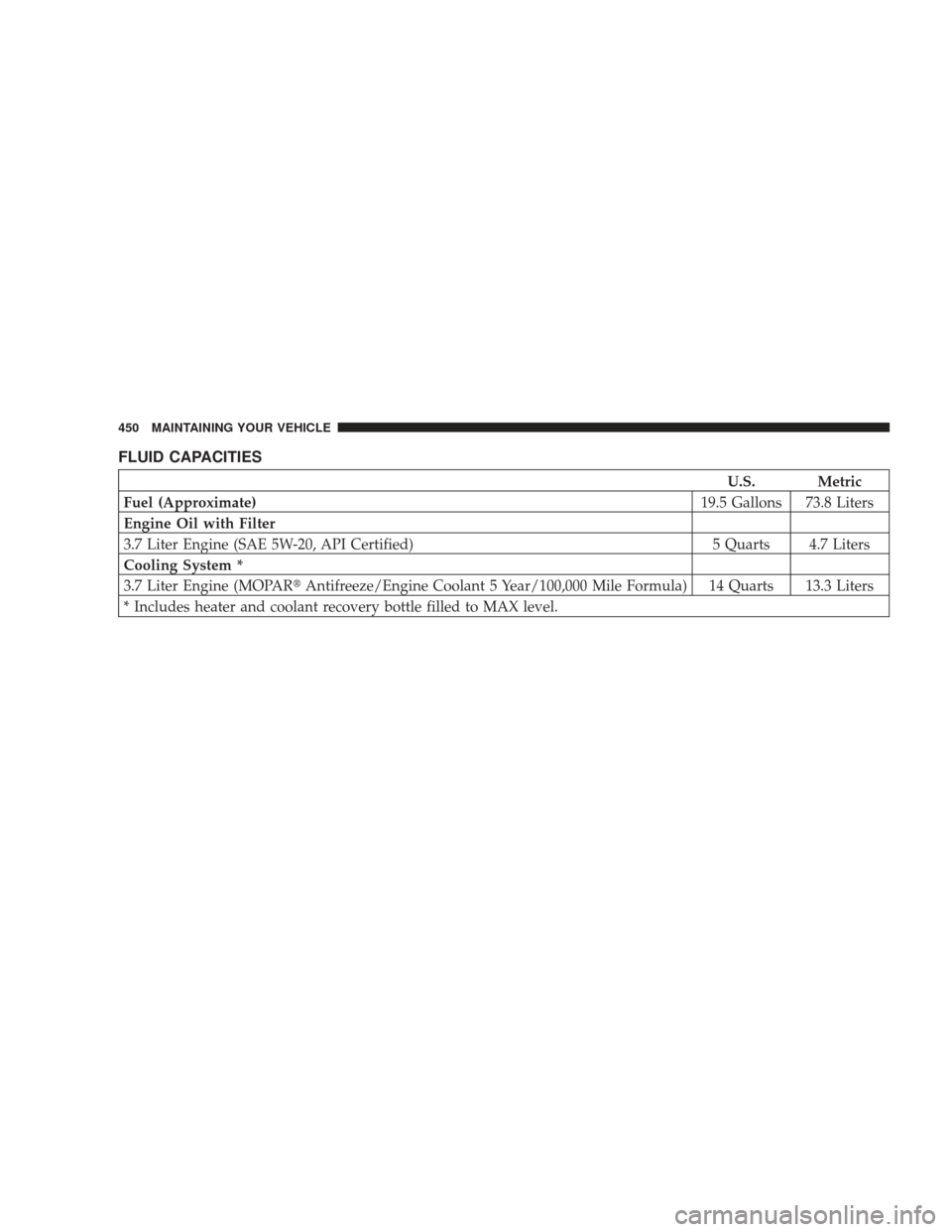
FLUID CAPACITIES
U.S. Metric
Fuel (Approximate) 19.5 Gallons 73.8 Liters
Engine Oil with Filter
3.7 Liter Engine (SAE 5W-20, API Certified) 5 Quarts 4.7 Liters
Cooling System *
3.7 Liter Engine (MOPAR� Antifreeze/Engine Coolant 5 Year/100,000 Mile Formula) 14 Quarts 13.3 Liters
* Includes heater and coolant recovery bottle filled to MAX level.
450 MAINTAINING YOUR VEHICLE
Page 453 of 506
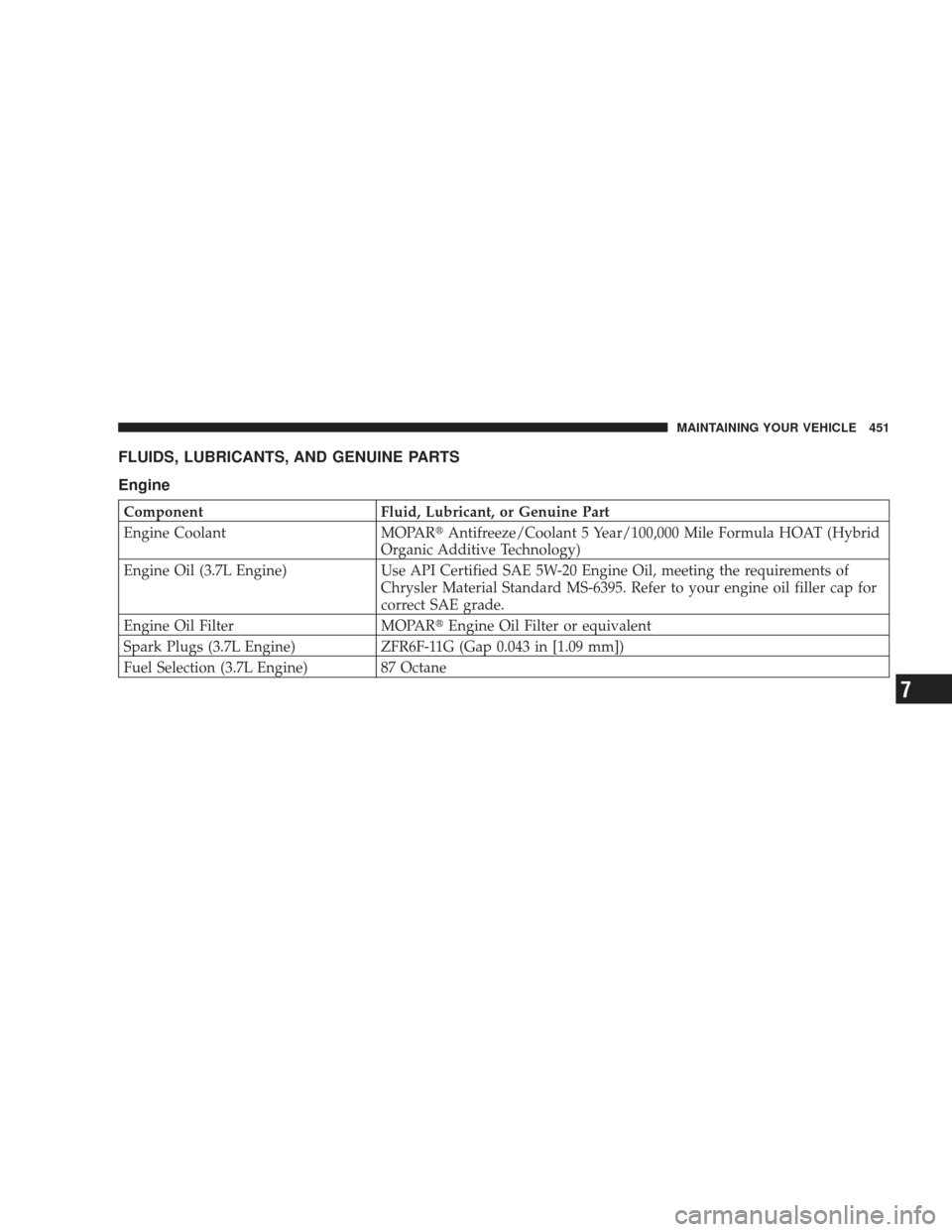
FLUIDS, LUBRICANTS, AND GENUINE PARTS
Engine
ComponentFluid, Lubricant, or Genuine Part
Engine Coolant MOPAR�Antifreeze/Coolant 5 Year/100,000 Mile Formula HOAT (Hybrid
Organic Additive Technology)
Engine Oil (3.7L Engine) Use API Certified SAE 5W-20 Engine Oil, meeting the requirements of
Chrysler Material Standard MS-6395. Refer to your engine oil filler cap for
correct SAE grade.
Engine Oil Filter MOPAR�Engine Oil Filter or equivalent
Spark Plugs (3.7L Engine) ZFR6F-11G (Gap 0.043 in [1.09 mm])
Fuel Selection (3.7L Engine) 87 Octane
MAINTAINING YOUR VEHICLE 451
7
Page 484 of 506

Brakes............................... 429
Brake/Transmission Interlock ............... 295
Break-In Recommendations, New Vehicle ........ 80
Brightness, Interior Lights .................. 148
Bulb Replacement ..................... 446,447
Bulbs, Light .......................... 83,446
Calibration, Compass ..................... 221
Capacities, Fluid ........................ 450
Caps, Filler Fuel ............................... 370
Oil (Engine) .......................... 415
Power Steering ........................ 319
Radiator (Coolant Pressure) ............... 426
Car Washes ............................ 435
Carbon Monoxide Warning ...............81,369
Cargo Area Cover ....................... 190
Cargo Area Features ...................... 186
Cargo Compartment ...................... 186 Light
............................... 148
Cargo Light ............................ 148
Cargo Load Floor ........................ 186
Cargo Tie-Downs ........................ 188
Cargo (Vehicle Loading) ................... 371
Cellular Phone .......................... 94
Certification Label ....................... 371
Changing A Flat Tire ..................... 395
Chart, Tire Sizing ........................ 339
Check Engine Light
(Malfunction Indicator Light) .............204,411
Checking Your Vehicle For Safety ............. 81
Checks, Safety ........................... 81
Child Restraint .................... 71,72,76,78
Child Restraint Tether Anchors .............74,76
Child Safety Locks ........................ 33
Clean Air Gasoline ....................... 366
Cleaning Windshield Wiper Blades ................ 420
482 INDEX