Page 68 of 521
WARNING!
Improper installation of a child restraint to the
LATCH anchorages can lead to failure of an infant or
child restraint. The child could be badly injured or
killed. Follow the manufacturer’s directions exactly
when installing an infant or child restraint.
Installing Child Restraints Using the Vehicle Seat
Belts
The passenger seat belts are equipped with either cinch-
ing latch plates or automatic locking retractors, which are
designed to keep the lap portion tight around the child
restraint so that it is not necessary to use a locking clip. If
the seat belt has a cinching latch plate, pulling up on the
shoulder portion of the lap/shoulder belt will tighten the
belt. The cinching latch plate will keep the belt tight,
however, any seat belt system will loosen with time, so
check the belt occasionally and pull it tight if necessary.
For seat belts having an Automatic Locking Retractor
(ALR), pull the belt from the retractor until there is enough
allowance to pass it through the child restraint and slide
the latch plate into the buckle. Then, pull the belt until it is
fully extended from the retractor. Allow the belt to return
into the retractor, pulling on the excess webbing to tighten
the lap portion about the child restraint. Refer to “Auto-
matic Locking Mode” earlier in this section.
In the rear seat, you may have trouble tightening the
lap/shoulder belt on the child restraint because the
buckle or latch plate is too close to the belt path opening
on the restraint. Disconnect the latch plate from the
buckle and twist the short buckle-end belt several times
to shorten it. Insert the latch plate into the buckle with the
release button facing out.
If the belt still can’t be tightened, or if by pulling and
pushing on the restraint loosens the belt, you may need
to do something more. Disconnect the latch plate from
66 THINGS TO KNOW BEFORE STARTING YOUR VEHICLE
Page 69 of 521
the buckle, turn the buckle around, and insert the latch
plate into the buckle again. If you still can’t make the
child restraint secure, try a different seating position.
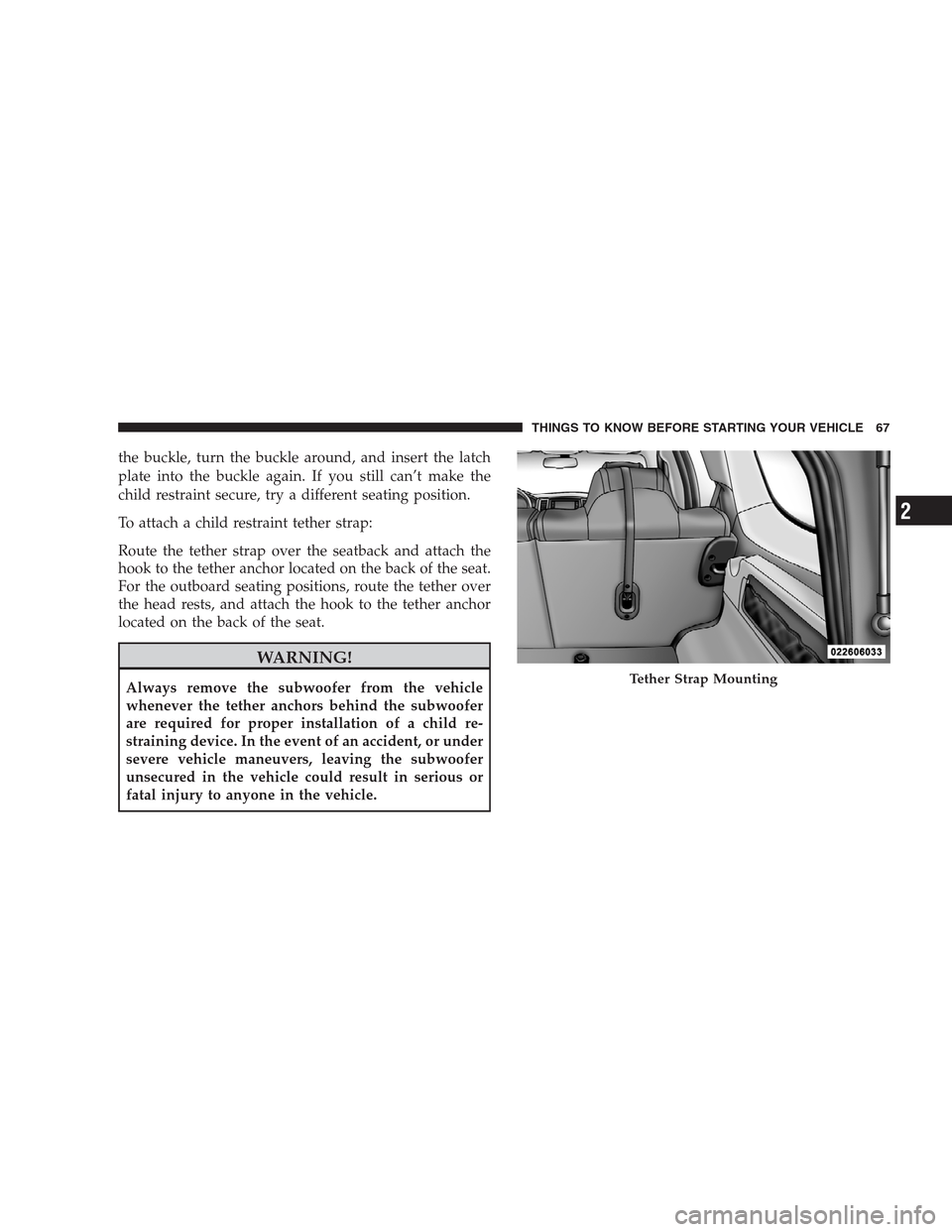
To attach a child restraint tether strap:
Route the tether strap over the seatback and attach the
hook to the tether anchor located on the back of the seat.
For the outboard seating positions, route the tether over
the head rests, and attach the hook to the tether anchor
located on the back of the seat.
WARNING!
Always remove the subwoofer from the vehicle
whenever the tether anchors behind the subwoofer
are required for proper installation of a child re-
straining device. In the event of an accident, or under
severe vehicle maneuvers, leaving the subwoofer
unsecured in the vehicle could result in serious or
fatal injury to anyone in the vehicle.Tether Strap Mounting
THINGS TO KNOW BEFORE STARTING YOUR VEHICLE 67
2
Page 70 of 521
WARNING!
An incorrectly anchored tether strap could lead to
increased head motion and possible injury to the
child. Use only the anchor positions directly behind
the child seat to secure a child restraint top tether
strap.
Transporting Pets
Airbags deploying in the front seat could harm your pet.
An unrestrained pet will be thrown about and possibly
injured, or injure a passenger during panic braking or in
a collision. Pets should be restrained in the rear seat in
pet harnesses or pet carriers that are secured by seat belts.
ENGINE BREAK-IN RECOMMENDATIONS
A long break-in period is not required for the engine in
your vehicle.Drive moderately during the first 300 miles (500 km).
After the initial 60 miles (100 km), speeds up to 50 or
55 mph (80 or 90 km/h) are desirable.
While cruising, brief full-throttle acceleration within the
limits of local traffic laws, contributes to a good break-in.
Wide-open throttle acceleration in low gear can be detri-
mental and should be avoided.
The engine oil installed in the engine at the factory is a
high-quality energy conserving type lubricant. Oil
changes should be consistent with anticipated climate
conditions under which vehicle operations will occur.
The recommended viscosity and quality grades are
shown under “Engine Oil”, under “Maintenance Proce-
dures” in section 7 of this manual. NON-DETERGENT
OR STRAIGHT MINERAL OILS MUST NEVER BE
USED.
68 THINGS TO KNOW BEFORE STARTING YOUR VEHICLE
Page 71 of 521
A new engine may consume some oil during its first few
thousand miles (kilometers) of operation. This should be
considered as a normal part of the break-in and not
interpreted as an indication of difficulty.
SAFETY TIPS
Transporting Passengers
NEVER TRANSPORT PASSENGERS IN THE CARGO
AREA.
WARNING!
•It is extremely dangerous to ride in a cargo area,
inside or outside of a vehicle. In a collision, people
riding in these areas are more likely to be seri-
ously injured or killed.
(Continued)
WARNING! (Continued)
•Do not allow people to ride in any area of your
vehicle that is not equipped with seats and seat
belts.
•Be sure everyone in your vehicle is in a seat and
using a seat belt properly.
Exhaust Gas
WARNING!
Exhaust gases can injure or kill. They contain carbon
monoxide (CO), which is colorless and odorless.
Breathing it can make you unconscious and can
eventually poison you. To avoid breathing (CO)
follow these safety tips:
THINGS TO KNOW BEFORE STARTING YOUR VEHICLE 69
2
Page 73 of 521

Airbag Warning Light
The light should come on and remain on for six to eight
seconds as a bulb check when the ignition switch is first
turned ON. If the light is not lit during starting, see your
authorized dealer. If the light stays on, flickers, or comes
on while driving, have the system checked by an autho-
rized dealer.
Defroster
Check operation by selecting the defrost mode and place
the blower control on high speed. You should be able to
feel the air directed against the windshield. See your
authorized dealer for service if your defroster is
inoperable.
Periodic Safety Checks You Should Make Outside
The Vehicle
Tires
Examine tires for excessive tread wear and uneven wear
patterns. Check for stones, nails, glass, or other objectslodged in the tread. Inspect the tread and sidewall for
cuts and cracks. Check the wheel nuts for tightness.
Check the tires (including spare) for proper pressure.
Lights
Have someone observe the operation of exterior lights
while you work the controls. Check turn signal and high
beam indicator lights on the instrument panel.
Door Latches
Check for positive closing, latching, and locking.
Fluid Leaks
Check area under vehicle after overnight parking for fuel,
engine coolant, oil, or other fluid leaks. Also, if gasoline
fumes are detected or if fuel, power steering fluid, or
brake fluid leaks are suspected, the cause should be
located and corrected immediately.
THINGS TO KNOW BEFORE STARTING YOUR VEHICLE 71
2
Page 78 of 521

▫To Resume Speed.................... 146
▫To Vary The Speed Setting.............. 146
▫To Accelerate For Passing.............. 147
�Rear Park Assist — If Equipped........... 147
▫Rear Park Assist Sensors............... 147
▫Rear Park Assist Warning Display........ 148
▫Enable/Disable The Rear Park Assist...... 150
▫Service The Rear Park Assist............ 150
▫Cleaning The Rear Park Assist........... 151
�Rear Camera — If Equipped.............. 151
▫Turning The Rear Camera On Or Off — With
Navigation Radio.................... 152
▫Turning The Rear Camera On Or Off —
Without Navigation Radio.............. 152�Overhead Console..................... 153
▫Courtesy/Reading Lights.............. 153
▫Sunglasses Storage................... 154
�Garage Door Opener — If Equipped........ 154
▫Programming HomeLink�.............. 155
▫Gate Operator/Canadian Programming.... 158
▫Using HomeLink�................... 158
▫Reprogramming A Single
HomeLink�Button................... 159
▫Security........................... 159
▫Troubleshooting Tips.................. 159
▫General Information.................. 160
�Power Sunroof — If Equipped............ 160
76 UNDERSTANDING THE FEATURES OF YOUR VEHICLE
Page 81 of 521
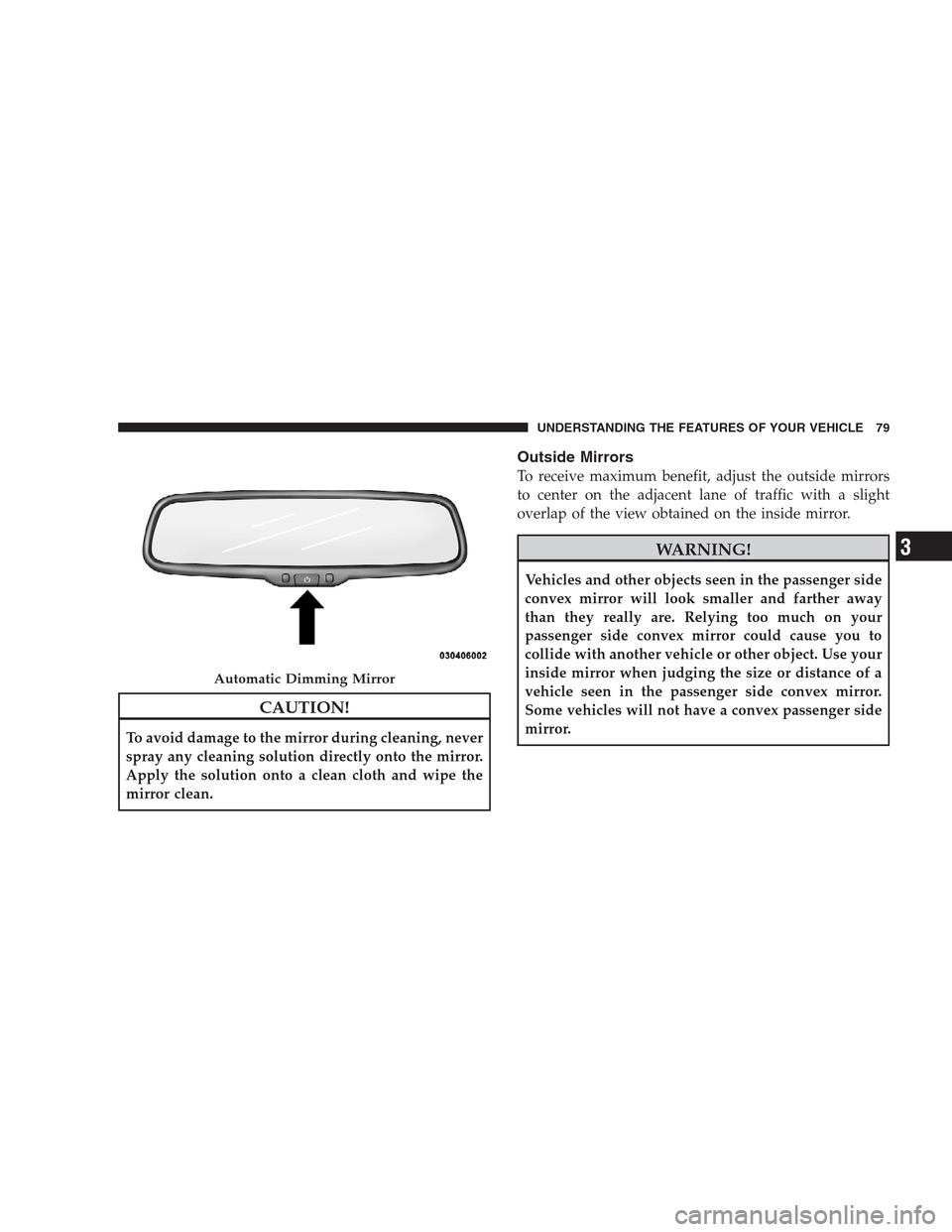
CAUTION!
To avoid damage to the mirror during cleaning, never
spray any cleaning solution directly onto the mirror.
Apply the solution onto a clean cloth and wipe the
mirror clean.
Outside Mirrors
To receive maximum benefit, adjust the outside mirrors
to center on the adjacent lane of traffic with a slight
overlap of the view obtained on the inside mirror.
WARNING!
Vehicles and other objects seen in the passenger side
convex mirror will look smaller and farther away
than they really are. Relying too much on your
passenger side convex mirror could cause you to
collide with another vehicle or other object. Use your
inside mirror when judging the size or distance of a
vehicle seen in the passenger side convex mirror.
Some vehicles will not have a convex passenger side
mirror.
Automatic Dimming Mirror
UNDERSTANDING THE FEATURES OF YOUR VEHICLE 79
3
Page 98 of 521
If the phone is not reachable and the uconnect�phone is
operational, you may reach the emergency number as
follows:
•Press the PHONE button to begin.
•After the�Ready�prompt and the following beep, say
�Emergency�and the uconnect�phone will instruct
the paired cellular phone to call the emergency num-
ber. This feature is supported in the U.S., Canada, and
Mexico.
NOTE:
•The emergency number dialed is based on the country
where the vehicle is purchased (911 for the U.S. and
Canada and 060 for Mexico). The number dialed may
not be applicable with the available cellular service
and area.
•If supported, this number may be programmable on
some systems. To do this, press the PHONE button
and say ‘Setup’, followed by ‘Emergency’.
•The uconnect�phone does slightly lower your chances
of successfully making a phone call as to that for the
cell phone directly.
WARNING!
Your phone must be turned on and paired to the
uconnect�phone to allow use of this vehicle feature
in emergency situations, when the cell phone has
network coverage and stays paired to the uconnect�
phone.
96 UNDERSTANDING THE FEATURES OF YOUR VEHICLE