Page 266 of 521
Recirculation
The recirculation feature can be selected with
the mode control knob. You may choose be-
tween Bi-Level Recirculation and Panel Recir-
culation air outlets while in this mode. Nor-
mally, air enters from outside the vehicle. However, when
in “Recirculation” mode air inside the vehicle is re-used.
Use this mode to rapidly cool the inside of the vehicle.
The “Recirculation” mode can also be used to tempo-
rarily block out outside odors, smoke, and dust.
Air Conditioning
To turn on the Air Conditioning, set the fan control
at any speed and press the snowflake button
located on the control panel. Conditioned air will
be directed through the outlets selected by the mode
control. A light in the snowflake button shows that the air
conditioning is on.Slight changes in engine speed or power may be noticed
when the air conditioning compressor is on. This is a
normal occurrence as the compressor will cycle on and
off to maintain comfort and increase fuel economy.
Automatic Temperature Control — If Equipped
The Automatic Temperature Control System automati-
cally maintains the interior comfort level desired by the
driver and passenger.
264 UNDERSTANDING YOUR INSTRUMENT PANEL
Page 274 of 521
When using the air conditioner in extremely heavy
traffic, in hot weather, especially when towing a trailer,
additional engine cooling may be required. If this situa-
tion is encountered, operate the transmission in a lower
gear to increase engine RPM, coolant flow and fan speed.
When stopped in heavy traffic, it may be necessary to
shift into NEUTRAL and depress the accelerator slightly
for fast idle operation to increase coolant flow and fan
speed.
Your air conditioning system is also equipped with an
automatic recirculation system. When the system senses
a heavy load or high heat conditions, it may use partial
Recirculation A/C mode to provide additional comfort.Winter Operation
When operating the system during the winter months,
make sure the air intake, located directly in front of the
windshield, is free of ice, slush, snow, or other
obstructions.
Vacation Storage
Anytime you store your vehicle, or keep it out of service
(i.e. vacation) for two weeks or more, run the air condi-
tioning system at idle for about five minutes in the fresh
air and high blower setting. This will ensure adequate
system lubrication to minimize the possibility of com-
pressor damage when the system is started again.
272 UNDERSTANDING YOUR INSTRUMENT PANEL
Page 284 of 521
release it as soon as the starter engages. The starter motor
will disengage automatically in 10 seconds. Once this
occurs, release the accelerator pedal, turn the ignition
switch to the LOCK position, wait 10 to 15 seconds, then
repeat the normal starting procedure.
CAUTION!
To prevent damage to the starter, wait 10 to 15 sec-
onds before trying again.
After Starting
The idle speed is controlled automatically and it will
decrease as the engine warms up.
Normal Starting — Diesel Engines
Observe the following when the engine is operating.
•All message center lights are off.
•Malfunction Indicator Light (MIL) is off.
•Low Oil Pressure Light is off.
Cold Weather Precautions
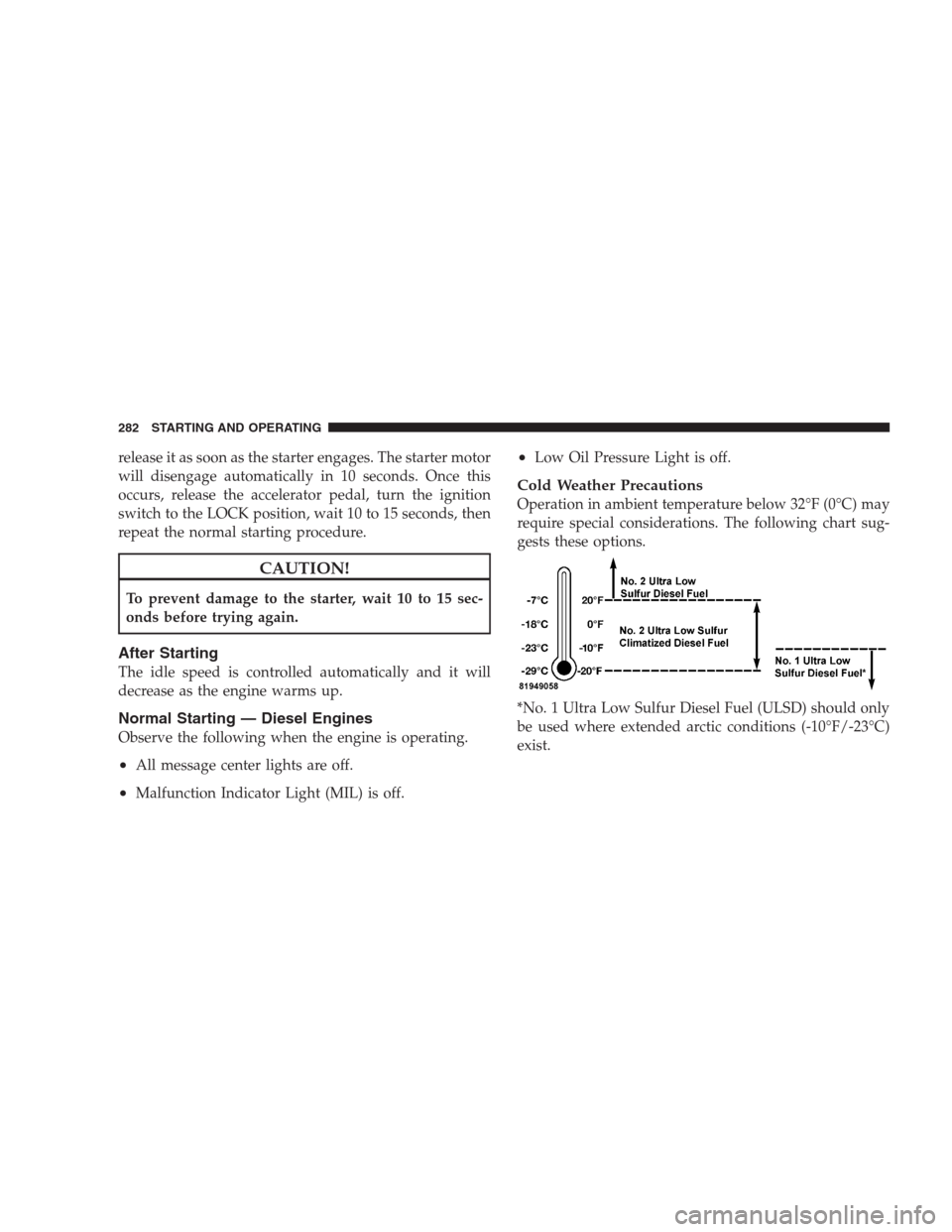
Operation in ambient temperature below 32°F (0°C) may
require special considerations. The following chart sug-
gests these options.
*No. 1 Ultra Low Sulfur Diesel Fuel (ULSD) should only
be used where extended arctic conditions (-10°F/-23°C)
exist.
282 STARTING AND OPERATING
Page 285 of 521
NOTE:
•Use of Climatized ULSD Diesel Fuel or Number 1
ULSD Diesel Fuel results in a noticeable decrease in
fuel economy.
•Climatized ULSD Diesel Fuel is a blend of Number 2
ULSD and Number 1 ULSD Diesel Fuels, which re-
duces the temperature at which wax crystals form in
fuel.
NOTE:This engine requires the use of“Ultra Low
Sulfur Diesel Fuel.”Use of incorrect fuel could result in
exhaust system damage. Refer to “Fuel Requirements” in
this section for further details on fuel recommendations.
Battery Blanket Usage
A battery loses 60% of its cranking power as the battery
temperature decreases to 0°F (-18°C). For the same de-
crease in temperature, the engine requires twice as much
power to crank at the same RPM. The use of batteryblankets will greatly increase starting capability at low
temperatures. Suitable battery blankets are available
from your authorized MOPAR�dealer.
Engine Starting Procedure
WARNING!
NEVER pour fuel or other flammable liquid into the
air inlet opening in an attempt to start the vehicle.
This could result in a flash fire causing serious
personal injury.
1. The shift lever must be in the NEUTRAL or PARK
position before you can start the engine.
2. Turn the ignition key to the ON position.
3. Watch for the “Wait To Start Light” in the instrument
cluster. Refer to “Instrument Cluster” in Section 4 of this
manual. It will glow for two to ten seconds or more,
STARTING AND OPERATING 283
5
Page 295 of 521
OVER TEMP” message may display, and the transmis-
sion may downshift out of Overdrive until the transmis-
sion cools down. After cool down, the transmission will
resume normal operation.
In high ambient temperatures with sustained high engine
speed and load, an upshift, followed shortly thereafter by
a downshift, may occur. The TOW/HAUL light will turn
off. This is a normal part of the overheat protection
strategy when operating in the TOW/HAUL mode.
The transmission will downshift from Overdrive, to the
most desirable gear, if the accelerator pedal is fully
depressed at vehicle speeds above approximately 35 mph
(56 km/h).
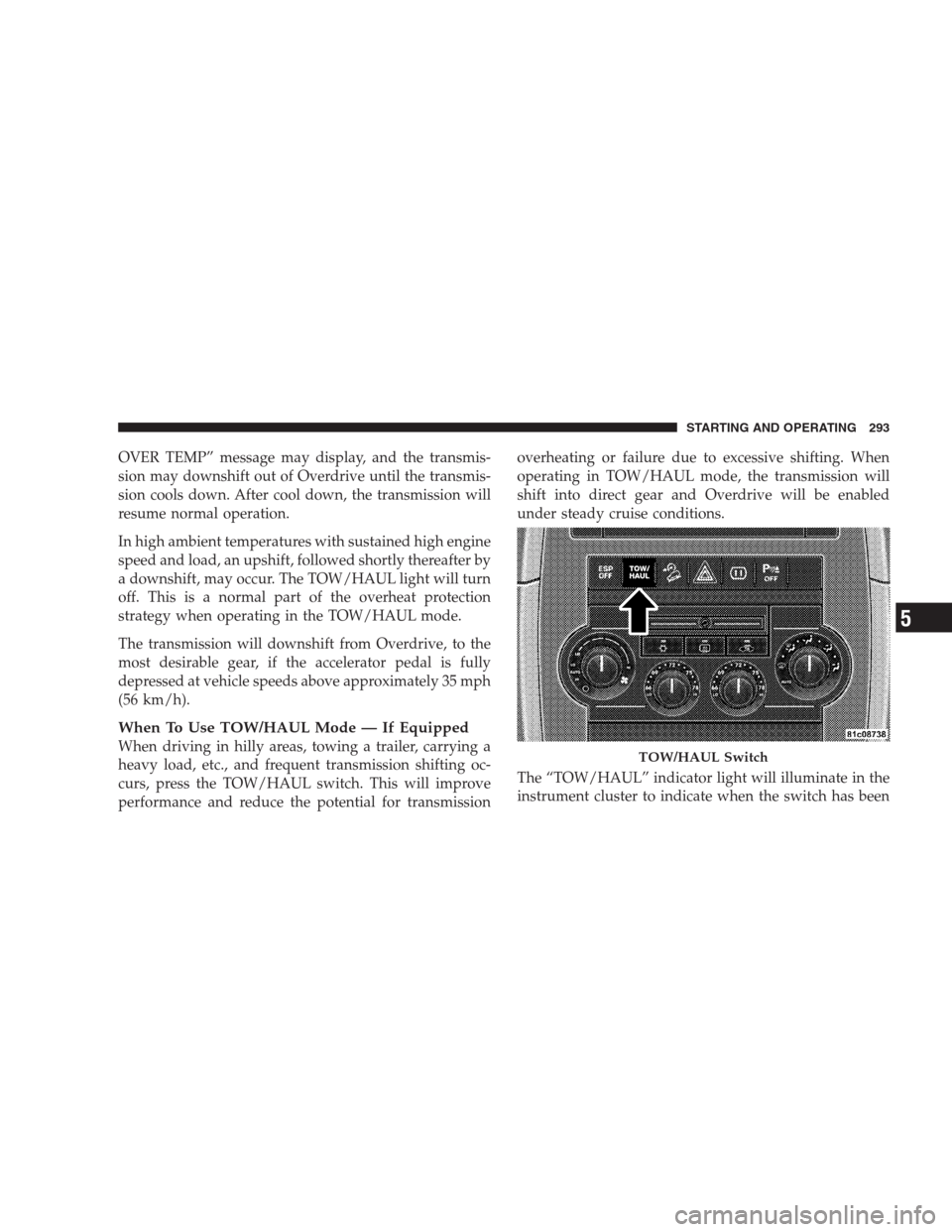
When To Use TOW/HAUL Mode — If Equipped
When driving in hilly areas, towing a trailer, carrying a
heavy load, etc., and frequent transmission shifting oc-
curs, press the TOW/HAUL switch. This will improve
performance and reduce the potential for transmissionoverheating or failure due to excessive shifting. When
operating in TOW/HAUL mode, the transmission will
shift into direct gear and Overdrive will be enabled
under steady cruise conditions.
The “TOW/HAUL” indicator light will illuminate in the
instrument cluster to indicate when the switch has beenTOW/HAUL Switch
STARTING AND OPERATING 293
5
Page 296 of 521
activated. Pressing the switch a second time restores
normal operation. If the TOW/HAUL mode is desired,
the switch must be pressed each time the engine is
started.
Transmission Limp Home Mode
Transmission function is monitored for abnormal condi-
tions. If a condition is detected that could result in
transmission damage, the transmission limp home mode
will be engaged. In this mode, the transmission will
remain in the current gear (3.7L and 3.0L diesel engine) or
in direct gear (4.7L and 5.7L engines) until the vehicle is
brought to a stop.
To reset the transmission, use the following procedure:
1. Stop the vehicle.
2. Move the shift lever into the PARK position.
3. Turn the engine off, and be sure to turn the key to the
LOCK position.4. Wait approximately 10 seconds, then restart the en-
gine.
5. Move the shift lever to the desired gear range.
If the problem is no longer detected, the transmission will
return to normal operation. If the problem persists,
PARK, REVERSE, and NEUTRAL will continue to oper-
ate. Only 2nd gear (3.7L and 3.0L diesel engine) or 3rd
gear (4.7L and 5.7L engines) will be available in the
DRIVE position. Have the transmission checked at your
authorized dealer as soon as possible.
Torque Converter Clutch
A feature, designed to improve fuel economy, has been
included in the automatic transmission on your vehicle.
A clutch within the torque converter engages automati-
cally, at a calibrated speed, at light throttle. It engages at
higher speeds under heavier acceleration. This may re-
sult in a slightly different feeling or response during
normal operation in high gear. When the vehicle speed
294 STARTING AND OPERATING
Page 297 of 521
drops below a calibrated speed, or during acceleration,
the clutch automatically and smoothly disengages. The
feature is operational in Overdrive and in DRIVE.
NOTE:
•The torque converter clutch will not engage until the
transmission fluid and engine coolant are warm [usu-
ally after 1 to 3 miles (1.6 to 4.8 km) of driving].
Because the engine speed is higher when the torque
converter clutch is not engaged, it may seem as if the
transmission is not shifting into Overdrive when cold.
This is normal. Manually shifting (using the ERS shift
control) between 4 (direct gear) and 5/D (Overdrive
gear) positions will demonstrate that the transmission
is able to shift into and out of Overdrive. For vehicles
with 4.7L or 5.7L engines (which have two Overdrive
gears), the transmission may not shift into the top
Overdrive gear (normal 5th gear) until the transmis-
sion fluid and engine coolant are warm.
•If the vehicle has not been driven in several days, the
first few seconds of operation after shifting the trans-
mission into gear may seem sluggish. This is due to the
fluid partially draining from the torque converter into
the transmission. This condition is normal and will not
cause damage to the transmission. The torque con-
verter will refill within five seconds of shifting from
PARK into any other gear position.
Rocking The Vehicle
If the vehicle becomes stuck in snow, sand, or mud, it can
often be moved by a rocking motion. Move the shift lever
between DRIVE and REVERSE, while applying slight
pressure to the accelerator.
NOTE:The Electronic Stability Program (ESP) and
Traction Control (if equipped) should be turned OFF
before attempting to rock the vehicle. Refer to “Electronic
Brake Control System” in Section 3 of this manual.
STARTING AND OPERATING 295
5
Page 300 of 521

Shift Positions
For additional information on the appropriate use of each
transfer case mode position, see the information below:
4WD HI
All roads surfaces such as ice, snow, gravel, sand, and dry
hard pavement.
NEUTRAL
Disengages both the front and rear driveshafts from the
powertrain. To be used for flat towing behind another
vehicle. Refer to “Recreational Towing” in Section 5 of
this manual.
4WD LOW
Low speed four-wheel drive. Locks the front and rear
driveshafts together. Forces the front and rear wheels to
rotate at the same speed. Additional traction and maxi-
mum pulling power for loose, slippery road surfaces
only. Do not exceed 25 mph (40 km/h).
Shifting Procedures
4WDHIto4WDLOW
With the vehicle at speeds of 0 to 3 mph (0 to 5 km/h),
key ON or engine running, shift the transmission into
NEUTRAL, and raise the transfer case T-handle. The
“4WD LOW” indicator light in the instrument cluster,
will begin to flash and remain on solid when the shift is
complete. Release the T-handle.
NOTE:If shift conditions/interlocks are not met, or a
transfer case motor temperature protection condition
exists, a “CHECK SHIFT PROCEDURES” message will
flash from the EVIC (Electronic Vehicle Information Cen-
ter). Refer to “Electronic Vehicle Information Center
(EVIC)” in Section 4 of this manual.
298 STARTING AND OPERATING