Page 171 of 439

WARNING!
A hot engine cooling system is dangerous. You or
others could be badly burned by steam or boiling
coolant. You may want to call an authorized dealer-
ship for service if your vehicle overheats. If you
decide to look under the hood yourself, see Section 7
of this manual. Follow the warnings under the Cool-
ing System Pressure Cap paragraph.
18. Cruise Indicator — If Equipped
This indicator shows that the Electronic Speed
Control System is ON.
19. Cruise Indicator — If Equipped
This indicator shows that the Electronic Speed Control
System is SET to the desired speed.
20. Shift Lever Indicator
This display indicator shows the automatic transmission
shift lever selection.NOTE:You must apply the brakes before shifting from
PARK.
21. Odometer/Trip Odometer Reset Button
Press this button to change the display from odometer to
either of the two trip odometer settings. Trip A or Trip B
will appear when in the trip odometer mode. Push in and
hold the button for two seconds to reset the trip odometer
to 0 miles or kilometers. The odometer must be in Trip
mode to reset.
22. Tire Pressure Monitoring Telltale Light — If
Equipped
Each tire, including the spare (if provided),
should be checked monthly, when cold and in-
flated to the inflation pressure recommended by
the vehicle manufacturer on the vehicle placard or
tire inflation pressure label. (If your vehicle has tires of a
different size than the size indicated on the vehicle placard
UNDERSTANDING YOUR INSTRUMENT PANEL 169
4
Page 175 of 439

Certain conditions such as a loose or missing gas cap,
poor fuel quality, etc. may illuminate the light after
engine start. The vehicle should be serviced if the light
stays on through several of your typical driving cycles. In
most situations the vehicle will drive normally and will
not require towing.
If the MIL flashes when the engine is running, serious
conditions may exist that could lead to immediate loss of
power or severe catalytic converter damage. The vehicle
should be serviced as soon as possible if this occurs.
NOTE:If this indicator comes on, it will brighten to
FULL DAYTIME INTENSITY and will not be dimmable.
26. Front Fog Light Indicator — If Equipped
This light shows when the front fog lights are ON.27.Electronic Stability Program (ESP) Indicator Light /
Traction Control System (TCS) Indicator Light — If
Equipped
If this indicator light flashes during accelera-
tion, apply as little throttle as possible. While
driving, ease up on the accelerator. Adapt your
speed and driving to the prevailing road con-
ditions, and do not switch off the Electronic Stability
Program (ESP), or Traction Control System (TCS).
28. Electronic Stability Program (ESP) Indicator Light
The malfunction lamp for the Electronic Stabil-
ity Program (ESP) is combined with Brake
Assist System (BAS). The yellow “ESP/BAS
Warning Lamp” comes on when the ignition
switch is turned to the “ON” position. They should go
out with the engine running. If the “ESP/BAS Warning
Lamp” comes on continuously with the engine running,
a malfunction has been detected in either the ESP or the
BAS system. If this light remains on after several ignition
UNDERSTANDING YOUR INSTRUMENT PANEL 173
4
Page 249 of 439
STARTING AND OPERATING
CONTENTS
�Starting Procedures.................... 251
▫Manual Transmission — If Equipped....... 251
▫Automatic Transmission — If Equipped..... 251
▫Normal Starting..................... 252
▫Extremely Cold Weather
(Below�20°F Or�29°C)............... 252
▫If Engine Fails To Start................. 253
▫After Starting....................... 253�Manual Transaxle — If Equipped........... 254
▫5–Speed Manual Transaxle.............. 254
▫Recommended Shift Speeds............. 255
▫Downshifting....................... 255
�Automatic Transaxle — If Equipped......... 256
▫Brake/Transmission Interlock System...... 257
▫Automatic Transaxle Ignition Interlock
System............................ 257
▫Gear Ranges........................ 258
5
Page 250 of 439

�AutoStick�— If Equipped............... 260
▫Operation.......................... 260
▫General Information................... 261
�Four-Wheel Drive Operation — If Equipped . . . 261
�Driving On Slippery Surfaces............. 262
▫Acceleration........................ 262
▫Traction........................... 263
�Driving Through Water.................. 263
▫Flowing/Rising Water................. 263
▫Shallow Standing Water................ 264
�Power Steering........................ 265
▫Power Steering Fluid Check............. 266
�Parking Brake........................ 267�Brake System......................... 268
▫Anti-Lock Brake System (ABS) —
If Equipped......................... 269
�Electronic Brake Control System........... 272
▫Anti-Lock Brake System (ABS)........... 272
▫Traction Control System (TCS)........... 272
▫Brake Assist System (BAS).............. 273
▫Electronic Roll Mitigation (ERM).......... 274
▫Electronic Stability Program (ESP)......... 275
�Tire Safety Information.................. 279
▫Tire Markings....................... 279
▫Tire Identification Number (TIN).......... 283
▫Tire Loading And Tire Pressure........... 284
248 STARTING AND OPERATING
Page 253 of 439

STARTING PROCEDURES
Before starting your vehicle, adjust your seat, adjust both
inside and outside mirrors, and fasten your seat belts.
WARNING!
Never leave children alone in a vehicle. Leaving
unattended children in a vehicle is dangerous for a
number of reasons. A child or others could be seri-
ously or fatally injured. Do not leave the key in the
ignition. A child could operate power windows,
other controls, or move the vehicle.
Manual Transmission — If Equipped
Before starting the engine fully apply the parking brake,
press the clutch pedal to the floor, and place the shift
lever in NEUTRAL.NOTE:
•The engine will not start unless the clutch pedal is
pressed to the floor.
•If the key will not turn and the steering wheel is
locked, rotate the wheel in either direction to relieve
pressure on the locking mechanism and then turn the
key.
Automatic Transmission — If Equipped
The shift lever must be in the PARK or NEUTRAL
position before you can start the engine. Apply the brakes
before shifting to any driving gear.
NOTE:You must press the brake pedal before shifting
out of PARK.
STARTING AND OPERATING 251
5
Page 256 of 439
MANUAL TRANSAXLE — IF EQUIPPED
5–Speed Manual Transaxle
WARNING!
You or others could be injured if you leave the
vehicle unattended without having the parking
brake fully applied. The parking brake should al-
ways be applied when the driver is not in the vehicle,
especially on an incline.
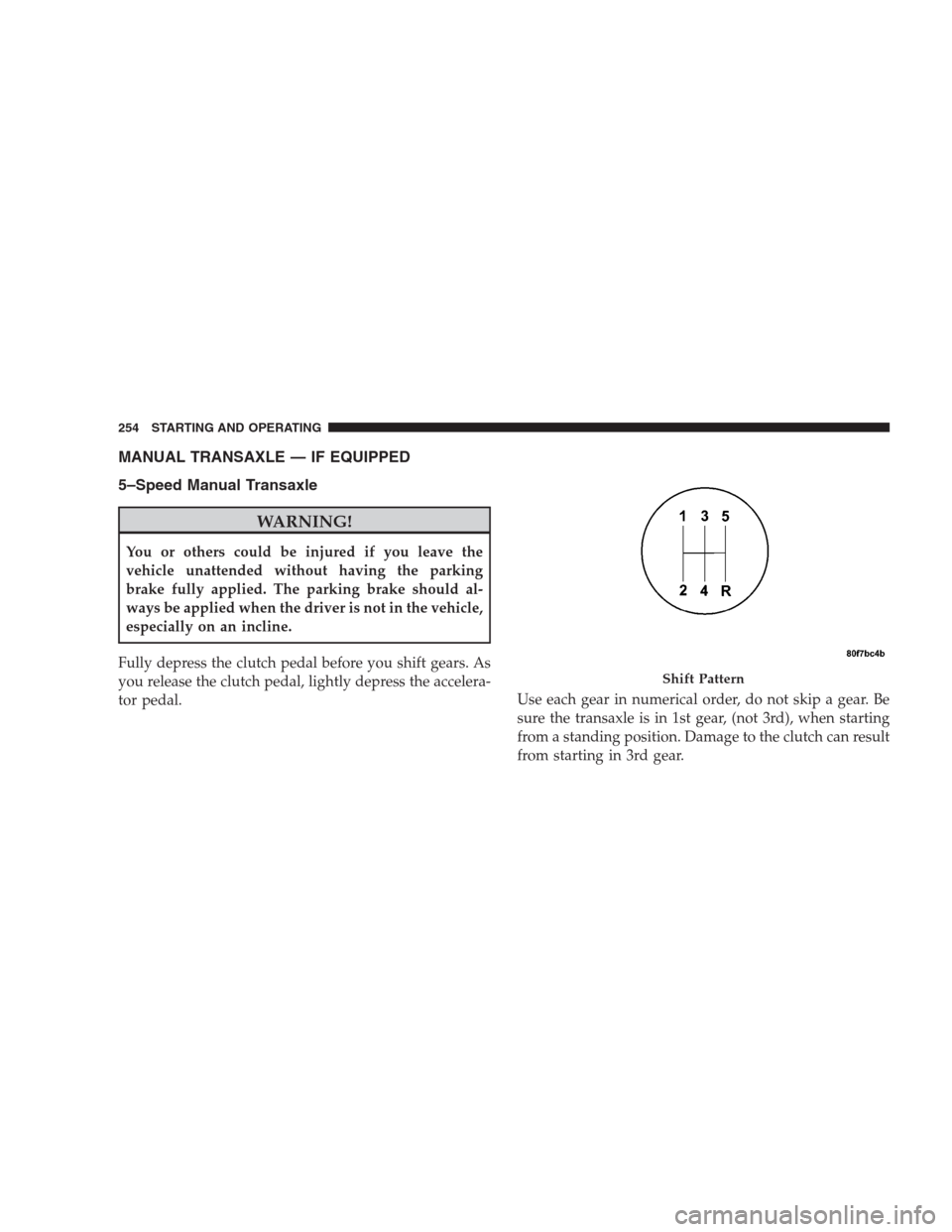
Fully depress the clutch pedal before you shift gears. As
you release the clutch pedal, lightly depress the accelera-
tor pedal.Use each gear in numerical order, do not skip a gear. Be
sure the transaxle is in 1st gear, (not 3rd), when starting
from a standing position. Damage to the clutch can result
from starting in 3rd gear.
Shift Pattern
254 STARTING AND OPERATING
Page 258 of 439

To maintain a safe speed and prolong brake life, shift
down to 2nd or 1st gear when descending a steep grade.
When turning a corner or driving up a steep grade,
downshift early so that the engine will not be
overburdened.
AUTOMATIC TRANSAXLE — IF EQUIPPED
NOTE:The Continuously Variable Automatic Transaxle
(CVT) changes ratios in a continuous manner. This may
sometimes “feel” as if it is slipping, but this is normal and
does not harm anything.
CAUTION!
Damage to the transaxle may occur if the following
precautions are not observed:
•Shift into PARK only after the vehicle has come to
a complete stop.
•Shift into or out of REVERSE only after the
vehicle has come to a complete stop and the engine
is at idle speed.
•Do not shift from REVERSE, PARK, or NEUTRAL
into any forward gear when the engine is above
idle speed.
•Before shifting into any gear, make sure your foot
is firmly on the brake pedal.
NOTE:You MUST press and hold the brake pedal down
while shifting out of PARK.
256 STARTING AND OPERATING
Page 259 of 439

WARNING!
It is dangerous to move the shift lever out of PARK or
NEUTRAL if the engine speed is higher than idle
speed. If your foot is not firmly on the brake pedal,
the vehicle could accelerate quickly forward or in
reverse. You could lose control of the vehicle and hit
someone or something. Only shift into gear when the
engine is idling normally and when your right foot is
firmly on the brake pedal.
Brake/Transmission Interlock System
This system prevents you from moving the shift lever out
of PARK and into any gear unless the brake pedal is
pressed. This system is active only while the ignition
switch is in the ON or ACC positions. Always depress the
brake pedal first,before moving the shift lever out of
PARK.NOTE:If a malfunction occurs, the transaxle will not
shift out of PARK. Battery power is required to release the
brake/transmission interlock system. There is a remov-
able plug in the right side of the shift lever housing that
allows you to insert your finger to override the system.
The key must be in the ignition and in the ON position to
use the override lever. If this occurs obtain service as
soon as possible.
Automatic Transaxle Ignition Interlock System
This system prevents the key from being removed unless
the shift lever is in PARK. It also prevents shifting out of
PARK unless the key is in the ACC or ON position, and
the brake pedal is depressed.
NOTE:If a malfunction occurs, the system will trap the
key in the ignition cylinder to warn you that this safety
feature is inoperable. The engine can be started and
stopped, but the key cannot be removed, until you obtain
service.
STARTING AND OPERATING 257
5