2009 JAGUAR XF gas type
[x] Cancel search: gas typePage 83 of 391
83
Lighting
CHANGING A BULB
General information
Note: In certain markets its a legal requirement
to carry spare bulbs. A replacement bulb kit is
available as an approved accessory from your
Dealer/Authorised Repairer.
Halogen bulbs
Halogen bulbs are used for main beam and
dipped beam headlamps. Take care not to
touch the glass part of the bulb with your
fingers; always use a cl oth to handle the bulb.
If necessary use methylated spirits to remove
finger prints.
Xenon lamps
Seek advice about the correct
disposal of Xenon lamp units from
your Dealer/Authorised Repairer, or
your local authority.
HEADLAMP UNIT BULBS
Halogen dipped beam
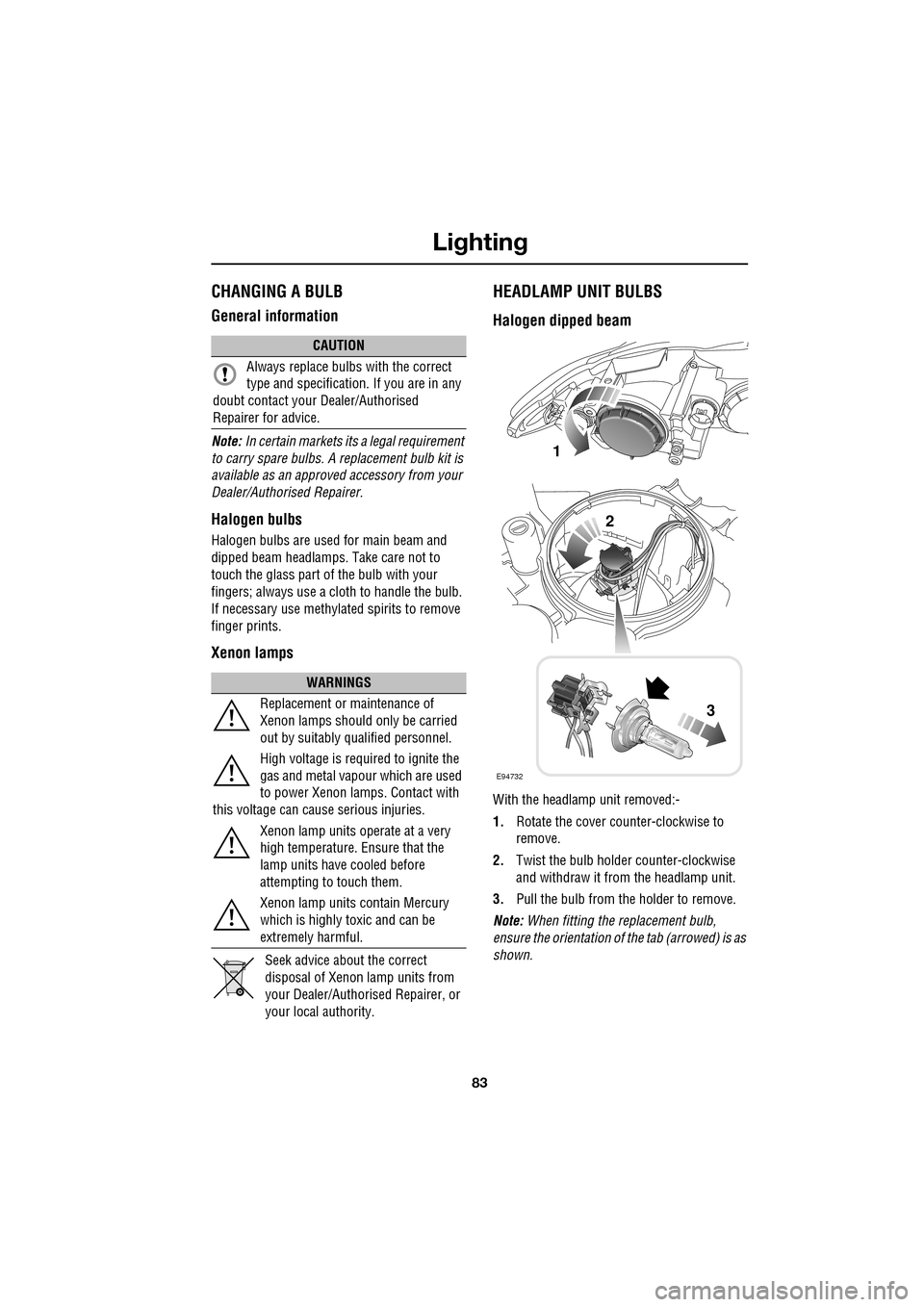
With the headlamp unit removed:-
1. Rotate the cover counter-clockwise to
remove.
2. Twist the bulb holder counter-clockwise
and withdraw it from the headlamp unit.
3. Pull the bulb from the holder to remove.
Note: When fitting the replacement bulb,
ensure the orientation of the tab (arrowed) is as
shown.
CAUTION
Always replace bulbs with the correct
type and specification. If you are in any
doubt contact your Dealer/Authorised
Repairer for advice.
WARNINGS
Replacement or maintenance of
Xenon lamps should only be carried
out by suitably qualified personnel.
High voltage is required to ignite the
gas and metal vapour which are used
to power Xenon lamps. Contact with
this voltage can cause serious injuries.
Xenon lamp units operate at a very
high temperature. Ensure that the
lamp units have cooled before
attempting to touch them.
Xenon lamp units contain Mercury
which is highly toxic and can be
extremely harmful.
E94732
1
2
3
Page 174 of 391

Fuel and refuelling
174
SAFETY PRECAUTIONSFUEL QUALITY
Water in fuel
Petrol engined vehicles
WARNINGS
Petroleum gasses are highly
flammable, have a low flash point,
and are explosive, especially in
confined spaces. Avoid exposing the gasses to
any potential sources of ignition as the
resulting fire and expl osion may cause serious
injuries and/or death.
Only use containe rs specifically
designed for carrying fuel and always
remove them from the vehicle to fill
them. Failure to do so may result in spillage,
and cause a fire.
Switch off the engine when refuelling,
as it is both a source of extreme
temperatures, and electrical sparks.
The resulting fire a nd explosion may cause
serious injury and death.
Switch off any personal electronic
devices such as mobile phones, or
music players. They have the
potential to cause electrical sparks. The
resulting fire and expl osion may cause serious
injury and death.
Do not smoke, use a naked flame, or
cause sparks. The resulting fire and
explosion may cause serious injury
and death.
Do not overfill the fuel tank.
Overfilling may cause spillage when
the vehicle is driven. Spillage may
also occur if the fuel expands in high ambient
temperatures.
Any modifications to the fuel system
not specifically designed for this
Jaguar are prohibited. Such
modifications in some circumstances, could
result in a fire. All se rvice actions should be
entrusted to a Dealer /Authorised Repairer.The presence of any unusual fumes
(e.g. petrol or exhaust fumes) in the
passenger compartment and/or
luggage compartment, should be corrected
immediately by a Dealer /Authorised Repairer.
If you must drive unde r these conditions, do
so only with all windows fully open.
CAUTIONS
If the warning WATER IN FUEL is
displayed in the message centre, an
excessive amount of wate r has collected in the
fuel filter bowl. Seek assistance from a Jaguar
Dealer/Authorised Repairer to have the filter
drained, as soon as possible.
CAUTIONS
Do not use leaded fuels, lead substitutes
or fuel additives. Doing so can cause
damage to the engine, fuel and emission
control systems.
Only use high quality petrol, as using
lower quality fuels ca n cause damage to
the engine, fuel and emission control systems.
Fuel system cleaning agents should not
be used, unless a pproved by Jaguar.
Unapproved products may be harmful to fuel
system components on your vehicle.
It is the driver’s resp onsibility to fill the
vehicle with the correct fuel. If the
vehicle is filled with the wrong type of fuel, do
not start the engine. Call for Roadside
Assistance.
WARNINGS
Page 214 of 391

Vehicle battery
214
USING BOOSTER CABLES
Note: Before connecti ng booster cables,
ensure that the battery connections on the
disabled vehicle are correct and that all
electrical equipment has been switched off.
1. Connect one end of the positive booster
cable to the positive terminal on the donor
vehicle's battery.
2. Connect the other end of the positive
booster cable to the positive terminal on
the disabled vehicle's battery. 3.
Connect one end of th e negative booster
cable to the earth point of the donor vehicle
that is recommended for jump starting by
the manufacturer.
4. Connect the other end of the negative
booster cable to a suitable earth point on
the disabled vehicle. The earth point
should be at least 0.5 metres (20 inches)
away from the battery and as far as
possible from any fu el or brake pipes.
• Check that all cables are clear of any
moving components and that all four
connections are secure.
5. Start the engine of the donor vehicle, and
allow it to idle for a few minutes.
6. Start the engine of the disabled vehicle.
7. Allow both vehicles to idle for two minutes.
8. Switch off the donor vehicle.
Disconnecting the cables
Note: Do not switch on any electrical
equipment until after th e cables have been
disconnected.
The engine should be running on the
previously disabled ve hicle and the engine
switched off on the donor vehicle. Disconnect
the booster cables in the exact reverse order of
that used for connection.
WARNINGS
Always wear appropriate eye
protection when working with
batteries.
During normal use, batteries emit
explosive hydrogen gas - ensure
sparks and naked lights are kept away
from the luggage compartment.
Do not attempt to start the vehicle if
the electrolyte in the battery is
suspected of being frozen.
Make sure both batt eries are of the 12
volt type and that the booster cables
have insulated clamps and are
approved for use with 12 volt batteries.
Do not disconnect the discharged
battery.
Do not connect posit ive (+) terminals
to negative (-) terminals and ensure
booster cables are kept away from
any moving parts in the engine compartment.
Do not connect a booster cable to the
negative (-) terminal of the battery.
Always connect to the recommended
earthing point.
WARNING
To avoid serious in jury use extreme
caution when removing the booster
cables as the engine will be running
on the previously disabl ed vehicle. This means
that you may be workin g close to components
which are moving at high speed, carry high
voltage, or may be hot.
Page 215 of 391
215
Vehicle battery
CHARGING THE VEHICLE BATTERY
CHANGING THE VEHICLE BATTERY
Battery disposal
Used batteries must be disposed of
correctly as they contain a number of
harmful substances. Seek advice on
disposal from your Dealer/
Authorised Repairer, and/or your local
authority.
WARNING
Ensure that the correct type of battery
charger is used. Using an unsuitable
charger may damage the battery and
could cause the battery to explode.
Always charge the battery in a well
ventilated area, away from any naked
flames, sparks or other ignition
sources. During charging, the battery can
produce a highly explosiv e and flammable gas.
CAUTIONS
Battery disconnecti on, removal and
replacement, should only be carried out
by qualified personne l. Consult your
Dealer/Authorised Repairer.
If the battery has been removed from
the vehicle to be charged, the Battery
Monitoring System will automatically
recalibrate. During this time, Low Battery
warning messages may appear.
Always follow the instructions supplied
with the battery charger. Failure to do so
may result in damage to the battery.
WARNING
Use caution when lifting the battery
our of, or into, the vehicle. It is heavy
and may cause injury when lifting or if
dropped.
Do not tilt the battery more than 45°,
as it may cause damage and may
cause the electrolyte to leak out.
Battery electrolyte is highly corrosive and
toxic.
CAUTIONS
Battery disconnect ion, removal and
replacement, should only be carried out
by qualified personnel. Consult your Dealer/
Authorised Repairer.
If the vehicle battery is replaced by a
new battery, the vehicle electrical
system must be reset to the new battery by
qualified personnel. Fa ilure to reset the
electrical system, may result in Low Battery
warning messages. Consult your Dealer/
Authorised Repairer.
Only a replacement battery of the same
type and specification as the original
should be fitted. Other batteries may vary in
size or have different terminal positions, which
could cause a fire hazard when connected to
the vehicle's electrical system.
Do not rest the battery on any part of the
vehicle, as it may cause damage due to
its weight.
Do not run the engine with the battery
disconnected. Doing so may damage
the charging system.