2009 HYUNDAI TUCSON airbag off
[x] Cancel search: airbag offPage 5 of 273

F4
A110A01A-AAT
VEHICLE DATA COLLECTION AND EVENT DATA RECORDERS
Your Hyundai vehicle is equipped with many high technology, electronically controlled systems
that help to ensure your vehicle operates properly and provides the performance that you
expect. These systems utilize computers to monitor the operation of various systems and
components and help to control their operation. These computerized system operations are
wide-ranging and involve components to reduce emissions, to continuously evaluate the
readiness of the airbag and seat belt pretensioner systems, to determine when the airbag and
seat belt pre-tensioner systems should be deployed and then to activate the deployment, and
if equipped, to operate anti-lock braking, traction control and electrical stability control to assist
the driver to control the vehicle in difficult driving situations. These systems electronically store
information that is useful to service technicians when they need to diagnose and repair these
systems. Additional information is stored only when a crash occurs that results in the
deployment of the airbags or seat belt pre-tensioners. This type of data storage is done by
devices called event data recorders(EDR).
After a crash event, the airbag and seat belt pre-tensioner computer system, known as the
Supplemental Restraint System Control Module (SRSCM) or Airbag Control Unit (ACU), may
record some information about the condition of the vehicle and how it was being operated. This
information consists of data related to seat belt usage and if there was diagnostic information
in the airbag or seat belt systems at the time that a crash occurred, and if the ACU sensed that
a crash of sufficient severity occurred to require seat belt pre-tensioner or airbag deployment.
To retrieve this information, special equipment is needed and access to the vehicle or the device
that stores the data is required. Hyundai will not access information about a crash event or share
it with others except:
o in response to an official request of police or similar government office, or
o with the consent of the vehicle owner or, if the vehicle is leased, with the consent of the lessee,
or
o as part of Hyundai’s defense of litigation, or
o as required by law.
Page 24 of 273
1
FEATURES OF YOUR HYUNDAI
13
OJM019002
!
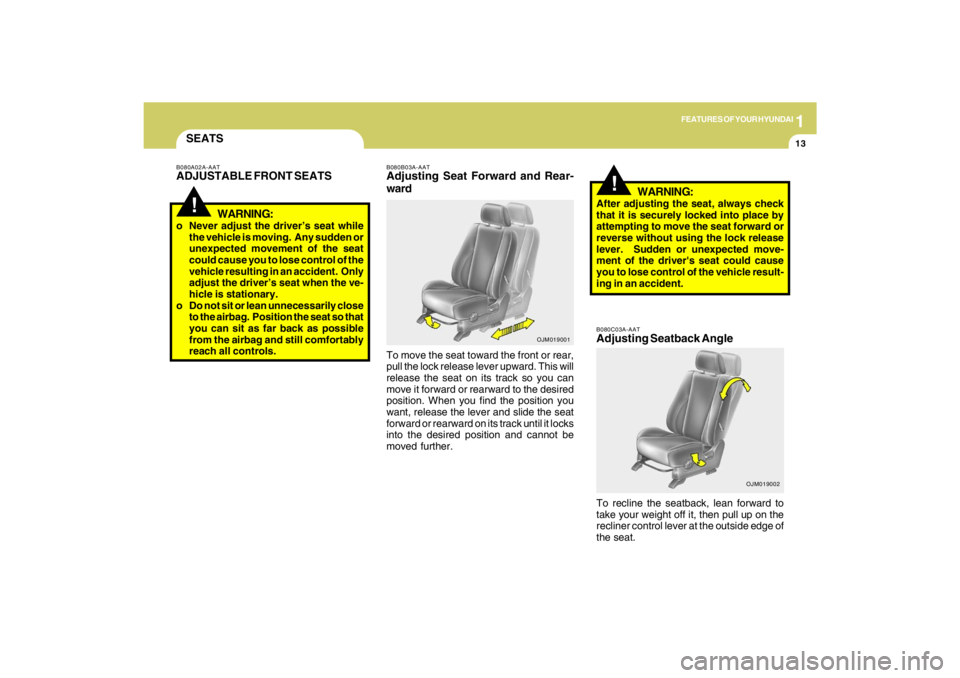
B080B03A-AATAdjusting Seat Forward and Rear-
wardTo move the seat toward the front or rear,
pull the lock release lever upward. This will
release the seat on its track so you can
move it forward or rearward to the desired
position. When you find the position you
want, release the lever and slide the seat
forward or rearward on its track until it locks
into the desired position and cannot be
moved further.
B080C03A-AATAdjusting Seatback AngleTo recline the seatback, lean forward to
take your weight off it, then pull up on the
recliner control lever at the outside edge of
the seat.
WARNING:
After adjusting the seat, always check
that it is securely locked into place by
attempting to move the seat forward or
reverse without using the lock release
lever. Sudden or unexpected move-
ment of the driver's seat could cause
you to lose control of the vehicle result-
ing in an accident.
OJM019001
SEATSB080A02A-AATADJUSTABLE FRONT SEATS
!
WARNING:
o Never adjust the driver’s seat while
the vehicle is moving. Any sudden or
unexpected movement of the seat
could cause you to lose control of the
vehicle resulting in an accident. Only
adjust the driver’s seat when the ve-
hicle is stationary.
o Do not sit or lean unnecessarily close
to the airbag. Position the seat so that
you can sit as far back as possible
from the airbag and still comfortably
reach all controls.
Page 44 of 273
1
FEATURES OF YOUR HYUNDAI
33
!
WARNING:
o Pre-tensioners are designed to oper-
ate only one time. After activation,
pre-tensioner seat belts must be re-
placed. All seat belts, of any type,
should always be replaced after they
have been worn during a collision.
o The pre-tensioner seat belt assembly
mechanisms become hot during acti-
vation. Do not touch the pre-tensioner
seat belt assemblies for several min-
utes after they have been activated.
o Do not attempt to inspect or replace
the pre-tensioner seat belts yourself.
This must be done by an authorized
Hyundai dealer.
o Do not strike the pre-tensioner seat
belt assemblies.
o Do not attempt to service or repair the
pre-tensioner seat belt system in any
manner.
o Improper handling of the pre-tensioner
seat belt assemblies, and failure to
heed the warnings to not strike, modify,
inspect, replace, service or repair the
pre-tensioner seat belt assemblies
may lead to improper operation or
inadvertent activation and serious
injury.
o Always wear seat belts when driving
or riding in a motor vehicle.
CAUTION:
o The sensor that activates the SRS
airbag is connected with the pre-
tensioner seat belts. The SRS airbag
warning light on the instrument
panel will illuminate for approximately
6 seconds after the ignition key has
been turned to the "ON" position, and
then it should turn off.
o If the pre-tensioner seat belt is not
working properly, this warning light
will illuminate even if there is no mal-
function of the SRS airbag system. If
the SRS airbag warning light does not
illuminate when the ignition key is
turned to "ON" or if it remains illumi-
nated after approximately 6 seconds,
or if it illuminates while the vehicle is
being driven, please have an autho-
rized Hyundai dealer inspect the pre-
tensioner seat belts and SRS airbag
system as soon as possible.
!
NOTE:o Both the driver's and front
passenger's pre-tensioner seat belts
will be activated in certain frontal col-
lisions. The pre-tensioner seat belt
may be activated with or without
airbag activation, depending on the
circumstances of a collision. The pre-
tensioners will not be activated if the
seat belts are not being worn at the
time of the collision.
o When the pre-tensioner seat belts are
activated, a loud noise may be heard
and fine dust, which may appear to be
smoke, may be visible in the passen-
ger compartment. These are normal
operating conditions and are not haz-
ardous.
o Although it is harmless, the fine dust
may cause skin irritation and should
not be breathed for prolonged peri-
ods. Wash all exposed skin areas
thoroughly after an accident in which
the pre-tensioner seat belts were ac-
tivated.
AIR
BAG
Page 45 of 273
1FEATURES OF YOUR HYUNDAI34
ADVANCED SUPPLEMENTAL
RESTRAINT (AIRBAG) SYSTEM
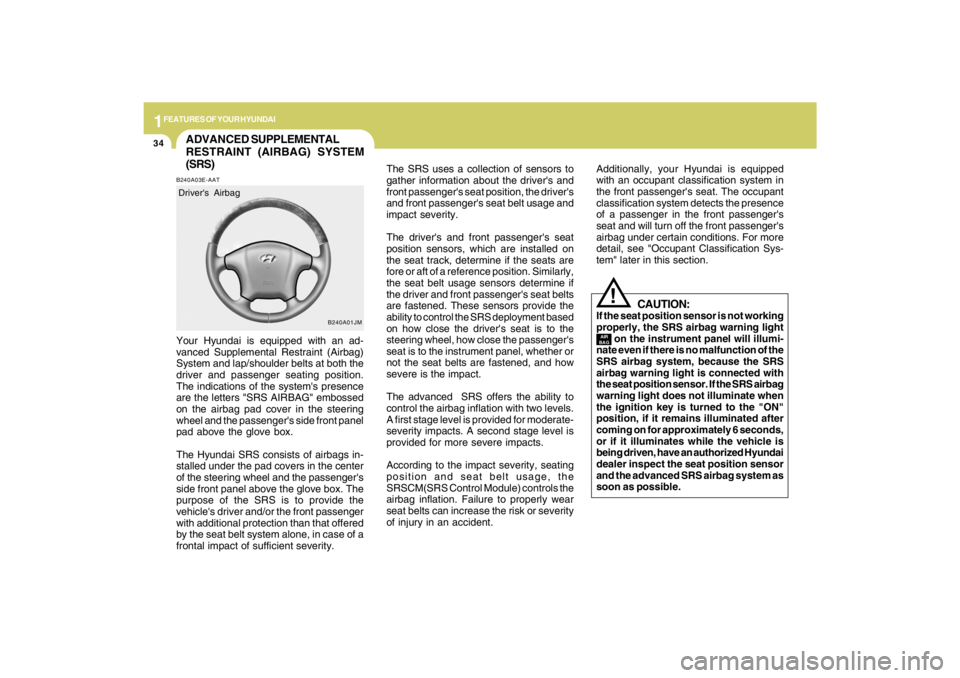
(SRS)B240A03E-AATYour Hyundai is equipped with an ad-
vanced Supplemental Restraint (Airbag)
System and lap/shoulder belts at both the
driver and passenger seating position.
The indications of the system's presence
are the letters "SRS AIRBAG" embossed
on the airbag pad cover in the steering
wheel and the passenger's side front panel
pad above the glove box.
The Hyundai SRS consists of airbags in-
stalled under the pad covers in the center
of the steering wheel and the passenger's
side front panel above the glove box. The
purpose of the SRS is to provide the
vehicle's driver and/or the front passenger
with additional protection than that offered
by the seat belt system alone, in case of a
frontal impact of sufficient severity.
B240A01JM
Driver's Airbag
The SRS uses a collection of sensors to
gather information about the driver's and
front passenger's seat position, the driver's
and front passenger's seat belt usage and
impact severity.
The driver's and front passenger's seat
position sensors, which are installed on
the seat track, determine if the seats are
fore or aft of a reference position. Similarly,
the seat belt usage sensors determine if
the driver and front passenger's seat belts
are fastened. These sensors provide the
ability to control the SRS deployment based
on how close the driver's seat is to the
steering wheel, how close the passenger's
seat is to the instrument panel, whether or
not the seat belts are fastened, and how
severe is the impact.
The advanced SRS offers the ability to
control the airbag inflation with two levels.
A first stage level is provided for moderate-
severity impacts. A second stage level is
provided for more severe impacts.
According to the impact severity, seating
position and seat belt usage, the
SRSCM(SRS Control Module) controls the
airbag inflation. Failure to properly wear
seat belts can increase the risk or severity
of injury in an accident.
CAUTION:
If the seat position sensor is not working
properly, the SRS airbag warning light
on the instrument panel will illumi-
nate even if there is no malfunction of the
SRS airbag system, because the SRS
airbag warning light is connected with
the seat position sensor. If the SRS airbag
warning light does not illuminate when
the ignition key is turned to the "ON"
position, if it remains illuminated after
coming on for approximately 6 seconds,
or if it illuminates while the vehicle is
being driven, have an authorized Hyundai
dealer inspect the seat position sensor
and the advanced SRS airbag system as
soon as possible.
!AIR
BAGAdditionally, your Hyundai is equipped
with an occupant classification system in
the front passenger's seat. The occupant
classification system detects the presence
of a passenger in the front passenger's
seat and will turn off the front passenger's
airbag under certain conditions. For more
detail, see "Occupant Classification Sys-
tem" later in this section.
Page 46 of 273
1
FEATURES OF YOUR HYUNDAI
35
!
!
WARNING:
Always use seat belts and child restraints
– every trip, every time, everyone!
Airbags inflate with considerable force
and in the blink of an eye. Seat belts help
keep occupants in proper position to
obtain maximum benefit from the airbag.
Even with advanced airbags, improp-
erly and unbelted occupants can be se-
verely injured when the airbag inflates.
Always follow the precautions about seat
belts, airbags and occupant safety con-
tained in this manual.
To reduce the chance of serious or fatal
injuries and receive the maximum safety
benefit from your restraint system:
o Never place a child in any child or
booster seat in the front seat (see
child restraints 1-26).
o ABC – Always Buckle Children in the
back seat. It is the safest place for
children of any age to ride.
o Front and side impact airbags can
injure occupants improperly posi-
tioned in the front seats.
o Move your seat as far back as prac-
tical from the front airbags, while still
maintaining control of the vehicle.
!
WARNING:
o Modification to the seat structure can
adversely affect the seat position
sensor and cause the airbag to de-
ploy at a different level than should be
provided.
o Do not place any objects underneath
the front seats which could damage
the seat position sensor or interfere
with the occupant classification sys-
tem.
o Do not place any objects that may
cause magnetic fields near the front
seats. These may cause a malfunc-
tion of the seat position sensor.NOTE:o Be sure to read information about the
SRS on the labels provided on the
backside of the sun visor.
o Advanced airbags are combined with
pre-tensioner seat belts to help pro-
vide enhanced occupant protection
in frontal crashes. Front airbags are
not intended to deploy in light colli-
sions in which protection can be pro-
vided by the pre-tensioner seat belt.
o If you are considering modification of
your vehicle due to a disability, please
contact the Hyundai Customer As-
sistance Center at 1-800-633-5151.o Never sit or lean unnecessarily close
to the front or side airbags.
o Never lean against the door or center
console – always sit in an upright
position.
o Do not allow an adult passenger to
ride in the front seat when the “Pas-
senger Airbag OFF” indicator is illu-
minated, because the airbag will not
deploy in the event of a moderate or
severe frontal crash.
o Never place objects over or near any
airbag module (front or side impact
airbags), because these objects can
injure passengers in a crash.
o Never place covers, blankets or af-
termarket seat warmers on the pas-
senger seat as these may interfere
with the occupant classification sys-
tem.
o Do not tamper or disconnect SRS
wiring or other components. Injuries
could result from inadvertent deploy-
ment or failure of the airbag to deploy
in a crash.
o If the SRS airbag warning light (see pg
1-50) remains illuminated while the
vehicle is being driven, have an au-
thorized Hyundai dealer inspect the
airbag system as soon as possible.
WARNING:
Page 48 of 273
1
FEATURES OF YOUR HYUNDAI
37
!
WARNING:
The SRSCM continually monitors all ele-
ments while the ignition is "ON" to deter-
mine if a frontal or near-frontal impact is
severe enough to require airbag deploy-
ment or pre-tensioner seat belt deploy-
ment.
The SRS service reminder indicator (SRI)
on the instrument panel will illuminate for
about 6 seconds after the ignition key is
turned to the "ON" position or after the
engine is started, after which the SRI should
go out.
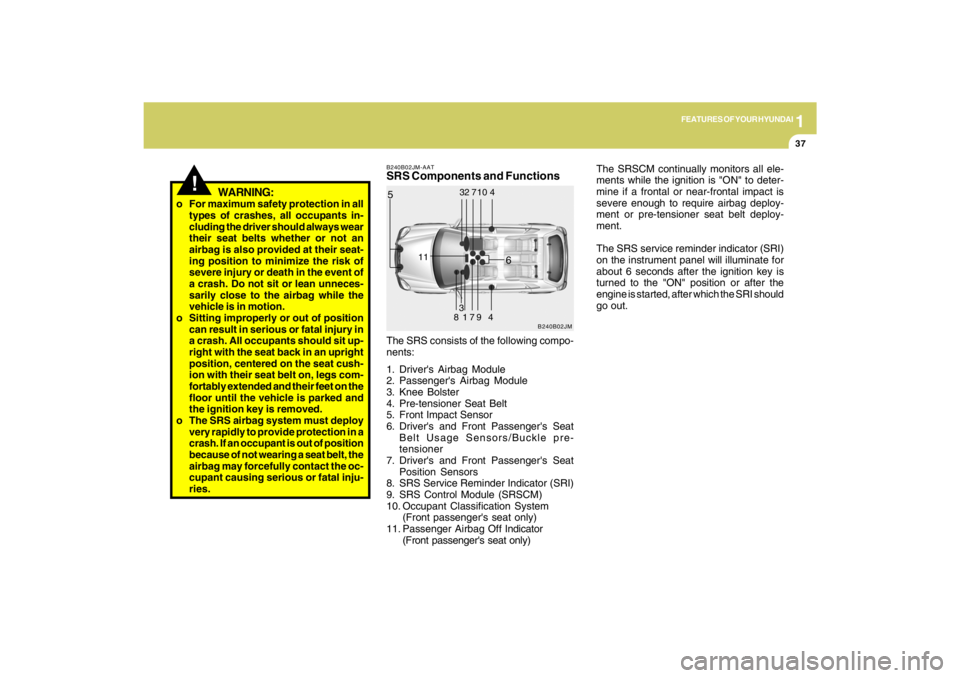
B240B02JM-AATSRS Components and FunctionsThe SRS consists of the following compo-
nents:
1. Driver's Airbag Module
2. Passenger's Airbag Module
3. Knee Bolster
4. Pre-tensioner Seat Belt
5. Front Impact Sensor
6. Driver's and Front Passenger's Seat
Belt Usage Sensors/Buckle pre-
tensioner
7. Driver's and Front Passenger's Seat
Position Sensors
8. SRS Service Reminder Indicator (SRI)
9. SRS Control Module (SRSCM)
10. Occupant Classification System
(Front passenger's seat only)
11. Passenger Airbag Off Indicator
(Front passenger's seat only)
B240B02JM
11
12710
79
5
6
4
3
4
83
o For maximum safety protection in all
types of crashes, all occupants in-
cluding the driver should always wear
their seat belts whether or not an
airbag is also provided at their seat-
ing position to minimize the risk of
severe injury or death in the event of
a crash. Do not sit or lean unneces-
sarily close to the airbag while the
vehicle is in motion.
o Sitting improperly or out of position
can result in serious or fatal injury in
a crash. All occupants should sit up-
right with the seat back in an upright
position, centered on the seat cush-
ion with their seat belt on, legs com-
fortably extended and their feet on the
floor until the vehicle is parked and
the ignition key is removed.
o The SRS airbag system must deploy
very rapidly to provide protection in a
crash. If an occupant is out of position
because of not wearing a seat belt, the
airbag may forcefully contact the oc-
cupant causing serious or fatal inju-
ries.
Page 51 of 273
1FEATURES OF YOUR HYUNDAI40
If the front passenger seat is occupied by
a person that the system determines to be
of adult size, and he/she sits properly (sit-
ting upright with the seatback in an upright
position, centered on the seat cushion with
their seat belt on, legs comfortably ex-
tended and their feet on the floor),
the PASSENGER AIR BAG "OFF" indica-
tor will be turned off (The "OFF" will not
illuminate) and the front passenger's airbag
will be able to inflate, if necessary, in frontal
crashes.
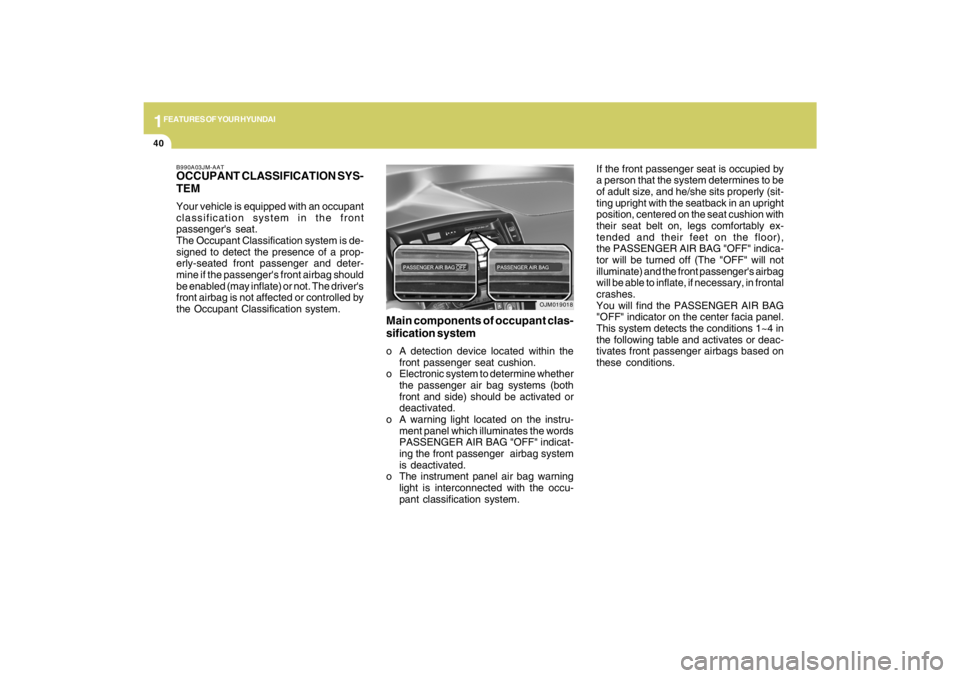
You will find the PASSENGER AIR BAG
"OFF" indicator on the center facia panel.
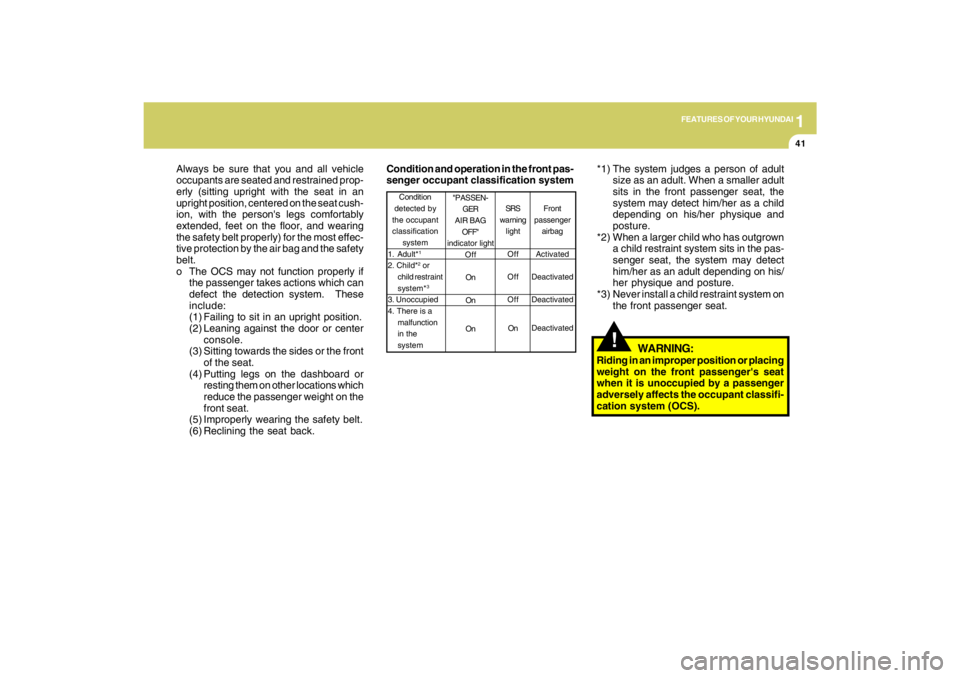
This system detects the conditions 1~4 in
the following table and activates or deac-
tivates front passenger airbags based on
these conditions.
OJM019018
Main components of occupant clas-
sification systemo A detection device located within the
front passenger seat cushion.
o Electronic system to determine whether
the passenger air bag systems (both
front and side) should be activated or
deactivated.
o A warning light located on the instru-
ment panel which illuminates the words
PASSENGER AIR BAG "OFF" indicat-
ing the front passenger airbag system
is deactivated.
o The instrument panel air bag warning
light is interconnected with the occu-
pant classification system.
B990A03JM-AATOCCUPANT CLASSIFICATION SYS-
TEMYour vehicle is equipped with an occupant
classification system in the front
passenger's seat.
The Occupant Classification system is de-
signed to detect the presence of a prop-
erly-seated front passenger and deter-
mine if the passenger's front airbag should
be enabled (may inflate) or not. The driver's
front airbag is not affected or controlled by
the Occupant Classification system.
Page 52 of 273
1
FEATURES OF YOUR HYUNDAI
41
!
*1) The system judges a person of adult
size as an adult. When a smaller adult
sits in the front passenger seat, the
system may detect him/her as a child
depending on his/her physique and
posture.
*2) When a larger child who has outgrown
a child restraint system sits in the pas-
senger seat, the system may detect
him/her as an adult depending on his/
her physique and posture.
*3) Never install a child restraint system on
the front passenger seat.
WARNING:
Riding in an improper position or placing
weight on the front passenger's seat
when it is unoccupied by a passenger
adversely affects the occupant classifi-
cation system (OCS).
Front
passenger
airbag
Activated
Deactivated
Deactivated
Deactivated Condition
detected by
the occupant
classification
system
1. Adult*
1
2. Child*
2 or
child restraint
system*3
3. Unoccupied
4. There is a
malfunction
in the
systemSRS
warning
light
Off
Off
Off
On
"PASSEN-
GER
AIR BAG
OFF"
indicator light
Off
On
On
On
Condition and operation in the front pas-
senger occupant classification system Always be sure that you and all vehicle
occupants are seated and restrained prop-
erly (sitting upright with the seat in an
upright position, centered on the seat cush-
ion, with the person's legs comfortably
extended, feet on the floor, and wearing
the safety belt properly) for the most effec-
tive protection by the air bag and the safety
belt.
o The OCS may not function properly if
the passenger takes actions which can
defect the detection system. These
include:
(1) Failing to sit in an upright position.
(2) Leaning against the door or center
console.
(3) Sitting towards the sides or the front
of the seat.
(4) Putting legs on the dashboard or
resting them on other locations which
reduce the passenger weight on the
front seat.
(5) Improperly wearing the safety belt.
(6) Reclining the seat back.