2009 Hyundai Sonata roof
[x] Cancel search: roofPage 14 of 286
1
Fuel Recommendations ................................................ 1-2
Breaking in Your New Hyundai ..................................... 1-3
Keys.............................................................................. 1-3
Door Locks ................................................................... 1-4
Theft-Alarm System ...................................................... 1-8
Windows.....................................................................1-11
Seats...........................................................................1-14
Seat Belts....................................................................1-21
Child Restraint System ...............................................1-26
Advanced Supplemental Restraint (AIRBAG)
System (SRS) ...........................................................1-34
Instrument Cluster and Indicator Lights...................... 1-48
Warning and Indicator Lights......................................1-50
Trip Computer.............................................................1-58
Multi-Function Light Switch .........................................1-60
Windshield Wiper and Washer Switch ........................1-63
Sunroof.......................................................................1-69
Mirror...........................................................................1-75
Homelink Mirror...........................................................1-77
Hood Release .............................................................1-87
Cruise Control.............................................................1-91
Heating and Cooling Control .......................................1-96
Antenna.....................................................................1-110
Stereo Sound System...............................................1-112
Audio System............................................................1-115
FEATURES OF YOUR HYUNDAI
1
Page 58 of 286
1
FEATURES OF YOUR HYUNDAI
45
!
o For best protection from the side im-
pact airbag system and to avoid being
injured by the deploying side impact
airbag, both front seat occupants
should sit in an upright position with
the seat belt properly fastened. The
driver's hands should be placed on
the steering wheel at the 9:00 and
3:00 positions. The passenger's arms
and hands should be placed on their
laps.
o Do not use any accessory seat covers.
o Use of seat covers could reduce or
prevent the effectiveness of the sys-
tem.
o Do not install any accessories on the
side or near the side impact airbag.
o Do not place any objects over the
airbag or between the airbag and
yourself.
o Do not place any objects (an umbrella,
bag, etc.) between the front door and
the front seat. Such objects may be-
come dangerous projectiles and
cause injury if the supplemental side
impact airbag inflates.
o To prevent unexpected deployment
of the side impact airbag that may
result in personal injury, avoid impact
to the side impact sensor when the
ignition key is on.
WARNING:
WARNING:
o The side impact airbag is
supplemental to the driver's and the
passenger's seat belt systems and is
not a substitute for them. Therefore
your seat belts must be worn at all
times while the vehicle is in motion.
The airbags deploy only in certain
side impact conditions severe enough
to cause significant injury to the
vehicle occupants.
!
ONF038022
Side impact
sensor
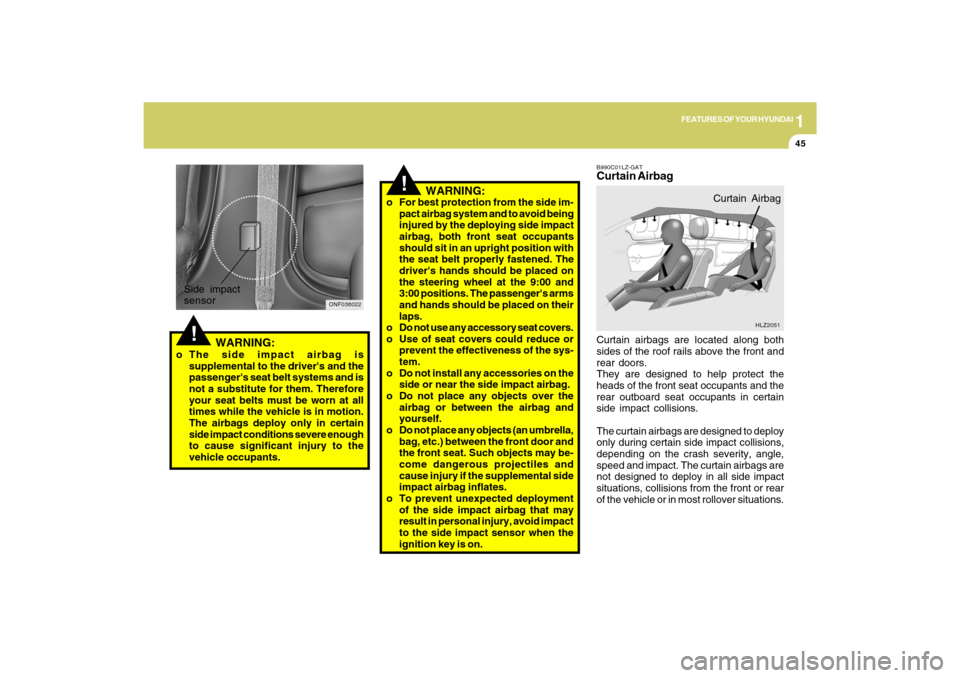
B990C01LZ-GATCurtain AirbagCurtain airbags are located along both
sides of the roof rails above the front and
rear doors.
They are designed to help protect the
heads of the front seat occupants and the
rear outboard seat occupants in certain
side impact collisions.
The curtain airbags are designed to deploy
only during certain side impact collisions,
depending on the crash severity, angle,
speed and impact. The curtain airbags are
not designed to deploy in all side impact
situations, collisions from the front or rear
of the vehicle or in most rollover situations.
HLZ2051
Curtain Airbag
Page 82 of 286
1
FEATURES OF YOUR HYUNDAI
69
!SUNROOFB460A02Y-AAT(If Installed)
Sun Shade
B460A01NF
Your HYUNDAI is equipped with a sliding
sunshade which you can manually adjust
to let in light with the sunroof closed, or to
block sunlight.
WARNING:
Never adjust the sunshade while driving.
This could result in loss of control and an
accident that may cause death, serious
injury, or property damage.
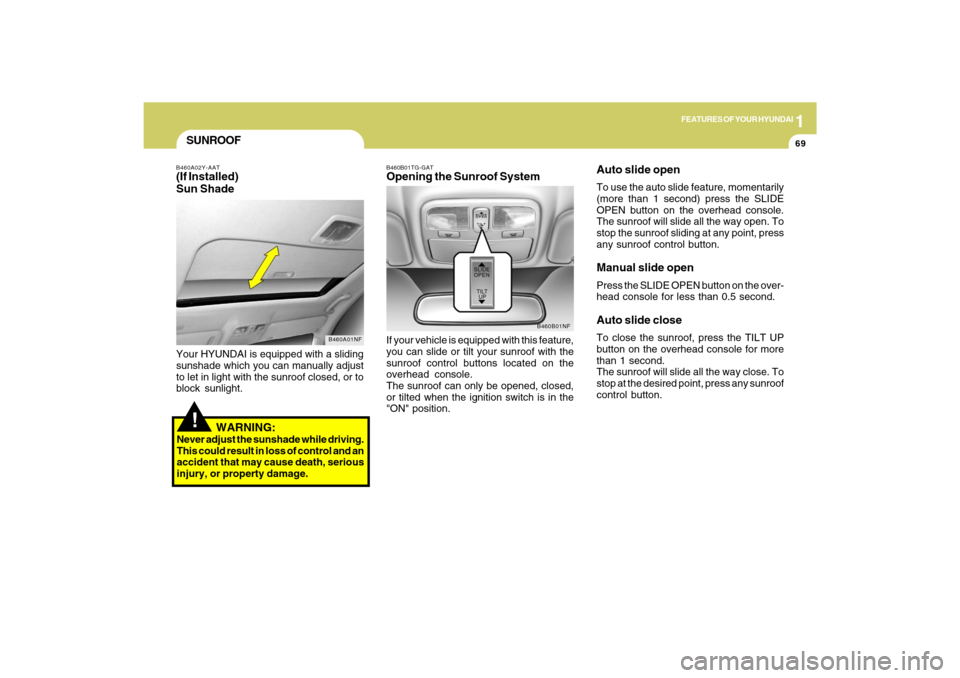
B460B01TG-GATOpening the Sunroof SystemIf your vehicle is equipped with this feature,
you can slide or tilt your sunroof with the
sunroof control buttons located on the
overhead console.
The sunroof can only be opened, closed,
or tilted when the ignition switch is in the
"ON" position.
B460B01NF
Auto slide openTo use the auto slide feature, momentarily
(more than 1 second) press the SLIDE
OPEN button on the overhead console.
The sunroof will slide all the way open. To
stop the sunroof sliding at any point, press
any sunroof control button.Manual slide openPress the SLIDE OPEN button on the over-
head console for less than 0.5 second.Auto slide closeTo close the sunroof, press the TILT UP
button on the overhead console for more
than 1 second.
The sunroof will slide all the way close. To
stop at the desired point, press any sunroof
control button.
Page 83 of 286
1FEATURES OF YOUR HYUNDAI70
!
Manual tilt downTo close the sunroof, press the SLIDE
OPEN button on the overhead console
and hold it until the sunroof is closed.NOTE:After washing the car or after there is
rain, be sure to wipe off any water that is
on the sunroof before operating it.
WARNING:
o Do not close a sunroof if anyone's
hands, arms or body are between the
sliding glass and the sunroof sash, as
this could result in injury.
o Do not place your head or arms out of
the sunroof opening at any time.
o While the vehicle is moving, always
keep the head, hands and other parts
of the body of all occupants away
from the roof opening. Otherwise, you
could be seriously injured if the ve-
hicle stops suddenly or if the vehicle
is involved in an accident.
!
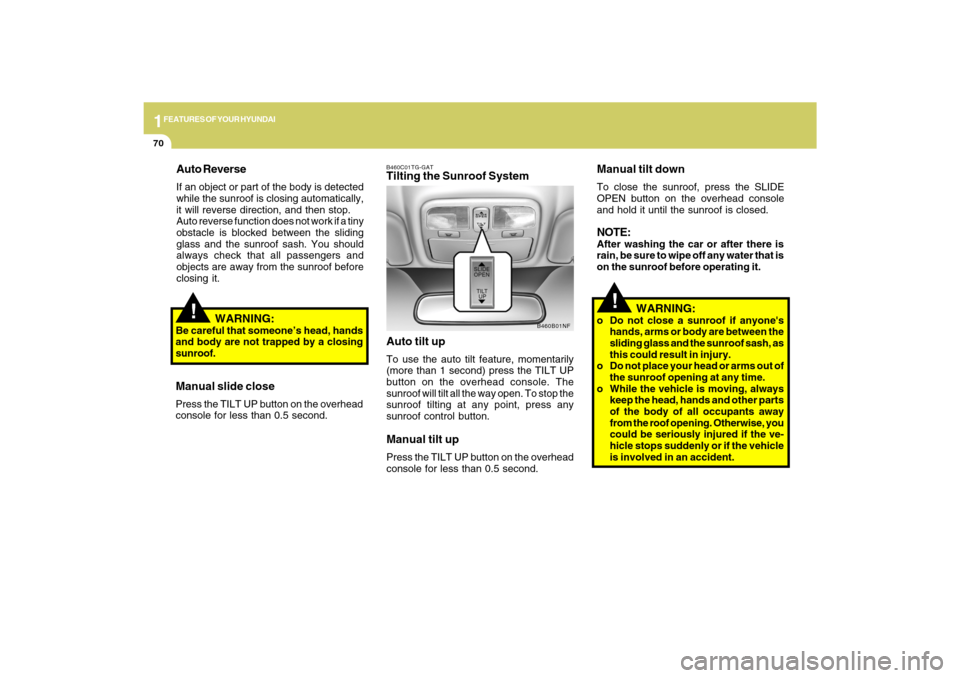
B460C01TG-GATTilting the Sunroof System
Auto tilt upTo use the auto tilt feature, momentarily
(more than 1 second) press the TILT UP
button on the overhead console. The
sunroof will tilt all the way open. To stop the
sunroof tilting at any point, press any
sunroof control button.Manual tilt upPress the TILT UP button on the overhead
console for less than 0.5 second.
Auto ReverseIf an object or part of the body is detected
while the sunroof is closing automatically,
it will reverse direction, and then stop.
Auto reverse function does not work if a tiny
obstacle is blocked between the sliding
glass and the sunroof sash. You should
always check that all passengers and
objects are away from the sunroof before
closing it.
WARNING:
Be careful that someone’s head, hands
and body are not trapped by a closing
sunroof.Manual slide closePress the TILT UP button on the overhead
console for less than 0.5 second.
B460B01NF
Page 84 of 286
1
FEATURES OF YOUR HYUNDAI
71
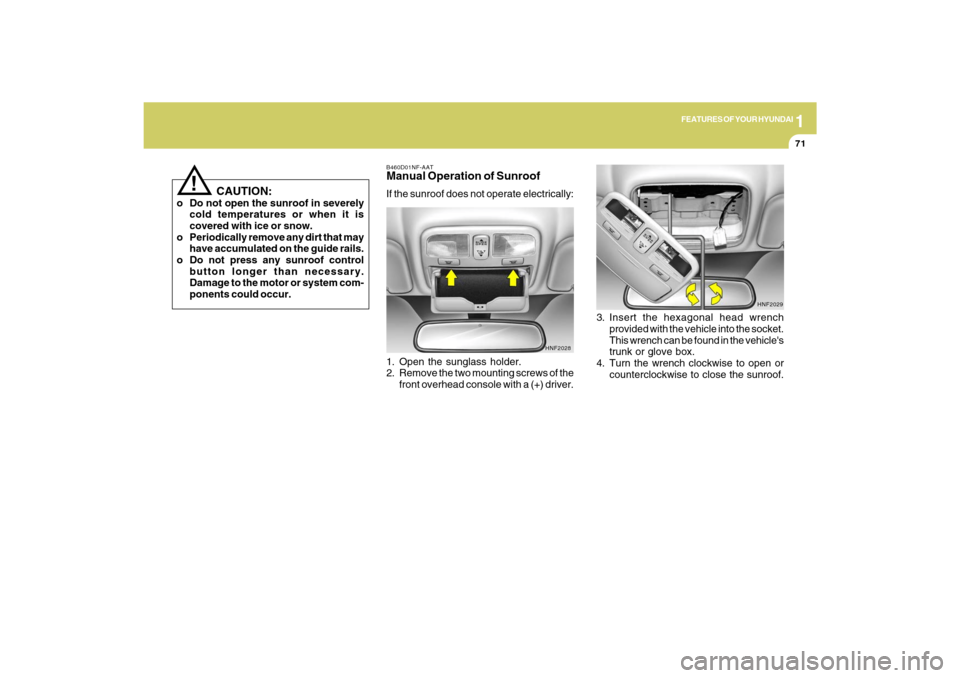
B460D01NF-AATManual Operation of SunroofIf the sunroof does not operate electrically:
1. Open the sunglass holder.
2. Remove the two mounting screws of the
front overhead console with a (+) driver.
HNF2028
!
CAUTION:
o Do not open the sunroof in severely
cold temperatures or when it is
covered with ice or snow.
o Periodically remove any dirt that may
have accumulated on the guide rails.
o Do not press any sunroof control
button longer than necessary.
Damage to the motor or system com-
ponents could occur.
3. Insert the hexagonal head wrench
provided with the vehicle into the socket.
This wrench can be found in the vehicle's
trunk or glove box.
4. Turn the wrench clockwise to open or
counterclockwise to close the sunroof.
HNF2029
Page 85 of 286
1FEATURES OF YOUR HYUNDAI72
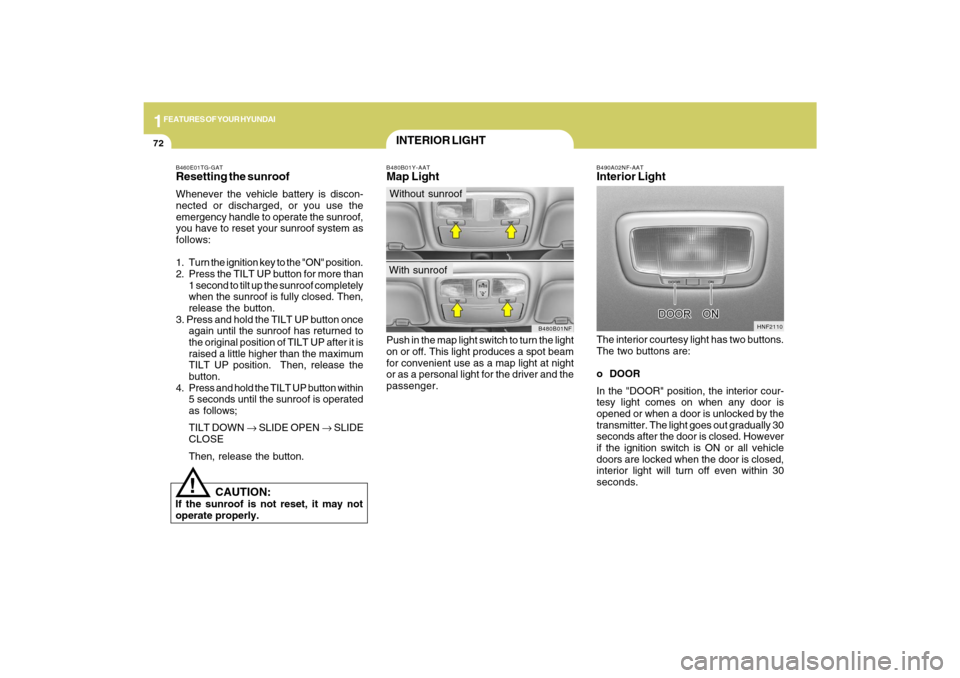
B490A02NF-AATInterior LightThe interior courtesy light has two buttons.
The two buttons are:
o DOOR
In the "DOOR" position, the interior cour-
tesy light comes on when any door is
opened or when a door is unlocked by the
transmitter. The light goes out gradually 30
seconds after the door is closed. However
if the ignition switch is ON or all vehicle
doors are locked when the door is closed,
interior light will turn off even within 30
seconds.
HNF2110
!
CAUTION:
If the sunroof is not reset, it may not
operate properly.B460E01TG-GATResetting the sunroofWhenever the vehicle battery is discon-
nected or discharged, or you use the
emergency handle to operate the sunroof,
you have to reset your sunroof system as
follows:
1. Turn the ignition key to the "ON" position.
2. Press the TILT UP button for more than
1 second to tilt up the sunroof completely
when the sunroof is fully closed. Then,
release the button.
3. Press and hold the TILT UP button once
again until the sunroof has returned to
the original position of TILT UP after it is
raised a little higher than the maximum
TILT UP position. Then, release the
button.
4. Press and hold the TILT UP button within
5 seconds until the sunroof is operated
as follows;
TILT DOWN → SLIDE OPEN → SLIDE
CLOSE
Then, release the button.
B480B01Y-AATMap LightPush in the map light switch to turn the light
on or off. This light produces a spot beam
for convenient use as a map light at night
or as a personal light for the driver and the
passenger.
B480B01NF
INTERIOR LIGHTWithout sunroofWith sunroof
Page 124 of 286
1
FEATURES OF YOUR HYUNDAI
111111
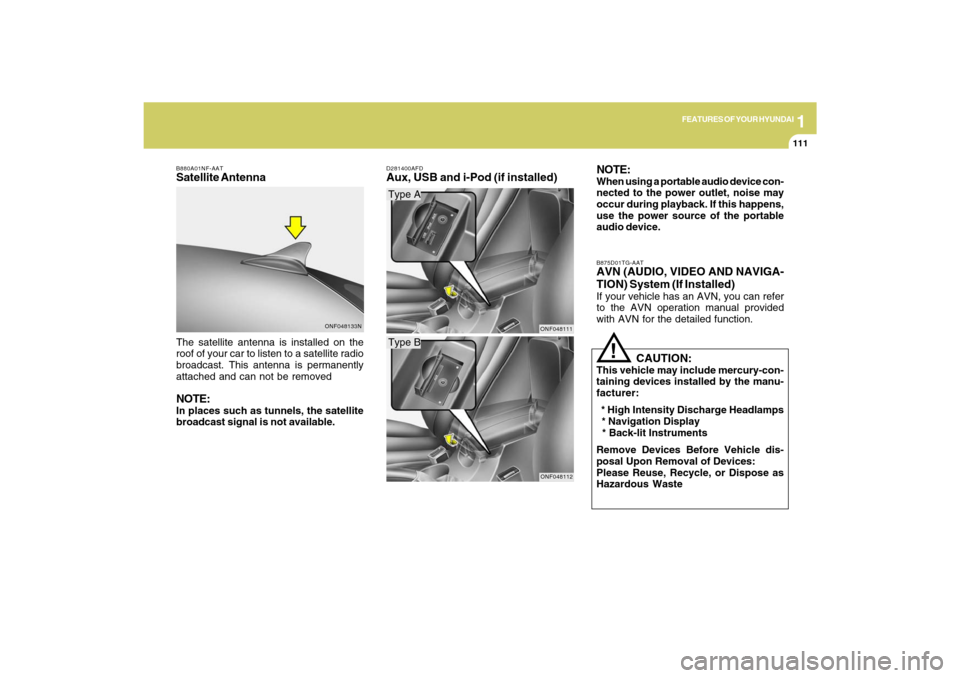
The satellite antenna is installed on the
roof of your car to listen to a satellite radio
broadcast. This antenna is permanently
attached and can not be removedNOTE:In places such as tunnels, the satellite
broadcast signal is not available.
D281400AFDAux, USB and i-Pod (if installed)NOTE:
When using a portable audio device con-
nected to the power outlet, noise may
occur during playback. If this happens,
use the power source of the portable
audio device.
Type AType B
ONF048111ONF048112B875D01TG-AAT
AVN (AUDIO, VIDEO AND NAVIGA-
TION) System (If Installed)If your vehicle has an AVN, you can refer
to the AVN operation manual provided
with AVN for the detailed function.
!
CAUTION:
This vehicle may include mercury-con-
taining devices installed by the manu-
facturer:
* High Intensity Discharge Headlamps
* Navigation Display
* Back-lit Instruments
Remove Devices Before Vehicle dis-
posal Upon Removal of Devices:
Please Reuse, Recycle, or Dispose as
Hazardous Waste
ONF048133N B880A01NF-AAT
Satellite Antenna
Page 211 of 286
5
VEHICLE MAINTENANCE REQUIREMENTS6
MAINTENANCE UNDER SEVERE USAGE
CONDITIONS
SEVERE DRIVING CONDITIONSA - Repeatedly driving short distance of less than 5miles (8km) in
normal temperature or less than 10miles (16km) in freezing
temperature
B - Extensive engine idling or low speed driving for long distances
C - Driving on rough, dusty, muddy, unpaved, graveled or salt-
spread roads
D - Driving in areas using salt or other corrosive materials or in
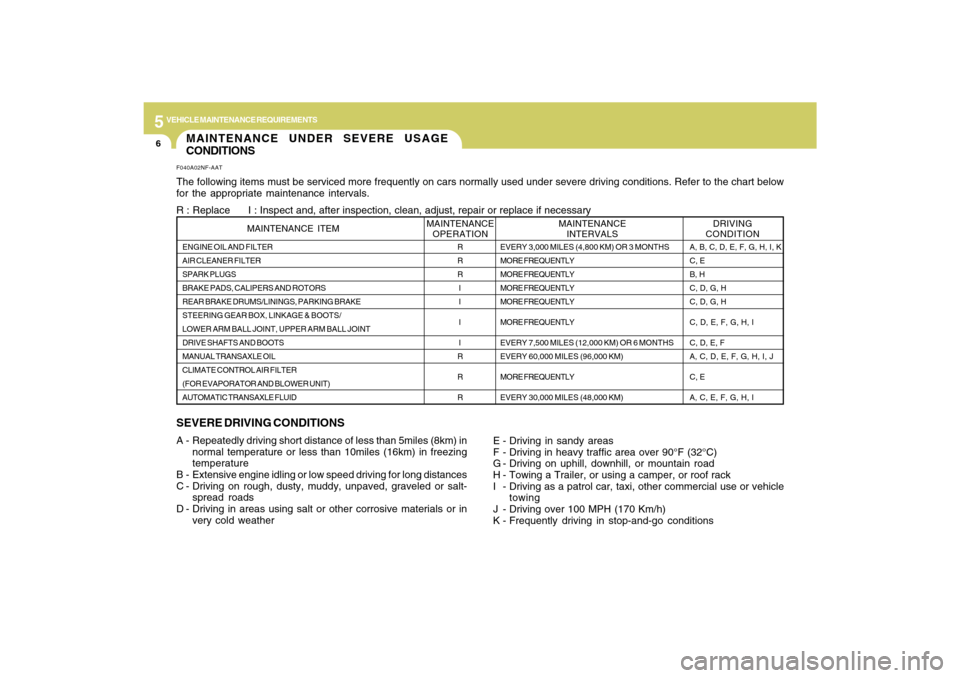
very cold weatherF040A02NF-AATThe following items must be serviced more frequently on cars normally used under severe driving conditions. Refer to the chart below
for the appropriate maintenance intervals.
R : Replace I : Inspect and, after inspection, clean, adjust, repair or replace if necessary
E - Driving in sandy areas
F - Driving in heavy traffic area over 90°F (32°C)
G - Driving on uphill, downhill, or mountain road
H - Towing a Trailer, or using a camper, or roof rack
I - Driving as a patrol car, taxi, other commercial use or vehicle
towing
J - Driving over 100 MPH (170 Km/h)
K - Frequently driving in stop-and-go conditionsENGINE OIL AND FILTER
AIR CLEANER FILTER
SPARK PLUGS
BRAKE PADS, CALIPERS AND ROTORS
REAR BRAKE DRUMS/LININGS, PARKING BRAKE
STEERING GEAR BOX, LINKAGE & BOOTS/
LOWER ARM BALL JOINT, UPPER ARM BALL JOINT
DRIVE SHAFTS AND BOOTS
MANUAL TRANSAXLE OIL
CLIMATE CONTROL AIR FILTER
(FOR EVAPORATOR AND BLOWER UNIT)
AUTOMATIC TRANSAXLE FLUID
MAINTENANCE ITEM
R
R
R
I
I
I
I
R
R
R
EVERY 3,000 MILES (4,800 KM) OR 3 MONTHS
MORE FREQUENTLY
MORE FREQUENTLY
MORE FREQUENTLY
MORE FREQUENTLY
MORE FREQUENTLY
EVERY 7,500 MILES (12,000 KM) OR 6 MONTHS
EVERY 60,000 MILES (96,000 KM)
MORE FREQUENTLY
EVERY 30,000 MILES (48,000 KM)
DRIVING
CONDITION MAINTENANCE
INTERVALS MAINTENANCE
OPERATION
A, B, C, D, E, F, G, H, I, K
C, E
B, H
C, D, G, H
C, D, G, H
C, D, E, F, G, H, I
C, D, E, F
A, C, D, E, F, G, H, I, J
C, E
A, C, E, F, G, H, I