2009 Hyundai Santa Fe engine overheat
[x] Cancel search: engine overheatPage 172 of 269
2
DRIVING YOUR HYUNDAI
27
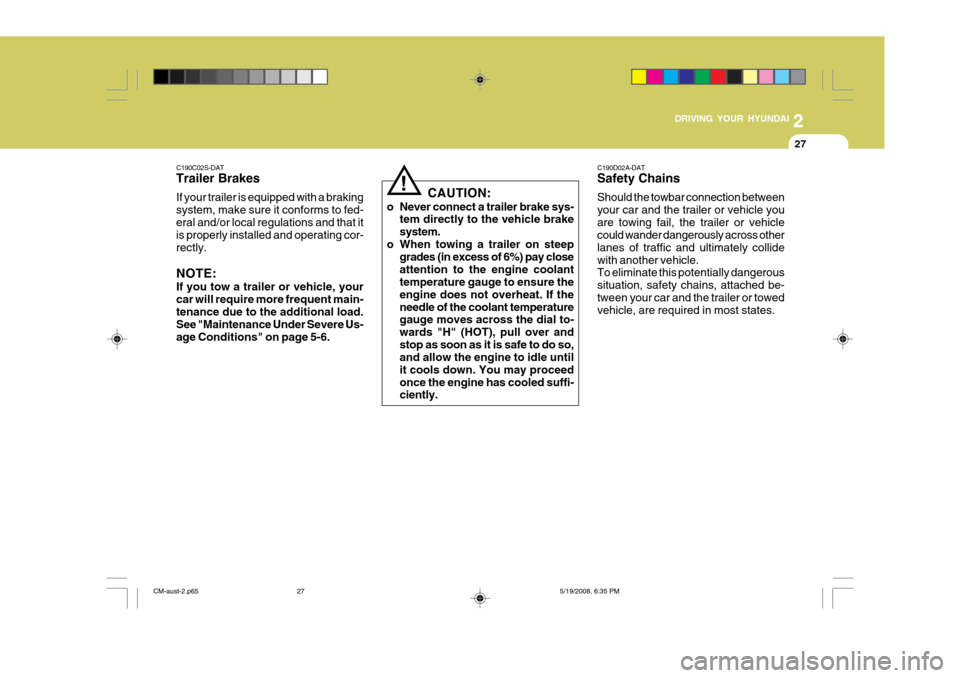
CAUTION:
o Never connect a trailer brake sys- tem directly to the vehicle brake system.
o When towing a trailer on steep grades (in excess of 6%) pay closeattention to the engine coolant temperature gauge to ensure the engine does not overheat. If theneedle of the coolant temperature gauge moves across the dial to- wards "H" (HOT), pull over andstop as soon as it is safe to do so, and allow the engine to idle until it cools down. You may proceedonce the engine has cooled suffi- ciently.
! C190D02A-DAT Safety Chains Should the towbar connection between your car and the trailer or vehicle youare towing fail, the trailer or vehicle could wander dangerously across other lanes of traffic and ultimately collidewith another vehicle. To eliminate this potentially dangerous situation, safety chains, attached be-tween your car and the trailer or towed vehicle, are required in most states.
C190C02S-DAT Trailer Brakes If your trailer is equipped with a braking system, make sure it conforms to fed-eral and/or local regulations and that it is properly installed and operating cor- rectly. NOTE: If you tow a trailer or vehicle, your car will require more frequent main-tenance due to the additional load. See "Maintenance Under Severe Us- age Conditions" on page 5-6.
CM-aust-2.p65
5/19/2008, 6:35 PM
27
Page 174 of 269
2
DRIVING YOUR HYUNDAI
29
!
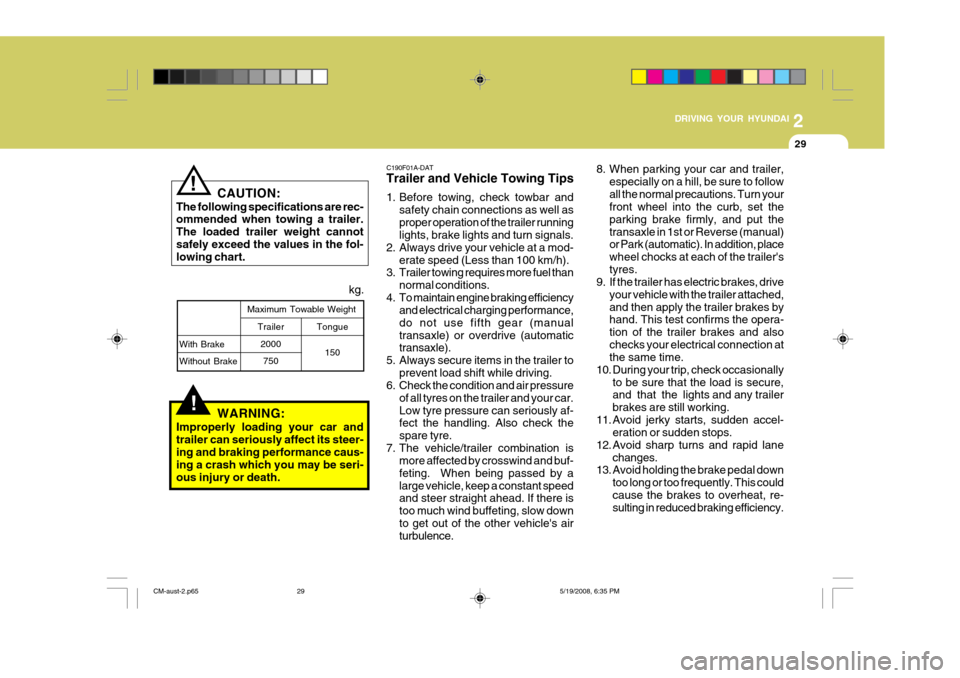
C190F01A-DAT Trailer and Vehicle Towing Tips
1. Before towing, check towbar and
safety chain connections as well as proper operation of the trailer running lights, brake lights and turn signals.
2. Always drive your vehicle at a mod- erate speed (Less than 100 km/h).
3. Trailer towing requires more fuel than
normal conditions.
4. To maintain engine braking efficiency and electrical charging performance, do not use fifth gear (manualtransaxle) or overdrive (automatic transaxle).
5. Always secure items in the trailer to prevent load shift while driving.
6. Check the condition and air pressure
of all tyres on the trailer and your car. Low tyre pressure can seriously af- fect the handling. Also check the spare tyre.
7. The vehicle/trailer combination is more affected by crosswind and buf-feting. When being passed by alarge vehicle, keep a constant speed and steer straight ahead. If there is too much wind buffeting, slow downto get out of the other vehicle's air turbulence. 8. When parking your car and trailer,
especially on a hill, be sure to follow all the normal precautions. Turn your front wheel into the curb, set the parking brake firmly, and put thetransaxle in 1st or Reverse (manual) or Park (automatic). In addition, place wheel chocks at each of the trailer'styres.
9. If the trailer has electric brakes, drive
your vehicle with the trailer attached,and then apply the trailer brakes by hand. This test confirms the opera- tion of the trailer brakes and alsochecks your electrical connection at the same time.
10. During your trip, check occasionally to be sure that the load is secure,and that the lights and any trailer brakes are still working.
11. Avoid jerky starts, sudden accel- eration or sudden stops.
12. Avoid sharp turns and rapid lane changes.
13. Avoid holding the brake pedal down
too long or too frequently. This couldcause the brakes to overheat, re- sulting in reduced braking efficiency.
CAUTION:
The following specifications are rec-ommended when towing a trailer. The loaded trailer weight cannotsafely exceed the values in the fol- lowing chart.
!
Maximum Towable Weight kg.
With Brake Without Brake
WARNING:
Improperly loading your car and trailer can seriously affect its steer-ing and braking performance caus- ing a crash which you may be seri- ous injury or death.
Tongue
150
Trailer
2000750
CM-aust-2.p65 5/19/2008, 6:35 PM
29
Page 175 of 269
2DRIVING YOUR HYUNDAI
30
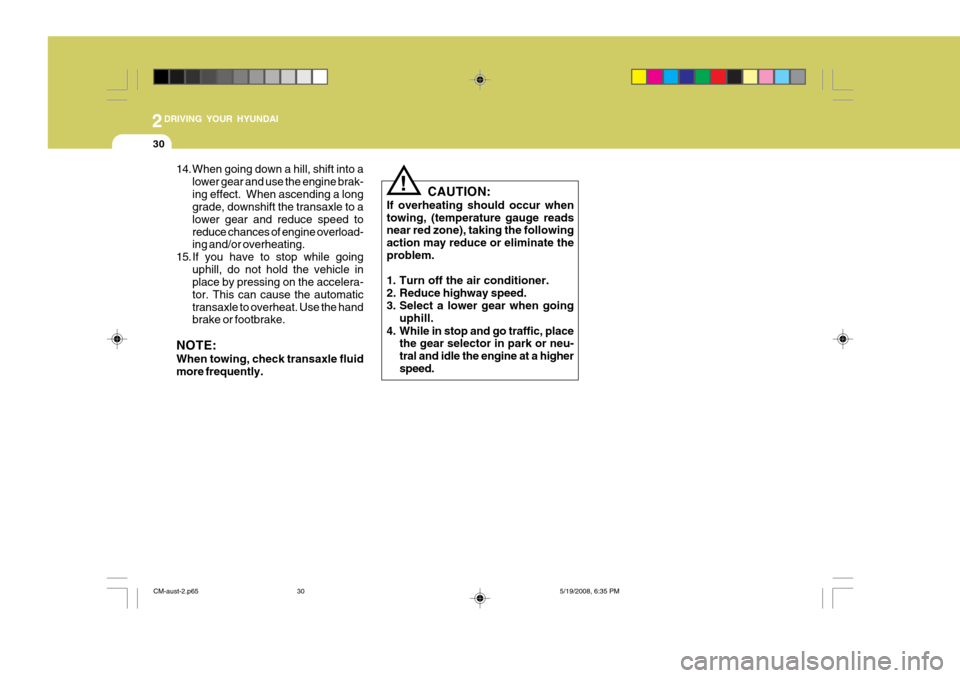
CAUTION:
If overheating should occur when towing, (temperature gauge reads near red zone), taking the following action may reduce or eliminate theproblem.
1. Turn off the air conditioner.
2. Reduce highway speed.
3. Select a lower gear when going uphill.
4. While in stop and go traffic, place the gear selector in park or neu-tral and idle the engine at a higher speed.
!
14. When going down a hill, shift into a
lower gear and use the engine brak- ing effect. When ascending a long grade, downshift the transaxle to a lower gear and reduce speed toreduce chances of engine overload- ing and/or overheating.
15. If you have to stop while going uphill, do not hold the vehicle inplace by pressing on the accelera- tor. This can cause the automatictransaxle to overheat. Use the hand brake or footbrake.
NOTE: When towing, check transaxle fluid more frequently.
CM-aust-2.p65 5/19/2008, 6:35 PM
30
Page 176 of 269
3
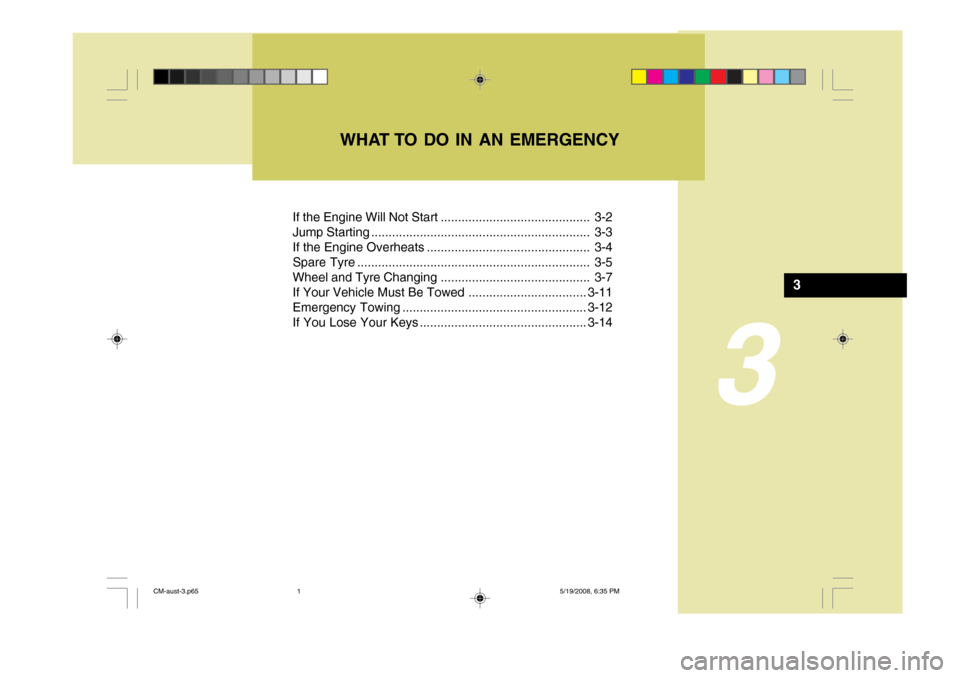
If the Engine Will Not Start ........................................... 3-2
Jump Starting ............................................................... 3-3
If the Engine Overheats ............................................... 3-4
Spare Tyre ................................................................... 3-5
Wheel and Tyre Changing ........................................... 3-7
If Your Vehicle Must Be Towed ..................................3-11
Emergency Towing ..................................................... 3-12
If You Lose Your K eys ................................................ 3-14
WHAT TO DO IN AN EMERGENCY
3
CM-aust-3.p65
5/19/2008, 6:35 PM
1
Page 179 of 269
3WHAT TO DO IN AN EMERGENCY
4
!
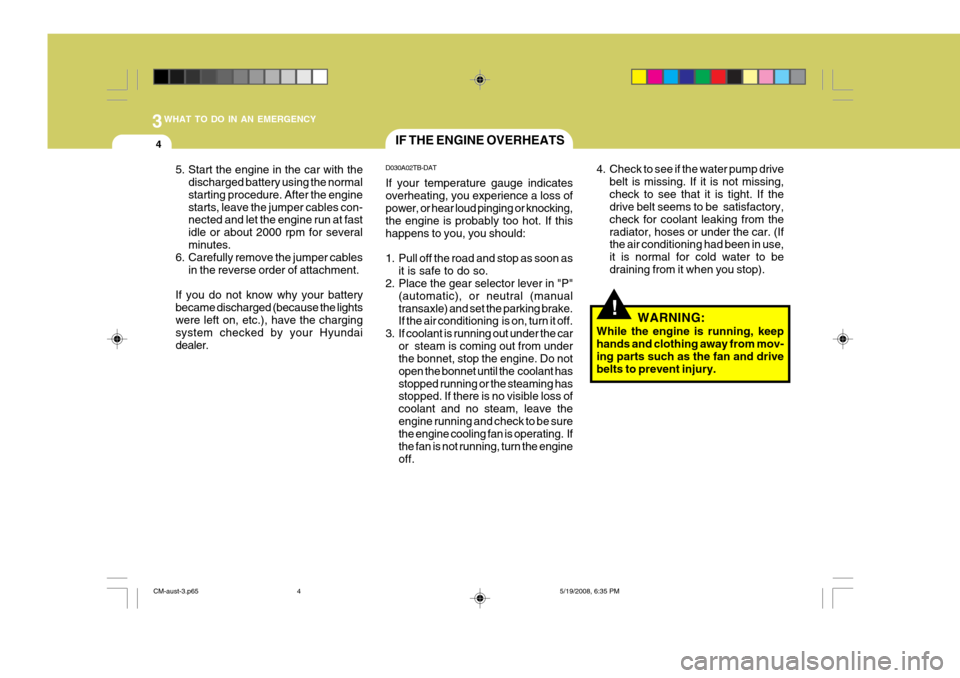
IF THE ENGINE OVERHEATS
4. Check to see if the water pump drivebelt is missing. If it is not missing, check to see that it is tight. If the drive belt seems to be satisfactory, check for coolant leaking from theradiator, hoses or under the car. (If the air conditioning had been in use, it is normal for cold water to bedraining from it when you stop).
D030A02TB-DAT If your temperature gauge indicates overheating, you experience a loss of power, or hear loud pinging or knocking, the engine is probably too hot. If thishappens to you, you should:
1. Pull off the road and stop as soon as
it is safe to do so.
2. Place the gear selector lever in "P"
(automatic), or neutral (manual transaxle) and set the parking brake. If the air conditioning is on, turn it off.
3. If coolant is running out under the car or steam is coming out from underthe bonnet, stop the engine. Do not open the bonnet until the coolant hasstopped running or the steaming has stopped. If there is no visible loss of coolant and no steam, leave theengine running and check to be sure the engine cooling fan is operating. If the fan is not running, turn the engineoff. WARNING:
While the engine is running, keephands and clothing away from mov-ing parts such as the fan and drive belts to prevent injury.
5. Start the engine in the car with the
discharged battery using the normal starting procedure. After the enginestarts, leave the jumper cables con- nected and let the engine run at fast idle or about 2000 rpm for severalminutes.
6. Carefully remove the jumper cables
in the reverse order of attachment.
If you do not know why your batterybecame discharged (because the lightswere left on, etc.), have the charging system checked by your Hyundai dealer.
CM-aust-3.p65 5/19/2008, 6:35 PM
4
Page 180 of 269
3
WHAT TO DO IN AN EMERGENCY
5
!
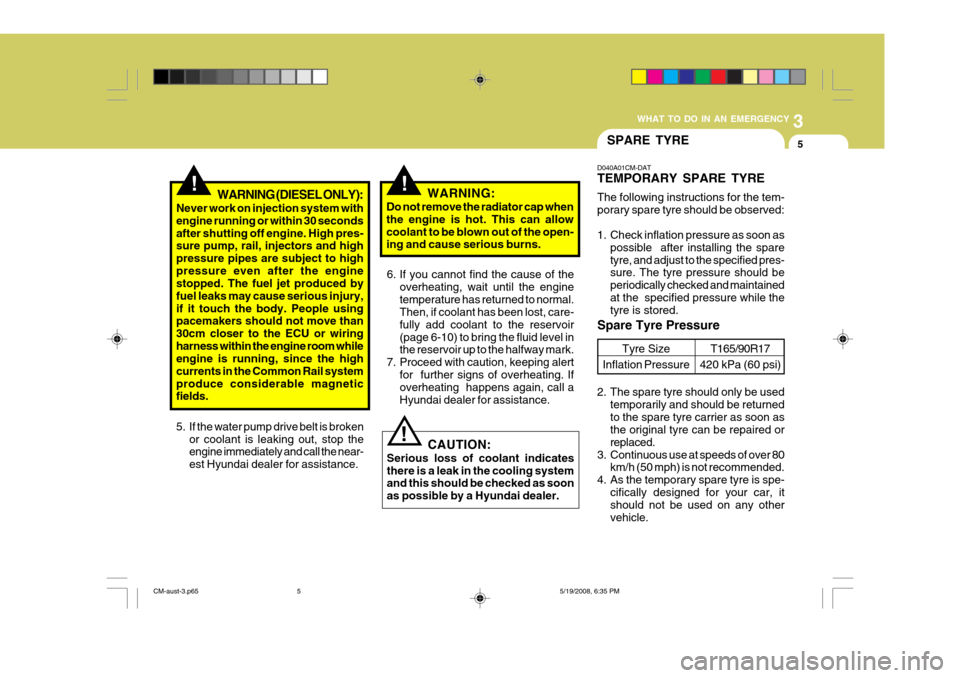
5. If the water pump drive belt is broken
or coolant is leaking out, stop the engine immediately and call the near- est Hyundai dealer for assistance. WARNING:
Do not remove the radiator cap whenthe engine is hot. This can allowcoolant to be blown out of the open- ing and cause serious burns.
!WARNING (DIESEL ONLY):
Never work on injection system with engine running or within 30 secondsafter shutting off engine. High pres- sure pump, rail, injectors and high pressure pipes are subject to highpressure even after the engine stopped. The fuel jet produced by fuel leaks may cause serious injury,if it touch the body. People using pacemakers should not move than 30cm closer to the ECU or wiringharness within the engine room while engine is running, since the high currents in the Common Rail systemproduce considerable magnetic fields. 6. If you cannot find the cause of the
overheating, wait until the engine temperature has returned to normal. Then, if coolant has been lost, care- fully add coolant to the reservoir(page 6-10) to bring the fluid level in the reservoir up to the halfway mark.
7. Proceed with caution, keeping alert for further signs of overheating. Ifoverheating happens again, call a Hyundai dealer for assistance.
CAUTION:
Serious loss of coolant indicatesthere is a leak in the cooling system and this should be checked as soon as possible by a Hyundai dealer.
!
SPARE TYRE
D040A01CM-DAT TEMPORARY SPARE TYRE The following instructions for the tem- porary spare tyre should be observed:
1. Check inflation pressure as soon as possible after installing the spare tyre, and adjust to the specified pres- sure. The tyre pressure should be periodically checked and maintainedat the specified pressure while the tyre is stored.
Spare Tyre Pressure
Tyre Size
Inflation PressureT165/90R17
420 kPa (60 psi)
2. The spare tyre should only be used temporarily and should be returned to the spare tyre carrier as soon as the original tyre can be repaired or replaced.
3. Continuous use at speeds of over 80 km/h (50 mph) is not recommended.
4. As the temporary spare tyre is spe-
cifically designed for your car, it should not be used on any other vehicle.
CM-aust-3.p65 5/19/2008, 6:35 PM
5
Page 216 of 269
6
DO-IT-YOURSELF MAINTENANCE
9
!!
!
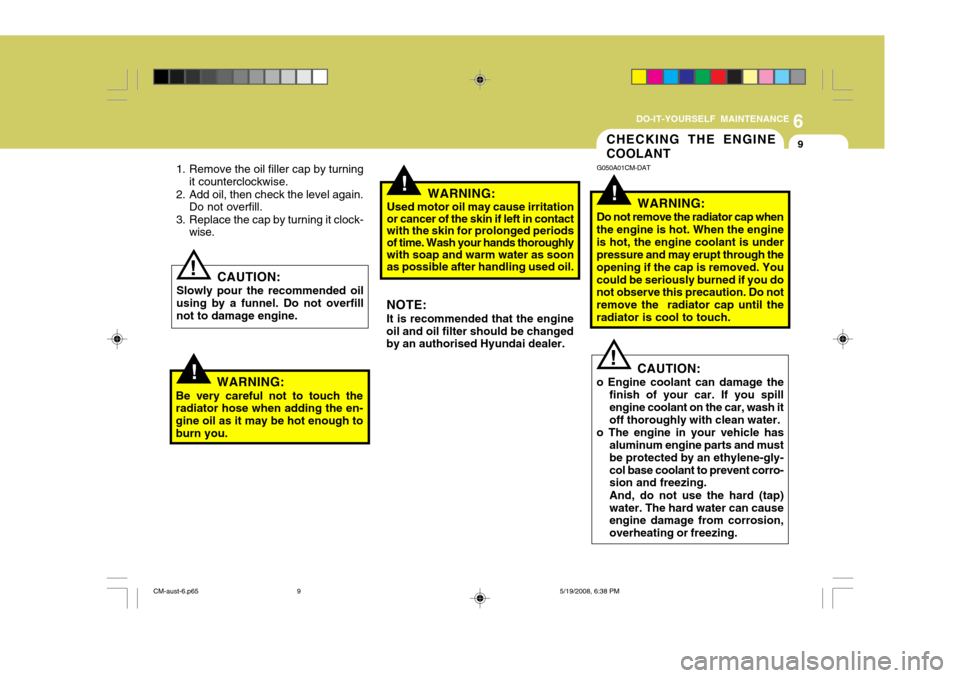
CHECKING THE ENGINE COOLANT
G050A01CM-DAT
WARNING:
Do not remove the radiator cap when the engine is hot. When the engineis hot, the engine coolant is under pressure and may erupt through the opening if the cap is removed. Youcould be seriously burned if you do not observe this precaution. Do not remove the radiator cap until theradiator is cool to touch.
WARNING:
Used motor oil may cause irritation or cancer of the skin if left in contact with the skin for prolonged periods of time. Wash your hands thoroughly with soap and warm water as soon as possible after handling used oil.
CAUTION:
Slowly pour the recommended oil
using by a funnel. Do not overfill not to damage engine.
!
WARNING:
Be very careful not to touch the radiator hose when adding the en- gine oil as it may be hot enough toburn you.
! CAUTION:
o Engine coolant can damage the finish of your car. If you spill engine coolant on the car, wash it off thoroughly with clean water.
o The engine in your vehicle has aluminum engine parts and must be protected by an ethylene-gly-col base coolant to prevent corro- sion and freezing. And, do not use the hard (tap) water. The hard water can cause engine damage from corrosion, overheating or freezing.
1. Remove the oil filler cap by turning
it counterclockwise.
2. Add oil, then check the level again. Do not overfill.
3. Replace the cap by turning it clock- wise.
NOTE: It is recommended that the engine
oil and oil filter should be changed by an authorised Hyundai dealer.
CM-aust-6.p65 5/19/2008, 6:38 PM
9
Page 266 of 269
3
10
INDEX
D Demisting/Defogging
................................................. 1-105
Door Central door locks .................................................... 1-9
Door locks ................................................................ 1-6
Front door edge warning light ..................................1-92
Locking, unlocking front doors with a key ................. 1-7
Drink Holder ................................................................ 1-71
Driving Driving for economy ................................................ 2-21
Smooth cornering .................................................... 2-22
Winter driving .......................................................... 2-23
EEmission Control System ............................................ 7-2
Engine Before starting the engine ........................................ 2-3Compartment ........................................................... 6-2
Coolant .................................................................... 6-9
Coolant temperature gauge .....................................1-54
If the engine overheats ............................................. 3-4
Number .................................................................... 8-2
Oil ............................................................................ 6-6Starting .................................................................... 2-6
Engine Exhaust Can Be Dangerous ............................. 2-2FFan Speed
Control .................................................... 1-100
Fog Light Front ....................................................................... 1-66
Rear ........................................................................ 1-67
Front Seats Adjustable front seats ............................................. 1-15
Adjustable headrests .............................................. 1-16
Adjusting seat forward and rearward ........................ 1-15
Adjusting seatback angle .. ......................................1-15
Fuel Capacity .................................................................. 9-2
Gauge ..................................................................... 1-54
Recommendations ................................................... 1-2
Fuel Filler Lid Remote release ....................................................... 1-88
Fuel Filter .................................................................... 6-27
Full-time 4 WD Operation ............................................. 2-16
Fuse Panel Description ............................................... 6-38
Fuses ......................................................................... 6-21
GGeneral Checks ........................................................... 6-5
Glove Box ................................................................... 1-78
CM-aust-10.p65 5/19/2008, 6:41 PM
3