2009 Hyundai Santa Fe brake
[x] Cancel search: brakePage 95 of 269
1FEATURES OF YOUR HYUNDAI
84
!
TAIL GATE
B540A01CM-AAT
WARNING:
The tail gate should always be kept completely closed while the vehicleis in motion. If it is left open or ajar, poisonous exhaust gases may enter the car resulting in serious illness ordeath to the occupants. See addi- tional warnings concerning exhaust gases on page 2-2.
o The tail gate is opened by pulling the outside handle up, raising the tail gate manually.
o To close, lower the tail gate, then
press down on it until it is closed. Tobe sure the tail gate is fully closed, always try to pull it up again without using the outside handle.
Releasing the parking brakeTo release the parking brake, first applythe foot brake and pull the praking brake lever slightly. Secondly, depress the release button and lower the parkingbrake lever while holding the button. Type B: Applying the parking brake To engage the parking brake, first applythe foot brake and then depress the parking brake pedal down as far as possible. In addition it is recommendedthat when parking the vehicle on a gradient, the shift lever should be in a low gear on manual transaxle vehiclesor in the P (Park) position on automatic transaxle vehicles.
B535A01CM-GAT Parking brake warning chime (if installed) The parking brake warning chime re- minds you that the parking brake isapplied when you are driving above 10km/h. Always release the parking brake before you drive.
Releasing the parking brakeTo release the parking brake, depressthe parking brake pedal a second time. If the parking brake pedal does not release or dose not release all the way,have the system checked by an authorised HYUNDAI dealer. NOTE: The parking brake pedal should be checked periodically for proper stroke.
!
CAUTION:
Driving with the parking brake ap- plied will cause excessive brake pad and brake rotor wear.
CM-aust-1a.p65 5/21/2008, 2:09 PM
84
Page 98 of 269
1
FEATURES OF YOUR HYUNDAI
87HIGH-MOUNTED REAR STOP LIGHT
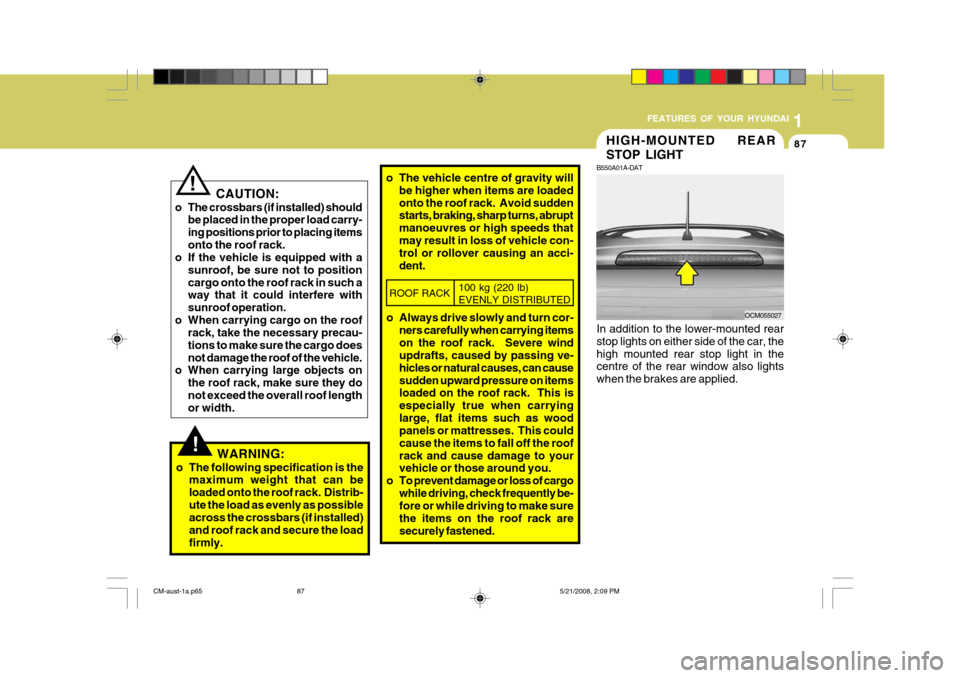
B550A01A-DAT In addition to the lower-mounted rear stop lights on either side of the car, the high mounted rear stop light in the centre of the rear window also lights when the brakes are applied. OCM055027
!WARNING:
o The following specification is the maximum weight that can be loaded onto the roof rack. Distrib-ute the load as evenly as possible across the crossbars (if installed) and roof rack and secure the loadfirmly. o The vehicle centre of gravity will
be higher when items are loadedonto the roof rack. Avoid sudden starts, braking, sharp turns, abrupt manoeuvres or high speeds thatmay result in loss of vehicle con- trol or rollover causing an acci- dent.
CAUTION:
o The crossbars (if installed) should be placed in the proper load carry-ing positions prior to placing itemsonto the roof rack.
o If the vehicle is equipped with a
sunroof, be sure not to positioncargo onto the roof rack in such a way that it could interfere with sunroof operation.
o When carrying cargo on the roof rack, take the necessary precau-tions to make sure the cargo doesnot damage the roof of the vehicle.
o When carrying large objects on
the roof rack, make sure they donot exceed the overall roof length or width.
!
ROOF RACK 100 kg (220 lb) EVENLY DISTRIBUTED
o Always drive slowly and turn cor-
ners carefully when carrying items on the roof rack. Severe wind updrafts, caused by passing ve- hicles or natural causes, can causesudden upward pressure on items loaded on the roof rack. This is especially true when carryinglarge, flat items such as wood panels or mattresses. This could cause the items to fall off the roofrack and cause damage to your vehicle or those around you.
o To prevent damage or loss of cargo while driving, check frequently be-fore or while driving to make sure the items on the roof rack aresecurely fastened.
CM-aust-1a.p65 5/21/2008, 2:09 PM
87
Page 107 of 269
1FEATURES OF YOUR HYUNDAI
96
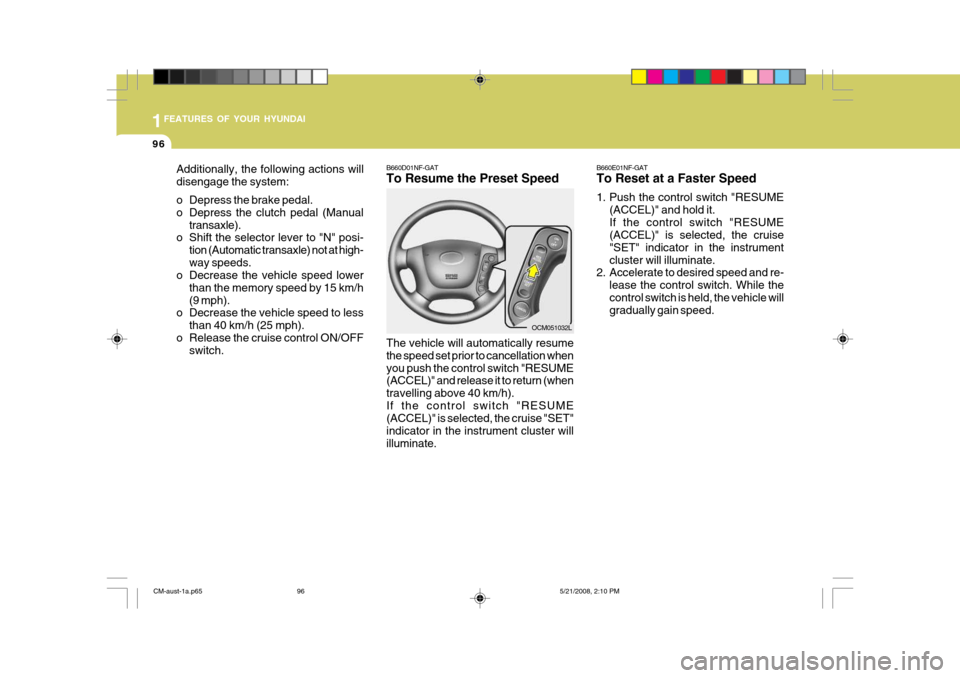
B660D01NF-GAT To Resume the Preset Speed The vehicle will automatically resume the speed set prior to cancellation whenyou push the control switch "RESUME (ACCEL)" and release it to return (when travelling above 40 km/h).If the control switch "RESUME (ACCEL)" is selected, the cruise "SET" indicator in the instrument cluster willilluminate.
OCM051032L
Additionally, the following actions will disengage the system:
o Depress the brake pedal.
o Depress the clutch pedal (Manual
transaxle).
o Shift the selector lever to "N" posi-
tion (Automatic transaxle) not at high-way speeds.
o Decrease the vehicle speed lower
than the memory speed by 15 km/h(9 mph).
o Decrease the vehicle speed to less
than 40 km/h (25 mph).
o Release the cruise control ON/OFF switch. B660E01NF-GAT To Reset at a Faster Speed
1. Push the control switch "RESUME
(ACCEL)" and hold it. If the control switch "RESUME (ACCEL)" is selected, the cruise "SET" indicator in the instrumentcluster will illuminate.
2. Accelerate to desired speed and re-
lease the control switch. While thecontrol switch is held, the vehicle will gradually gain speed.
CM-aust-1a.p65 5/21/2008, 2:10 PM
96
Page 108 of 269
1
FEATURES OF YOUR HYUNDAI
97
o Use the cruise control system only
when traveling on open highways in good weather.
o Do not use the cruise control when
it may not be safe to keep the carat a constant speed, for instance, driving in heavy or varying traffic, or on slippery (rainy, icy or snow-covered) or winding roads or over 6% up-hill or down-hill roads.
o Pay particular attention to the driv-
ing conditions whenever using thecruise control system.
o During cruise-control driving with a manual transaxle vehicle, do not shift into neutral without depress-ing the clutch pedal, since the engine will be overrevved. If this happens, depress the clutch pedalor release the cruise control ON/ OFF switch.
o During normal cruise control op-
eration, when the "SET" switch isactivated or reactivated after ap- plying the brakes, the cruise con-trol will energize after approxi- mately 3 seconds. This delay is normal.
!WARNING:
o Keep the cruise control ON/OFF switch off when not using the cruise control.
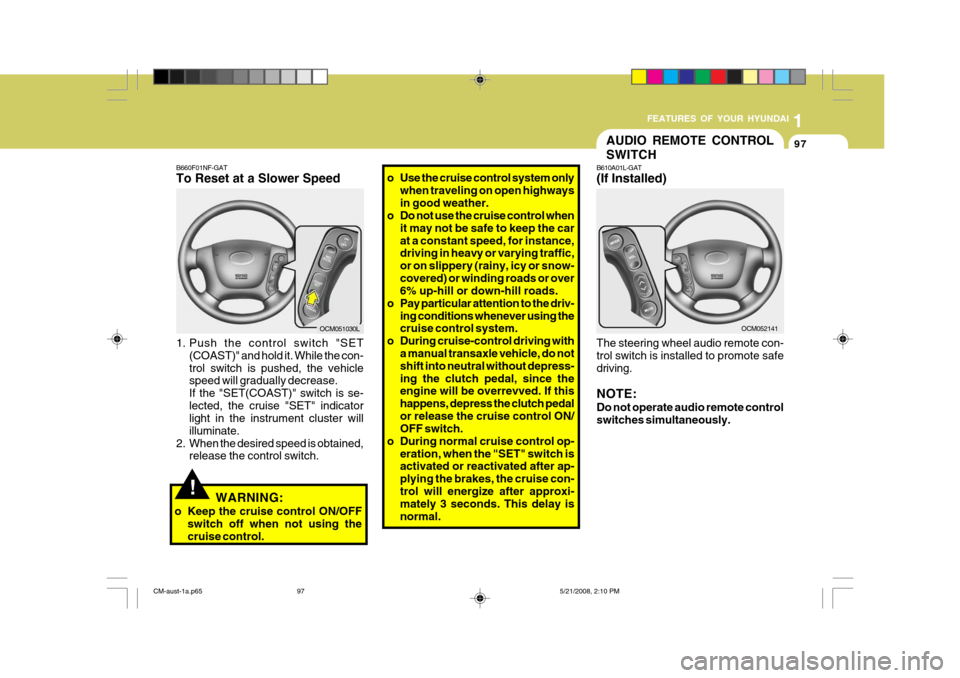
B660F01NF-GAT To Reset at a Slower Speed
1. Push the control switch "SET (COAST)" and hold it. While the con- trol switch is pushed, the vehicle speed will gradually decrease. If the "SET(COAST)" switch is se-lected, the cruise "SET" indicator light in the instrument cluster will illuminate.
2. When the desired speed is obtained, release the control switch.
OCM051030L
AUDIO REMOTE CONTROL SWITCH
B610A01L-GAT (If Installed) The steering wheel audio remote con- trol switch is installed to promote safedriving. NOTE: Do not operate audio remote control switches simultaneously. OCM052141
CM-aust-1a.p65
5/21/2008, 2:10 PM
97
Page 146 of 269
2
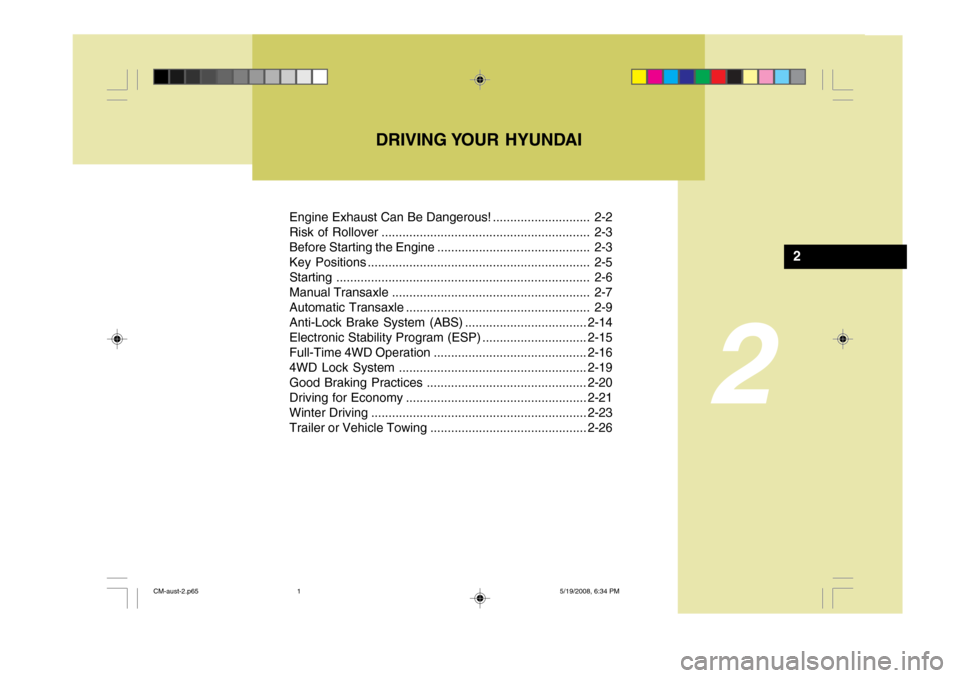
Engine Exhaust Can Be Dangerous! ............................ 2-2
Risk of Rollover ............................................................ 2-3
Before Starting the Engine ............................................ 2-3
Key Positions ................................................................ 2-5Starting ......................................................................... 2-6
Manual Transaxle ......................................................... 2-7
Automatic Transaxle ..................................................... 2-9Anti-Lock Brake System (ABS) ................................... 2-14
Electronic Stability Program (ESP) ..............................2-15
Full-Time 4WD Operation ............................................ 2-16
4WD Lock System ...................................................... 2-19
Good Braking Practices .............................................. 2-20
Driving for Economy .................................................... 2-21
Winter Driving .............................................................. 2-23
Trailer or Vehicle Towing ............................................. 2-26
DRIVING YOUR HYUNDAI
2
CM-aust-2.p65
5/19/2008, 6:34 PM
1
Page 148 of 269
2
DRIVING YOUR HYUNDAI
3
!
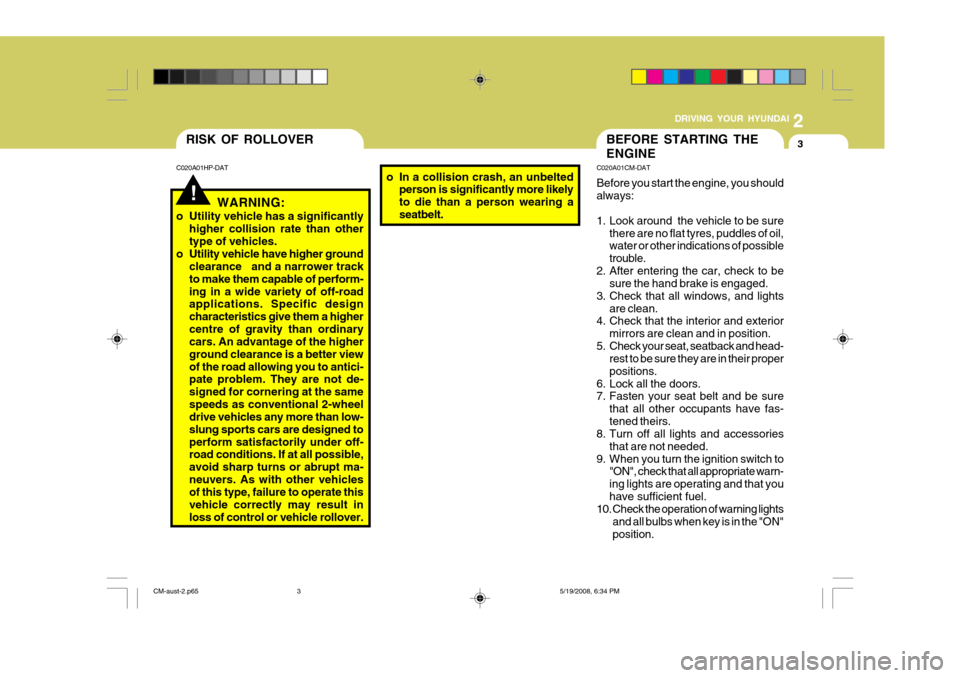
BEFORE STARTING THE ENGINE
C020A01CM-DAT Before you start the engine, you should always:
1. Look around the vehicle to be sure
there are no flat tyres, puddles of oil, water or other indications of possible trouble.
2. After entering the car, check to be sure the hand brake is engaged.
3. Check that all windows, and lights are clean.
4. Check that the interior and exterior
mirrors are clean and in position.
5. Check your seat, seatback and head- rest to be sure they are in their properpositions.
6. Lock all the doors.
7. Fasten your seat belt and be sure
that all other occupants have fas- tened theirs.
8. Turn off all lights and accessories
that are not needed.
9. When you turn the ignition switch to "ON", check that all appropriate warn-ing lights are operating and that youhave sufficient fuel.
10. Check the operation of warning lights
and all bulbs when key is in the "ON"position.
C020A01HP-DAT
o In a collision crash, an unbelted
person is significantly more likelyto die than a person wearing aseatbelt.
RISK OF ROLLOVER
WARNING:
o Utility vehicle has a significantly higher collision rate than othertype of vehicles.
o Utility vehicle have higher ground clearance and a narrower trackto make them capable of perform-ing in a wide variety of off-road applications. Specific design characteristics give them a highercentre of gravity than ordinary cars. An advantage of the higher ground clearance is a better viewof the road allowing you to antici- pate problem. They are not de- signed for cornering at the samespeeds as conventional 2-wheel drive vehicles any more than low- slung sports cars are designed toperform satisfactorily under off- road conditions. If at all possible, avoid sharp turns or abrupt ma-neuvers. As with other vehicles of this type, failure to operate this vehicle correctly may result inloss of control or vehicle rollover.
CM-aust-2.p65 5/19/2008, 6:34 PM
3
Page 149 of 269
2DRIVING YOUR HYUNDAI
4
!
TO START THE ENGINE
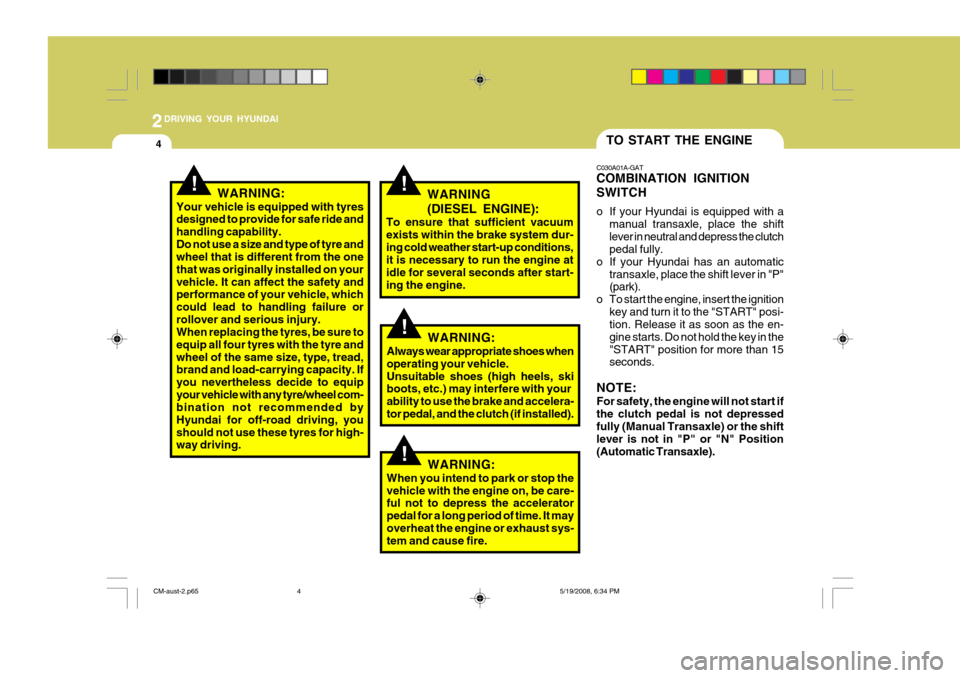
C030A01A-GAT COMBINATION IGNITION SWITCH
o If your Hyundai is equipped with a manual transaxle, place the shift lever in neutral and depress the clutch pedal fully.
o If your Hyundai has an automatic
transaxle, place the shift lever in "P"(park).
o To start the engine, insert the ignition key and turn it to the "START" posi-tion. Release it as soon as the en- gine starts. Do not hold the key in the"START" position for more than 15 seconds.
NOTE: For safety, the engine will not start if the clutch pedal is not depressed
fully (Manual Transaxle) or the shift lever is not in "P" or "N" Position(Automatic Transaxle).
WARNING:
Your vehicle is equipped with tyres designed to provide for safe ride and handling capability.Do not use a size and type of tyre and wheel that is different from the one that was originally installed on yourvehicle. It can affect the safety and performance of your vehicle, which could lead to handling failure orrollover and serious injury. When replacing the tyres, be sure to equip all four tyres with the tyre andwheel of the same size, type, tread, brand and load-carrying capacity. If you nevertheless decide to equipyour vehicle with any tyre/wheel com- bination not recommended by Hyundai for off-road driving, youshould not use these tyres for high- way driving.
!WARNING:
Always wear appropriate shoes when operating your vehicle.Unsuitable shoes (high heels, ski boots, etc.) may interfere with your ability to use the brake and accelera-tor pedal, and the clutch (if installed).
!WARNING (DIESEL ENGINE):
To ensure that sufficient vacuum exists within the brake system dur-ing cold weather start-up conditions, it is necessary to run the engine at idle for several seconds after start-ing the engine.
!WARNING:
When you intend to park or stop the vehicle with the engine on, be care- ful not to depress the accelerator pedal for a long period of time. It mayoverheat the engine or exhaust sys- tem and cause fire.
CM-aust-2.p65 5/19/2008, 6:34 PM
4
Page 153 of 269
2DRIVING YOUR HYUNDAI
8
C070D02O-AAT Good Driving Practices
o Never take the car out of gear andcoast down a hill. This is extremely hazardous. Always leave the car in gear.
o Don't "ride" the brakes. This can cause them to overheat and mal-function. Instead, when you are driv- ing down a long hill, slow down andshift to a lower gear. When you do this, engine braking will help slow the car.
o Slow down before shifting to a lower gear. This will help avoid over-rev-ving the engine, which can causedamage.
o Slow down when you encounter cross
winds. This gives you much bettercontrol of your car.
o Be sure the car is completely stopped
before you attempt to shift into re-verse. The transaxle can be dam- aged if you do not. To shift into reverse, depress the clutch, movethe shift lever to neutral, wait three seconds, then shift to the reverse position.
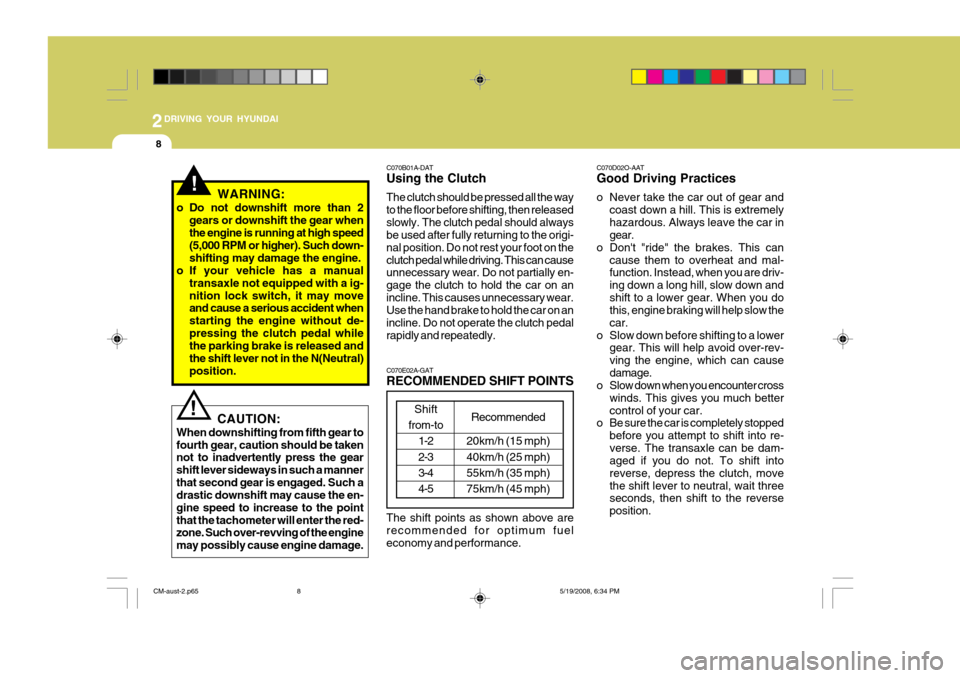
C070B01A-DAT Using the Clutch The clutch should be pressed all the way to the floor before shifting, then releasedslowly. The clutch pedal should always be used after fully returning to the origi- nal position. Do not rest your foot on theclutch pedal while driving. This can cause unnecessary wear. Do not partially en- gage the clutch to hold the car on anincline. This causes unnecessary wear. Use the hand brake to hold the car on an incline. Do not operate the clutch pedalrapidly and repeatedly. C070E02A-GAT RECOMMENDED SHIFT POINTS The shift points as shown above are recommended for optimum fuel economy and performance.
Shift
from-to 1-2 2-33-4 4-5
Recommended
20km/h (15 mph) 40km/h (25 mph)55km/h (35 mph) 75km/h (45 mph)
!WARNING:
o Do not downshift more than 2 gears or downshift the gear when the engine is running at high speed (5,000 RPM or higher). Such down-shifting may damage the engine.
o If your vehicle has a manual
transaxle not equipped with a ig-nition lock switch, it may move and cause a serious accident when starting the engine without de-pressing the clutch pedal while the parking brake is released and the shift lever not in the N(Neutral)position.
! CAUTION:
When downshifting from fifth gear to fourth gear, caution should be taken not to inadvertently press the gear shift lever sideways in such a mannerthat second gear is engaged. Such a drastic downshift may cause the en- gine speed to increase to the pointthat the tachometer will enter the red- zone. Such over-revving of the engine may possibly cause engine damage.
CM-aust-2.p65 5/19/2008, 6:34 PM
8