2009 Hyundai Getz jump start
[x] Cancel search: jump startPage 14 of 191
FEATURES OF YOUR HYUNDAI 1- 3
B020A01S-DAT RUNNING IN YOUR NEW HYUNDAIDuring the First 2,000 km No formal running in period is required with your new Hyundai. However, you can contribute to the economical op-eration and durability of your Hyundai by observing the following recommen- dations during the first 2,000 km.
o Don't drive faster than 88 km/h.
o While driving, keep your engine
speed or revolutions per minute between 2,000 and 4,000 rpm.
o Use moderate acceleration. Don't use full-throttle starts.
o For the first 300 km, try to avoid
hard braking.
o Don't labour the engine (in other words, don't drive so slowly in too high a gear that the engine jumps:shift to a lower gear).
o Whether going fast or slow, vary
your speed from time to time.
o Don't let the engine idle longer than 3 minutes.
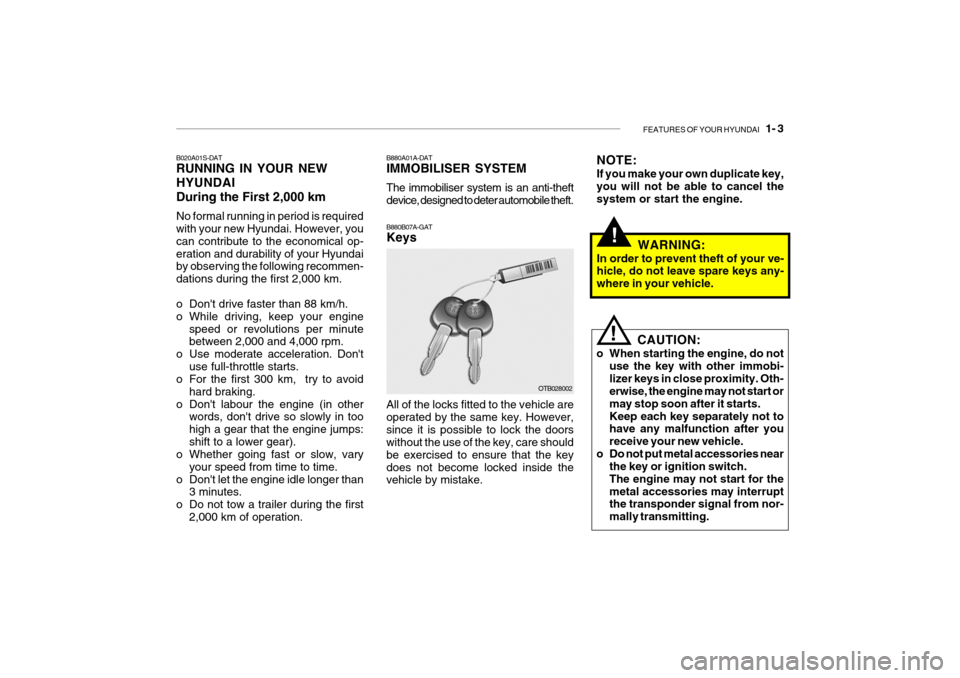
o Do not tow a trailer during the first 2,000 km of operation. B880A01A-DAT IMMOBILISER SYSTEM The immobiliser system is an anti-theft device, designed to deter automobile theft. B880B07A-GAT Keys
!
CAUTION:
o When starting the engine, do not use the key with other immobi- lizer keys in close proximity. Oth- erwise, the engine may not start or may stop soon after it starts.Keep each key separately not to have any malfunction after you receive your new vehicle.
o Do not put metal accessories near the key or ignition switch.The engine may not start for themetal accessories may interrupt the transponder signal from nor- mally transmitting.
OTB028002
All of the locks fitted to the vehicle are operated by the same key. However,since it is possible to lock the doors without the use of the key, care should be exercised to ensure that the keydoes not become locked inside the vehicle by mistake.
!WARNING:
In order to prevent theft of your ve- hicle, do not leave spare keys any- where in your vehicle.
NOTE: If you make your own duplicate key, you will not be able to cancel the system or start the engine.
Page 117 of 191

3. WHAT TO DO IN AN EMERGENCY
If the engine will not start .................................................................. 3-2
Jump starting .................................................................................... 3-3
If the engine overheats ..................................................................... 3-4
Spare tyre ........................................................................................ 3-5
Wheel and tyre changing .................................................................. 3-5
If your car must be towed ................................................................. 3-8Emergency towing......................................................................... 3-10
If you lose your keys ...................................................................... 3-10
3
Page 118 of 191
3- 2 WHAT TO DO IN AN EMERGENCY
HTB165
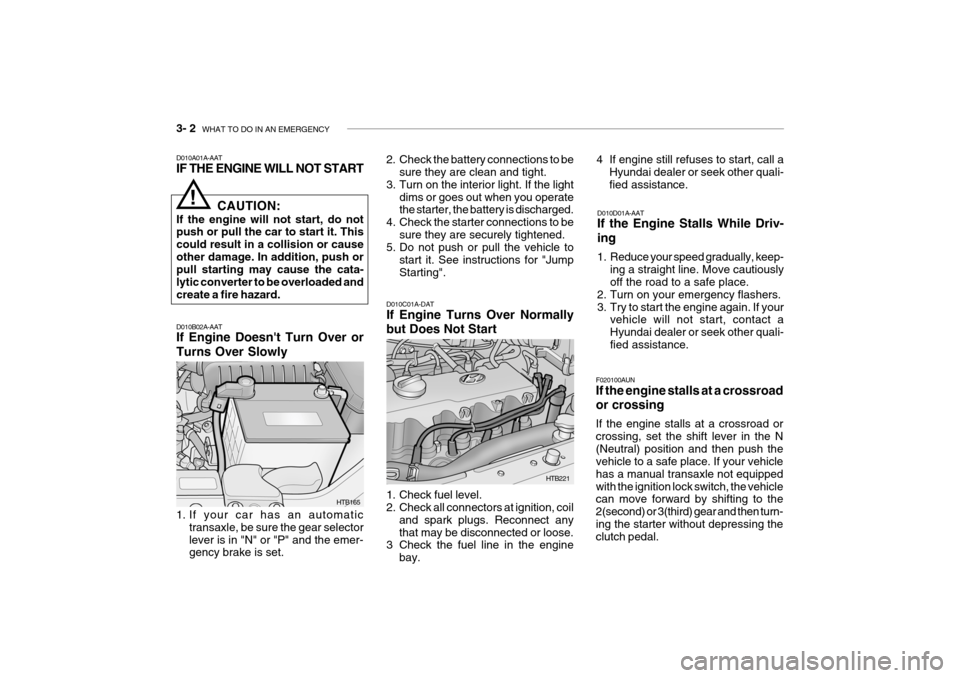
D010B02A-AAT If Engine Doesn't Turn Over or Turns Over Slowly 2. Check the battery connections to be
sure they are clean and tight.
3. Turn on the interior light. If the light dims or goes out when you operate the starter, the battery is discharged.
4. Check the starter connections to be sure they are securely tightened.
5. Do not push or pull the vehicle to
start it. See instructions for "Jump Starting".
D010C01A-DAT If Engine Turns Over Normally but Does Not Start 4 If engine still refuses to start, call a
Hyundai dealer or seek other quali- fied assistance.
D010D01A-AAT If the Engine Stalls While Driv- ing
1. Reduce your speed gradually, keep- ing a straight line. Move cautiously off the road to a safe place.
2. Turn on your emergency flashers.
3. Try to start the engine again. If your vehicle will not start, contact aHyundai dealer or seek other quali-fied assistance.
D010A01A-AAT IF THE ENGINE WILL NOT START
!
HTB221
CAUTION:
If the engine will not start, do not push or pull the car to start it. This could result in a collision or causeother damage. In addition, push or pull starting may cause the cata- lytic converter to be overloaded andcreate a fire hazard.
F020100AUN If the engine stalls at a crossroad or crossing If the engine stalls at a crossroad or crossing, set the shift lever in the N(Neutral) position and then push the vehicle to a safe place. If your vehicle has a manual transaxle not equippedwith the ignition lock switch, the vehicle can move forward by shifting to the 2(second) or 3(third) gear and then turn-ing the starter without depressing the clutch pedal.
1. If your car has an automatic
transaxle, be sure the gear selector lever is in "N" or "P" and the emer- gency brake is set. 1. Check fuel level.
2. Check all connectors at ignition, coil
and spark plugs. Reconnect any that may be disconnected or loose.
3 Check the fuel line in the engine
bay.
Page 119 of 191
WHAT TO DO IN AN EMERGENCY 3- 3
!
HTB218
Discharged battery
Booster battery
WARNING:
The gas produced by the battery during the jump-start operation is highly explosive. If these instruc- tions are not followed exactly, seri-ous personal injury and damage to the vehicle may occur! If you are not sure how to follow this proce-dure, seek qualified assistance. Automobile batteries contain sul- furic acid. This is poisonous andhighly corrosive. When jump start- ing, wear protective glasses and be careful not to get acid on yourself,your clothing or on the car. 3. Attach the clamps of the jumper
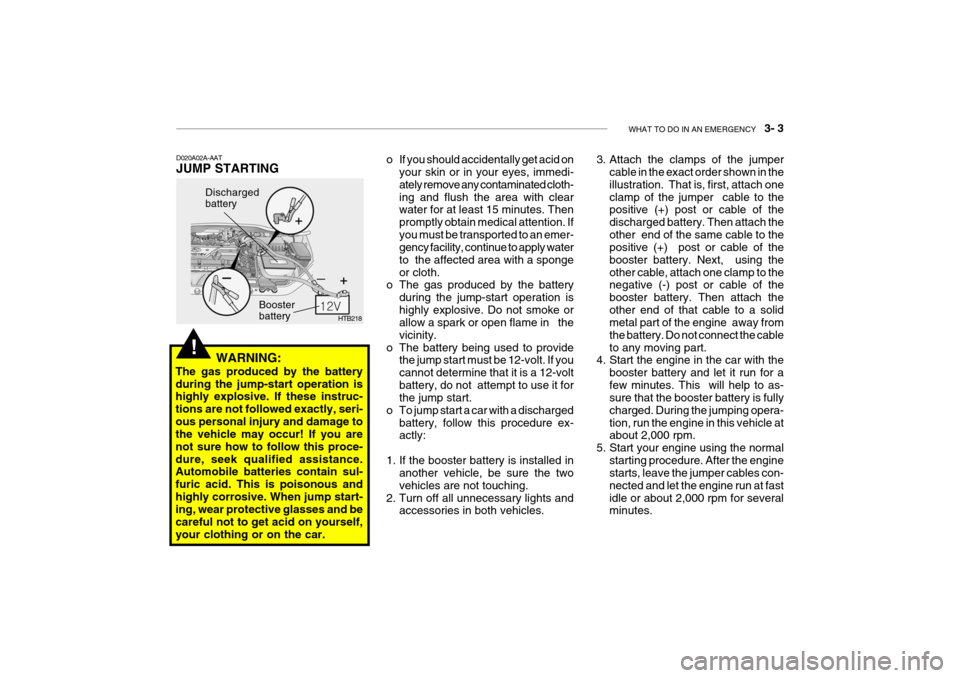
cable in the exact order shown in theillustration. That is, first, attach oneclamp of the jumper cable to the positive (+) post or cable of the discharged battery. Then attach theother end of the same cable to the positive (+) post or cable of the booster battery. Next, using theother cable, attach one clamp to the negative (-) post or cable of the booster battery. Then attach theother end of that cable to a solid metal part of the engine away from the battery. Do not connect the cableto any moving part.
4. Start the engine in the car with the
booster battery and let it run for afew minutes. This will help to as- sure that the booster battery is fully charged. During the jumping opera-tion, run the engine in this vehicle at about 2,000 rpm.
5. Start your engine using the normal starting procedure. After the enginestarts, leave the jumper cables con- nected and let the engine run at fastidle or about 2,000 rpm for several minutes.
D020A02A-AAT JUMP STARTING
o If you should accidentally get acid on
your skin or in your eyes, immedi- ately remove any contaminated cloth-ing and flush the area with clear water for at least 15 minutes. Then promptly obtain medical attention. Ifyou must be transported to an emer- gency facility, continue to apply water to the affected area with a spongeor cloth.
o The gas produced by the battery
during the jump-start operation ishighly explosive. Do not smoke or allow a spark or open flame in the vicinity.
o The battery being used to provide the jump start must be 12-volt. If youcannot determine that it is a 12-voltbattery, do not attempt to use it for the jump start.
o To jump start a car with a discharged battery, follow this procedure ex-actly:
1. If the booster battery is installed in another vehicle, be sure the two vehicles are not touching.
2. Turn off all unnecessary lights and accessories in both vehicles.
Page 190 of 191

10- 4 INDEX
High-Mounted Rear Stop Light.................................... 1-62
How to use luggage Room ......................................... 1-66
Horn ............................................................................ 1-69
I Ignition Switch ............................................................. 2-3
Immobilizer System ..................................................... 1-3
Instrument Cluster and Indicator Lights ...................... 1-35
Instrument Panel Light Control (Rheostat) .................. 1-52
Interior Light ................................................................ 1-57
Intermittent Wiper ....................................................... 1-49
JJump Starting .............................................................. 3-3
KKey If you lose y our keys .............................................. 3-10
Positions ................................................................... 2-3
L
Lubrication Chart .......................................................... 9-4
Luggage Board ............................................................ 1-67
Luggage Net ............................................................... 1-67
Luggage side trim ....................................................... 1-66M Maintenance Intervals
Explanation of scheduled maintenance items........................................................................ 5-7 ~ 5-9
Maintenance under severe usage conditions ............ 5-6
Scheduled maintenance ................................... 5-4 ~ 5-5
Service requirements ................................................ 5-2
Mirrors Outside rearview mirror heater .................................1-60
O
Odometer .................................................................... 1-41
Outside rearview Mirror............................................... 1-59
Outside rearview Mirror Heater................................... 1-60
P
Power Steering Fluid Level ......................................... 6-22
Power windows ........................................................... 1-11
RRear seat .................................................................... 1-15
Rear Seat F old Down ................................................. 1-16
Rear Window Demister Switch ................................... 1-50
Running in your New Hyundai ..................................... 1-3