2009 Hyundai Getz cooling
[x] Cancel search: coolingPage 12 of 191

1. FEATURES OF YOUR HYUNDAI
Fuel Recommendations ................................................................... 1-2
Running in Your New Hyundai ......................................................... 1-3
Immobiliser system .......................................................................... 1-3
Door locks ........................................................................................ 1-4Power windows.............................................................................. 1-11
Seat ................................................................................................ 1-11
Seat Belt ..... .................................................................................... 1-18
Child restraint system .................................................................... 1-23
Supplemental restraint (AIRBAG) system .....................................1-28
Instrument cluster and indicator lights ............................................1-35
Warning Light and Indicator ............................................................ 1-37
Trip computer ................................................................................. 1-44
Multi-Function Light Switch............................................................ 1-46
Windshield wiper/Washer Switch ...................................................1-48
Sunroof ........................................................................................... 1-54
Mirror ......... ..................................................................................... 1-58
Bonnet Release .............................................................................. 1-62
How to use luggage Room ............................................................. 1-66
Heating and cooling control ............................................................ 1-71
Stereo sound system ..................................................................... 1-80
Antenna .......................................................................................... 1-84
1
Page 82 of 191
FEATURES OF YOUR HYUNDAI 1- 71
B710A01TB-DAT
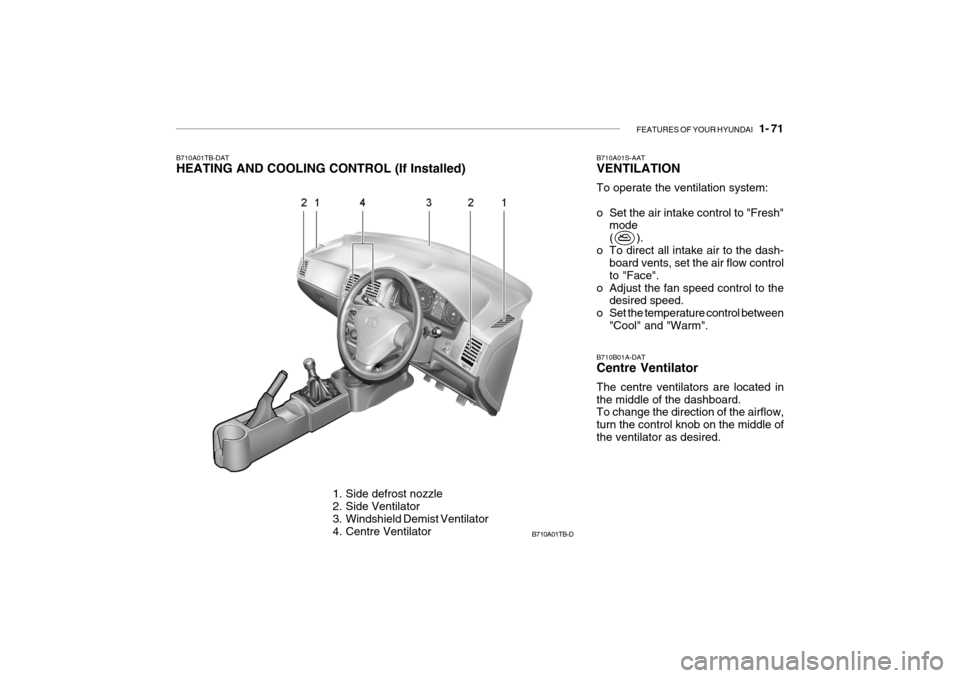
HEATING AND COOLING CONTROL (If Installed)
B710A01TB-D
1. Side defrost nozzle
2. Side Ventilator
3. Windshield Demist Ventilator
4. Centre Ventilator B710A01S-AAT VENTILATION To operate the ventilation system:
o Set the air intake control to "Fresh"
mode
( ).
o To direct all intake air to the dash- board vents, set the air flow controlto "Face".
o Adjust the fan speed control to the desired speed.
o Set the temperature control between "Cool" and "Warm".
B710B01A-DAT Centre Ventilator The centre ventilators are located in the middle of the dashboard. To change the direction of the airflow, turn the control knob on the middle ofthe ventilator as desired.
Page 88 of 191

FEATURES OF YOUR HYUNDAI 1- 77
B740A01A-AAT AIR CONDITIONING SWITCH (If Installed)
B730A01FC-GAT Operation Tips
o To keep dust or unpleasant fumes
from entering the car through the ventilation system, temporarily set the air intake control at "Recircula- tion". Be sure to return the control to"Fresh" when the irritation has passed to keep fresh air in the ve- hicle. This will help keep the driveralert and comfortable.
o Air for the heating/cooling system is
drawn in through the grilles justahead of the windshield. Care should be taken that these are not blocked by leaves, snow, ice or other ob-structions.
o To prevent interior fog on the wind-
shield, set the air intake control tothe fresh air ( ) position and fan speed to the desired position.
To remove the frost or exterior fog on the windshield:
o Set the air intake control to the fresh
( ) position.
o Set the air flow control to the defrost ( ) position
o Set the temperature control to warm.
o Set the fan speed control to position
"3" or "4".
NOTE: When the A/C is operated continu- ously on the floor-demist level ( ) or demist level ( ), it may cause fog to form on the exterior wind-shield. If this occurs, set the air flow control to the face level posi- tion ( ) and fan speed control tothe low position. The air conditioning is turned on by pushing the A/C button on the heating/ air conditioning control panel.
HTB037-D
Page 89 of 191
1- 78 FEATURES OF YOUR HYUNDAI
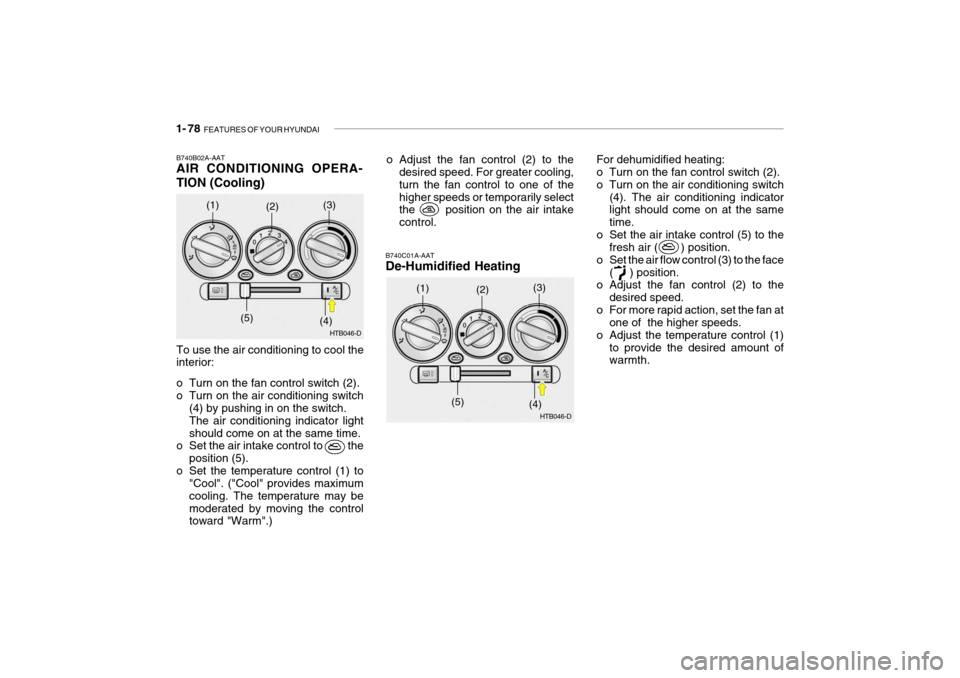
B740B02A-AAT AIR CONDITIONING OPERA- TION (Cooling)
B740C01A-AAT De-Humidified Heating
To use the air conditioning to cool the interior:
o Turn on the fan control switch (2).
o Turn on the air conditioning switch(4) by pushing in on the switch.The air conditioning indicator lightshould come on at the same time.
o Set the air intake control to the
position (5).
o Set the temperature control (1) to "Cool". ("Cool" provides maximumcooling. The temperature may bemoderated by moving the control toward "Warm".) HTB046-D
o Adjust the fan control (2) to the
desired speed. For greater cooling, turn the fan control to one of thehigher speeds or temporarily select
the position on the air intake control. For dehumidified heating:
o Turn on the fan control switch (2).
o Turn on the air conditioning switch
(4). The air conditioning indicator light should come on at the same time.
o Set the air intake control (5) to the fresh air ( ) position.
o Set the air flow control (3) to the face ( ) position.
o Adjust the fan control (2) to the
desired speed.
o For more rapid action, set the fan at one of the higher speeds.
o Adjust the temperature control (1)
to provide the desired amount of warmth.
(1)
(2)
(3)
(4)
(5)
HTB046-D
(1)
(2)
(3)
(4)
(5)
Page 111 of 191

2- 16 DRIVING YOUR HYUNDAI
C160G01A-GAT To Keep Locks from Freezing To keep the locks from freezing, squirt an approved de-icer fluid or glycerineinto the key opening. If a lock is cov- ered with ice, squirt it with an approved de-icing fluid to remove the ice. If thelock is frozen internally, you may be able to thaw it out by using a heated key. Handle the heated key with careto avoid burning your fingers. NOTE: The proper temperature for using the immobilizer key is from -40°C to80°C. If you heat the immobilizer key over 80°C to open a frozen lock, it may cause damage to the tran-sponder in its head.
C160F01A-AAT Check Spark Plugs and Ignition System Inspect your spark plugs as described in Section 6 and replace them if neces- sary. Also check all ignition wiring and components to be sure they are notcracked, worn or damaged in any way.
C160E01A-AAT Change to "Winter Weight" Oil if Necessary In some climates it is recommended that a lower viscosity "winter weight" oil be used during cold weather. SeeSection 9 for recommendations. If you aren't sure what weight oil you should use, consult your Hyundai dealer.
C160C01A-AAT
Use High Quality Ethylene Glycol Coolant Your Hyundai is delivered with high quality ethylene glycol coolant in the cooling system. It is the only type ofcoolant that should be used because it helps prevent corrosion in the cooling system, lubricates the water pump andprevents freezing. Be sure to replace or replenish your coolant in accor- dance with the maintenance schedulein Section 5. Before winter, have your coolant tested to assure that its freez- ing point is sufficient for the tempera-tures anticipated during the winter. C160D01A-DAT Check Battery and Cables Winter puts additional burdens on the battery and charging system. Visually inspect the battery and cables as de-scribed in Section 6. The level of charge in your battery can be checked by your Hyundai dealer or a service station.
Page 120 of 191
3- 4 WHAT TO DO IN AN EMERGENCY
!
!
WARNING:
Do not remove the radiator cap when the engine is hot. This can allow coolant to be blown out of the open- ing and cause serious burns.
6. If you cannot find the cause of the overheating, wait until the engine temperature has returned to nor- mal. Then, if the engine coolant has been lost, carefully remove the ra-diator cap and add engine coolant to bring the fluid level in the reservoir up to the halfway mark.
7. Proceed with caution, keeping alert for further signs of overheating. Ifoverheating happens again, call aHyundai dealer for assistance.
D030A01A-DAT IF THE ENGINE OVERHEATS If your temperature gauge indicates overheating, you experience a loss ofpower, or hear loud pinging or knock- ing, the engine is probably too hot. If this happens, you should:
1. Pull off the road and stop as soon as
it is safe to do so.
2. Place the gear selector lever in "P" (automatic), or neutral (manual transaxle) and set the hand brake. Ifthe air conditioning is on, turn it off.
6. Carefully remove the jumper cables
in the reverse order of attachment.
If you do not know why your battery became discharged (because the lights were left on, etc.), have the chargingsystem checked by your Hyundai dealer. 3. If coolant is running out under the car
or steam is coming out from the bonnet, stop the engine. Do notopen the bonnet until the coolant has stopped running or the steam- ing has stopped. If there is no visibleloss of coolant and no steam, leave the engine running and check to be sure the engine cooling fan is oper-ating. If the fan is not running, turn the engine off.
4. Check to see if the water pump drive belt is missing. If it is not missing,check to see that it is tight. If the drive belt seems to be satisfactory,check for engine coolant leaking from the radiator, hoses or under the car. (If the air conditioning hadbeen in use, it is normal for cold water to be draining from it when you stop).
WARNING:
While the engine is running, keephair, hands and clothing away frommoving parts such as the fan and drive belts to prevent injury. 5. If the water pump drive belt is broken
or engine coolant is leaking out, stop the engine immediately and call thenearest Hyundai dealer for assis- tance.
Page 121 of 191
WHAT TO DO IN AN EMERGENCY 3- 5
!
CAUTION:
Serious loss of coolant indicates there is a leak in the cooling system and this should be checked as soon as possible by a Hyundai dealer.
Tyre Size
Inflation Pressure
D040A01A-DAT SPARE TYRE For Full Size The following instructions for the FULL SIZE spare tyre should be observed: Check inflation pressure as soon as practical after installing the spare tyre, and adjust to the specified pressure. The tyre pressure should be periodi-cally checked and maintained at the specified pressure while the tyre is stored. Spare Tyre Pressure D040B01A-DAT Handling the Spare Tyre Release the securing bolt to remove the spare tyre. To install the spare tyre, tighten the bolt firmly with your fingers until the spare tyre is secured.
HTB154
Full Size
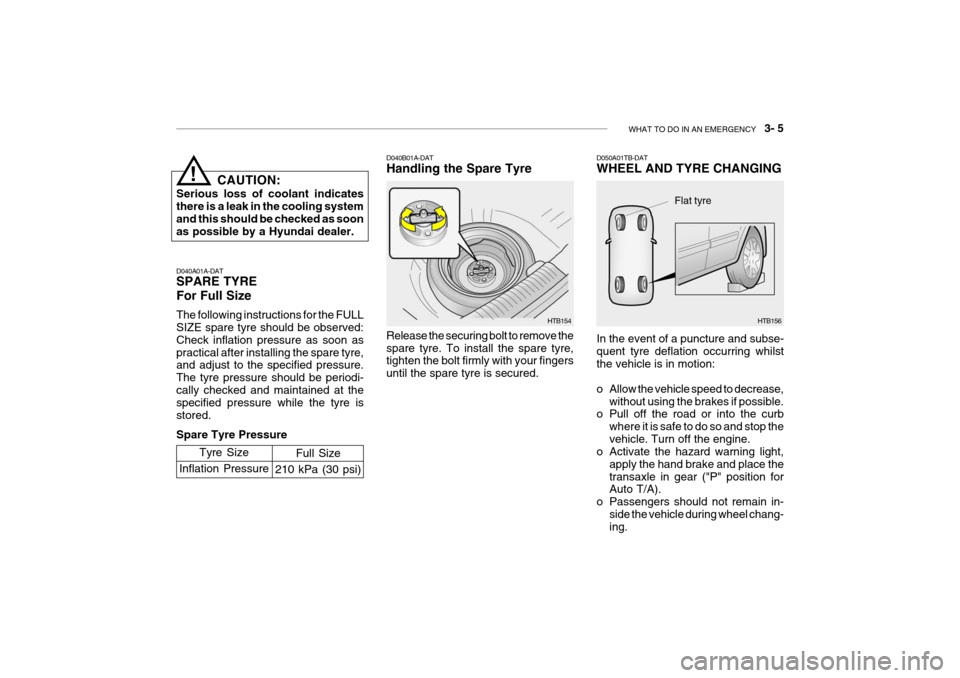
210 kPa (30 psi) D050A01TB-DAT WHEEL AND TYRE CHANGING In the event of a puncture and subse- quent tyre deflation occurring whilstthe vehicle is in motion:
o Allow the vehicle speed to decrease,
without using the brakes if possible.
o Pull off the road or into the curb
where it is safe to do so and stop the vehicle. Turn off the engine.
o Activate the hazard warning light,
apply the hand brake and place thetransaxle in gear ("P" position for Auto T/A).
o Passengers should not remain in-
side the vehicle during wheel chang-ing.
HTB156
Flat tyre
Page 138 of 191

VEHICLE MAINTENANCE REQUIREMENTS 5- 5
1 23456789
101112131415
Note : FOR THE FIRST TIME, REPLACE THE COOLANT AT 96,000 KM OR 60 MONTHS.
AFTER THAT, REPLACE IT EVERY 45,000 KM OR 24 MONTHS.
F030C06TB-DAT R : Replace I : Inspect and, after inspection, clean, adjust, repair or replace if necessary
GENERAL MAINTENANCE COOLING SYSTEMCOOLANTMANUAL TRANSAXLE OILAUTOMATIC TRANSAXLE FLUIDBRAKE HOSES AND LINESBRAKE FLUIDREAR BRAKE DRUMS/LININGS, PARKING BRAKEBRAKE PADS, CALIPERS AND ROTORSEXHAUST PIPE AND MUFFLERSUSPENSION MOUNTING BOLTSSTEERING GEAR BOX, LINKAGE & BOOTS/LOWER ARM BALL JOINTPOWER STEERING PUMP, BELT AND HOSESDRIVE SHAFTS AND BOOTSAIR CONDITIONING REFRIGERANT
AIR CONDITIONER FILTER (FOR EVAPORATOR AND BLOWER UNIT)
120
96
I I IIII I IIIII I
R
105
84
I I II I IIII I
R
90 72
75 60
6048
I I
R I II I IIIII I
R
I I I I I I I II I
R
II I IIIII I IIII
R
45 36
3024
I I II I IIII I
R
II IIII I IIII I I
R
15 12
I I II I IIII I
R
KILOMETERS X 1000 MONTHS
NO. DESCRIPTION
See Note