2009 Hyundai Getz coolant reservoir
[x] Cancel search: coolant reservoirPage 120 of 191
3- 4 WHAT TO DO IN AN EMERGENCY
!
!
WARNING:
Do not remove the radiator cap when the engine is hot. This can allow coolant to be blown out of the open- ing and cause serious burns.
6. If you cannot find the cause of the overheating, wait until the engine temperature has returned to nor- mal. Then, if the engine coolant has been lost, carefully remove the ra-diator cap and add engine coolant to bring the fluid level in the reservoir up to the halfway mark.
7. Proceed with caution, keeping alert for further signs of overheating. Ifoverheating happens again, call aHyundai dealer for assistance.
D030A01A-DAT IF THE ENGINE OVERHEATS If your temperature gauge indicates overheating, you experience a loss ofpower, or hear loud pinging or knock- ing, the engine is probably too hot. If this happens, you should:
1. Pull off the road and stop as soon as
it is safe to do so.
2. Place the gear selector lever in "P" (automatic), or neutral (manual transaxle) and set the hand brake. Ifthe air conditioning is on, turn it off.
6. Carefully remove the jumper cables
in the reverse order of attachment.
If you do not know why your battery became discharged (because the lights were left on, etc.), have the chargingsystem checked by your Hyundai dealer. 3. If coolant is running out under the car
or steam is coming out from the bonnet, stop the engine. Do notopen the bonnet until the coolant has stopped running or the steam- ing has stopped. If there is no visibleloss of coolant and no steam, leave the engine running and check to be sure the engine cooling fan is oper-ating. If the fan is not running, turn the engine off.
4. Check to see if the water pump drive belt is missing. If it is not missing,check to see that it is tight. If the drive belt seems to be satisfactory,check for engine coolant leaking from the radiator, hoses or under the car. (If the air conditioning hadbeen in use, it is normal for cold water to be draining from it when you stop).
WARNING:
While the engine is running, keephair, hands and clothing away frommoving parts such as the fan and drive belts to prevent injury. 5. If the water pump drive belt is broken
or engine coolant is leaking out, stop the engine immediately and call thenearest Hyundai dealer for assis- tance.
Page 141 of 191

5- 8 VEHICLE MAINTENANCE REQUIREMENTS
F070H01A-DAT
o Rear Brake Drums/Linings,
Hand Brake
Check the rear brake drums and lin- ings for scoring, burning, leaking fluid, broken parts, and excessive wear. Inspect the hand brake system in-cluding the hand brake lever and ca- bles. For detailed service procedures, refer to the Shop Manual.
F060H01A-AAT
o Air Cleaner Filter A Genuine Hyundai air cleaner filter is recommended when filter is replaced. F060J01A-AAT
o Spark Plugs Make sure to install new spark plugs of the correct heat range. F070C02A-AAT
o Coolant The coolant should be changed at the intervals specified in the mainte-nance schedule.
F070F01A-AAT
o Brake Hoses and Lines
Visually check for proper installation,chafing, cracks, deterioration and anyleakage. Replace any deteriorated or damaged parts immediately. F070G02A-AAT
o Brake Fluid
Check brake fluid level in the brake fluid reservoir. The level should be between "MIN" and "MAX" marks on the side of the reservoir. Use onlyhydraulic brake fluid conforming to DOT 3 or DOT 4.
F070E05A-DAT
o Automatic Transaxle Fluid
The fluid level should be in the "HOT" range of the dipstick, after the engine and transaxle are at normal operating temperature. Check the automatictransaxle fluid level with the engine running and the transaxle in neutral, with the hand brake properly applied.Use Hyundai Genuine ATF SP-III, DIA- MOND ATF SP-III, SK ATF SP-III or other brands appraoved by HyundaiMotor Co., when adding or changing fluid.
Page 143 of 191

6. Do-It-Yourself Maintenance
Engine compartment ........................................................................ 6-2
General checks ................................................................................ 6-3
Checking the engine oil .................................................................... 6-4
Checking the engine coolant ............................................................ 6-6
Changing the air cleaner filter ........................................................... 6-7
Filling the washer reservoir .............................................................. 6-9Checking the transaxle oil (manual)............................................... 6-10
Checking the transaxle fluid (Automatic)....................................... 6-11
Checking the brakes ...................................................................... 6-13
Air conditioning care ....................................................................... 6-14
Checking drive belts ...................................................................... 6-18
Checking and replacing fuses ........................................................ 6-18
Checking the battery ...................................................................... 6-20
Checking electric cooling fans ....................................................... 6-22
Power steering fluid level ............................................................... 6-22
Replacement of bulbs .................................................................... 6-24
Fuse panel description ................................................................... 6-30
6
Page 144 of 191
6- 2 DO-IT-YOURSELF MAINTENANCE
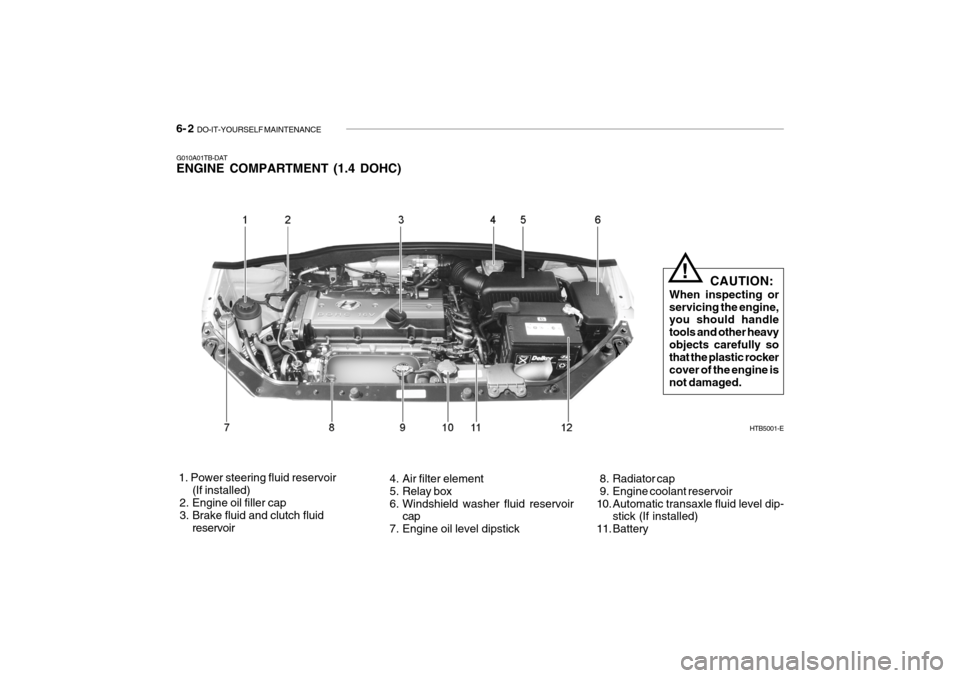
G010A01TB-DAT ENGINE COMPARTMENT (1.4 DOHC) 1. Power steering fluid reservoir
(If installed)
2. Engine oil filler cap
3. Brake fluid and clutch fluid
reservoir 4. Air filter element
5. Relay box
6. Windshield washer fluid reservoir
cap
7. Engine oil level dipstick 8. Radiator cap
9. Engine coolant reservoir
10. Automatic transaxle fluid level dip-
stick (If installed)
11. Battery HTB5001-E
CAUTION:
When inspecting or servicing the engine, you should handle tools and other heavyobjects carefully so that the plastic rocker cover of the engine isnot damaged.!
Page 149 of 191
DO-IT-YOURSELF MAINTENANCE 6- 7
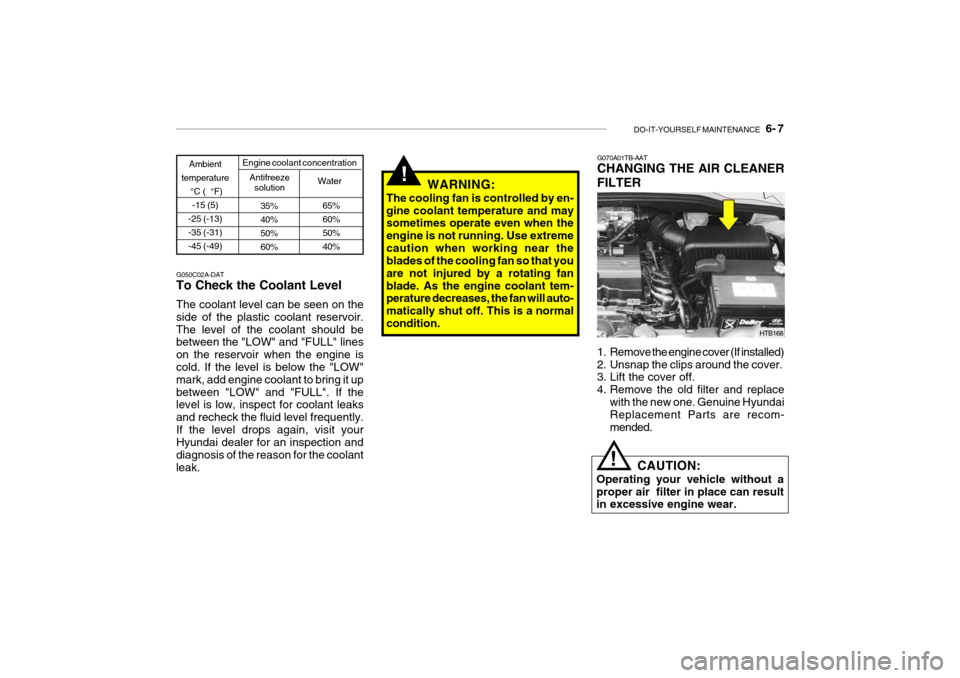
G050C02A-DAT To Check the Coolant Level The coolant level can be seen on the side of the plastic coolant reservoir.The level of the coolant should be between the "LOW" and "FULL" lines on the reservoir when the engine is cold. If the level is below the "LOW" mark, add engine coolant to bring it upbetween "LOW" and "FULL". If the level is low, inspect for coolant leaks and recheck the fluid level frequently.If the level drops again, visit your Hyundai dealer for an inspection and diagnosis of the reason for the coolantleak.
35% 40%50%60%
Ambient
temperature °C ( °F)-15 (5)
-25 (-13)-35 (-31)-45 (-49)
Antifreeze solution Water
Engine coolant concentration
65% 60%50%40%
!WARNING:
The cooling fan is controlled by en- gine coolant temperature and may sometimes operate even when the engine is not running. Use extremecaution when working near the blades of the cooling fan so that you are not injured by a rotating fanblade. As the engine coolant tem- perature decreases, the fan will auto- matically shut off. This is a normalcondition.
HTB168
G070A01TB-AAT CHANGING THE AIR CLEANER FILTER
1. Remove the engine cover (If installed)
2. Unsnap the clips around the cover.
3. Lift the cover off.
4. Remove the old filter and replace
with the new one. Genuine Hyundai Replacement Parts are recom- mended.
CAUTION:
Operating your vehicle without aproper air filter in place can result in excessive engine wear.
!
Page 164 of 191
6- 22 DO-IT-YOURSELF MAINTENANCE
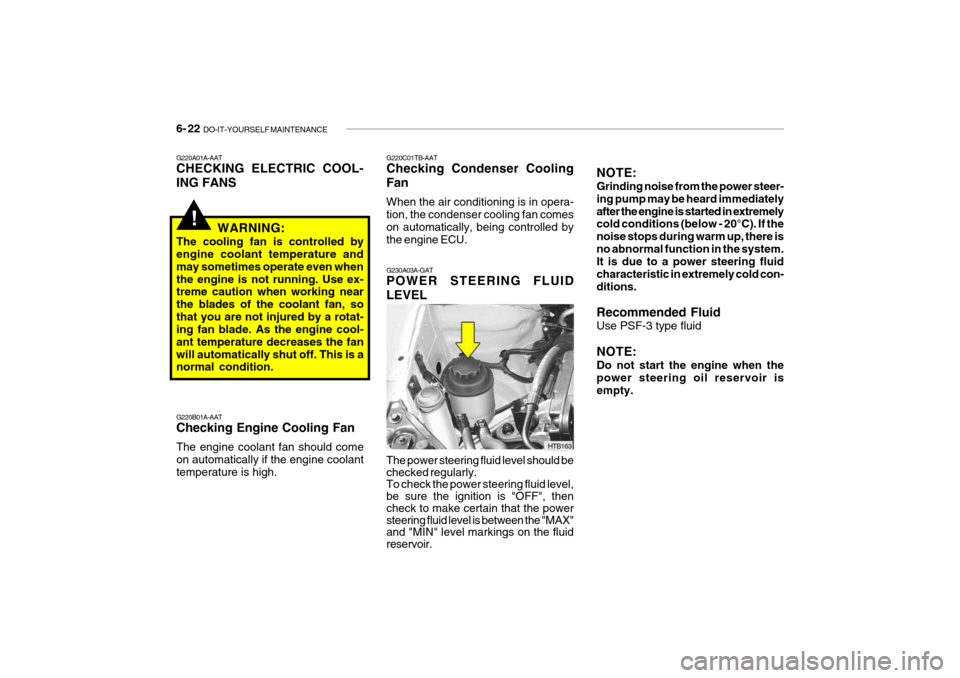
G230A03A-GAT POWER STEERING FLUID LEVEL The power steering fluid level should be checked regularly. To check the power steering fluid level, be sure the ignition is "OFF", then check to make certain that the power steering fluid level is between the "MAX" and "MIN" level markings on the fluid reservoir. HTB163NOTE: Grinding noise from the power steer- ing pump may be heard immediatelyafter the engine is started in extremely cold conditions (below - 20°C). If the noise stops during warm up, there isno abnormal function in the system. It is due to a power steering fluid characteristic in extremely cold con-ditions. Recommended Fluid Use PSF-3 type fluid NOTE: Do not start the engine when the power steering oil reservoir is empty.
!
G220A01A-AAT CHECKING ELECTRIC COOL- ING FANS
WARNING:
The cooling fan is controlled by engine coolant temperature and may sometimes operate even whenthe engine is not running. Use ex- treme caution when working near the blades of the coolant fan, sothat you are not injured by a rotat- ing fan blade. As the engine cool- ant temperature decreases the fanwill automatically shut off. This is a normal condition. G220B01A-AAT Checking Engine Cooling Fan The engine coolant fan should come on automatically if the engine coolanttemperature is high. G220C01TB-AAT Checking Condenser Cooling Fan When the air conditioning is in opera- tion, the condenser cooling fan comes on automatically, being controlled by
the engine ECU.