Page 5 of 308
15
Introduction
Biodiesel
Commercially supplied biodiesel blends of no more than 5% biodiesel, commonly
known as "B5 biodiesel" may be used in
your vehicle if it meets EN 14214 or
equivalent specifications. (EN stands for
"European Norm"). The use of biofuels
made from rapeseed methyl ester
(RME), fatty acid methyl ester (FAME),
vegetable oil methyl ester (VME) etc. ormixing diesel with biodiesel will cause
increased wear or damage to the engine
and fuel system. Repair or replacement
of worn or damaged components due to
the use of non approved fuels will not be
covered by the manufactures warranty.No special run-in period is needed. By
following a few simple precautions for the
first 1,000 km you may add to the per-
formance, economy and life of your vehi-
cle.
Do not race the engine.
While driving, keep your engine speed
or revolutions per minute between
2,000 rpm and 4,000 rpm.
Do not maintain a single speed for long
periods of time, either fast or slow.
Varying engine speed is needed to
properly run-in the engine.
Avoid hard stops, except in emergen- cies, to allow the brakes to seat prop-
erly.
Don't let the engine idle longer than 3
minutes at one time.
Don't tow a trailer during the first 2,000 km of operation.CAUTION
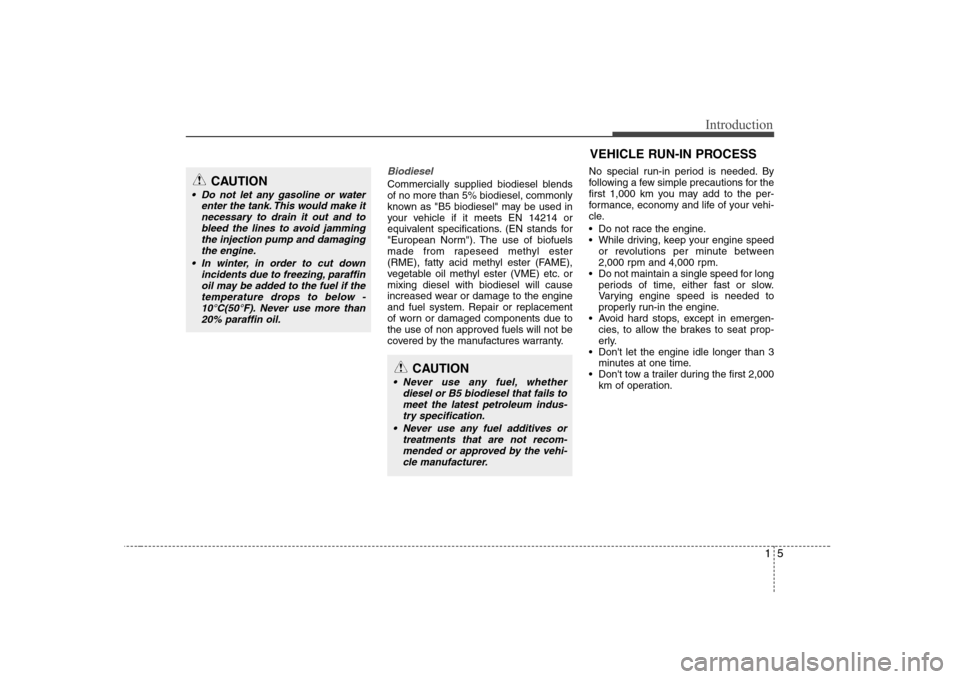
Do not let any gasoline or water
enter the tank. This would make itnecessary to drain it out and tobleed the lines to avoid jamming
the injection pump and damagingthe engine.
In winter, in order to cut down incidents due to freezing, paraffinoil may be added to the fuel if the
temperature drops to below -10°C(50°F). Never use more than20% paraffin oil.
CAUTION
Never use any fuel, whether diesel or B5 biodiesel that fails tomeet the latest petroleum indus-
try specification.
Never use any fuel additives or treatments that are not recom-mended or approved by the vehi-cle manufacturer.
VEHICLE RUN-IN PROCESS
Page 98 of 308
443
Features of your vehicle
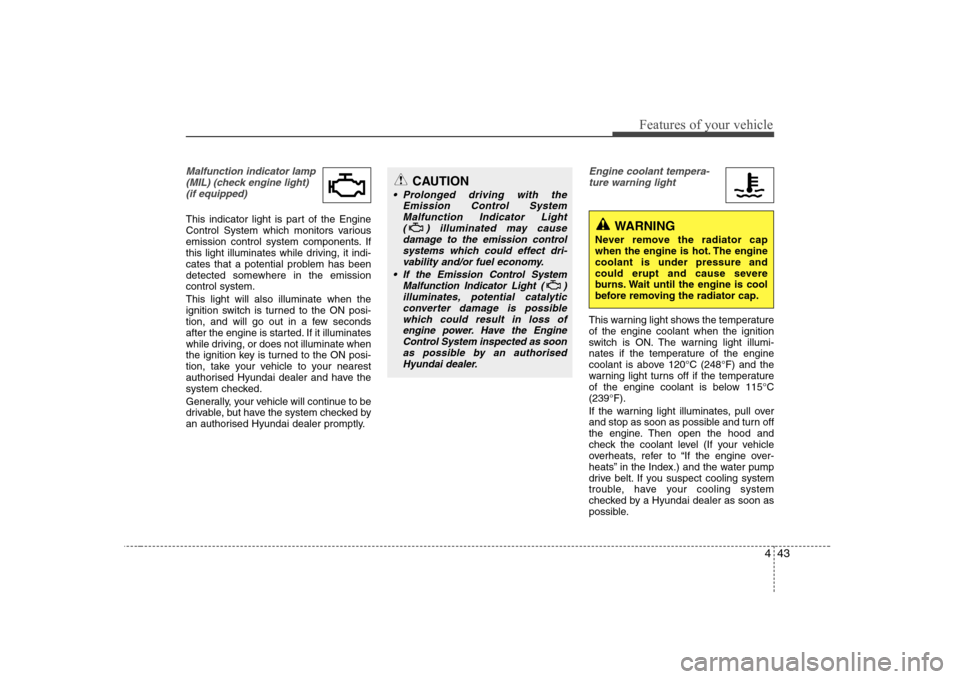
Malfunction indicator lamp(MIL) (check engine light) (if equipped)
This indicator light is part of the Engine
Control System which monitors various
emission control system components. If
this light illuminates while driving, it indi-
cates that a potential problem has been
detected somewhere in the emissioncontrol system. This light will also illuminate when the
ignition switch is turned to the ON posi-
tion, and will go out in a few seconds
after the engine is started. If it illuminates
while driving, or does not illuminate when
the ignition key is turned to the ON posi-
tion, take your vehicle to your nearest
authorised Hyundai dealer and have the
system checked.
Generally, your vehicle will continue to be
drivable, but have the system checked by
an authorised Hyundai dealer promptly.
Engine coolant tempera-ture warning light
This warning light shows the temperature of the engine coolant when the ignition
switch is ON. The warning light illumi-
nates if the temperature of the engine
coolant is above 120°C (248°F) and the
warning light turns off if the temperature
of the engine coolant is below 115°C(239°F).
If the warning light illuminates, pull over
and stop as soon as possible and turn off
the engine. Then open the hood and
check the coolant level (If your vehicle
overheats, refer to “If the engine over-
heats” in the Index.) and the water pump
drive belt. If you suspect cooling system
trouble, have your cooling system
checked by a Hyundai dealer as soon as
possible.
CAUTION
Prolonged driving with the
Emission Control SystemMalfunction Indicator Light ( ) illuminated may cause
damage to the emission controlsystems which could effect dri- vability and/or fuel economy.
If the EmissionControl System
Malfunction Indicator Light ( ) illuminates, potential catalytic converter damage is possiblewhich could result in loss of
engine power. Have the EngineControl System inspected as soonas possible by an authorised
Hyundai dealer.
WARNING
Never remove the radiator cap
when the engine is hot. The enginecoolant is under pressure and
could erupt and cause severe
burns. Wait until the engine is cool
before removing the radiator cap.
Page 233 of 308
Maintenance
8
7
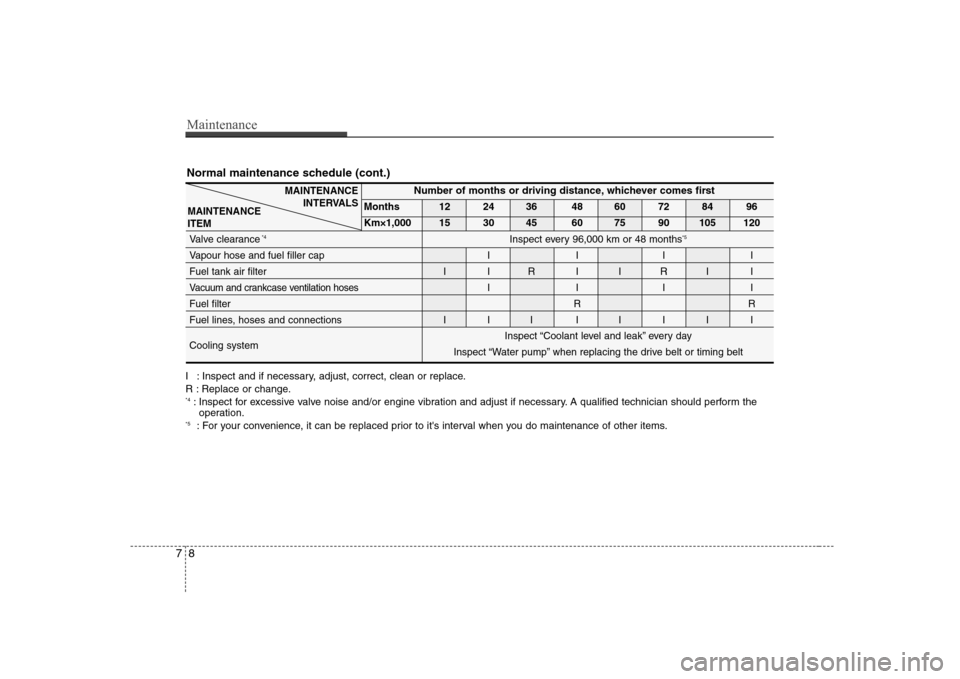
Normal maintenance schedule (cont.)
MAINTENANCE
INTERVALSNumber of months or driving distance, whichever comes first
Months 12 24 36 48 60 72 84 96
Km×1,000 15 30 45 60 75 90 105 120
Valve clearance *4
Vapour hose and fuel filler cap
I I I I
Fuel tank air filter I I R I I R I I
Vacuum and crankcase ventilation hosesIIII
Fuel filter
RR
Fuel lines, hoses and connections I I I I I I I I Cooling system Inspect every 96,000 km or 48 months
*5
Inspect “Coolant level and leak” every day
Inspect “Water pump” when replacing the drive belt or timing belt
I : Inspect and if necessary, adjust, correct, clean or replace.
R : Replace or change. *4 : Inspect for excessive valve noise and/or engine vibration and adjust if necessary. A qualified technician should perform the
operation.
*5 : For your convenience, it can be replaced prior to it's interval when you do maintenance of other items.
MAINTENANCE ITEM
Page 273 of 308
Maintenance
48
7
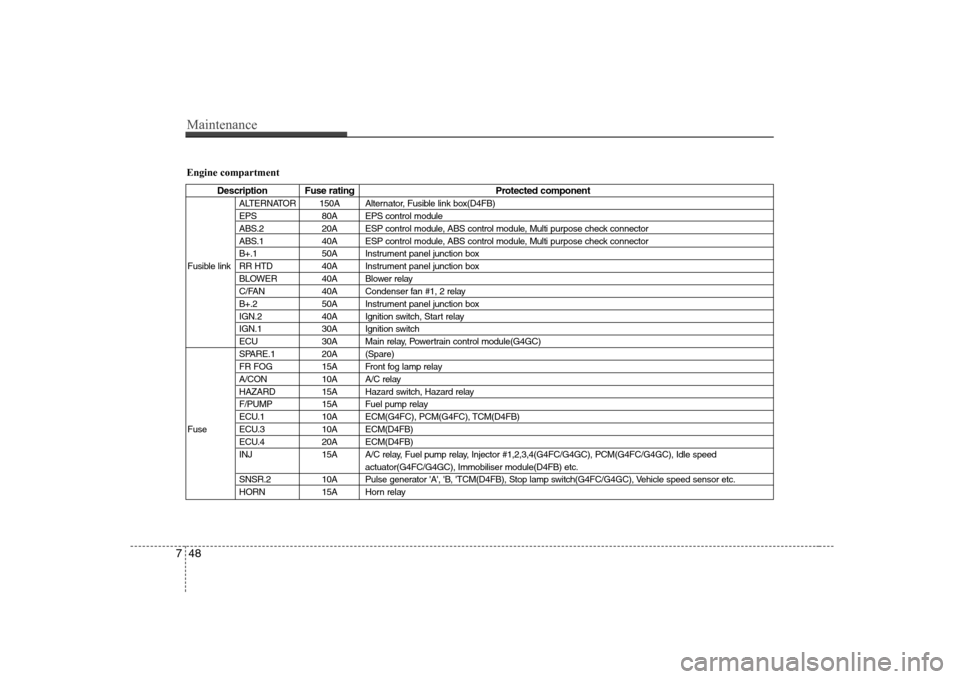
Engine compartment
Description Fuse rating Protected component
ALTERNATOR 150A Alternator, Fusible link box(D4FB)
EPS 80A EPS control module
ABS.2 20A ESP control module, ABS control module, Multi purpose check connector
ABS.1 40A ESP control module, ABS control module, Multi purpose check connector
B+.1 50A Instrument panel junction box
Fusible link RR HTD 40A Instrument panel junction box BLOWER 40A Blower relay
C/FAN 40A Condenser fan #1, 2 relay
B+.2 50A Instrument panel junction box
IGN.2 40A Ignition switch, Start relay
IGN.1 30A Ignition switch
ECU 30A Main relay, Powertrain control module(G4GC)
SPARE.1 20A (Spare)
FR FOG 15A Front fog lamp relay
A/CON 10A A/C relay
HAZARD 15A Hazard switch, Hazard relay
F/PUMP 15A Fuel pump relay
ECU.1 10A ECM(G4FC), PCM(G4FC), TCM(D4FB)
Fuse ECU.3 10A ECM(D4FB) ECU.4 20A ECM(D4FB)
INJ 15A A/C relay, Fuel pump relay, Injector #1,2,3,4(G4FC/G4GC), PCM(G4FC/G4GC), Idle speed actuator(G4FC/G4GC), Immobiliser module(D4FB) etc.
SNSR.2 10A Pulse generator 'A', 'B, 'TCM(D4FB), Stop lamp switch(G4FC/G4GC), Vehicle speed sensor etc.
HORN 15A Horn relay