2009 Hyundai Elantra warning
[x] Cancel search: warningPage 258 of 308
733
Maintenance
WARNING - Tyre inflation
Overinflation or underinflation can
reduce tyre life, adversely affect
vehicle handling, and lead to sud-
den tyre failure. This could result in
loss of vehicle control and potential
injury.
CAUTION - Tyre pressure
Always observe the following:
Check tyre pressure when the tyres are cold. (After vehicle hasbeen parked for at least threehours or hasn't been driven more
than 1.6 km (one mile) since start- up.)
Check the pressure of your spare tyre each time you check thepressure of other tyres.
Never overload your vehicle. Be careful not to overload a vehicleluggage rack if your vehicle is equipped with one.
Worn, old tyres can cause acci- dents. If your tread is badly worn,or if your tyres have been dam- aged, replace them.
CAUTION
Underinflation also results in
excessive wear, poor handlingand reduced fuel economy. Wheeldeformation also is possible.
Keep your tyre pressures at theproper levels. If a tyre frequentlyneeds refilling, have it checked byan authorised Hyundai dealer.
Overinflation produces a harsh ride, excessive wear at the centreof the tyre tread, and a greaterpossibility of damage from road
hazards.
CAUTION
Warm tyres normally exceed rec- ommended cold tyre pressuresby 28 to 41 kPa (4 to 6 psi). Do notrelease air from warm tyres to
adjust the pressure or the tyres will be underinflated.
Be sure to reinstall the tyre infla- tion valve caps. Without the valvecap, dirt or moisture could get
into the valve core and cause air leakage. If a valve cap is missing,install a new one as soon as pos-
sible.
Page 260 of 308
735
Maintenance
Disc brake pads should be inspected forwear whenever tyres are rotated.
✽✽NOTICE
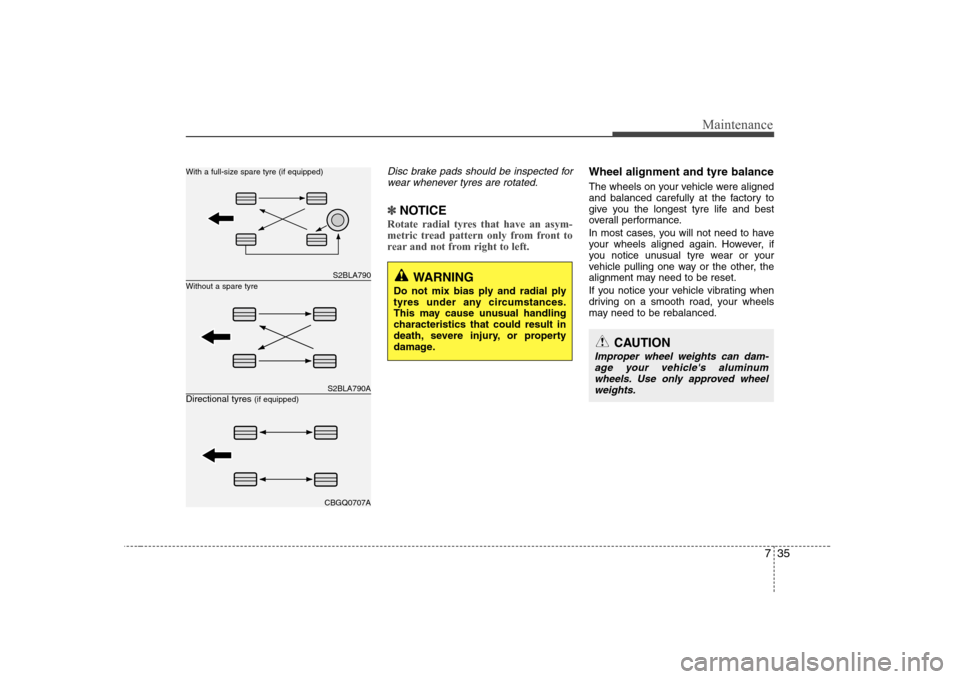
Rotate radial tyres that have an asym-
metric tread pattern only from front to
rear and not from right to left.
Wheel alignment and tyre balance
The wheels on your vehicle were aligned
and balanced carefully at the factory to
give you the longest tyre life and best
overall performance.
In most cases, you will not need to have
your wheels aligned again. However, if
you notice unusual tyre wear or your
vehicle pulling one way or the other, the
alignment may need to be reset.
If you notice your vehicle vibrating when
driving on a smooth road, your wheels
may need to be rebalanced.
WARNING
Do not mix bias ply and radial ply
tyres under any circumstances.
This may cause unusual handling
characteristics that could result in
death, severe injury, or property
damage.S2BLA790
S2BLA790A
CBGQ0707A
Without a spare tyre
With a full-size spare tyre (if equipped) Directional tyres
(if equipped)
CAUTION
Improper wheel weights can dam-
age your vehicle's aluminumwheels. Use only approved wheel
weights.
Page 261 of 308
Maintenance
36
7
Tyre replacement
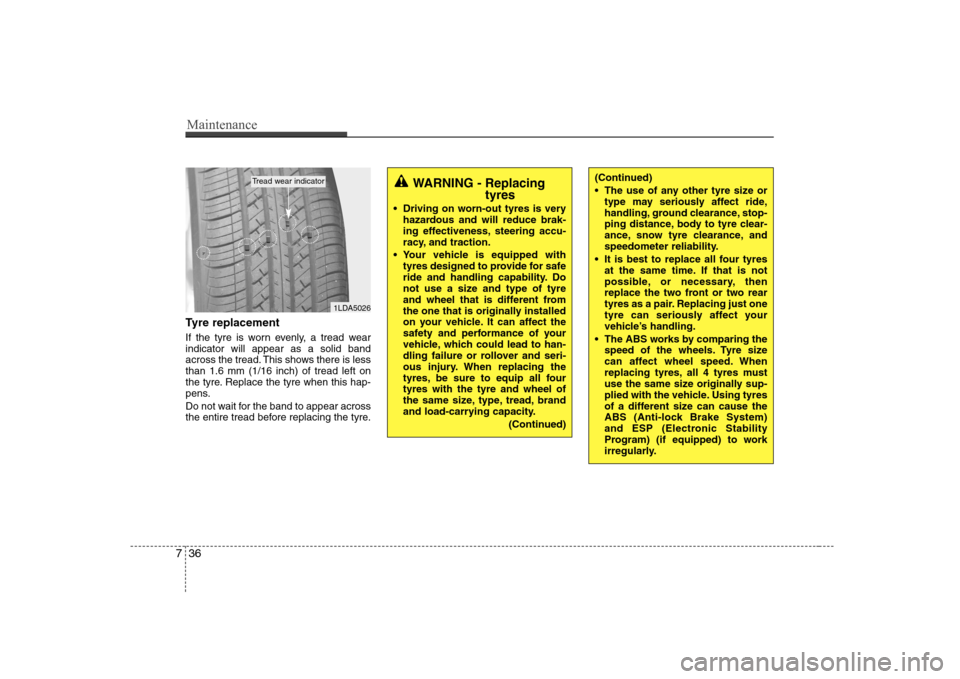
If the tyre is worn evenly, a tread wear indicator will appear as a solid band
across the tread. This shows there is lessthan 1.6 mm (1/16 inch) of tread left on
the tyre. Replace the tyre when this hap-
pens.
Do not wait for the band to appear across
the entire tread before replacing the tyre.
WARNING - Replacing
tyres
Driving on worn-out tyres is very hazardous and will reduce brak-
ing effectiveness, steering accu-
racy, and traction.
Your vehicle is equipped with tyres designed to provide for safe
ride and handling capability. Do
not use a size and type of tyre
and wheel that is different from
the one that is originally installed
on your vehicle. It can affect the
safety and performance of your
vehicle, which could lead to han-
dling failure or rollover and seri-
ous injury. When replacing the
tyres, be sure to equip all fourtyres with the tyre and wheel of
the same size, type, tread, brand
and load-carrying capacity.
(Continued)
1LDA5026
Tread wear indicator(Continued)
The use of any other tyre size ortype may seriously affect ride,
handling, ground clearance, stop-
ping distance, body to tyre clear-
ance, snow tyre clearance, and
speedometer reliability.
It is best to replace all four tyres at the same time. If that is not
possible, or necessary, then
replace the two front or two rear
tyres as a pair. Replacing just one
tyre can seriously affect your
vehicle’s handling.
The ABS works by comparing the speed of the wheels. Tyre size
can affect wheel speed. When
replacing tyres, all 4 tyres must
use the same size originally sup-
plied with the vehicle. Using tyres
of a different size can cause the
ABS (Anti-lock Brake System)
and ESP (Electronic Stability
Program) (if equipped) to work
irregularly.
Page 262 of 308
737
Maintenance
Compact spare tire replacement (if equipped)
A compact spare tire has a shorter tread
life than a regular size tire. Replace it
when you can see the tread wear indica-
tor bars on the tire. The replacementcompact spare tire should be the same
size and design tire as the one provided
with your new vehicle and should bemounted on the same compact spare tire
wheel. The compact spare tire is notdesigned to be mounted on a regular
size wheel, and the compact spare tire
wheel is not designed for mounting a reg-
ular size tire. Wheel replacement
When replacing the metal wheels for any
reason, make sure the new wheels are
equivalent to the original factory units in
diameter, rim width and offset. Tyre traction
Tyre traction can be reduced if you drive
on worn tyres, tyres that are improperly
inflated or on slippery road surfaces.
Tyres should be replaced when tread
wear indicators appear. To reduce the
possibility of losing control, slow down
whenever there is rain, snow or ice onthe road.
Tyre maintenance In addition to proper inflation, correct wheel alignment helps to decrease tyre
wear. If you find a tyre is worn unevenly,
have your dealer check the wheel align-ment.
When you have new tyres installed,
make sure they are balanced. This will
increase vehicle ride comfort and tyre
life. Additionally, a tyre should always be
rebalanced if it is removed from thewheel.
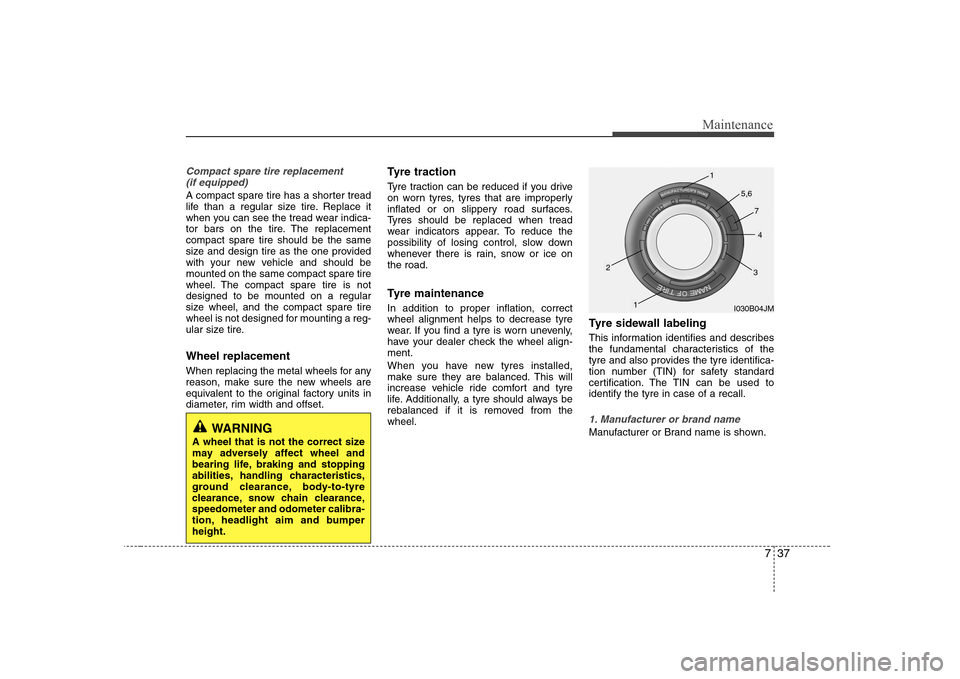
Tyre sidewall labeling
This information identifies and describes
the fundamental characteristics of the
tyre and also provides the tyre identifica-
tion number (TIN) for safety standard
certification. The TIN can be used toidentify the tyre in case of a recall.
1. Manufacturer or brand name
Manufacturer or Brand name is shown.WARNING
A wheel that is not the correct size
may adversely affect wheel and
bearing life, braking and stopping
abilities, handling characteristics,
ground clearance, body-to-tyre
clearance, snow chain clearance,speedometer and odometer calibra-
tion, headlight aim and bumperheight.
I030B04JM
1
1
23
4
5,6
7
Page 264 of 308
739
Maintenance
3. Checking tyre life (TIN : TyreIdentification Number)
Any tyres that are over 6 years, based on
the manufacturing date, tyre strength and
performance, decline with age naturally
(even unused spare tyres). Therefore, thetyres (including the spare tyre) should be
replaced by new ones. You can find the
manufacturing date on the tyre sidewall
(possibly on the inside of the wheel), dis-
playing the DOT Code. The DOT Code is
a series of numbers on a tyre consisting
of numbers and English letters. The
manufacturing date is designated by the
last four digits (characters) of the DOT
code.
DOT : XXXX XXXX OOOO
The front part of the DOT means a plant
code number, tyre size and tread pattern
and the last four numbers indicate week
and year manufactured.
For example:
DOT XXXX XXXX 1606 represents that
the tyre was produced in the 16th weekof 2006.
4. Tyre ply composition and material
The number of layers or plies of rubber-
coated fabric are in the tyre. Tyre manu-
facturers also must indicate the materials
in the tyre, which include steel, nylon,
polyester, and others. The letter "R"
means radial ply construction; the letter
"D" means diagonal or bias ply construc-
tion; and the letter "B" means belted-bias
ply construction.
5. Maximum permissible inflationpressure
This number is the greatest amount of air
pressure that should be put in the tyre.
Do not exceed the maximum permissible
inflation pressure. Refer to the Tyre and
Loading Information label for recom-
mended inflation pressure.
6. Maximum load rating
This number indicates the maximum load
in kilograms and pounds that can be car-
ried by the tyre. When replacing the tyres
on the vehicle, always use a tyre that has
the same load rating as the factory
installed tyre.
WARNING - Tyre age
Tyres degrade over time, even
when they are not being used.
Regardless of the remaining tread,it is recommended that tyres tread,
It is recommended that tyres gener-
ally be replaced after 6 years of nor-
mal service. Heat caused by not cli-mates or frequent high loadingConditions can accelerate the
aging process. Failure to follow this
Warning can result in sudden tyre
failure, which could lead to a loss
of control and an accident involving
serious injury or death.
Page 265 of 308
Maintenance
40
7
7. Uniform tyre quality grading
Quality grades can be found where
applicable on the tyre sidewall
between tread shoulder and maxi-
mum section width.
For example:
TREADWEAR 200
TRACTION AA
TEMPERATURE A
Tread wear
The tread wear grade is a comparative
rating based on the wear rate of the tyrewhen tested under controlled conditions
on a specified government test course.
For example, a tyre graded 150 would
wear one-and-a-half times as well on the
government course as a tyre graded 100.
The relative performance of tyres depends upon the actual conditions of
their use. However, performance may dif-
fer from the norm because of variations
in driving habits, service practices and
differences in road characteristics and
climate.
These grades are moulded on the side-
walls of passenger vehicle tyres. The
tyres available as standard or optional
equipment on your vehicles may vary
with respect to grade. Traction - AA, A, B & C
The traction grades, from highest to low-
est, are AA, A, B and C. The grades rep-
resent the tyres ability to stop on wet
pavement as measured under controlled
conditions on specified government test
surfaces of asphalt and concrete. A tyre
marked C may have poor traction per-
formance.
Temperature -A, B & C
The temperature grades are A (the high-
est), B and C. The grades represent the
tyre’s resistance to the generation of heatand its ability to dissipate heat when test-ed under controlled conditions on a spec-
ified indoor laboratory test wheel.
Sustained high temperature can cause
the material of the tyre to degenerate and
reduce tyre life, and excessive tempera-
ture can lead to sudden tyre failure.
Grades A and B represent higher levels
of performance on the laboratory test
wheel than the minimum required by the
law.WARNING - Tyre
temperature
The temperature grade for this tyre
is established for a tyre that is
properly inflated and not over-
loaded. Excessive speed, underin-
flation, or excessive loading, either
separately or in combination, can
cause heat build-up and possible
sudden tyre failure. This can cause
loss of vehicle control and serious
injury or death.
Page 266 of 308
741
Maintenance
FUSES
A vehicle’s electrical system is protected
from electrical overload damage by
fuses. This vehicle has 2 (or 3) fuse panels, one
located in the driver’s side panel bolster,
the other in the engine compartment
near the battery.
If any of your vehicle’s lights, acces-
sories, or controls do not work, check the
appropriate circuit fuse. If a fuse has
blown, the element inside the fuse will bemelted.
If the electrical system does not work,
first check the driver’s side fuse panel.
Always replace a blown fuse with one of
the same rating.
If the replacement fuse blows, this indi-
cates an electrical problem. Avoid using
the system involved and immediately
consult an authorised Hyundai dealer.
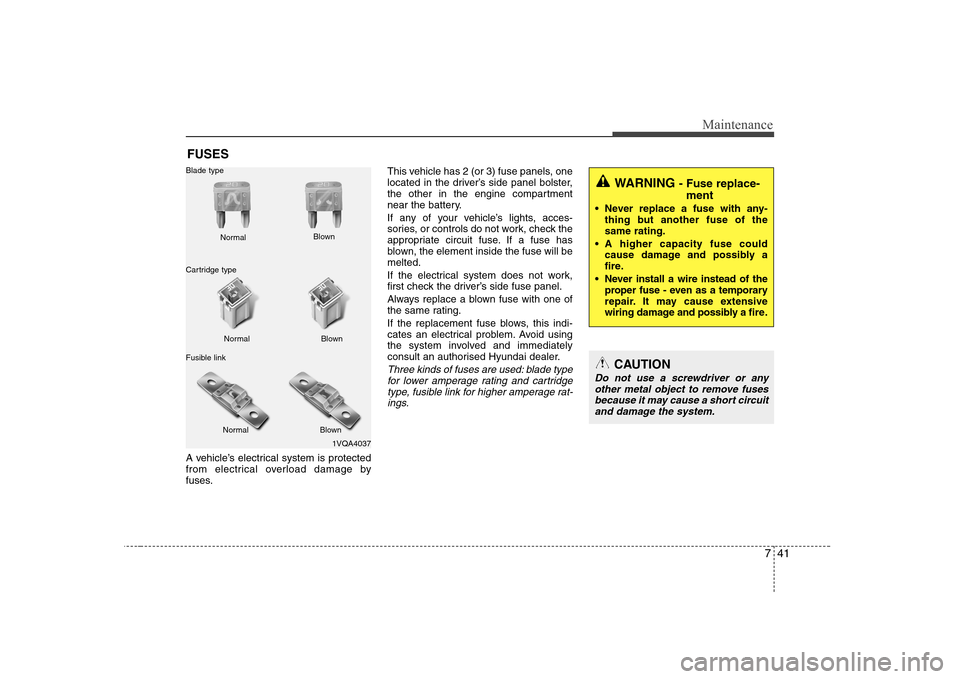
Three kinds of fuses are used: blade type
for lower amperage rating and cartridge
type, fusible link for higher amperage rat-ings.
1VQA4037
Normal
Normal
Blade type
Cartridge type
Fusible link Blown
Blown
Normal Blown
WARNING - Fuse replace-
ment
Never replace a fuse with any- thing but another fuse of the same rating.
A higher capacity fuse could cause damage and possibly a
fire.
Never install a wire instead of the proper fuse - even as a temporary
repair. It may cause extensive
wiring damage and possibly a fire.
CAUTION
Do not use a screwdriver or any
other metal object to remove fuses because it may cause a short circuit
and damage the system.
Page 275 of 308
Maintenance
50
7
LIGHT BULBS
Use only the bulbs of the specified
wattage.
All bulbs are available from your Hyundaidealers Parts Department.
✽✽ NOTICE
After heavy, driving rain or washing, headlight and taillight lenses could
appear frosty. This condition is caused by
the temperature difference between the
lamp inside and outside. This is similar
to the condensation on your windows
inside your vehicle during the rain and
doesn’t indicate a problem with your
vehicle. If the water leaks into the lamp
bulb circuitry, have the vehicle checked
by an authorised Hyundai dealer.WARNING - Working on
the lights
Prior to working on the light, firmly
apply the hand brake, ensure that
the ignition switch is turned to the
“LOCK” position and turn off the
lights to avoid sudden movement
of the vehicle and burning your fin-
gers or receiving an electric shock.
CAUTION
Be sure to replace the burned-out bulb with one of the same wattage rating. Otherwise, it may cause
damage to the fuse or electricwiring system.
CAUTION
If you don’t have necessary tools,
the correct bulbs and the expertise,consult an authorised Hyundai dealer. In many cases, it is difficult
to replace vehicle light bulbsbecause other parts of the vehicle must be removed before you can get to the bulb. This is especially
true if you have to remove the head- light assembly to
get to the bulb(s).
Removing/installingthe headlight
assembly can result in damage to the vehicle.