2009 Hyundai Accent fuel tank
[x] Cancel search: fuel tankPage 76 of 266

1FEATURES OF YOUR HYUNDAI66
B260J01MC-AAT
Charging System Warning
Light
The charging system warning light should
come on when the ignition is turned on,
then go out when the engine is running.
If the light stays on while the engine is
running, there is a malfunction in the
electrical charging system. If the light
comes on while you are driving, have the
system checked by your Hyundai dealer
as soon as possble.
B260M01A-AAT
Low Fuel Level Warning Light
The low fuel level warning light comes on
when the fuel tank is approaching empty.
When it comes on, you should add fuel as
soon as possible. Driving with the fuel
level warning light on or with the fuel level
below "E" can cause the engine to misfire
and damage the catalytic converter.
B260L02HP-GAT
Door Ajar Warning Light
and Chime
The door ajar warning light warns you
that a door is not completely closed and
the chime warns you that the key is in the
ignition switch.NOTE :The warning chime only sounds when-
ever the key is in the ignition switch and
the driver's side front door is open simul-
taneously. The chime sounds until the
key is removed from the ignition switch
or the driver's side front door is closed.B260K02A-AAT
Trunk Lid/Tail Gate
Open Warning Light
This light remains on unless the trunk lid/
tail gate is completely closed and latched.
B260O01MC-AAT
Check Fuel Filler Cap Warn-
ing Light
This warning light indicates the fuel filler
cap is not tight securely.
Always make sure that the fuel filler cap
is tight.
Your Hyundai is equipped with dual-di-
agonal braking systems. This means you
still have braking on two wheels even if
one of the dual systems should fail. With
only one of the dual systems working,
more than normal pedal travel and greater
pedal pressure are required to stop the
car. Also, the car will not stop in as short
a distance with only a portion of the brake
system working. If the brakes fail while
you are driving, shift to a lower gear for
additional engine braking and stop the
car as soon as it is safe to do so.
Page 80 of 266

1FEATURES OF YOUR HYUNDAI70
B330A03A-AATTACHOMETERThe tachometer registers the speed of
your engine in revolutions per minute
(rpm).
CAUTION:
The engine should not be increased to
such a speed that the needle enters the
red zone on the tachometer face. This
can cause severe engine damage and
may void your warranty.
!
INSTRUMENT CLUSTERB280A01TG-AATFUEL GAUGEThe needle on the gauge indicates the
approximate fuel level in the fuel tank.
The fuel capacity is given in Section 9.NOTE:The "
" symbol means the fuel filler
lid is placed on the left side of the vehicle.
OMC029420
Type A
Type B
OMC029424B330A02MC-D
Type A
Type B
Page 85 of 266
1
FEATURES OF YOUR HYUNDAI
751
FEATURES OF YOUR HYUNDAI
75
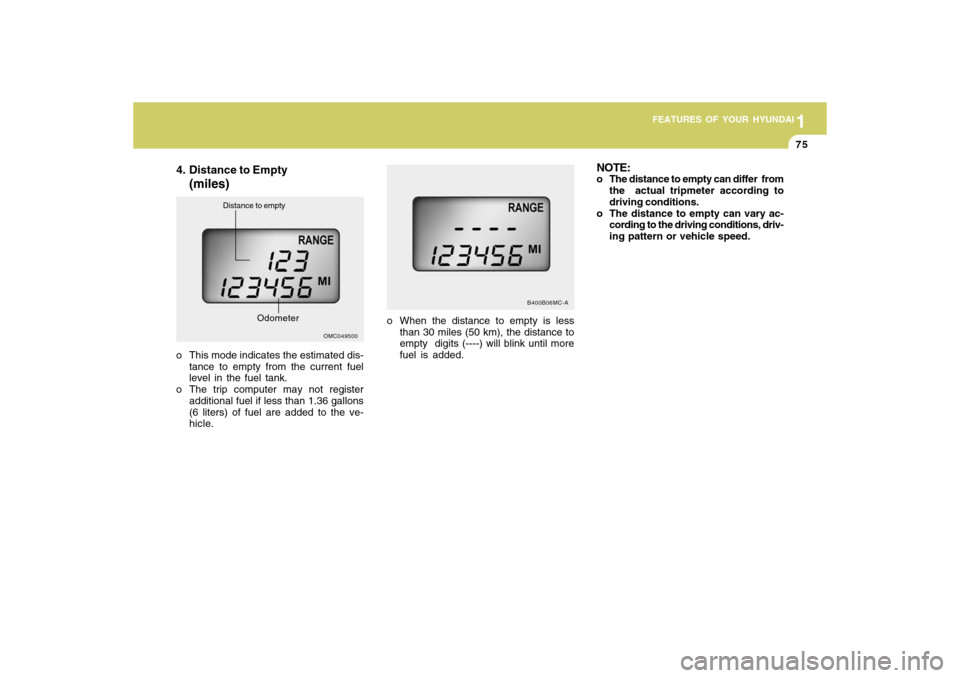
4. Distance to Empty
(miles)
o This mode indicates the estimated dis-
tance to empty from the current fuel
level in the fuel tank.
o The trip computer may not register
additional fuel if less than 1.36 gallons
(6 liters) of fuel are added to the ve-
hicle.
OMC049500
Distance to empty
Odometer
o When the distance to empty is less
than 30 miles (50 km), the distance to
empty digits (----) will blink until more
fuel is added.
B400B06MC-A
NOTE:o The distance to empty can differ from
the actual tripmeter according to
driving conditions.
o The distance to empty can vary ac-
cording to the driving conditions, driv-
ing pattern or vehicle speed.
Page 197 of 266

5
VEHICLE MAINTENANCE REQUIREMENTS2
MAINTENANCE INTERVALSF010B01A-AATMaintenance RequirementsThe maintenance required for your
Hyundai can be divided into three main
areas:
o Specified scheduled procedures
o General checks
o Do-it-yourself maintenanceF010A01A-AATService RequirementsTo ensure that you receive the greatest
number of miles of satisfying operation
from your Hyundai, certain maintenance
procedures must be performed. Although
careful design and engineering have re-
duced these to a minimum, those that are
required are of the utmost importance.
It is your responsibility to have these
maintenance procedures performed to
comply with the terms of the warranties
covering your new Hyundai. The Owner's
Handbook supplied with your new ve-
hicle provides further information about
these warranties.
F010D01A-AATGeneral ChecksThese are the regular checks you should
perform when you drive your Hyundai or
you fill the fuel tank. A list of these items
will be found on page 6-3.
F010C01A-AATSpecified Scheduled ProceduresThese are the procedures such as in-
spections, adjustments and replacements
that are listed in the maintenance charts
starting on page 5-4. These procedures
must be performed at the intervals shown
in the maintenance schedule to assure
that your warranty remains in effect. Al-
though it is strongly recommended that
they be performed by the factory-trained
or distributor-trained technicians at your
Hyundai dealer, these procedures may
be performed at any qualified service
facility.
It is suggested that genuine Hyundai
service parts be used for any required
repairs or replacements. Other parts of
equivalent quality such as engine oil,
engine coolant, manual or auto transaxle
oil, brake fluid and so on which are not
supplied by Hyundai Motor Company or
its distributor may be used without affect-
ing your warranty coverage but you should
always be sure these are equivalent to
the quality of the original Hyundai parts.
Your Owner's Handbook provides further
information about your warranty cover-
age.
F010E01A-AATDo-It-Yourself MaintenanceIf you are mechanically inclined, own a
few tools that are required and want to
take the time to do so, you can inspect
and service a number of items. For more
information about doing it yourself, see
Section 6.
Page 199 of 266

5
VEHICLE MAINTENANCE REQUIREMENTS4
SCHEDULED MAINTENANCE
150
240
120
R
I
I
I
I
R
R
R MILES X 1000
KILOMETERS X 1000
MONTHS
EMISSION CONTROL ITEMS
ENGINE OIL AND FILTER
FUEL FILTER
FUEL LINES, FUEL HOSES AND CONNECTIONS
VACUUM HOSE
CRANKCASE VENTILATION HOSE
VAPOR HOSE AND FUEL FILLER CAP
AIR CLEANER FILTER
FUEL TANK AIR FILTER
SPARK PLUGS No.DESCRIPTION
1
2
3
4
5
6
7
8
97.5
12
6
R
I
I15
24
12
R
I
I
I22.5
36
18
R
I
I30
48
24
R
I
I
I
I
R
R
R37.5
60
30
R
I
I45
72
36
R
I
I
I52.5
84
42
R
R
I
I60
96
48
R
I
I
I
I
R
R
R67.5
108
54
R
I
I
75
120
60
R
I
I
I82.5
132
66
R
I
I90
144
72
R
I
I
I
I
R
R
R97.5
156
78
R
I
I105
168
84
R
R
I
I
I112.5
180
90
R
I
I120
192
96
R
I
I
I
I
R
R
R127.5
204
102
R
I
I135
216
108
R
I
I
I142.5
228
114
R
I
I
F030B02MC-AATR : Replace I : Inspect and, after inspection, clean, adjust, repair or replace if necessaryF030A01A-AATThe following maintenance services must be performed to assure good vehicle control and performance. Keep receipts for all vehicle
services to protect your warranty. Where both mileage and time are shown, the frequency of service is determined by whichever occurs
first.
Page 202 of 266

5
VEHICLE MAINTENANCE REQUIREMENTS
7
EXPLANATION OF SCHEDULED
MAINTENANCE ITEMS
F060D01A-AATo Fuel Lines, Fuel Hoses and
ConnectionsCheck the fuel lines, fuel hoses and con-
nections for leakage and damage. Have
a trained techincian, replace any dam-
aged or leaking parts immediately.
F060C01A-AATo Fuel FilterA clogged filter can limit the speed at
which the vehicle may be driven, damage
the emission system and cause hard start-
ing. If an excessive amount of foreign
matter accumulates in the fuel tank, the
filter may require replacement more fre-
quently.
After installing a new filter, run the engine
for several minutes, and check for leaks
at the connections.
Fuel filters should be installed by trained
technicians.F060M01A-AATo Engine Oil and FilterThe engine oil and filter should be
changed at the intervals specified in the
maintenance schedule. If the car is being
driven in severe conditions, more fre-
quent oil and filter changes are required.
F060H01A-AATo Air Cleaner FilterA Genuine Hyundai air cleaner filter is
recommended when the filter is replaced.F060G01A-AATo Vapor Hose and Fuel Filler CapThe vapor hose and fuel filler cap should
be inspected at those intervals specified
in the maintenance schedule. Make sure
that a new vapor hose or fuel filler cap is
correctly replaced.
F060F01A-AATo Vacuum, Crankcase Ventilation
HosesInspect the surface of hoses for evidence
of heat and/or mechanical damage. Hard
and brittle rubber, cracking, tears, cuts,
abrasions, and excessive swelling indi-
cate deterioration. Particular attention
should be paid to examine those hose
surfaces nearest to high heat sources,
such as the exhaust manifold.
Inspect the hose routing to assure that
the hoses do not come in contact with any
heat source, sharp edges or moving com-
ponent which might cause heat damage
or mechanical wear. Inspect all hose
connections, such as clamps and cou-
plings, to make sure they are secure, and
that no leaks are present. Hoses should
be replaced immediately if there is any
evidence of deterioration or damage.
F060B01A-AATo Drive BeltsInspect all drive belts for evidence of cuts,
cracks, excessive wear or oil saturation
and replace if necessary. Drive belts
should be checked periodically for proper
tension and adjusted as necessary.F060J01A-AATo Spark PlugsMake sure to install new spark plugs of
the correct heat range.
Page 237 of 266

7
EMISSION CONTROL SYSTEMS2
EMISSION CONTROL SYSTEM
CanisterFuel vapors generated inside the fuel
tank are absorbed and stored in the
onboard canister. When the engine is
running, the fuel vapors absorbed in the
canister are drawn into the induction sys-
tem through the purge control solenoid
valve.Purge Control Solenoid Valve (PCSV)The purge control solenoid valve is con-
trolled by the Engine Control Module
(ECM); when the engine coolant tem-
perature is low during idling, the PCSV
closes so that evaporated fuel is not taken
into the engine. After the engine warms-
up during ordinary driving, the PCSV
opens to introduce evaporated fuel to the
engine.
H010B01A-AAT1. Crankcase Emission Control
SystemThe positive crankcase ventilation sys-
tem is employed to prevent air pollution
caused by blow-by gases being emitted
from the crankcase. This system supplies
filtered fresh air to the crankcase through
the air intake hose. Inside the crankcase,
the fresh air mixes with blow-by gases,
then passes through the PCV valve into
the induction system.
H010A01A-AATYour Hyundai is equipped with an emis-
sion control system to meet all require-
ments of the U.S. Environmental Protec-
tion Agency or California Air Resources
Board.
There are three emission control systems
which are as follows.
1) Crankcase Emission Control System
2) Evaporative Emission Control System
3) Exhaust Emission Control System
In order to ensure the proper function of
the emission control systems, it is recom-
mended that you have your car inspected
and maintained by an authorized Hyundai
dealer in accordance with the mainte-
nance schedule in this manual.
H010D01A-AAT3. Exhaust Emission
Control SystemThe Exhaust Emission Control System is
a highly effective system which controls
exhaust emissions while maintaining
good vehicle performace.
H010C01S-AAT2. Evaporative Emission Control (In-
cluding ORVR: Onboard Refuel-
ing Vapor Recovery) SystemThe Evaporative Emission Control Sys-
tem is designed to prevent fuel vapors
from escaping into the atmosphere.
(The ORVR system is designed to allow
the vapors from the fuel tank to be loaded
into a canister while refueling at the gas
station, preventing the escape of fuel
vapors into the atmosphere.)
Page 258 of 266

9
VEHICLE SPECIFICATIONS2
Tire Size
P175/70 R14, P185/65 R14, P195/55 R15
P175/70 R14, P185/65 R14, P205/45 R16
T115/70 D15
in. (mm)
Liter
45
Dual hydraulic with brake booster
Ventilated disc
Drum
Cable operated on rear wheel
4Door
3Door
Spare
US. gal
11.9 Fuel tank capacityImp.gal
9.9
Type
Front brake type
Rear brake type
Parking brake
Inflation Pressure
32PSI (220 kPa)
60PSI (420 kPa)
J010A03MC-AATMEASUREMENTJ020A01MC-AATPOWER STEERING
J060A01A-AATFUEL SYSTEMJ050A02MC-AATBRAKEJ030A03MC-AATTIRE
4 DOOR
168.5 (4280)
66.7 (1695)
57.8 (1470)
98.4 (2500)
57.8 (1470) / 58.4 (1485)*
57.4 (1460) / 58 (1475)* Item
Overall length
Overall width
Overall height
Wheel base
Wheel tread
Front
Rear
3 DOOR
159.2 (4045)
Type
Wheel free play
Rack stroke
Oil pump type
Rack and pinion
0 ~ 1.18 in (0 ~ 30 mm)
5.59 in. (142 mm)
5.43 in. (138 mm)
Vane type
175 Tire only
Except 175 Tire
* with P175/70R14 Tire