2009 Hyundai Accent fuel pressure
[x] Cancel search: fuel pressurePage 10 of 266

YOUR VEHICLE AT A GLANCE
F10
High Beam Indicator Light
Parking Brake/Low Brake Fluid Level
Warning Light
Door Ajar Warning Light and Chime O/D OFF Indicator
(Automatic transaxle only)
B255A03MC-AATINDICATOR SYMBOLS ON THE INSTRUMENT PANEL
* More detailed explanations of these items will be found begining
on page 1-64.
SRS (Airbag) Warning Light
ABS Service Reminder Indicator (If Installed)
Turn Signal Indicator Lights
Low Oil Pressure Warning Light
Charging System Warning LightLow Fuel Level Warning Light
Malfunction Indicator Light
Seat Belt Warning Light and Chime
Trunk Lid / Tail Gate Open Warning Light
Check Fuel Filler Cap Warning LightEngine Coolant Temperature Warning LightLow Tire Pressure Telltale (If Installed)TPMS (Tire Pressure Monitoring System) Malfunction
Indicator (If Installed)Cruise Indicator Light (If Installed)Cruise SET Indicator Light (If Installed)
Page 71 of 266

1
FEATURES OF YOUR HYUNDAI
611
FEATURES OF YOUR HYUNDAI
61
1. Tachometer
2. Turn Signal Indicator Lights
3. High Beam Indicator Light
4. Automatic Transaxle Position Indicator Light
(If Installed)
5. Odometer/Trip Odometer/Trip Computer (If Installed)
6. Overdrive Off Indicator Light (Automatic transaxle only)
7. Speedometer
8. Check Fuel Cap Warning Light
9. Low Tire Pressure Telltale (If Installed)
10. TPMS (Tire Pressure Monitoring System) Malfunction
Indicator (If Installed)
11. Door Ajar Warning Light12. Charging System Warning Light
13. Parking Brake/Low Brake fluid Level Warning Light
14. SRS (Airbag) Warning Light
15. Seat Belt Warning Light
16. Fuel Gauge
17. Engine Coolant Temperature Warning Light
18. Low Oil Pressure Warning Light
19. Low Fuel Warning Light
20. Trunk Lid/Tail Gate Open Warning Light
21. Malfunction Indicator Light (MIL)
22. ABS Service Reminder Indicator Light (If Installed)
23. Cruise Control Indicator Lights (If Installed)
Page 73 of 266

1
FEATURES OF YOUR HYUNDAI
631
FEATURES OF YOUR HYUNDAI
63
12. Door Ajar Warning Light
13. Charging System Warning Light
14. Parking Brake/Low Brake fluid Level Warning Light
15. Seat Belt Warning Light
16. High Beam Indicator Light
17. Fuel Gauge
18. Engine Coolant Temperature Warning Light
19. Overdrive Off Indicator Light (Automatic transaxle only)
20. Low Fuel Warning Light
21. Trunk Lid/Tail Gate Open Warning Light
22. ABS Service Reminder Indicator Light (If Installed)
23. Cruise Control Indicator Lights (If Installed) 1. Tachometer
2. Turn Signal Indicator Lights
3. Low Oil Pressure Warning Light
4. Automatic Transaxle Position Indicator Light
(If Installed)
5. Odometer/Trip Odometer
6. SRS (Airbag) Warning Light
7. Malfunction Indicator Light (MIL)
8. Speedometer
9. Check Fuel Cap Warning Light
10. Low Tire Pressure Telltale (If Installed)
11. TPMS (Tire Pressure Monitoring System)
Malfunction Indicator (If Installed)
Page 76 of 266

1FEATURES OF YOUR HYUNDAI66
B260J01MC-AAT
Charging System Warning
Light
The charging system warning light should
come on when the ignition is turned on,
then go out when the engine is running.
If the light stays on while the engine is
running, there is a malfunction in the
electrical charging system. If the light
comes on while you are driving, have the
system checked by your Hyundai dealer
as soon as possble.
B260M01A-AAT
Low Fuel Level Warning Light
The low fuel level warning light comes on
when the fuel tank is approaching empty.
When it comes on, you should add fuel as
soon as possible. Driving with the fuel
level warning light on or with the fuel level
below "E" can cause the engine to misfire
and damage the catalytic converter.
B260L02HP-GAT
Door Ajar Warning Light
and Chime
The door ajar warning light warns you
that a door is not completely closed and
the chime warns you that the key is in the
ignition switch.NOTE :The warning chime only sounds when-
ever the key is in the ignition switch and
the driver's side front door is open simul-
taneously. The chime sounds until the
key is removed from the ignition switch
or the driver's side front door is closed.B260K02A-AAT
Trunk Lid/Tail Gate
Open Warning Light
This light remains on unless the trunk lid/
tail gate is completely closed and latched.
B260O01MC-AAT
Check Fuel Filler Cap Warn-
ing Light
This warning light indicates the fuel filler
cap is not tight securely.
Always make sure that the fuel filler cap
is tight.
Your Hyundai is equipped with dual-di-
agonal braking systems. This means you
still have braking on two wheels even if
one of the dual systems should fail. With
only one of the dual systems working,
more than normal pedal travel and greater
pedal pressure are required to stop the
car. Also, the car will not stop in as short
a distance with only a portion of the brake
system working. If the brakes fail while
you are driving, shift to a lower gear for
additional engine braking and stop the
car as soon as it is safe to do so.
Page 77 of 266

1
FEATURES OF YOUR HYUNDAI
671
FEATURES OF YOUR HYUNDAI
67
B260N01MC-AAT
Malfunction Indicator Light
This light illuminates when there is a
malfunction of an exhaust gas related
component and the system is not func-
tioning properly. This light will also illumi-
nate when the ignition key is turned to the
"ON" position, and will go out in a few
seconds after the engine is started. If it
illuminates while driving, or does not illumi-
nate when the ignition key is turned to the
"ON" position, take your car to your nearest
authorized Hyundai dealer and have the
system checked.
!
CAUTION:
Prolonged driving with the Emission
Control System Malfunction Indicator
Light illuminated may cause damage to
the emission control systems which
could effect drivability or fuel economy.
If the Emission Control System Malfunc-
tion Indicator Light begins to flash ON
and OFF, potential catalytic converter
damage is possible which could result in
loss of engine power. Have the Engine
Control System inspected as soon as
possible by an authorized Hyundai
dealer.The driver's seat belt warning light and
chime will activate to the following table
when the ignition switch is in "ON" posi-
tion.
B265E01MC-AAT
Seat Belt Warning Light
and Chime
*1) Warning pattern repeats 11 times with
an interval of 24 seconds. If the driver's
seat belt is buckled, the light will stop
within 6 seconds and chime will stop
immediately.
*2) The light will stop within 6 seconds
and chime will stop immediately.
Conditions Warning Pattern
Seat BeltVehicle SpeedLight-Blink Chime-SoundUnbuckled
Buckled
Buckled
→ →→ →
→ Unbuckled
UnbuckledAbove 6mph
(10 km/h)
↓
Below 3mph
(5 km/h)6 seconds
6 seconds
6 seconds *1)
↓Stop *2)
6 secondsNone
B290A02MC-AAT
Engine Coolant Temperature
Warning Light
WARNING:
Never remove the radiator cap when the
engine is hot. The engine coolant is un-
der pressure and could erupt and cause
severe burns. Wait until the engine is
cool before removing the radiator cap.
!
This warning light shows the temperature
of the engine coolant when the ignition
switch is ON. The warning light illumi-
nates if the temperature of the engine
coolant is above 253.4±5.4°F (123±3°C).
If the warning light illuminates, pull over
and stop as soon as possible and turn off
the engine. Then open the hood and
check the coolant level (See "If the en-
gine overheats" on the page 3-4.) and the
water pump drive belt. If you suspect
cooling system trouble, have your cool-
ing system checked by a Hyundai dealer
as soon as possible.NOTE:If the engine coolant temperature warn-
ing light illuminates, it indicates over-
heating that may damage the engine.
Page 105 of 266
1
FEATURES OF YOUR HYUNDAI
951
FEATURES OF YOUR HYUNDAI
95
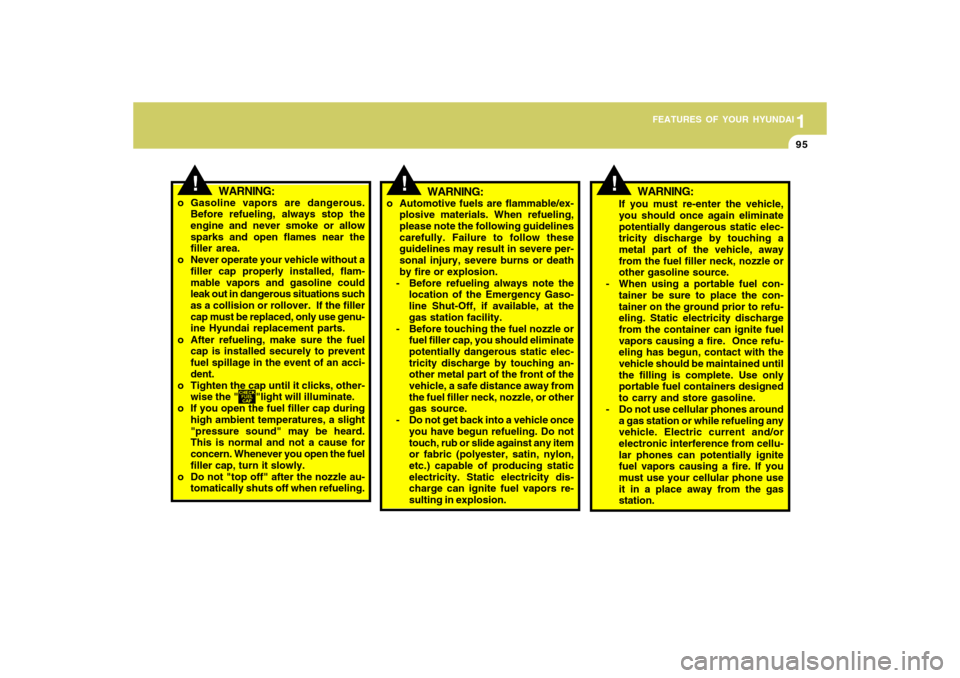
!
WARNING:
If you must re-enter the vehicle,
you should once again eliminate
potentially dangerous static elec-
tricity discharge by touching a
metal part of the vehicle, away
from the fuel filler neck, nozzle or
other gasoline source.
- When using a portable fuel con-
tainer be sure to place the con-
tainer on the ground prior to refu-
eling. Static electricity discharge
from the container can ignite fuel
vapors causing a fire. Once refu-
eling has begun, contact with the
vehicle should be maintained until
the filling is complete. Use only
portable fuel containers designed
to carry and store gasoline.
- Do not use cellular phones around
a gas station or while refueling any
vehicle. Electric current and/or
electronic interference from cellu-
lar phones can potentially ignite
fuel vapors causing a fire. If you
must use your cellular phone use
it in a place away from the gas
station.
!
WARNING:
o Gasoline vapors are dangerous.
Before refueling, always stop the
engine and never smoke or allow
sparks and open flames near the
filler area.
o Never operate your vehicle without a
filler cap properly installed, flam-
mable vapors and gasoline could
leak out in dangerous situations such
as a collision or rollover. If the filler
cap must be replaced, only use genu-
ine Hyundai replacement parts.
o After refueling, make sure the fuel
cap is installed securely to prevent
fuel spillage in the event of an acci-
dent.
o Tighten the cap until it clicks, other-
wise the "
"light will illuminate.
o If you open the fuel filler cap during
high ambient temperatures, a slight
"pressure sound" may be heard.
This is normal and not a cause for
concern. Whenever you open the fuel
filler cap, turn it slowly.
o Do not "top off" after the nozzle au-
tomatically shuts off when refueling.
o Automotive fuels are flammable/ex-
plosive materials. When refueling,
please note the following guidelines
carefully. Failure to follow these
guidelines may result in severe per-
sonal injury, severe burns or death
by fire or explosion.
- Before refueling always note the
location of the Emergency Gaso-
line Shut-Off, if available, at the
gas station facility.
- Before touching the fuel nozzle or
fuel filler cap, you should eliminate
potentially dangerous static elec-
tricity discharge by touching an-
other metal part of the front of the
vehicle, a safe distance away from
the fuel filler neck, nozzle, or other
gas source.
- Do not get back into a vehicle once
you have begun refueling. Do not
touch, rub or slide against any item
or fabric (polyester, satin, nylon,
etc.) capable of producing static
electricity. Static electricity dis-
charge can ignite fuel vapors re-
sulting in explosion.
!
WARNING:
Page 158 of 266

DRIVING YOUR HYUNDAI
152
DRIVING FOR ECONOMYC140A02A-AATYou can save fuel and get more miles
from your car if you follow these sugges-
tions:
o Drive smoothly. Accelerate at a mod-
erate rate. Don't make "jack-rabbit"
starts or full-throttle shifts and maintain
a steady cruising speed. Don't race
between stoplights. Try to adjust your
speed to that of the other traffic so you
don't have to change speeds unnec-
essarily. Avoid heavy traffic whenever
possible. Always maintain a safe dis-
tance from other vehicles so you can
avoid unnecessary braking. This also
reduces brake wear.
o Drive at a moderate speed. The faster
you drive, the more fuel your car uses.
Driving at a moderate speed, espe-
cially on the highway, is one of the
most effective ways to reduce fuel con-
sumption.
o Don't "ride" the brake or clutch pedal.
This can increase fuel consumption
and also increase wear on these com-
ponents. In addition, driving with your
foot resting on the brake pedal may
cause the brakes to overheat, which
reduces their effectiveness and may
lead to more serious consequences. o Under some conditions your parking
brake can freeze in the engaged posi-
tion. This is most likely to happen when
there is an accumulation of snow or ice
around or near the rear brakes or if the
brakes are wet. If there is a risk that the
parking brake may freeze, apply it only
temporarily while you put the gear
selector lever in "P" (automatic) or in
first or reverse gear (manual transaxle)
and block the rear wheels so the car
cannot roll. Then release the parking
brake.
o Do not hold the vehicle on the upgrade
with the accelerator pedal. This can
cause the transaxle to overheat. Al-
ways use the brake pedal or parking
brake.o Take care of your tires. Keep them
inflated to the recommended pressure.
Incorrect inflation, either too much or
too little, results in unnecessary tire
wear. Check the tire pressures at least
once a month.
o Be sure that the wheels are aligned
correctly. Improper alignment can re-
sult from hitting curbs or driving too fast
over irregular surfaces. Poor align-
ment causes faster tire wear and may
also result in other problems as well as
greater fuel consumption.
o Keep your car in good condition. For
better fuel economy and reduced main-
tenance costs, maintain your car in
accordance with the maintenance
schedule in Section 5. If you drive your
car in severe conditions, more fre-
quent maintenance is required (see
Section 5 for details).
o Keep your car clean. For maximum
service, your Hyundai should be kept
clean and free of corrosive materials.
It is especially important that mud, dirt,
ice, etc. not be allowed to accumulate
on the underside of the car. This extra
weight can result in increased fuel
consumption and also contribute to
corrosion.
Page 162 of 266

DRIVING YOUR HYUNDAI
192
!
!
USE OF LIGHTSC180A01A-AATCheck your lights regularly for correct
operation and always keep them clean.
When driving during the day in conditions
of poor visibility, it is helpful to drive with
headlights on low beam. This enables
you to be seen, as well as to see.
HIGHER SPEED MOTORINGC170A02A-AATPre-Trip Inspections1. Tires:
Adjust the tire inflation pressures for high-
way driving. Low tire inflation pressures
will result in overheating and possible
failure of the tires.
Avoid using worn or damaged tires which
may result in reduced traction or tire fail-
ure.NOTE:Never exceed the maximum tire infla-
tion pressure shown on the tires.
WARNING:
o Underinflated or overinflated tires
can cause poor handling, loss of ve-
hicle control, and sudden tire failure
leading to accidents, injuries, and
even death. Always check tires are
properly inflated before driving. Refer
to pages 2-20 and 8-3 for proper tire
pressures and further information.2. Fuel, engine coolant and engine oil:
High speed travel consumes more fuel
than urban motoring. Do not forget to
check both engine coolant and engine
oil.
3. Drive belt:
A loose or damaged drive belt may result
in overheating of the engine. o Driving on tires with no or insuffi-
cient tread is dangerous. Worn-out
tires can result in loss of vehicle
control, collisions, injury, and even
death. Worn-out tires should be re-
placed as soon as possible and
should never be used for driving.
Always check tire tread before driv-
ing your car. Refer to 8-12 for further
information and tread limits.
WARNING: