2009 Hyundai Accent shift lever
[x] Cancel search: shift leverPage 153 of 266

2
DRIVING YOUR HYUNDAI
10
C090H01A-AATNOTE:o For smooth and safe operation, de-
press the brake pedal when shifting
from "Neutral" position or "Park"
position to a forward or reverse gear.
o The ignition key must be in the "ON"
position and the brake pedal fully
depressed in order to move the shift
lever from the "P" (Park) position to
any of the other positions.
o It is always possible to shift from
"R", "N", "D", "2", "L" position to "P"
position.
C090G01A-AATo L (Low gear):Use for driving up a very steep grade or
for engine braking when descending
steep hills. When downshifting to "L", the
transaxle will temporarily remain in sec-
ond gear until the vehicle has slowed
enough for low gear to engage. Do not
exceed 31 mph (50 km/h) in low gear.C090F01A-AATo 2 (Second gear):Use for driving on a slippery road, hill
climbing or engine braking downhill. "2"
automatically shifts between first and
second gears.
This means that no shift-up to 3rd gear is
performed. However, the shift-up to third
gear is done when the car speed ex-
ceeds a certain value to prevent the en-
gine from over-revving.
Manually move the selector to "D" return-
ing to normal driving condition.
C090C01A-AATo R(Reverse):Use for backing up the vehicle. Bring the
car to a complete stop before shifting the
selector lever to "R" position.C090D02A-AATo N (Neutral):In the "N" position, the transaxle is in
neutral position, which means that no
gears are engaged. The engine can be
started with the shift lever in "N" position,
although this is not recommended except
if the engine stalls while the car is mov-
ing.C090E02A-AATo D (Drive):Use for normal driving. Bring the car to a
complete stop before shifting the selector
to "D" position. The transaxle will auto-
matically shift through a four-gear se-
quence. Never downshift manually to "2"
position or "L" position when vehicle
speed is more than 60 mph (96 km/h).
Page 154 of 266

DRIVING YOUR HYUNDAI
112
C090I05A-AAT
CAUTION:
o Shift into "R", "D" and "P" position
only when the vehicle has completely
stopped.
o Do not accelerate the engine in re-
verse or any of the forward positions
with the brakes applied.
o Always apply the footbrake when
shifting from "P" or "N", to "R", "D",
"2" or "L" position.
o Do not use the "P" (Park) position in
place of the parking brake. Always
set the parking brake, shift the
transaxle into "P" (Park) position and
turn off the ignition when you leave
the vehicle, even momentarily. Never
leave the vehicle unattended while
the engine is running.
o When accelerating from a stop on a
steep hill, the vehicle may have a
tendency to roll backwards. Shifting
the shift lever into 2nd gear will help
prevent the vehicle from rolling back-
wards.
!
o Check the automatic transaxle fluid
level regularly, and add fluid as nec-
essary.
o See the maintenance schedule for
the proper fluid recommendation.
C090P01A-AATOverdrive SwitchWhen the overdrive switch is turned on,
the transaxle will automatically upshift to
the second, third and overdrive gears.
When the overdrive switch is turned off,
the transaxle will not upshift to the over-
drive gear. For normal driving, the selec-
tor lever should be left in the "D" position
and the overdrive switch turned on.
If you need to accelerate rapidly, press
the accelerator pedal all the way to the
floor. The transaxle will automatically shift
to a lower gear, depending on the vehicle
speed and load.
OMC035016
Page 155 of 266
2
DRIVING YOUR HYUNDAI
12
WARNING:
o Always buckle-up! In a collision, an
unbelted occupant is significantly
more likely to be seriously injured or
killed than a properly belted occu-
pant.
o Avoid high speeds when cornering
or turning.
o Do not make quick steering wheel
movements, such as sharp lane
changes or fast, sharp turns.
o The risk of rollover is greatly in-
creased if you lose control of your
vehicle at highway speeds.
o Loss of control often occurs if two or
more wheels drop off the roadway
and the driver oversteers to reenter
the roadway.
o In the event your vehicle leaves the
roadway, do not steer sharply. In-
stead, slow down before pulling back
into the travel lanes.
o Never exceed posted speed limits.
!
o Exercise extreme caution when driv-
ing on a slippery surface. Be espe-
cially careful when braking, accelerat-
ing or shifting gears. On a slippery
surface, an abrupt change in vehicle
speed can cause the drive wheels to
lose traction and the vehicle to go out
of control.
o Optimum vehicle performance and
economy is obtained by smoothly de-
pressing and releasing the accelera-
tor pedal.
o Turn the overdrive switch on for good
fuel economy and smooth driving. If
engine braking is needed in the "D"
range or if repeated upshifting and
downshifting between the 3rd and 4th
gear is needed when climbing a gentle
slope, it is recommended that the over-
drive switch be turned off. Turn the
overdrive switch back on immediately
afterward.
C090N07A-AATGood Driving Practiceso Never move the gear selector lever
from "P" or "N" to any other position
with the accelerator pedal depressed.
o Never move the gear selector lever
into "P" when the vehicle is in motion.
o Be sure the car is completely stopped
before you attempt to shift into "R" or
"D".
o Never take the car out of gear and
coast down a hill. This may be ex-
tremely hazardous. Always leave the
car in gear when moving.
o Do not "ride" the brakes. This can
cause them to overheat and malfunc-
tion. Instead, when you are driving
down a long hill, slow down and shift
to a lower gear. When you do this,
engine braking will help slow the car.
o Slow down before shifting to a lower
gear. Otherwise, the lower gear may
not be engaged.
o Always use the parking brake. Do not
depend on placing the transaxle in "P"
to keep the car from moving.
Page 157 of 266
2
DRIVING YOUR HYUNDAI
14
o After being parked, check to be sure
the parking brake is not engaged and
that the parking brake indicator light is
out before driving away.
o Driving through water may get the
brakes wet. They can also get wet
when the car is washed. Wet brakes
can be dangerous! Your car will not
stop as quickly if the brakes are wet.
Wet brakes may cause the car to pull
to one side. To dry the brakes, apply
the brakes lightly until the braking ac-
tion returns to normal, taking care to
keep the car under control at all times.
If the braking action does not return to
normal, stop as soon as it is safe to do
so and call your Hyundai dealer for
assistance.
o Don't coast down hills with the car out
of gear. This is extremely hazardous.
Keep the car in gear at all times, use
the brakes to slow down, then shift to
a lower gear so that engine braking
will help you maintain a safe speed.
o Don't "ride" the brake pedal. Resting
your foot on the brake pedal while
driving can be dangerous because it
can result in the brakes overheating
and losing their effectiveness. It also
increases the wear of the brake com-
ponents.o If a tire goes flat while you are driving,
apply the brakes gently and keep the
car pointed straight ahead while you
slow down. When you are moving
slowly enough for it to be safe to do so,
pull off the road and stop in a safe
place.
o If your car is equipped with an auto-
matic transaxle, don't let your car creep
forward. To avoid creeping forward,
keep your foot firmly on the brake pedal
when the car is stopped.
o Use caution when parking on a hill.
Firmly engage the parking brake and
place the gear selector lever in "P"
(automatic transaxle) or in first or re-
verse gear (manual transaxle). If your
car is facing downhill, turn the front
wheels into the curb to help keep the
car from rolling. If your car is facing
uphill, turn the front wheels away from
the curb to help keep the car from
rolling. If there is no curb or if it is
required by other conditions to keep
the car from rolling, block the wheels.
GOOD BRAKING PRACTICES!
C130A02A-AAT
WARNING:
o Whenever leaving vehicle or park-
ing, always set the parking brake as
far as possible and fully engage the
vehicle's transaxle into the park po-
sition. Vehicles not fully engaged in
park with the parking brake set are
at risk for moving inadvertently and
injuring yourself or others.
o All vehicles should always have the
parking brake fully engaged when
parking to avoid inadvertent move-
ment of the car which can injure
occupants or pedestrians.
o Nothing should be carried on top of
the shelf panel behind the rear seat.
If there were an accident or a sudden
stop, such objects could move for-
ward and cause damage to the ve-
hicle or injure the occupants.
Page 158 of 266

DRIVING YOUR HYUNDAI
152
DRIVING FOR ECONOMYC140A02A-AATYou can save fuel and get more miles
from your car if you follow these sugges-
tions:
o Drive smoothly. Accelerate at a mod-
erate rate. Don't make "jack-rabbit"
starts or full-throttle shifts and maintain
a steady cruising speed. Don't race
between stoplights. Try to adjust your
speed to that of the other traffic so you
don't have to change speeds unnec-
essarily. Avoid heavy traffic whenever
possible. Always maintain a safe dis-
tance from other vehicles so you can
avoid unnecessary braking. This also
reduces brake wear.
o Drive at a moderate speed. The faster
you drive, the more fuel your car uses.
Driving at a moderate speed, espe-
cially on the highway, is one of the
most effective ways to reduce fuel con-
sumption.
o Don't "ride" the brake or clutch pedal.
This can increase fuel consumption
and also increase wear on these com-
ponents. In addition, driving with your
foot resting on the brake pedal may
cause the brakes to overheat, which
reduces their effectiveness and may
lead to more serious consequences. o Under some conditions your parking
brake can freeze in the engaged posi-
tion. This is most likely to happen when
there is an accumulation of snow or ice
around or near the rear brakes or if the
brakes are wet. If there is a risk that the
parking brake may freeze, apply it only
temporarily while you put the gear
selector lever in "P" (automatic) or in
first or reverse gear (manual transaxle)
and block the rear wheels so the car
cannot roll. Then release the parking
brake.
o Do not hold the vehicle on the upgrade
with the accelerator pedal. This can
cause the transaxle to overheat. Al-
ways use the brake pedal or parking
brake.o Take care of your tires. Keep them
inflated to the recommended pressure.
Incorrect inflation, either too much or
too little, results in unnecessary tire
wear. Check the tire pressures at least
once a month.
o Be sure that the wheels are aligned
correctly. Improper alignment can re-
sult from hitting curbs or driving too fast
over irregular surfaces. Poor align-
ment causes faster tire wear and may
also result in other problems as well as
greater fuel consumption.
o Keep your car in good condition. For
better fuel economy and reduced main-
tenance costs, maintain your car in
accordance with the maintenance
schedule in Section 5. If you drive your
car in severe conditions, more fre-
quent maintenance is required (see
Section 5 for details).
o Keep your car clean. For maximum
service, your Hyundai should be kept
clean and free of corrosive materials.
It is especially important that mud, dirt,
ice, etc. not be allowed to accumulate
on the underside of the car. This extra
weight can result in increased fuel
consumption and also contribute to
corrosion.
Page 171 of 266
3
WHAT TO DO IN AN EMERGENCY
3
JUMP STARTING
D010D01A-AATIf the Engine Stalls While Driving1. Reduce your speed gradually, keep-
ing a straight line. Move cautiously off
the road to a safe place.
2. Turn on your emergency flashers.
3. Try to start the engine again. If your
vehicle will not start, contact a Hyundai
dealer or seek other qualified assis-
tance.
!
D020A02A-AAT
WARNING:
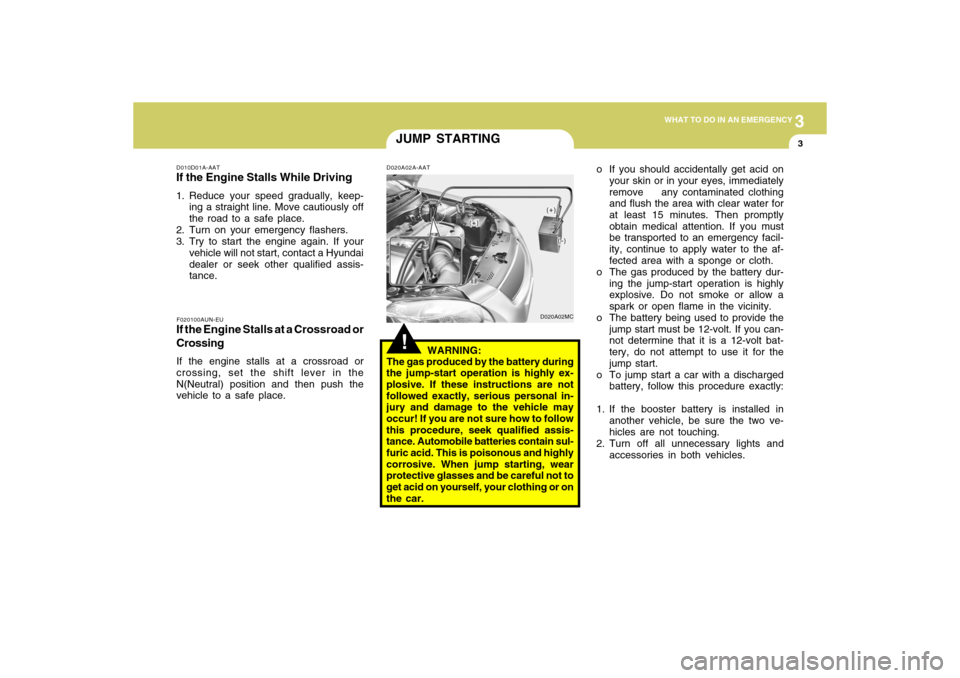
The gas produced by the battery during
the jump-start operation is highly ex-
plosive. If these instructions are not
followed exactly, serious personal in-
jury and damage to the vehicle may
occur! If you are not sure how to follow
this procedure, seek qualified assis-
tance. Automobile batteries contain sul-
furic acid. This is poisonous and highly
corrosive. When jump starting, wear
protective glasses and be careful not to
get acid on yourself, your clothing or on
the car.
D020A02MC
o If you should accidentally get acid on
your skin or in your eyes, immediately
remove any contaminated clothing
and flush the area with clear water for
at least 15 minutes. Then promptly
obtain medical attention. If you must
be transported to an emergency facil-
ity, continue to apply water to the af-
fected area with a sponge or cloth.
o The gas produced by the battery dur-
ing the jump-start operation is highly
explosive. Do not smoke or allow a
spark or open flame in the vicinity.
o The battery being used to provide the
jump start must be 12-volt. If you can-
not determine that it is a 12-volt bat-
tery, do not attempt to use it for the
jump start.
o To jump start a car with a discharged
battery, follow this procedure exactly:
1. If the booster battery is installed in
another vehicle, be sure the two ve-
hicles are not touching.
2. Turn off all unnecessary lights and
accessories in both vehicles.
F020100AUN-EUIf the Engine Stalls at a Crossroad or
CrossingIf the engine stalls at a crossroad or
crossing, set the shift lever in the
N(Neutral) position and then push the
vehicle to a safe place.
Page 217 of 266
6
DO-IT-YOURSELF MAINTENANCE
12
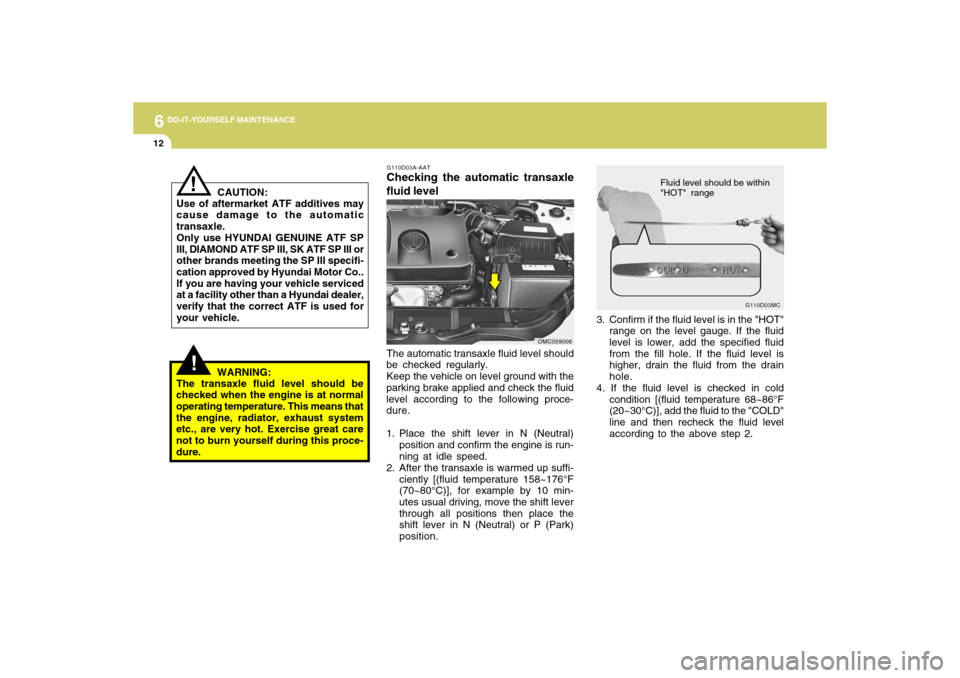
3. Confirm if the fluid level is in the "HOT"
range on the level gauge. If the fluid
level is lower, add the specified fluid
from the fill hole. If the fluid level is
higher, drain the fluid from the drain
hole.
4. If the fluid level is checked in cold
condition [(fluid temperature 68~86°F
(20~30°C)], add the fluid to the "COLD"
line and then recheck the fluid level
according to the above step 2.
G110D03MC
Fluid level should be within
"HOT" range
OMC059006
!
WARNING:
The transaxle fluid level should be
checked when the engine is at normal
operating temperature. This means that
the engine, radiator, exhaust system
etc., are very hot. Exercise great care
not to burn yourself during this proce-
dure.
!
CAUTION:
Use of aftermarket ATF additives may
cause damage to the automatic
transaxle.
Only use HYUNDAI GENUINE ATF SP
III, DIAMOND ATF SP III, SK ATF SP III or
other brands meeting the SP III specifi-
cation approved by Hyundai Motor Co..
If you are having your vehicle serviced
at a facility other than a Hyundai dealer,
verify that the correct ATF is used for
your vehicle.
G110D03A-AATChecking the automatic transaxle
fluid levelThe automatic transaxle fluid level should
be checked regularly.
Keep the vehicle on level ground with the
parking brake applied and check the fluid
level according to the following proce-
dure.
1. Place the shift lever in N (Neutral)
position and confirm the engine is run-
ning at idle speed.
2. After the transaxle is warmed up suffi-
ciently [(fluid temperature 158~176°F
(70~80°C)], for example by 10 min-
utes usual driving, move the shift lever
through all positions then place the
shift lever in N (Neutral) or P (Park)
position.