2009 Hyundai Accent section 9
[x] Cancel search: section 9Page 160 of 266

DRIVING YOUR HYUNDAI
172
C160D01A-AATCheck Battery and CablesWinter puts additional burdens on the
battery system. Visually inspect the bat-
tery and cables as described in Section
6. The level of charge in your battery can
be checked by your Hyundai dealer or a
service station.C160C01A-AATUse High Quality Ethylene Glycol
CoolantYour Hyundai is delivered with high qual-
ity ethylene glycol coolant in the cooling
system. It is the only type of coolant that
should be used because it helps prevent
corrosion in the cooling system, lubri-
cates the water pump and prevents freez-
ing. Be sure to replace or replenish your
coolant in accordance with the mainte-
nance schedule in Section 5. Before win-
ter, have your coolant tested to assure
that its freezing point is sufficient for the
temperatures anticipated during the win-
ter.
C160B01A-AATSnowy or Icy ConditionsTo drive your vehicle in deep snow, it may
be necessary to use snow tires or to
install tire chains on your tires. If snow
tires are needed, it is necessary to select
tires equivalent in size and type to the
original equipment tires. Failure to do so
may adversely affect the safety and han-
dling of your car. Furthermore, speeding,
rapid acceleration, sudden brake appli-
cations, and sharp turns are potentially
very hazardous practices.
During deceleration, use engine braking
to the fullest extent. Sudden brake appli-
cations on snowy or icy roads may cause
skids to occur. You need to keep suffi-
cient distance between the vehicle in
operation in front and your vehicle. Also,
apply the brake gently. It should be noted
that installing tire chains on the tire will
provide a greater driving force, but will
not prevent side skids.NOTE:Tire chains are not legal in all states.
Check state laws before fitting tire
chains.
C160E01A-AATChange to "Winter Weight" Oil if
NecessaryIn some climates it is recommended that
a lower viscosity "winter weight" oil be
used during cold weather. See Section 9
for recommendations. If you aren't sure
what weight oil you should use, consult
your Hyundai dealer.C160F02A-AATCheck Spark Plugs and Ignition
SystemInspect your spark plugs and replace
them if necessary. Also check all ignition
wiring and components to be sure they
are not cracked, worn or damaged in any
way.
Page 192 of 266
44
CORROSION PREVENTION AND APPEARANCE CARE4
Use a clean sponge or cloth, rinse it
frequently and don't damage the finish by
rubbing too hard. For stubborn spots,
dampen them frequently and remove
them a little at a time.
To clean whitewall tires, use a stiff brush
or soap-impregnated steel-wool scour-
ing pad.
To clean plastic wheel covers, use a
clean sponge or soft cloth and water.
To clean cast aluminum alloy wheels,
use a mild soap or neutral detergent. Do
not use abrasive cleaners. Protect the
bare-metal surfaces by cleaning, polish-
ing and waxing. Because aluminum is
subject to corrosion, be sure to give alu-
minum alloy wheels special attention in
winter. If you drive on salted roads, clean
the wheels thoroughly afterwards.
After washing, be sure to rinse thoroughly.
If soapy water dries on the finish, streak-
ing will result.
When the weather is warm and the hu-
midity low, you may find it necessary to
rinse each section immediately after wash-
ing to avoid streaking.After rinsing, dry the car using a damp
chamois or soft, absorbent cloth. The rea-
son for drying the car is to remove water
from the car so it will dry without water
spots. Don't rub, this can damage the
finish.
If you find any nicks or scratches in the
paint, use touch-up paint to cover them to
prevent corrosion. To protect the
paintwork of the car against corrosion,
you must clean your Hyundai (at least
once a month). Give special attention to
the removal of salt, mud and other sub-
stances on the underside of the
splashboards of the car. Make sure that
the outlets and the underside of the doors
are open. Paint damage can be caused
by small accumulation of tar, industrial
precipitation, tree resin, insects and bird
droppings, when not removed immedi-
ately.
If water alone is not strong enough to
remove the accumulated dirt, use a mild
car washing solution. Be sure to rinse the
surface after washing to remove the solu-
tion. Never allow the solution to dry on the
painted surfaces.
WASHING AND WAXINGE030A02A-AATWashing Your HyundaiNever wash your car when the surface is
hot from being in the sun. Always wash
your car in the shade.
Wash your car frequently. Dirt is abrasive
and can scratch the paint if it is not re-
moved. Air pollution or acid rain may
damage the paint and trim through chemi-
cal action if pollutants are allowed to
remain in contact with the surface. If you
live near the ocean or in an area where
road salts or dust control chemicals are
used, you should pay particular attention
to the underside of the car. Start by rins-
ing the car to remove dust and loose dirt.
In winter, or if you have driven through
mud or muddy water, be sure to thor-
oughly clean the underside as well. Use
a hard direct stream of water to remove
accumulations of mud or corrosive mate-
rials. Use a good quality car-washing
solution and follow the manufacturer's
directions on the package. These are
available at your Hyundai dealer or auto
parts outlet. Don't use strong household
detergents, gasoline, strong solvents or
abrasive cleaning powders as these may
damage the finish.
Page 197 of 266

5
VEHICLE MAINTENANCE REQUIREMENTS2
MAINTENANCE INTERVALSF010B01A-AATMaintenance RequirementsThe maintenance required for your
Hyundai can be divided into three main
areas:
o Specified scheduled procedures
o General checks
o Do-it-yourself maintenanceF010A01A-AATService RequirementsTo ensure that you receive the greatest
number of miles of satisfying operation
from your Hyundai, certain maintenance
procedures must be performed. Although
careful design and engineering have re-
duced these to a minimum, those that are
required are of the utmost importance.
It is your responsibility to have these
maintenance procedures performed to
comply with the terms of the warranties
covering your new Hyundai. The Owner's
Handbook supplied with your new ve-
hicle provides further information about
these warranties.
F010D01A-AATGeneral ChecksThese are the regular checks you should
perform when you drive your Hyundai or
you fill the fuel tank. A list of these items
will be found on page 6-3.
F010C01A-AATSpecified Scheduled ProceduresThese are the procedures such as in-
spections, adjustments and replacements
that are listed in the maintenance charts
starting on page 5-4. These procedures
must be performed at the intervals shown
in the maintenance schedule to assure
that your warranty remains in effect. Al-
though it is strongly recommended that
they be performed by the factory-trained
or distributor-trained technicians at your
Hyundai dealer, these procedures may
be performed at any qualified service
facility.
It is suggested that genuine Hyundai
service parts be used for any required
repairs or replacements. Other parts of
equivalent quality such as engine oil,
engine coolant, manual or auto transaxle
oil, brake fluid and so on which are not
supplied by Hyundai Motor Company or
its distributor may be used without affect-
ing your warranty coverage but you should
always be sure these are equivalent to
the quality of the original Hyundai parts.
Your Owner's Handbook provides further
information about your warranty cover-
age.
F010E01A-AATDo-It-Yourself MaintenanceIf you are mechanically inclined, own a
few tools that are required and want to
take the time to do so, you can inspect
and service a number of items. For more
information about doing it yourself, see
Section 6.
Page 205 of 266
5
VEHICLE MAINTENANCE REQUIREMENTS
10
CALIFORNIA PERCHLORATE
NOTICEF080A01NF-AATPerchlorate Material-special handling
may apply, See www.dtsc.ca.gov/
hazardouswaste/perchlorate.
Notice to California Vehicle Dismantlers:
Perchlorate containing materials, such
as airbag inflators, seatbelt pretensioners
and keyless remote entry batteries, must
be disposed of according to Title 22 Cali-
fornia Code of Regulations Section
67384.10 (a).
Page 209 of 266
6
DO-IT-YOURSELF MAINTENANCE4
CHECKING THE ENGINE OILG030A01A-AATEngine oil is essential to the performance
and service of the engine. It is suggested
that you check the oil level at least once
a week in normal use and more often if
you are on a trip or driving in severe
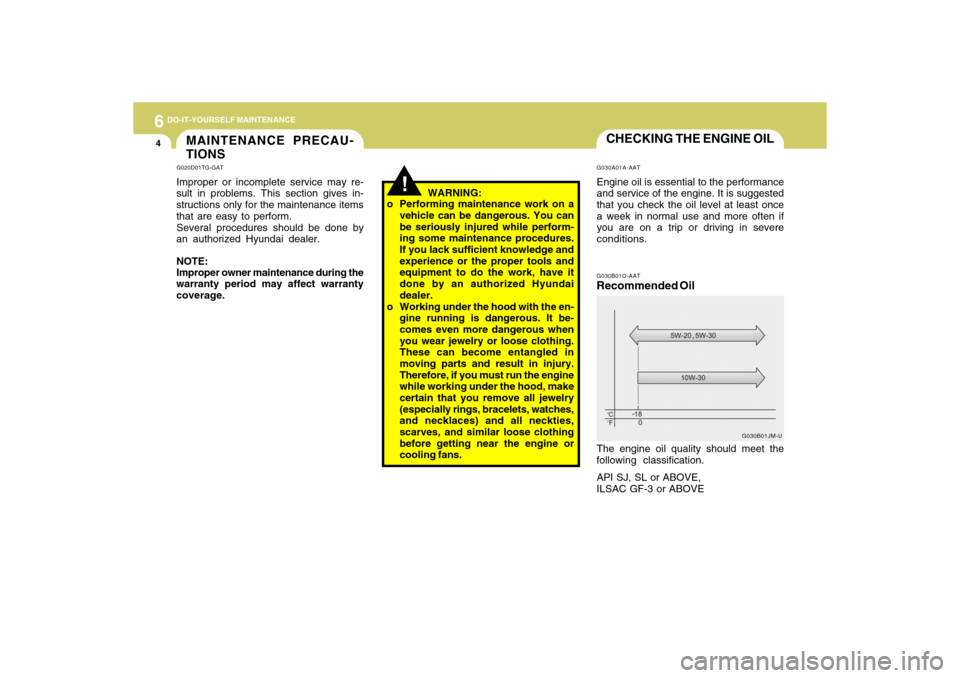
conditions.G030B01O-AATRecommended OilThe engine oil quality should meet the
following classification.
API SJ, SL or ABOVE,
ILSAC GF-3 or ABOVE
G030B01JM-U
MAINTENANCE PRECAU-
TIONS
!
G020D01TG-GATImproper or incomplete service may re-
sult in problems. This section gives in-
structions only for the maintenance items
that are easy to perform.
Several procedures should be done by
an authorized Hyundai dealer.
NOTE:
Improper owner maintenance during the
warranty period may affect warranty
coverage.WARNING:
o Performing maintenance work on a
vehicle can be dangerous. You can
be seriously injured while perform-
ing some maintenance procedures.
If you lack sufficient knowledge and
experience or the proper tools and
equipment to do the work, have it
done by an authorized Hyundai
dealer.
o Working under the hood with the en-
gine running is dangerous. It be-
comes even more dangerous when
you wear jewelry or loose clothing.
These can become entangled in
moving parts and result in injury.
Therefore, if you must run the engine
while working under the hood, make
certain that you remove all jewelry
(especially rings, bracelets, watches,
and necklaces) and all neckties,
scarves, and similar loose clothing
before getting near the engine or
cooling fans.
Page 216 of 266
6
DO-IT-YOURSELF MAINTENANCE
11
!
G100A01MC-GATTransaxle lubricant in the manual
transaxle should be checked at those
intervals specified in the vehicle mainte-
nance schedule in Section 5.
!CHECKING THE TRANSAXLE
OIL (MANUAL)
!
CAUTION:
o Radiator anti-freeze (engine coolant)
should not be used in the washer
system because it will damage the
car's finish.
o The washer should not be operated
if the washer reservoir is empty.
This can damage the washer fluid
pump.WARNING:
It is always better to check the transaxle
oil level when the engine is cool or cold.
If the engine is hot, you should exercise
great caution to avoid burning yourself
on hot engine or exhaust parts.
WARNING:
o Windshield washer fluid agents con-
tain some amounts of alcohol and
can be flammable under certain cir-
cumstances. Do not allow sparks or
flame to contact the washer fluid or
the washer fluid reservoir. Damage
to the vehicle or its occupants could
occur.
o Windshield washer fluid is poison-
ous to humans and animals. Do not
drink windshield washer fluid. Seri-
ous injury or death could occur.NOTE:
It is recommended that the manual
transaxle fluid should be checked by an
authorized Hyundai dealer.
G110A01MC-AATTransaxle fluid in the automatic transaxle
should be checked at those intervals
specified in the vehicle maintenance
schedule in Section 5.
NOTE:
Automatic transaxle fluid is basically a
red color. As driving distance increases,
the fluid color turns darkish red gradu-
ally. It is a normal condition and you
should not judge the need to replace
based upon the changing color.
You must replace the automatic
transaxle fluid in accordance with inter-
vals specified in the vehicle mainte-
nance schedule in section 5.CHECKING THE TRANSAXLE
FLUID (AUTOMATIC)
Page 218 of 266
6
DO-IT-YOURSELF MAINTENANCE
13
CHECKING THE BRAKES!
G120A01A-AAT
G120B01A-AATChecking the Brake Fluid Level
CAUTION:
Because brakes are essential to the
safe operation of the car, it is sug-
gested that they be checked and in-
spected by your Hyundai dealer. The
brakes should be checked and in-
spected for wear at those intervals
specified in the vehicle maintenance
schedule in Section 5.
!
WARNING:
Use caution when handling brake fluid.
It can damage your vision if it gets into
your eyes. It will also damage your
vehicle's paint if spilled on it and not
removed immediately.
!
WARNING:
The cooling fan is controlled by the
engine coolant temperature and may
sometimes operate even when the en-
gine is not running. Use extreme cau-
tion when working near the blades of
the cooling fan, so that you are not
injured by a rotating fan blade. As the
engine coolant temperature decreases,
the fan will automatically shut off. This
is a normal condition.
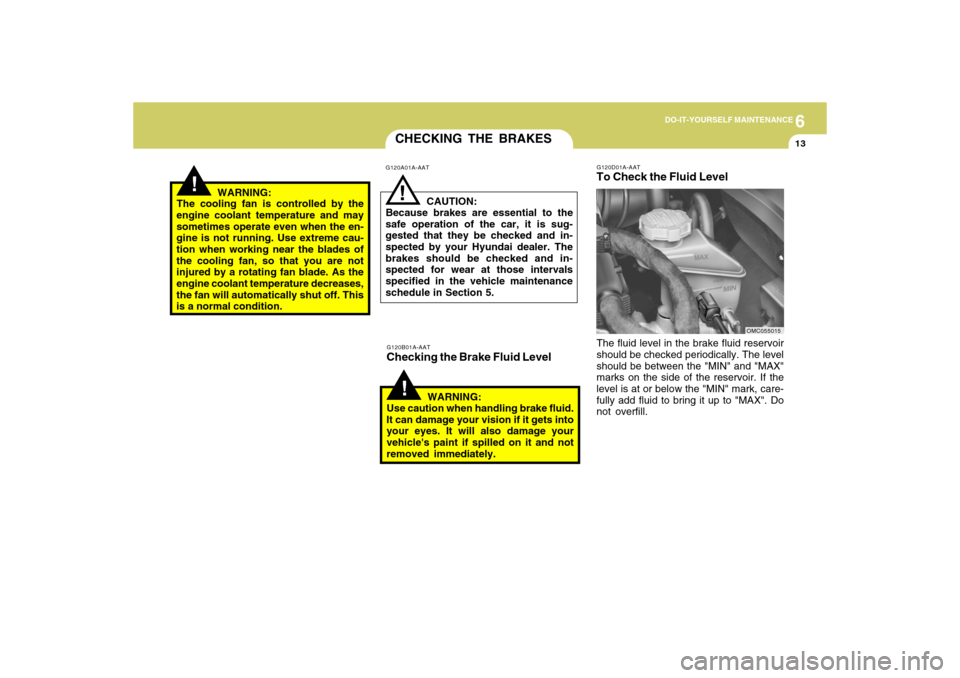
G120D01A-AATTo Check the Fluid LevelThe fluid level in the brake fluid reservoir
should be checked periodically. The level
should be between the "MIN" and "MAX"
marks on the side of the reservoir. If the
level is at or below the "MIN" mark, care-
fully add fluid to bring it up to "MAX". Do
not overfill.
OMC055015
Page 226 of 266

6
DO-IT-YOURSELF MAINTENANCE
21
G240A01A-AATPOWER STEERING HOSESIt is suggested that you check the power
steering hose connections for fluid leak-
age at those intervals specified in the
vehicle maintenance schedule in Section
5.
The power steering hoses should be re-
placed if there is severe surface cracking,
pulling, scuffing or worn spots. Deteriora-
tion of the hose could cause premature
failure.
POWER STEERING FLUID
LEVELG230A01MC-AAT(If Installed)The power steering fluid level should be
checked regularly. To check the power
steering fluid level, be sure the engine is
"OFF", then check to make certain that the
power steering fluid level is between the
"MAX" and "MIN" level markings on the
fluid reservoir.NOTE:
o Grinding noise from the power steer-
ing pump may be heard immediately
after the engine is started in ex-
tremely cold conditions (below -4°F).
If the noise stops during warm up,
there is no abnormal function in the
system. It is due to a power steering
fluid characteristic in extremely cold
conditions.
o Do not start the engine when the
power steering oil reservoir is empty.
OMC055014
FOR MORE INFORMATION
ABOUT YOUR HYUNDAIG250A01A-AATIf you desire additional information about
maintaining and servicing your Hyundai,
you may purchase a factory Shop Manual
at your Hyundai dealer's parts depart-
ment. This is the same manual used by
dealership technicians and while it is
highly technical it can be useful in obtain-
ing a better understanding of your car
and how it works.