2009 HUMMER H3 display
[x] Cancel search: displayPage 186 of 382

And, of course, actual stopping
distances vary greatly with the
surface of the road, whether it is
pavement or gravel; the condition of
the road, whether it is wet, dry, or
icy; tire tread; the condition of
the brakes; the weight of the vehicle;
and the amount of brake force
applied.
Avoid needless heavy
braking. Some people drive in
spurts — heavy acceleration
followed by heavy braking — rather
than keeping pace with traffic.
This is a mistake. The brakes might
not have time to cool between
hard stops. The brakes will wear out
much faster with a lot of heavy
braking. Keeping pace with
the traffic and allowing realistic
following distances eliminates a lot
of unnecessary braking. That
means better braking and longer
brake life.
If the vehicle ever loses electrical
power while it is being driven, brake
normally but do not pump the
brakes. If the brakes are pumped,the pedal could get harder to push
down. If the vehicle loses electrical
power, there will still be some
power brake assist but it will be
used when the brake is applied.
Once the power assist is used up, it
can take longer to stop, the brake
pedal will be harder to push,
and you might experience longer
pedal travel.
Adding non-dealer/non-retailer
accessories can affect vehicle
performance. SeeAccessories and
Modifications on page 5-3.
Hill Start Assist
This vehicle has a Hill Start Assist
(HSA) feature, which may be
useful when the vehicle is stopped
on a grade. This feature is
designed to prevent the vehicle from
rolling, either forward or rearward,
during vehicle drive off. After
the vehicle is stopped on an incline,
push the brake pedal completely
to the oor to activate Hill StartAssist. When the system activates,
a chime will sound and the HSA
ON message will be displayed.
Letting off the brake pedal slightly or
applying the accelerator pedal to
disengage Hill Start Assist gives the
driver two seconds to pull forward
or back up before the vehicle
starts to roll. Lightly ease off the
brake pedal to disengage Hill
Start Assist. The brakes will
automatically be held for a maximum
of two seconds while the driver
switches from applying the brakes
to pushing the accelerator pedal.
When Hill Start Assist is active, the
driver might experience a “hard
pedal.” This is normal and does not
affect safe brake operation.
On steeper hills, Hill Start Assist will
only activate if the driver tries to
move the vehicle up the hill. It will
not activate if the vehicle is in a
drive gear and facing downhill or if
the vehicle is facing uphill and
in R (Reverse).
4-4 Driving Your Vehicle
Page 188 of 382

Braking in Emergencies
ABS allows the driver to steer
and brake at the same time. In many
emergencies, steering can help
more than even the very best
braking.
Brake Assist
This vehicle has a Brake Assist
feature designed to assist the driver
in stopping or decreasing vehicle
speed in emergency driving
conditions. This feature uses the
stability system hydraulic brake
control module to supplement the
power brake system under
conditions where the driver has
quickly and forcefully applied
the brake pedal in an attempt to
quickly stop or slow down the
vehicle. The stability system
hydraulic brake control module
increases brake pressure at each
corner of the vehicle until the
ABS activates. Minor brake pedal
pulsations or pedal movement
during this time is normal and the
driver should continue to applythe brake pedal as the driving
situation dictates The Brake Assist
feature will automatically disengage
when the brake pedal is released
or brake pedal pressure is quickly
decreased.
StabiliTrak®System
The vehicle has a vehicle stability
enhancement system called
StabiliTrak. It is an advanced
computer controlled system that
assists the driver with directional
control of the vehicle in difficult
driving conditions.
StabiliTrak activates when the
computer senses a discrepancy
between the intended path and the
direction the vehicle is actually
traveling. StabiliTrak selectively
applies braking pressure at any one
of the vehicle’s brakes to assist
the driver with keeping the vehicle
on the intended path.
When the vehicle is started and
begins to move, the system
performs several diagnostic checksto insure there are no problems.
The system may be heard or
felt while it is working. This is normal
and does not mean there is a
problem with the vehicle.
If cruise control is being used when
StabiliTrak activates, the cruise
control automatically disengages.
The cruise control can be
re-engaged when road conditions
allow. SeeCruise Control on
page 3-9.
If there is a problem detected with
StabiliTrak, a SERVICE STAB
SYS message displays on the Driver
Information Center (DIC). See
DIC Warnings and Messages on
page 3-37for more information.
When this message is displayed, the
system is not working. Adjust your
driving accordingly.
StabiliTrak comes on automatically
whenever the vehicle is started
and resets itself at each ignition
cycle. However, when the transfer
case is placed in Four-Wheel-Low
Lock mode, StabiliTrak is
4-6 Driving Your Vehicle
Page 189 of 382

automatically disabled. See
Full-Time Four-Wheel Drive on
page 2-24for more information. It is
recommended to leave the system
on for normal driving conditions,
but it may be necessary to turn the
system off if the vehicle is stuck
in sand, mud, ice, or snow, and it is
necessary to “rock” the vehicle to
attempt to free it. SeeIf Your
Vehicle is Stuck in Sand, Mud, Ice,
or Snow on page 4-33.
To turn the system off, press and
hold the TCS/StabiliTrak button until
the traction off light comes on.
This light comes on steady when
TCS has been turned off. This light
ashes when StabiliTrak is active.To Turn off TCS and StabiliTrak,
press and hold the TCS/StabiliTrak
button until the STAB SYS OFF
message displays on the DIC. Press
and release the TCS/StabiliTrak
button again to turn StabiliTrak
back on. See “Traction Control
System (TCS)”, following, for more
information on turning TCS off
and on.
Traction Control
System (TCS)
The vehicle has a Traction Control
System (TCS) that limits wheel
spin. This is especially useful
in slippery road conditions. The
system operates only if it senses
that any of the wheels are spinning
or beginning to lose traction.
When this happens, TCS reduces
engine power. The system may
be heard or felt while it is working.
This is normal and does not
mean there is a problem with the
vehicle.TCS can operate on dry roads
under some conditions. When this
happens, the system may be
heard working or a reduction in
acceleration may be noticed. This is
normal and does not mean there
is a problem with the vehicle.
Examples of these conditions
include hard acceleration in a turn,
an abrupt upshift or downshift of
the transmission or driving on rough
roads.
If cruise control is being used when
TCS begins to limit wheel spin,
the cruise control automatically
disengages. The cruise control
can be re-engaged when road
conditions allow. SeeCruise Control
on page 3-9for more information.
TRACTION FAULT appears on
the Driver information Center (DIC)
when a TCS or antilock brake
system problem has been detected
and the vehicle needs service.
When this message is on, the
system will not limit wheel spin.
Driving Your Vehicle 4-7
Page 244 of 382

{CAUTION
Fuel can spray out on you if you
open the fuel cap too quickly.
If you spill fuel and then
something ignites it, you could
be badly burned. This spray can
happen if the tank is nearly full,
and is more likely in hot weather.
Open the fuel cap slowly and wait
for any hiss noise to stop. Then
unscrew the cap all the way.
Be careful not to spill fuel. Do not
top off or overll the tank and wait
a few seconds after you have
nished pumping before removing
the nozzle. Clean fuel from
painted surfaces as soon as
possible. SeeWashing Your
Vehicle on page 5-86.When replacing the fuel cap,
turn it clockwise until it clicks.
Make sure the cap is fully
installed. The diagnostic system
can determine if the fuel cap
has been left off or improperly
installed. This would allow fuel to
evaporate into the atmosphere.
SeeMalfunction Indicator Lamp
on page 3-30.
The FUEL CAP message displays
on the Driver Information Center
(DIC) if the fuel cap is not properly
installed. SeeDIC Warnings
and Messages on page 3-37for
more information.
{CAUTION
If a re starts while you are
refueling, do not remove the
nozzle. Shut off the ow of fuel
by shutting off the pump or by
notifying the station attendant.
Leave the area immediately.Notice:If you need a new fuel
cap, be sure to get the right type.
Your dealer/retailer can get one
for you. If you get the wrong type,
it may not t properly. This may
cause the malfunction indicator
lamp to light and may damage the
fuel tank and emissions system.
SeeMalfunction Indicator
Lamp on page 3-30.
Filling a Portable Fuel
Container
{CAUTION
Never ll a portable fuel container
while it is in the vehicle. Static
electricity discharge from the
container can ignite the fuel
(Continued)
5-8 Service and Appearance Care
Page 252 of 382

When the system has calculated
that oil life has been diminished,
it indicates that an oil change
is necessary. A CHANGE OIL
message comes on. SeeDIC
Warnings and Messages on
page 3-37. Change the oil as soon
as possible within the next
600 miles (1 000 km). It is possible
that, if driving under the best
conditions, the oil life system might
not indicate that an oil change is
necessary for over a year. However,
the engine oil and lter must be
changed at least once a year and
at this time the system must be
reset. Your dealer/retailer has
trained people who will perform this
work using genuine parts and reset
the system. It is also important
to check the oil regularly and keep it
at the proper level.
If the system is ever reset
accidentally, the oil must be
changed at 3,000 miles (5 000 km)
since the last oil change.
Remember to reset the oil life
system whenever the oil is changed.How to Reset the Engine Oil
Life System
The Engine Oil Life System
calculates when to change the
engine oil and lter based on vehicle
use. Whenever the oil is changed,
reset the system so it can calculate
when the next oil change is required.
If a situation occurs where the oil is
changed prior to a CHANGE OIL
message being turned on, reset the
system.
To reset the Engine Oil Life system:
1. With the engine off, turn the
ignition to ON/RUN.
2. Press and release the stem in
the lower center of the
instrument cluster until the OIL
LIFE message is displayed.
3. Once the alternating OIL LIFE
and RESET messages appear,
press and hold the stem until
several beeps sound. This
conrms that the oil life system
has been reset.
4. Turn the key to LOCK/OFF.If the CHANGE OIL message
comes back on when the vehicle is
started, the engine oil life system
has not reset. Repeat the procedure.
SeeDIC Warnings and Messages
on page 3-37.
What to Do with Used Oil
Used engine oil contains certain
elements that can be unhealthy for
your skin and could even cause
cancer. Do not let used oil stay on
your skin for very long. Clean your
skin and nails with soap and water,
or a good hand cleaner. Wash or
properly dispose of clothing or rags
containing used engine oil. See the
manufacturer’s warnings about the
use and disposal of oil products.
Used oil can be a threat to the
environment. If you change your own
oil, be sure to drain all the oil from the
lter before disposal. Never dispose
of oil by putting it in the trash, pouring
it on the ground, into sewers, or into
streams or bodies of water. Recycle
it by taking it to a place that collects
used oil.
5-16 Service and Appearance Care
Page 263 of 382

Engine Overheating
The vehicle has an indicator to warn
of engine overheating.
A coolant temperature gage is
displayed on the instrument panel.
SeeEngine Coolant Temperature
Gage on page 3-29.
You may decide not to lift the hood
when this warning appears, but
instead get service help right away.
SeeRoadside Service on page 7-6.
If you do decide to lift the hood,
make sure the vehicle is parked on
a level surface.
Then check to see if the engine
cooling fans are running. If the
engine is overheating, both fans
should be running. If they are not, do
not continue to run the engine and
have the vehicle serviced.The air conditioning might stop
working if the engine is too hot.
This is normal and helps cool the
engine.
Notice:Engine damage from
running the engine without
coolant is not covered by the
warranty.
Notice:If the engine catches re
because of being driven with
no coolant, your vehicle can be
badly damaged. The costly
repairs would not be covered by
the vehicle warranty.
If Steam Is Coming From The
Engine Compartment
{CAUTION
Steam from an overheated engine
can burn you badly, even if you
just open the hood. Stay away
from the engine if you see or hear
steam coming from it. Just turn it
off and get everyone away from
the vehicle until it cools down.
Wait until there is no sign of
steam or coolant before you
open the hood.
If you keep driving when your
engine is overheated, the liquids
in it can catch re. You or others
could be badly burned. Stop your
engine if it overheats, and get
out of the vehicle until the engine
is cool.
Service and Appearance Care 5-27
Page 264 of 382

If No Steam Is Coming From
The Engine Compartment
If an engine overheat warning is
displayed but no steam can be seen
or heard, the problem may not be
too serious. Sometimes the engine
can get a little too hot when the
vehicle:
Climbs a long hill on a hot day.
Stops after high-speed driving.
Idles for long periods in traffic.
Tows a trailer. See “Driving
on Grades” underTowing a
Trailer on page 4-42.
If the overheat warning is displayed
with no sign of steam:
1. Turn the air conditioning off.
2. Turn the heater on to the highest
temperature and to the highest
fan speed. Open the windows as
necessary.3. In heavy traffic, let the engine idle
in N (Neutral) while stopped. If it
is safe to do so, pull off the road,
shift to P (Park) or N (Neutral) and
let the engine idle.
If the temperature overheat gage is
no longer in the overheat zone
or an overheat warning no longer
displays, the vehicle can be driven.
Continue to drive the vehicle
slow for about 10 minutes. Keep a
safe vehicle distance from the
car in front of you. If the warning
does not come back on, continue to
drive normally.
If the warning continues, pull over,
stop, and park the vehicle right away.
If there is no sign of steam, idle the
engine for three minutes while
parked. If the warning is still
displayed, turn off the engine until
it cools down.
Engine Fan Noise
This vehicle has a clutched engine
cooling fan. When the clutch is
engaged, the fan spins faster
to provide more air to cool the
engine. In most everyday driving
conditions, the clutch is not
engaged. This improves fuel
economy and reduces fan noise.
Under heavy vehicle loading,
trailer towing and/or high outside
temperatures, the fan speed
increases when the clutch engages.
So you may hear an increase in
fan noise. This is normal and should
not be mistaken as the transmission
slipping or making extra shifts.
It is merely the cooling system
functioning properly. The fan will
slow down when additional cooling
is not required and the clutch
disengages.
You may also hear this fan noise
when you start the engine. It will go
away as the fan clutch disengages.
5-28 Service and Appearance Care
Page 290 of 382
Tire Pressure Monitor
Operation
This vehicle may have a Tire
Pressure Monitor System (TPMS).
The TPMS is designed to warn
the driver when a low tire pressure
condition exists. TPMS sensors
are mounted onto each tire and
wheel assembly on the vehicle,
excluding the spare tire. The TPMS
sensors monitor the air pressure
in the vehicle’s tires and transmit the
tire pressure readings to a receiver
located in the vehicle.
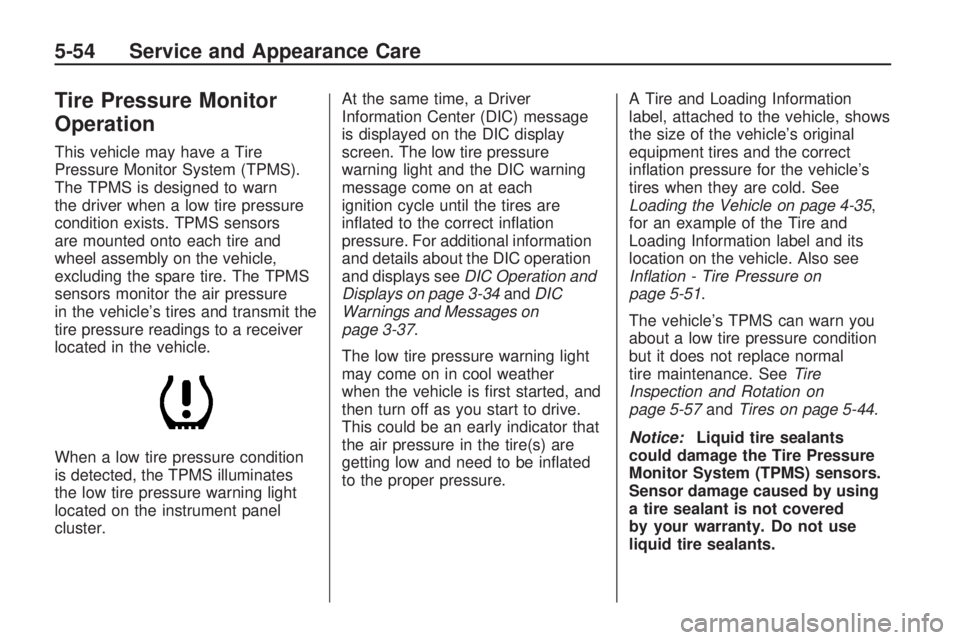
When a low tire pressure condition
is detected, the TPMS illuminates
the low tire pressure warning light
located on the instrument panel
cluster.At the same time, a Driver
Information Center (DIC) message
is displayed on the DIC display
screen. The low tire pressure
warning light and the DIC warning
message come on at each
ignition cycle until the tires are
inated to the correct ination
pressure. For additional information
and details about the DIC operation
and displays seeDIC Operation and
Displays on page 3-34andDIC
Warnings and Messages on
page 3-37.
The low tire pressure warning light
may come on in cool weather
when the vehicle is rst started, and
then turn off as you start to drive.
This could be an early indicator that
the air pressure in the tire(s) are
getting low and need to be inated
to the proper pressure.A Tire and Loading Information
label, attached to the vehicle, shows
the size of the vehicle’s original
equipment tires and the correct
ination pressure for the vehicle’s
tires when they are cold. See
Loading the Vehicle on page 4-35,
for an example of the Tire and
Loading Information label and its
location on the vehicle. Also see
Inflation - Tire Pressure on
page 5-51.
The vehicle’s TPMS can warn you
about a low tire pressure condition
but it does not replace normal
tire maintenance. SeeTire
Inspection and Rotation on
page 5-57andTires on page 5-44.
Notice:Liquid tire sealants
could damage the Tire Pressure
Monitor System (TPMS) sensors.
Sensor damage caused by using
a tire sealant is not covered
by your warranty. Do not use
liquid tire sealants.
5-54 Service and Appearance Care