2009 HUMMER H2 trailer
[x] Cancel search: trailerPage 389 of 524

If you get the ENGINE COOLANT HOT message with
no sign of steam, try this for a minute or so:
1. Turn on the heater to full hot at the highest fan
speed and open the windows as necessary.
2. If you are in a traffic jam, shift to N (Neutral);
otherwise, shift to the highest gear while
driving—D(Drive).
If you no longer have the overheat warning, you can
drive. Just to be safe, drive slower for about 10 minutes.
If the warning does not come back on, you can drive
normally.
If the warning continues and you have not stopped, pull
over, stop, and park the vehicle right away.
If there is still no sign of steam, push down the
accelerator until the engine speed is about twice as fast
as normal idle speed for at least three minutes while
you are parked. If you still have the warning, turn off the
engine and get everyone out of the vehicle until it
cools down. Also, see “Overheated Engine Protection
Operating Mode” later in this section.
You may decide not to lift the hood but to get service
help right away.Overheated Engine Protection
Operating Mode
If an overheated engine condition exists and the
ENGINE POWER IS REDUCED message is displayed,
an overheat protection mode which alternates ring
groups of cylinders helps prevent engine damage. In this
mode, you will notice a loss in power and engine
performance. This operating mode allows the vehicle to
be driven to a safe place in an emergency. Driving
extended miles (km) and/or towing a trailer in the
overheat protection mode should be avoided.
Notice:After driving in the overheated engine
protection operating mode, to avoid engine damage,
allow the engine to cool before attempting any
repair. The engine oil will be severely degraded.
Repair the cause of coolant loss, change the oil and
reset the oil life system. SeeEngine Oil on
page 5-15.
5-35
Page 468 of 524

Fuses Usage
1 Left Trailer Stop/Turn Lamp
2 Engine Controls
3Engine Control Module, Throttle
Control
4 Right Trailer Stop/Turn LampFuses Usage
5 Front Washer
6 Oxygen Sensors
7Vehicle Stability System, Antilock
Brake System-2
8 Trailer Back-up Lamps
5-114
Page 469 of 524
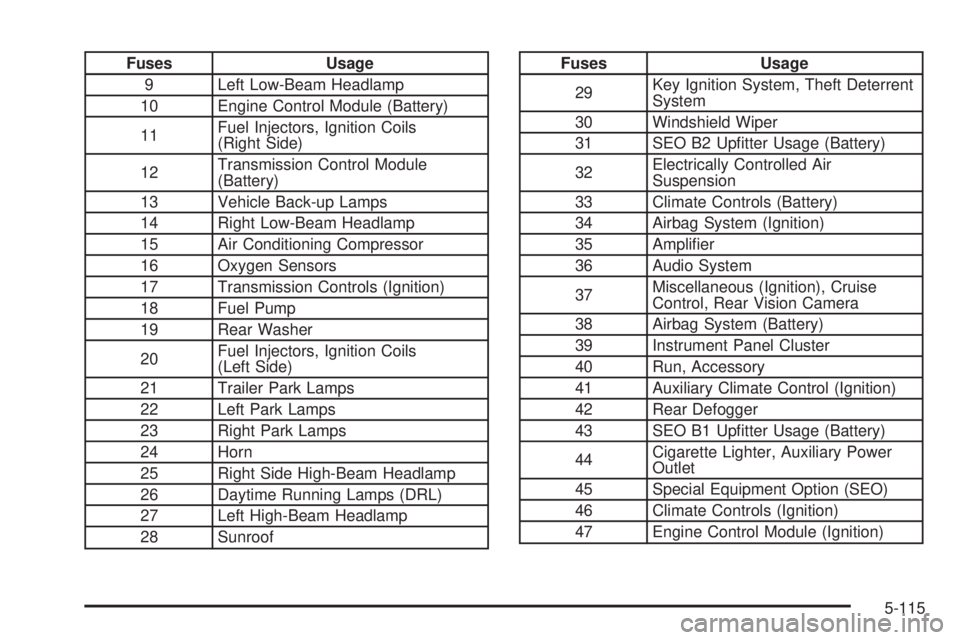
Fuses Usage
9 Left Low-Beam Headlamp
10 Engine Control Module (Battery)
11Fuel Injectors, Ignition Coils
(Right Side)
12Transmission Control Module
(Battery)
13 Vehicle Back-up Lamps
14 Right Low-Beam Headlamp
15 Air Conditioning Compressor
16 Oxygen Sensors
17 Transmission Controls (Ignition)
18 Fuel Pump
19 Rear Washer
20Fuel Injectors, Ignition Coils
(Left Side)
21 Trailer Park Lamps
22 Left Park Lamps
23 Right Park Lamps
24 Horn
25 Right Side High-Beam Headlamp
26 Daytime Running Lamps (DRL)
27 Left High-Beam Headlamp
28 SunroofFuses Usage
29Key Ignition System, Theft Deterrent
System
30 Windshield Wiper
31 SEO B2 Uptter Usage (Battery)
32Electrically Controlled Air
Suspension
33 Climate Controls (Battery)
34 Airbag System (Ignition)
35 Amplier
36 Audio System
37Miscellaneous (Ignition), Cruise
Control, Rear Vision Camera
38 Airbag System (Battery)
39 Instrument Panel Cluster
40 Run, Accessory
41 Auxiliary Climate Control (Ignition)
42 Rear Defogger
43 SEO B1 Uptter Usage (Battery)
44Cigarette Lighter, Auxiliary Power
Outlet
45 Special Equipment Option (SEO)
46 Climate Controls (Ignition)
47 Engine Control Module (Ignition)
5-115
Page 470 of 524

Fuses Usage
50 Cooling Fan 1 (J-Case)
51Electronically Controlled Air
Suspension (J-Case)
52Vehicle Stability System, Antilock
Brake System-1 (J-Case)
53 Cooling Fan 2 (J-Case)
54 Starter (J-Case)
55Stud 2 Trailer Brake Module
(J-Case)
56Left Bussed Electrical Center 1
(J-Case)
57Heated Windshield Washer System
(J-Case)
58 Four-Wheel Drive System (J-Case)
59Stud 1 Trailer Connector Battery
Power (J-Case)Fuses Usage
60Mid Bussed Electrical Center 1
(J-Case)
61 Climate Control Blower (J-Case)
62Left Bussed Electrical Center 2
(J-Case)
Relays Usage
A/C CMPRSR Air Conditioning Compressor
FAN CNTRL Cooling Fan Control
FAN HI Cooling Fan High Speed
FAN LO Cooling Fan Low Speed
HDLP LO Low-Beam Headlamp
PRK LAMP Parking Lamps
PWR/TRN Powertrain
REAR DEFOG Rear Defogger
RUN/CRNK Switched Power
STRTR Starter
5-116
Page 480 of 524

(d)Inspect wiper blades for wear, cracking, or
contamination. Clean the windshield and wiper blades, if
contaminated. Replace wiper blades that are worn or
damaged. See Windshield Wiper Blade Replacement on
page 5-56 and Windshield, Backglass, and Wiper Blades
on page 5-107 for more information.
(e)Make sure the safety belt reminder light and safety
belt assemblies are working properly. Look for any
other loose or damaged safety belt system parts. If you
see anything that might keep a safety belt system
from doing its job, have it repaired. Have any torn or
frayed safety belts replaced. Also see Checking
the Restraint Systems on page 1-80.
(f)Lubricate all key lock cylinders, hood latch assembly,
secondary latch, pivots, spring anchor, release pawl,
rear compartment hinges, outer liftgate handle pivot
points, rear door detent link, roller mechanism, liftgate
handle pivot points, latch bolt, fuel door hinge, cargo door
hinge, locks, and folding seat hardware. More frequent
lubrication may be required when exposed to a corrosive
environment. Applying silicone grease on weatherstrips
with a clean cloth will make them last longer, seal better,
and not stick or squeak.Spare tire carrier hinge and latch: Inspect for leaks and
lubricate if required. Remove the setscrew at the hinge
casting and add lubricant, moving the hinge back and
forth periodically, until lubricant can be seen coming
from the setscrew opening. Install setscrew and tighten
to7ftlb(9Y). SeeRecommended Fluids and
Lubricants on page 6-13 for what lubricant to use.
(g)Check vent hose at transfer case for kinks and
proper installation. Check to be sure vent hose is
unobstructed, clear, and free of debris. During any
maintenance, if a power washer is used to clean mud
and dirt from the underbody, care should be taken to
not directly spray the transfer case output seals.
High pressure water can overcome the seals and
contaminate the transfer case fluid. Contaminated fluid
will decrease the life of the transfer case and should
be replaced.
(h)Change automatic transmission fluid and filter if the
vehicle is mainly driven under one or more of these
conditions:
In heavy city traffic where the outside temperature
regularly reaches 90°F (32°C) or higher.
In hilly or mountainous terrain.
When doing frequent trailer towing.
Uses such as found in taxi, police, or delivery
service.
6-8
Page 481 of 524

(i)Drain, flush, and refill cooling system. This service can
be complex; you should have your dealer/retailer perform
this service. See Engine Coolant on page 5-31 for what to
use. Inspect hoses. Clean radiator, condenser, pressure
cap, and filler neck. Pressure test the cooling system and
pressure cap.
(j)A fluid loss in any vehicle system could indicate a
problem. Have the system inspected and repaired and
the fluid level checked. Add fluid if needed.
(k)Visually inspect belt for fraying, excessive cracks, or
obvious damage. Replace belt if necessary.
(l)Severe Service: Change transfer case fluid if the
vehicle is mainly used for trailer towing or driven in city
traffic, wet environment, or high ambient temperatures.
Owner Checks and Services
These owner checks and services should be performed
at the intervals specied to help ensure vehicle safety,
dependability, and emission control performance. Your
dealer/retailer can assist with these checks and services.
Be sure any necessary repairs are completed at once.
Whenever any uids or lubricants are added to the
vehicle, make sure they are the proper ones, as shown
inRecommended Fluids and Lubricants on page 6-13.
At Each Fuel Fill
It is important to perform these underhood checks at
each fuel fill.
Engine Oil Level Check
Notice:It is important to check the engine oil
regularly and keep it at the proper level. Failure to
keep the engine oil at the proper level can cause
damage to the engine not covered by the vehicle
warranty.
Check the engine oil level and add the proper oil if
necessary. SeeEngine Oil on page 5-15.
Engine Coolant Level Check
Check the engine coolant level and add DEX-COOL®
coolant mixture if necessary. SeeEngine Coolant
on page 5-31.
Windshield Washer Fluid Level Check
Check the windshield washer uid level in the windshield
washer uid reservoir and add the proper uid if
necessary.
6-9
Page 523 of 524

Tool Kit .........................................................4-42
Tow/Haul Mode ...............................................2-36
Tow/Haul Mode Light.......................................3-44
Towing
Recreational Vehicle.....................................4-50
Towing a Trailer..........................................4-55
Your Vehicle...............................................4-50
Traction
Control System (TCS).................................... 4-9
StabiliTrak
®System....................................... 4-6
Trailer
Recommendations.......................................4-68
Transmission
Fluid, Automatic...........................................5-23
Transmission Operation, Automatic....................2-32
Trip Odometer................................................3-31
Turn and Lane-Change Signals.......................... 3-8
Turn Signal/Multifunction Lever........................... 3-8
U
Uniform Tire Quality Grading............................5-74
Universal Home Remote System.......................2-57
Operation...................................................2-58
V
Vehicle
Control........................................................ 4-3
Loading......................................................4-44
Running While Parked..................................2-46
Symbols......................................................... iii
Vehicle Customization, DIC..............................3-64
Vehicle Data Recording and Privacy..................7-16
Vehicle Identication
Number (VIN)............................................5-109
Service Parts Identication Label..................5-109
Vehicle, Remote Start....................................... 2-7
Ventilation Adjustment......................................3-27
Visors...........................................................2-23
Voltmeter Gage..............................................3-36
13