2009 HUMMER H2 climate control
[x] Cancel search: climate controlPage 324 of 524

Blizzard Conditions
Being stuck in snow can be in a serious situation. Stay
with the vehicle unless there is help nearby. If possible,
use theRoadside Service on page 7-7. To get help and
keep everyone in the vehicle safe:
Turn on theHazard Warning Flashers on page 3-6.
Tie a red cloth to an outside mirror.
{CAUTION:
Snow can trap engine exhaust under the vehicle.
This may cause exhaust gases to get inside.
Engine exhaust contains carbon monoxide (CO)
which cannot be seen or smelled. It can cause
unconsciousness and even death.
If the vehicle is stuck in the snow:
Clear away snow from around the base of
your vehicle, especially any that is blocking
the exhaust pipe.
Check again from time to time to be sure
snow does not collect there.
CAUTION: (Continued)
CAUTION: (Continued)
Open a window about two inches (5 cm) on
the side of the vehicle that is away from the
wind to bring in fresh air.
Fully open the air outlets on or under the
instrument panel.
Adjust the Climate Control system to a setting
that circulates the air inside the vehicle and
set the fan speed to the highest setting.
See Climate Control System in the Index.
For more information about carbon monoxide, see
Engine Exhaust on page 2-45.
Snow can trap exhaust gases under your vehicle.
This can cause deadly CO (carbon monoxide) gas
to get inside. CO could overcome you and kill you.
You cannot see it or smell it, so you might not
know it is in your vehicle. Clear away snow from
around the base of your vehicle, especially any
that is blocking the exhaust.
Run the engine for short periods only as needed to
keep warm, but be careful.
To save fuel, run the engine for only short periods as
needed to warm the vehicle and then shut the engine off
and close the window most of the way to save heat.
4-38
Page 349 of 524

Trailer Brakes
A loaded trailer that weighs more than 2,000 lbs
(900 kg) needs to have its own brake system that is
adequate for the weight of the trailer. Be sure to read
and follow the instructions for the trailer brakes so
they are installed, adjusted and maintained properly.
Since the vehicle is equipped with StabiliTrak
®, the trailer
brakes cannot tap into the vehicle’s hydraulic brake
system.
Driving with a Trailer
{CAUTION:
When towing a trailer, exhaust gases may collect
at the rear of the vehicle and enter if the liftgate,
trunk/hatch, or rear-most window is open.
Engine exhaust contains carbon monoxide (CO)
which cannot be seen or smelled. It can cause
unconsciousness and even death.
CAUTION: (Continued)
CAUTION: (Continued)
To maximize safety when towing a trailer:
Have the exhaust system inspected for leaks
and make necessary repairs before starting
a trip.
Never drive with the liftgate, trunk/hatch, or
rear-most window open.
Fully open the air outlets on or under the
instrument panel.
Adjust the Climate Control system to a setting
that brings in only outside air and set the fan
speed to the highest setting. See Climate
Control System in the Index.
For more information about carbon monoxide, see
Engine Exhaust on page 2-45.
Towing a trailer requires a certain amount of experience.
Get to know the rig before setting out for the open
road. Get acquainted with the feel of handling and
braking with the added weight of the trailer. And always
keep in mind that the vehicle you are driving is now
longer and not as responsive as the vehicle is by itself.
4-63
Page 361 of 524

Fuels containing MMT can reduce the life of spark plugs
and the performance of the emission control system
could be affected. The malfunction indicator lamp might
turn on. If this occurs, return to your dealer/retailer for
service.
Fuel E85 (85% Ethanol)
This vehicle can use either unleaded gasoline or
85% ethanol fuel (E85). We encourage the use of
E85 in vehicles that are designed to use it. The ethanol
in E85 is a “renewable” fuel, meaning it is made from
renewable sources such as corn and other crops.
Many service stations will not have an 85% ethanol fuel
(E85) pump available. The U. S. Department of Energy
has an alternative fuels website (www.eere.energy.gov/
afdc/infrastructure/locator.html) that can help you nd
E85 fuel. Those stations that do have E85 should have a
label indicating ethanol content. Do not use the fuel if the
ethanol content is greater than 85%.
At a minimum, E85 should meet ASTM Specication
D 5798. By denition, this means that fuel labeled E85
will have an ethanol content between 70% and 85%.
Filling the fuel tank with fuel mixtures that do not meet
ASTM specications can affect driveability and could
cause the malfunction indicator lamp to come on.
To ensure quick starts in the wintertime, the E85 fuel
must be formulated properly for your climate according to
ASTM specication D 5798. If you have trouble startingon E85, it could be because the E85 fuel is not properly
formulated for your climate. If this happens, switching to
gasoline or adding gasoline to the fuel tank can improve
starting. For good starting and heater efficiency below
32°F (0°C), the fuel mix in the fuel tank should contain
no more than 70% ethanol. It is best not to alternate
repeatedly between gasoline and E85. If you do switch
fuels, it is recommended that you add as much fuel as
possible — do not add less than three gallons (11 L)
when refueling. You should drive the vehicle immediately
after refueling for at least seven miles (11 km) to allow the
vehicle to adapt to the change in ethanol concentration.
E85 has less energy per gallon than gasoline, so you will
need to rell the fuel tank more often when using E85
than when you are using gasoline. SeeFilling the
Tank on page 5-8.
Notice:Some additives are not compatible with
E85 fuel and can harm the vehicle’s fuel system.
Do not add anything to E85. Damage caused by
additives would not be covered by the vehicle
warranty.
Notice:This vehicle was not designed for fuel that
contains methanol. Do not use fuel containing
methanol. It can corrode metal parts in the fuel
system and also damage plastic and rubber parts.
That damage would not be covered under the
vehicle warranty.
5-7
Page 429 of 524

Treadwear
The treadwear grade is a comparative rating
based on the wear rate of the tire when tested
under controlled conditions on a specied
government test course. For example, a tire
graded 150 would wear one and a half (1.5) times
as well on the government course as a tire
graded 100. The relative performance of tires
depends upon the actual conditions of their use,
however, and may depart signicantly from
the norm due to variations in driving habits, service
practices, and differences in road characteristics
and climate.
Traction – AA, A, B, C
The traction grades, from highest to lowest, are
AA, A, B, and C. Those grades represent the tire’s
ability to stop on wet pavement as measured under
controlled conditions on specied government test
surfaces of asphalt and concrete. A tire marked C
may have poor traction performance.
{WARNING:
The traction grade assigned to this tire is
based on straight-ahead braking traction
tests, and does not include acceleration,
cornering, hydroplaning, or peak traction
characteristics.
5-75
Page 465 of 524

Instrument Panel Fuse Block
The instrument panel fuse block access door is located
on the driver side edge of the instrument panel.
Fuses Usage
AUX PWRRear Cargo Accessory Power
Outlets
AUX PWR 2 Floor Console Power Outlets
BCM Body Control Module
Fuses Usage
CTSYDome Lamps, Front Passenger Side
Turn Signal
DDM Driver Door Module
DIM Instrument Panel Back Lighting
DSM Drive Seat Module
INFOInfotainment System, Remote
Keyless Entry System
IS LPS Interior Lamps
LCK 1 Power Door Lock 1 (Lock Feature)
LCK2 Power Door Lock 2 (Lock Feature)
LT DRDriver Side Power Window Circuit
Breaker
LT STOP TRN Driver Side Turn Signal, Stoplamp
ONSTAR OnStar
®
PDM Passenger Door Module
REAR HVAC Rear Climate Controls
REAR SEAT Rear Seats
5-111
Page 469 of 524
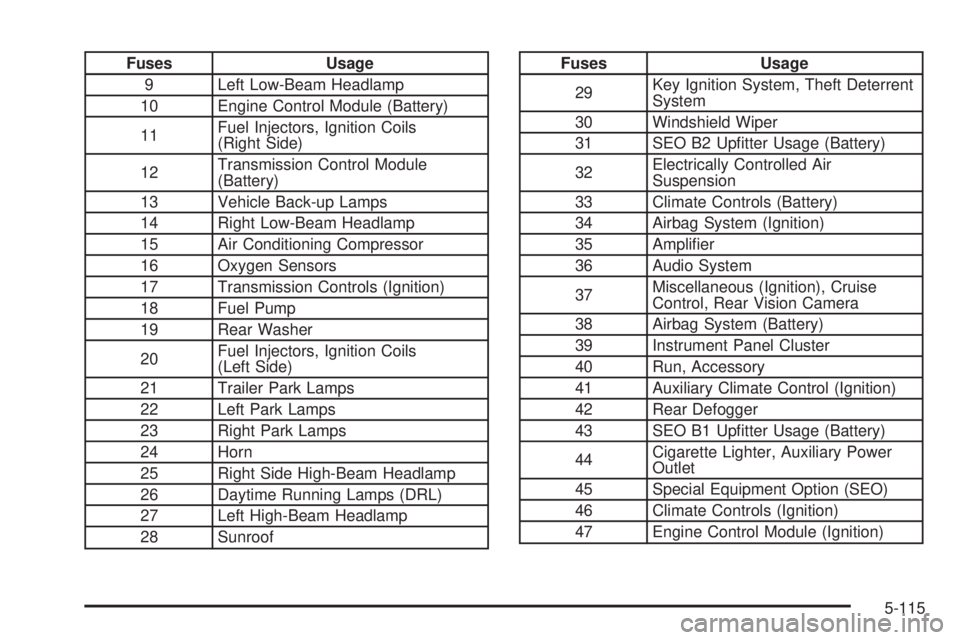
Fuses Usage
9 Left Low-Beam Headlamp
10 Engine Control Module (Battery)
11Fuel Injectors, Ignition Coils
(Right Side)
12Transmission Control Module
(Battery)
13 Vehicle Back-up Lamps
14 Right Low-Beam Headlamp
15 Air Conditioning Compressor
16 Oxygen Sensors
17 Transmission Controls (Ignition)
18 Fuel Pump
19 Rear Washer
20Fuel Injectors, Ignition Coils
(Left Side)
21 Trailer Park Lamps
22 Left Park Lamps
23 Right Park Lamps
24 Horn
25 Right Side High-Beam Headlamp
26 Daytime Running Lamps (DRL)
27 Left High-Beam Headlamp
28 SunroofFuses Usage
29Key Ignition System, Theft Deterrent
System
30 Windshield Wiper
31 SEO B2 Uptter Usage (Battery)
32Electrically Controlled Air
Suspension
33 Climate Controls (Battery)
34 Airbag System (Ignition)
35 Amplier
36 Audio System
37Miscellaneous (Ignition), Cruise
Control, Rear Vision Camera
38 Airbag System (Battery)
39 Instrument Panel Cluster
40 Run, Accessory
41 Auxiliary Climate Control (Ignition)
42 Rear Defogger
43 SEO B1 Uptter Usage (Battery)
44Cigarette Lighter, Auxiliary Power
Outlet
45 Special Equipment Option (SEO)
46 Climate Controls (Ignition)
47 Engine Control Module (Ignition)
5-115
Page 470 of 524

Fuses Usage
50 Cooling Fan 1 (J-Case)
51Electronically Controlled Air
Suspension (J-Case)
52Vehicle Stability System, Antilock
Brake System-1 (J-Case)
53 Cooling Fan 2 (J-Case)
54 Starter (J-Case)
55Stud 2 Trailer Brake Module
(J-Case)
56Left Bussed Electrical Center 1
(J-Case)
57Heated Windshield Washer System
(J-Case)
58 Four-Wheel Drive System (J-Case)
59Stud 1 Trailer Connector Battery
Power (J-Case)Fuses Usage
60Mid Bussed Electrical Center 1
(J-Case)
61 Climate Control Blower (J-Case)
62Left Bussed Electrical Center 2
(J-Case)
Relays Usage
A/C CMPRSR Air Conditioning Compressor
FAN CNTRL Cooling Fan Control
FAN HI Cooling Fan High Speed
FAN LO Cooling Fan Low Speed
HDLP LO Low-Beam Headlamp
PRK LAMP Parking Lamps
PWR/TRN Powertrain
REAR DEFOG Rear Defogger
RUN/CRNK Switched Power
STRTR Starter
5-116
Page 513 of 524

Chains, Tire...................................................5-77
Charging System Light....................................3-35
Check
Engine Lamp..............................................3-40
Checking Things Under the Hood......................5-11
Chemical Paint Spotting.................................5-108
Child Restraints
Child Restraint Systems...............................1-47
Infants and Young Children...........................1-43
Lower Anchors and Tethers for Children..........1-51
Older Children.............................................1-40
Securing a Child Restraint in a
Rear Seat Position...................................1-62
Securing a Child Restraint in the
Right Front Seat Position..........................1-64
Where to Put the Restraint...........................1-50
Cigarette Lighter.............................................3-21
Cleaning
Aluminum Wheels......................................5-107
Exterior Lamps/Lenses................................5-106
Fabric/Carpet............................................5-103
Finish Care...............................................5-106
Instrument Panel, Vinyl, and Other
Plastic Surfaces.....................................5-104
Interior.....................................................5-102
Leather....................................................5-104
Speaker Covers.........................................5-105
Tires........................................................5-108
Underbody Maintenance.............................5-108
Washing Your Vehicle.................................5-105Cleaning (cont.)
Weatherstrips............................................5-105
Windshield, Backglass, and Wiper Blades......5-107
Wood Panels............................................5-104
Climate Control System
Dual Automatic............................................3-22
Outlet Adjustment........................................3-27
Rear Air Conditioning and Heating System,
Electronic................................................3-28
Clock............................................................
3-21
Clock, Setting.................................................3-73
Collision Damage Repair..................................7-11
Compass.......................................................3-54
Content Theft-Deterrent....................................2-24
Control of a Vehicle.......................................... 4-3
Coolant
Engine.......................................................5-31
Engine Temperature Gage............................3-39
Cooling System..............................................5-27
Cruise Control................................................3-12
Cruise Control Light........................................3-44
Cupholders....................................................2-64
Customer Assistance Information
Courtesy Transportation................................7-10
Customer Assistance for
Text Telephone (TTY) Users........................ 7-6
Customer Assistance Offices........................... 7-6
Customer Satisfaction Procedure..................... 7-2
GM Mobility Reimbursement Program............... 7-7
Reporting Safety Defects to General Motors....7-15
3