Page 43 of 427
CONT INUED
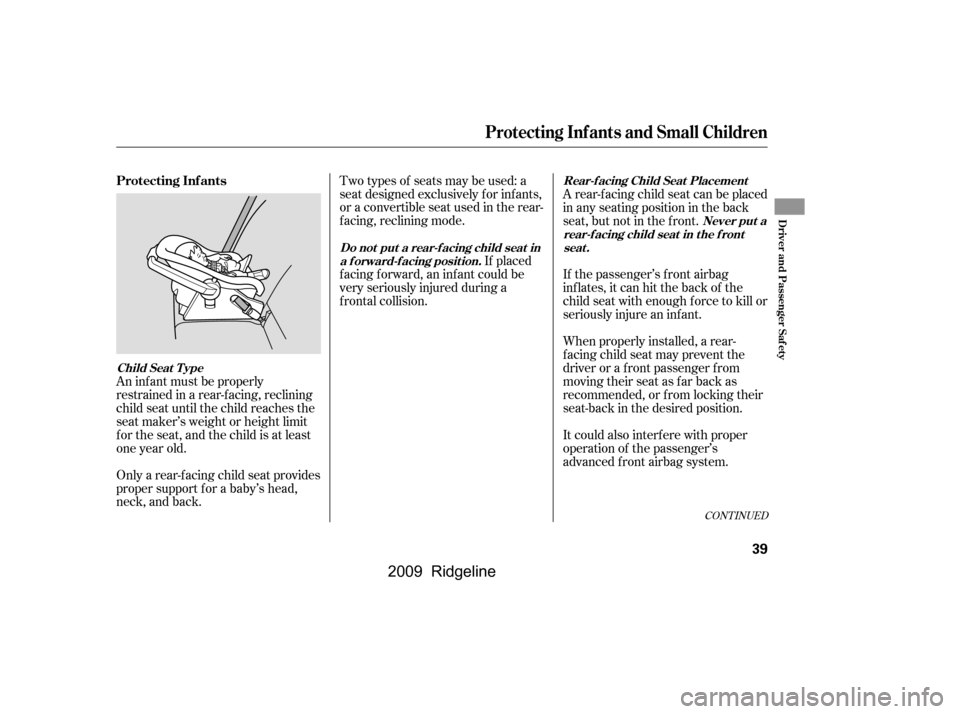
An inf ant must be properly
restrained in a rear-f acing, reclining
child seat until the child reaches the
seat maker’s weight or height limit
f or the seat, and the child is at least
one year old.
Only a rear-f acing child seat provides
proper support f or a baby’s head,
neck, and back.Two types of seats may be used: a
seat designed exclusively f or inf ants,
or a convertible seat used in the rear-
f acing, reclining mode.
If placed
f acing f orward, an inf ant could be
very seriously injured during a
f rontal collision. A rear-f acing child seat can be placed
in any seating position in the back
seat, but not in the f ront.
If the passenger’s front airbag
inflates, it can hit the back of the
child seat with enough f orce to kill or
seriously injure an inf ant.
When properly installed, a rear-
f acing child seat may prevent the
driver or a f ront passenger f rom
moving their seat as far back as
recommended, or f rom locking their
seat-back in the desired position.
It could also interf ere with proper
operation of the passenger’s
advanced front airbag system.
Protecting Inf ants
Child Seat T ype
Do not put a rear-f acing child seat in
a f orward-f acing position. Never put a
rear-f acing child seat in t he f ront seat .
Rear-f acing Child Seat Placement
Protecting Inf ants and Small Children
Driver and Passenger Saf ety
39
�\f���—�\f���—�\f���y�
�������������y���
�(���������\f�y�\f�\f�����y
2009 Ridgeline
Page 57 of 427

If you decide that a child can saf ely
ride up f ront, be sure to:Caref ully read the owner’s manual,
and make sure you understand all
seat belt instructions and all saf ety
inf ormation.
Move the vehicle seat to the rear-
most position.
Have the child sit up straight, back
against the seat, and feet on or
near the f loor.
Check that the child’s seat belt is
properly and securely positioned.
Physically, a child must be large
enough f or the lap/shoulder belt to
properly f it (see pages and ). If
the seat belt does not f it properly,
with or without the child sitting on a
booster seat, the child should not sit
in f ront.
To saf ely ride in f ront, a child must
be able to f ollow the rules, including
sitting properly, and wearing the seat
belt properly throughout a ride.
A side airbag also poses risks. If any
part of a larger child’s body is in the
path of a deploying side airbag, the
child could receive possibly serious
injuries.
If the passenger’s front airbag
inf lates in a moderate to severe
f rontal collision, the airbag can cause
serious injuries to a child who is
unrestrained, improperly restrained,
sitting too close to the airbag, or out
of position.
The National Highway Traffic Safety
Administration and Transport
Canada recommend that all children
age 12 and under be properly
restrained in the back seat. Of course, children vary widely. And
while age may be one indicator of
when a child can saf ely ride in f ront,
there are other important f actors you
should consider.
Supervise the child. Even a mature
child sometimes needs to be
reminded to f asten the seat belt or
sit properly.
1651
Physical Size
Maturity
When Can a L arger Child Sit in
Front
Protecting L arger Children
Driver and Passenger Saf ety
53
�\f���—�\f���—�\f���y�
������\f����\f�y���
�(���������\f�y�\f�\f�����y
2009 Ridgeline
Page 60 of 427
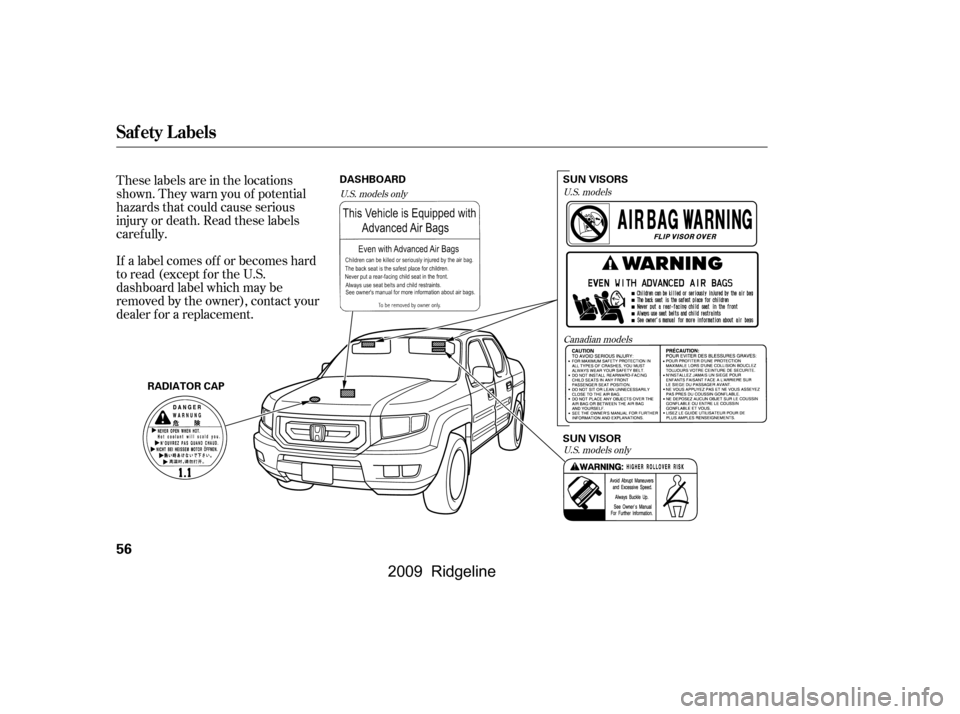
These labels are in the locations
shown. They warn you of potential
hazards that could cause serious
injury or death. Read these labels
caref ully.
If a label comes of f or becomes hard
to read (except for the U.S.
dashboard label which may be
removed by the owner), contact your
dealer f or a replacement.U.S. modelsCanadian models
U.S. models only
U.S. models only
Saf ety L abels
56
RADIATOR CAPDASHBOARD
SUN VISORSUN VISORS
�\f���—�\f���—�\f���y�
������
��\f���y���
�(���������\f�y�\f�\f���
�y
2009 Ridgeline
Page 66 of 427

The instrument panel has many
indicators to give you important
inf ormation about your vehicle. This indicator comes on when youturn the ignition switch to the ON
(II) position. It reminds you and your
passengers to f asten your seat belts.
A beeper also sounds if you have not
f astened your seat belt.
If you turn the ignition switch to the
ON (II) position bef ore f astening
your seat belts, the beeper sounds,
and the indicator f lashes. If you do
not fasten your seat belts before the
beeper stops, the indicator stops
f lashing but remains on.If your f ront passenger does not
f asten their seat belt, the indicator
comes on about 6 seconds af ter the
ignition switch is turned to the ON
(II) position.
If either of you do not f asten your
seat belt while driving, the beeper
will sound and the indicator will f lash
again at regular intervals. For more
inf ormation, see page .
You will also see a ‘‘FASTEN SEAT
BELT’’ or ‘‘FASTEN PASSENGER
SEAT BELT’’ message on the multi-
inf ormation display (see page ).
For more inf ormation, see page .
20
20
90
On models with navigation system
Seat Belt Reminder
Indicator
Instrument Panel Indicators
62
�\f���—�\f���—�\f���y�
���������\f���y���
�(���������\f�y�\f�\f�����y
2009 Ridgeline
Page 68 of 427

This indicator comes on f or several
seconds when you turn the ignition
switch to the ON (II) position. If it
comes on at any other time, it
indicates a potential problem with
your f ront airbags. This indicator will
also alert you to a potential problem
with your side airbags, passenger’s
side airbag automatic cutoff system,
side curtain airbags, rollover sensor,
automatic seat belt tensioners,
driver’s seat position sensor, or the
f ront passenger’s weight sensors.
For more inf ormation, see page .You will also see a ‘‘CHECK
AIRBAG SYSTEM’’ message on the
multi-inf ormation display (see page
).
You will also see a ‘‘PASSENGER
SIDE AIRBAG OFF’’ message on the
multi-inf ormation display (see page).
This indicator comes on f or several
seconds when you turn the ignition
switch to the ON (II) position. If it
comes on at any other time, it
indicates that the passenger’s side
airbag has automatically shut off.
For more inf ormation, see page .
30 90
31
90
On models with navigation system
On models with navigation system
Side Airbag Of f
Indicator
Supplemental Restraint
System Indicator
Instrument Panel Indicators
64
U.S. Canada
�\f���—�\f���—�\f���y�
�����������
�y���
�(���������\f�y�\f�\f�����y
2009 Ridgeline
Page 70 of 427

This indicator normally comes on f or
a f ew seconds when you turn the
ignition switch to the ON (II)
position, and when the ignition
switch is turned to the START (III)
position. If it comes on at any other
time, there is a problem with the
ABS. If this happens, have your
vehicle checked at a dealer. With the
indicator on, your vehicle still has
normal braking ability but no anti-
lock brakes. For more inf ormation,
see page .This indicator comes on f or a f ew
seconds when you turn the ignition
switch to the ON (II) position. It will
go of f if you have inserted a properly
coded ignition key. If it is not a
properly coded key, the indicator will
blink and the engine will not start
(see page ).
This indicator also blinks several
times when you turn the ignition
switch f rom the ON (II) position to
the ACCESSORY (I) or LOCK (0)
position.
You will also see a ‘‘CHECK ABS
SYSTEM’’ message on the multi-
inf ormation display (see page ). The lef t or right turn signal indicator
blinks when you signal a lane change
or turn. If an indicator does not blink
or blinks rapidly, it usually means
one of the turn signal bulbs is
burned out (see pages and ).
Replace the bulb as soon as possible,
since other drivers cannot see that
you are signaling.
When you press the hazard warning
button, both turn signal indicators
and all turn signals on the outside of
the vehicle f lash.
289
91101
338340
On models with navigation system
Anti-lock Brake System
(A BS) IndicatorImmobilizer System
Indicator Turn Signal and
Hazard Warning
Indicators
Instrument Panel Indicators
66
�\f���—�\f���—�\f���y�
�������������y���
�(���������\f�y�\f�\f���
�y
2009 Ridgeline
Page 73 of 427
This indicator monitors the
temperature of the automatic
transmission f luid. It should come on
f or a f ew seconds when you turn the
ignition switch to the ON (II)
position. If it comes on while driving,
it means the transmission f luid
temperature is too high. Pull to the
side of the road when it is saf e, shif t
to Park, and let the engine idle until
the indicator goes out.
This indicator reminds you that the
exterior lights are on. It comes on
when you turn the headlight control
dial to either the or
position.
If you turn the ignition switch to the
ACCESSORY (I) or LOCK (0)
position without turning of f the
headlight control dial, this indicator
remains on. A reminder chime will
also sound when you open the driver’s
door. You will also see an ‘‘A/T TEMP
HIGH’’ message on the multi-
inf ormation display (see page ).91
On models with navigation system
Lights On Indicator A/T Temperature
Indicator
Instrument Panel Indicators
Inst rument s and Cont rols
69
Continuing to drive with the A/T
temperature indicator on may cause
serious damage to the transmission.
�\f���—�\f���—�\f���y�
���������\f�\f�y���
�(���������\f�y�\f�\f�����y
2009 Ridgeline
Page 74 of 427

This indicator normally comes on f or
a f ew seconds when you turn the
ignition switch to the ON (II)
position.
If itcomesonandstaysonatany
other time, or if it does not come on
when you turn the ignition switch to
the ON (II) position, there is a
problem with the VSA system. Take
your vehicle to a dealer to have it
checked. Without VSA, your vehicle
still has normal driving ability, but
will not have VSA traction and
stability enhancement. See pagef or more inf ormation on the
VSA system. You will also see a ‘‘CHECK VSA
SYSTEM’’ message on the multi-
inf ormation display (see page ).
This indicator normally comes on f or
a f ew seconds when you turn the
ignition switch to the ON (II)
position. If it comes on at any other
time, there is a problem in the 4WD
system. Take the vehicle to your
dealer to have it checked.
If the indicator blinks while driving,
the VTM-4 fluid temperature is too
high. Pull to the side of the road
when it is saf e, shif t to Park, and let
the engine idle until the indicator
goes out.
291 91
On models with navigation system
Instrument Panel Indicators
Vehicle Stability Assist
(VSA ) System Indicator
VTM-4 Indicator
70
Continuing to drive with the VTM-4
indicator blinking may cause serious
damage to the system.
�\f���—�\f���—�\f���y�
���������\f���y���
�(���������\f�y�\f�\f�����y
2009 Ridgeline