Page 454 of 578

When preparing to tow, and bef ore
driving away, be sure to check the
f ollowing:The added weight, length, and
height of a trailer will af f ect your
vehicle’s handling and perf ormance,
so driving with a trailer requires
some special driving skills and
techniques.
The vehicle has been properly
serviced, and the suspension and
the cooling system are in good
operating condition. The lights and brakes on your
vehicle and the trailer are working
properly.
Your vehicle tires and spare are in
good condition and properly
inf lated.
The trailer has been properly
serviced and is in good condition.
All weights and loads are within
limits.
Thehitch,safetychains,andany
other attachments are secure.
Allitemsonandinthetrailerare
properly secured and cannot shif t
while you drive. Foryoursafetyandthesafetyof
others,taketimetopracticedriving
maneuvers bef ore heading f or the
open road, and f ollow the guidelines
in this section.
Towing perf ormance can be
af f ected by high altitude, high
temperature, or when climbing
steep grades. Theref ore, premium
f uel (premium unleaded gasoline
with pump octane number of 91 or
higher) is recommended when
towing more than 3,500 lbs (1,590
kg).
The trailer tires and spare are in
good condition and inf lated as
recommended by the trailer
maker.
Towing a Trailer
Pre-T ow Checklist
Driving Saf ely With a T railer
450
�����—�����—�
���y�
�������������y���
�(�/���������y���������y
2009 Pilot
Page 461 of 578

This section explains why it is
important to keep your vehicle well
maintained and how to f ollow basic
maintenance saf ety precautions.
This section also includes
instructions on how to read the
maintenance minder messages on
the inf ormation display or multi-
inf ormation display (depending on
models), and instructions f or simple
maintenance tasks you may want to
take care of yourself .
If you have the skills and tools to
perf orm more complex maintenance
tasks on your vehicle, you may want
to purchase the service manual. See
page f or inf ormation on how to
obtain a copy, or see your dealer.......................
Maintenance Saf ety .458
....................
Maintenance Minder . 459
..............................
Fluid Locations .474
......
Engine Compartment Covers . 475
........................
Adding Engine Oil .476
Changing the Engine Oil and ...........................................
Filter .477
..............................
Engine Coolant .479
....................
Windshield Washers .481
....
Automatic Transmission Fluid . 482
.................
Rear Dif f erential Fluid . 484
.............
Transf er Assembly Fluid . 484
....................................
Brake Fluid .485
....................
Power Steering Fluid . 486
....................................
Timing Belt .486
.............................................
Lights .487
..................
Dust and Pollen Filter . 494
................
Cleaning the Seat Belts . 494
.....................................
Floor Mats .495
.................................
Wiper Blades .496
...............................................
Tires .500
...................
Checking the Battery . 508
.............................
Vehicle Storage .510
469
Maintenance
Maint enance
457
�����—�����—�
���y�
�������������y���
�(�/���������y���������y
2009 Pilot
Page 476 of 578
�µ�µ
�µ
Lights Check the operation of
the headlights, parking lights,
taillights, high-mount brake light,
and license plate lights monthly.
See page . Brakes Check the f luid level
monthly. See page .
Tires Check the tire pressure
monthly. Examine the tread f or
wear and foreign objects. See page .
501 485
487
Maintenance Minder
472
�����—�����—�
���y�
������
��
���y���
�(�/���������y���������y
2009 Pilot
Page 496 of 578
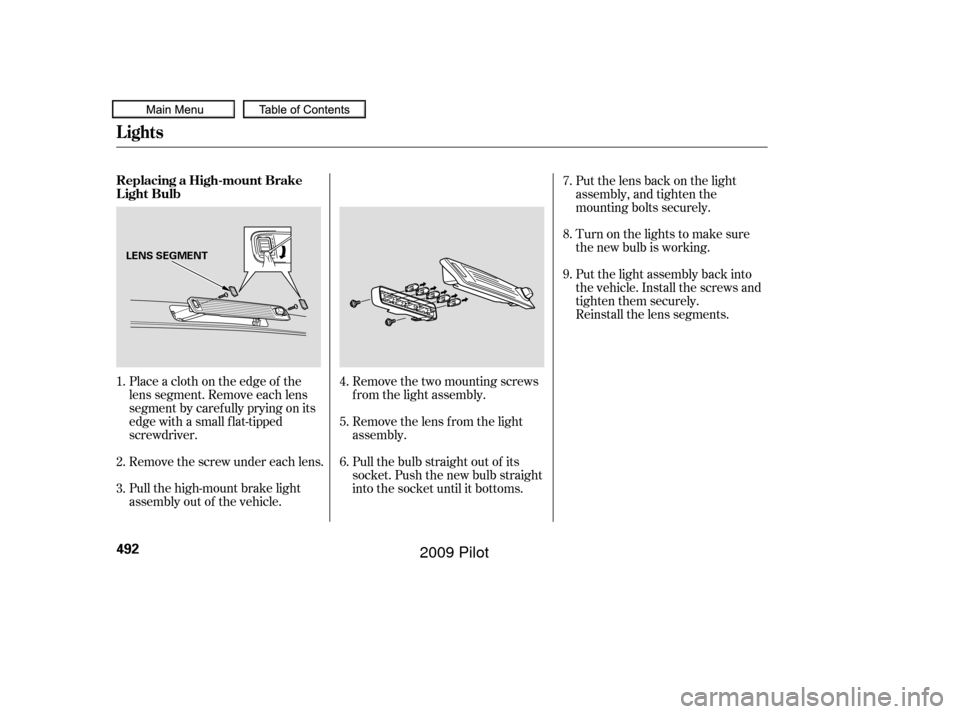
Place a cloth on the edge of the
lens segment. Remove each lens
segment by caref ully prying on its
edge with a small f lat-tipped
screwdriver.
Remove the screw under each lens.
Pull the high-mount brake light
assembly out of the vehicle.Remove the lens f rom the light
assembly.
Pull the bulb straight out of its
socket. Push the new bulb straight
into the socket until it bottoms.Turn on the lights to make sure
the new bulb is working. Put the lens back on the light
assembly, and tighten the
mounting bolts securely.
Put the light assembly back into
the vehicle. Install the screws and
tighten them securely.
Reinstall the lens segments.
Remove the two mounting screws
f rom the light assembly.
1.
2.
3. 4.
5.7.
8.
9.
6.
Lights
Replacing a High-mount Brake
Light Bulb
492
LENS SEGMENT
�����—�
���—�
���y�
����
��������y���
�(�/���������y���������y
2009 Pilot
Page 514 of 578

If you need to park your vehicle f or
an extended period (more than 1
month), there are several things you
should do to prepare it f or storage.
Proper preparation helps prevent
deterioration and makes it easier to
get your vehicle back on the road. If
possible, store your vehicle indoors.Fill the f uel tank. Block the rear wheels.
If the vehicle is to be stored f or a
longer period, it should be
supported on jackstands so the
tires are of f the ground.
Leave one window open slightly (if
the vehicle is being stored
indoors).
Disconnect the battery.
Support the f ront and rear wiper
blade arms with a f olded towel or
ragsotheydonottouchthe
windshield.
To minimize sticking, apply a
silicone spray lubricant to all door
and tailgate seals. Also, apply a
vehiclebodywaxtothepainted
surfaces that mate with the door
and tailgate seals.Cover the vehicle with a
‘‘breathable’’ cover, one made
f rom a porous material such as
cotton. Non-porous materials, such
as plastic sheeting, trap moisture,
which can damage the paint.
If possible, periodically run the
engine until it reaches f ull
operating temperature (the
cooling f ans cycle on and of f
twice). Pref erably, do this once a
month.
Wash and dry the exterior
completely.
Cleantheinterior.Makesurethe
carpeting, floor mats, etc., are
completely dry.
Leave the parking brake off. Put
the transmission in Park.
Vehicle Storage
510
�����—�����—�
���y�
�������������y���
�(�/���������y�����
���y
2009 Pilot
Page 517 of 578
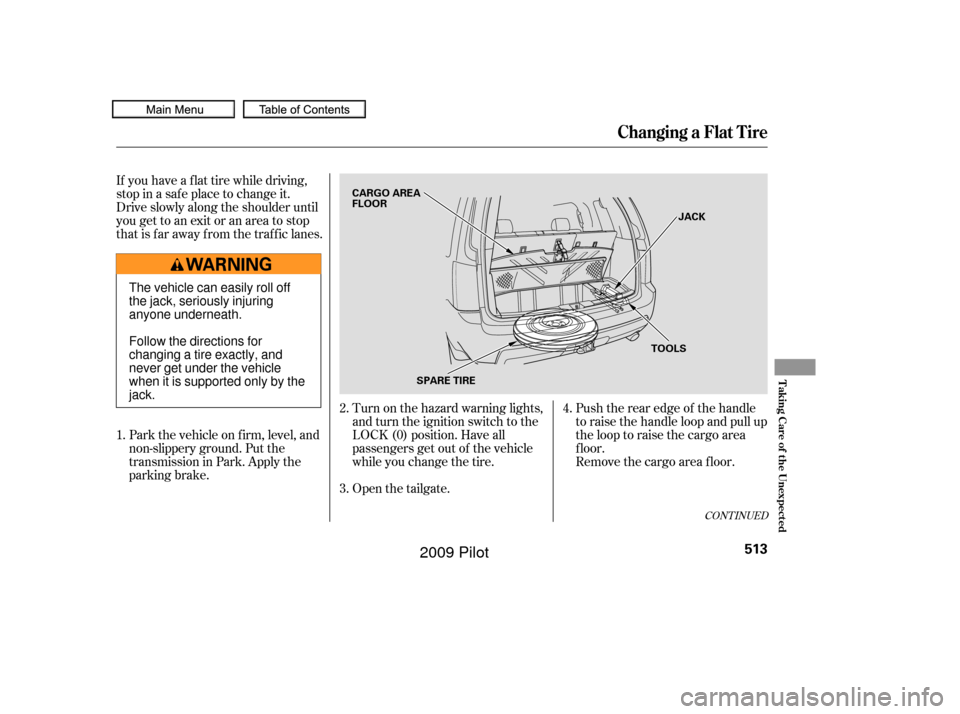
If you have a f lat tire while driving,
stop in a saf e place to change it.
Drive slowly along the shoulder until
you get to an exit or an area to stop
that is far away from the traffic lanes.Park the vehicle on f irm, level, and
non-slippery ground. Put the
transmission in Park. Apply the
parking brake. Turn on the hazard warning lights,
and turn the ignition switch to the
LOCK (0) position. Have all
passengers get out of the vehicle
while you change the tire.
Open the tailgate.Push the rear edge of the handle
to raise the handle loop and pull up
the loop to raise the cargo area
f loor.
Remove the cargo area floor.
2.
1.
3.4.
CONT INUED
Changing a Flat Tire
T aking Care of t he Unexpect ed
513
JACK
TOOLS
SPARE TIRE
CARGO AREA
FLOOR
The vehicle can easily roll off
the jack, seriously injuring
anyone underneath.
Follow the directions for
changing a tire exactly, and
never get under the vehicle
when it is supported only by the
jack.
�����—�����—�
���y�
�������������y���
�(�/���������y�����
���y
2009 Pilot
Page 525 of 578

Are you using the proper starting
procedure? Ref er toon page .
Do you have f uel? Check the f uel
gauge; the warning indicator may
not be working.
There may be an electrical
problem, such as no power to the
f uel pump. Check all the f uses
(see page ).
If youfindnothingwrong,youwill
need a qualif ied technician to f ind
the problem. See on page . Although this seems like a simple
procedure, you should take several
precautions.
You cannot start your vehicle by
pushing or pulling it.
Put the transmission in neutral or
Park, and set the parking brake. Turn of f all the electrical acces-
sories: heater, A/C, climate
control, audio system, lights, etc. Open the hood, and check the
physical condition of the battery.
In very cold weather, check the
condition of the electrolyte. If it
seems slushy or f rozen, do not try
jump starting until it thaws.
1.
2.
415
529 535
CONT INUED
Starting the
Engine
Emergency
Towing Jump Starting
To Jump Start Your Vehicle:
If the Engine Won’t Start, Jump Starting
T aking Care of t he Unexpect ed
521
A battery can explode if you do
not follow the correct procedure,
seriously injuring anyone
nearby.
Keep all sparks, open flames,
and smoking materials away
from the battery.
If a battery sits in extreme cold, the
electrolyte inside can f reeze.
Attempting to jump start with a f rozen
battery can cause it to rupture.
�����—�����—�
���y�
�������������y���
�(�/���������y���������y
2009 Pilot
Page 531 of 578

However, if the brake pedal does not
f eel normal, you should take
immediate action. A problem in one
part of the system’s dual circuit
design will still give you braking at
two wheels. You will f eel the brake
pedal go down much f arther bef ore
the vehicle begins to slow down, and
you will have to press harder on the
pedal.
The brake system
indicator normally
comes on when you turn the ignition
switch to the ON (II) position, and as
a reminder to check the parking
brake. It will stay on if you do not
f ully release the parking brake.
If the brake system indicator comes
on while driving, the brake f luid level
is probably low. Press lightly on the
brake pedal to see if it f eels normal.
If it does, check the brake f luid level
thenexttimeyoustopataservice
station (see page ). If the f luid level is low, take your
vehicle to a dealer, and have the
brake system inspected f or leaks or
worn brake pads.
Slow down by shif ting to a lower
gear, and pull to the side of the road
when it is saf e. Because of the long
distance needed to stop, it is
hazardous to drive the vehicle. You
should have it towed, and repaired as
soon as possible (see
on page ).
If you must drive the vehicle a short
distance in this condition, drive
slowly and caref ully.
If the ABS indicator and the VSA
system indicator come on with the
brake system indicator, have your
vehicle inspected by your dealer
immediately.
You will also see a ‘‘LOW BRAKE
FLUID’’ message on the multi-
inf ormation display (see page ). You will also see a ‘‘CHECK BRAKE
SYSTEM’’ message on the multi-
inf ormation display (see page ).
485
93 93535
On Touring models
On Touring models
Emergency
Towing
Brake System Indicator
T aking Care of t he Unexpect ed
527
U.S. Canada
�����—�����—�
���y�
�����������
�y���
�(�/���������y���������y
2009 Pilot