Page 432 of 532

Install a new oil f ilter according to
the instructions that come with it.
Put a new washer on the drain bolt,
then reinstall the drain bolt.
Tighten the drain bolt to:
Refill the engine with the
recommended oil.
Engine oil change capacity
(including f ilter):Replace the engine oil f ill cap.
Start the engine. The oil pressure
indicator should go out within 5
seconds. If it does not, turn of f the
engine, and check your work.
Let the engine run f or several
minutes, then check the drain bolt
and oil f ilter f or leaks.
Turn of f the engine and let it sit
f or several minutes, then check
the oil level on the dipstick. If
necessary, add more oil.
4.
5.
6.
7.
8.
9.
Changing the Engine Oil and Filter
Maint enance
429
29 lbf·ft (39 N·m , 4.0 kgf·m)
4.5 US qt (4.3
) Improper disposal of engine oil can be
harmf ul to the environment. If you
change your own oil, please dispose of
the used oil properly. Put it in a sealed
container, and take it to a recycling
center. Do not discard it in a trash bin
or dump it on the ground.
�\f���—�\f���—���
�y�
����
��������y���
�(���������\f�y�\f�������y
2009 Odyssey
Page 436 of 532
CONT INUED
Insert the dipstick all the way into
the transmission securely as
shown in the illustration.
Remove the dipstick, and check
the f luid level. It should be
between the upper and lower
marks.
Remove the dipstick (yellow loop)
f rom the transmission, and wipe it
with a clean cloth.
Check the f luid level with the engine
at normal operating temperature.
Park the vehicle on level ground.
Start the engine, let it run until the
radiator f an comes on, then shut
of f the engine. For accurate
results, wait about 60 seconds (but
no longer than 90 seconds) bef ore
doing step 2.
1.
2.3.
4.
Automatic Transmission Fluid
Maint enance
433
DIPSTICK HOT
MARK
UPPER MARK
LOWER MARK
�\f���—�\f���—���
�y�
����
����\f���y���
�(���������\f�y�\f�������y
2009 Odyssey
Page 454 of 532

CONT INUED
Even though your vehicle is
equipped with TPMS, we
recommend that you visually check
your tires every day. If you think a
tire might be low, check it
immediately with a tire gauge.
Use a gauge to measure the air
pressure in each tire at least once a
month. Even tires that are in good
condition may lose 1 to 2 psi (10 to
20 kPa, 0.1 to 0.2 kgf /cm ) per
month. Remember to check the
sparetireatthesametime.
Check the air pressures when the
tires are cold. This means the
vehicle has been parked f or at least 3
hours, or driven less than 1 mile (1.6
km). Add or release air, if needed, to
match the recommended cold tire
pressures.If you check air pressures when the
tires are hot [driven f or several miles
(kilometers)], you will see readings 4
to6psi(30to40kPa,0.3to0.4
kgf /cm ) higher than the cold
readings. This is normal. Do not let
air out to match the recommended
cold air pressure. The tire will be
underinf lated.
Youshoulduseyourowntire
pressure gauge whenever you check
your tire pressures. This will make it
easier f or you to tell if a pressure
loss is due to a tire problem and not
due to a variation between gauges.
While tubeless tires have some
ability to self -seal if they are
punctured, you should look closely
for punctures if a tire starts losing
pressure.
The following chart shows the
recommended cold tire pressures f or
most normal and high-speed driving
conditions.
Tire Size
Tire Size
Cold Tire Pressure for
Normal Driving
Front:
Rear:
Front:
Rear:
Cold Tire Pressure for
Normal Driving
EX-L models
LX, EX and Canadian DX models
Tires
Recommended T ire Pressures
Maint enance
451
235/65R16 103T
35 psi (240 kPa ,2.4 kgf/cm
)
33 psi (230 kPa ,
2.3 kgf/cm
)
235/65R16 103T 35 psi (240 kPa ,
2.4 kgf/cm
)
35 psi (240 kPa , 2.4 kgf/cm
)
�\f���—�\f���—���
�y�
����
��������y���
�(���������\f�y�\f�������y
2009 Odyssey
Page 464 of 532

This section covers the more
common problems that motorists
experience with their vehicles. It
gives you inf ormation about how to
safely evaluate the problem and what
to do to correct it. If the problem has
stranded you on the side of the road,
you may be able to get going again.
If not, you will also f ind instructions
on getting your vehicle towed................
Driving with a Flat Tire .462
..........
Michelin
PAXSystem .462
......................
Compact Spare Tire .465
....................
Changing a Flat Tire .466
.............
If the Engine Won’t Start .473
................................
Jump Starting .475
..............
If the Engine Overheats .477
.........
Low Oil Pressure Indicator .479
..........
Charging System Indicator .479
.......
Malf unction Indicator Lamp .480
...........................
Readiness Codes .480
...............
Brake System Indicator .481
..............................................
Fuses .482
..............................
Fuse Locations .485
......................
Emergency Towing .488
Taking Care of the Unexpected
T aking Care of t he Unexpect ed
461
�\f���—�\f���—���
�y�
����
����\f���y���
�(���������\f�y�\f�������y
2009 Odyssey
Page 465 of 532
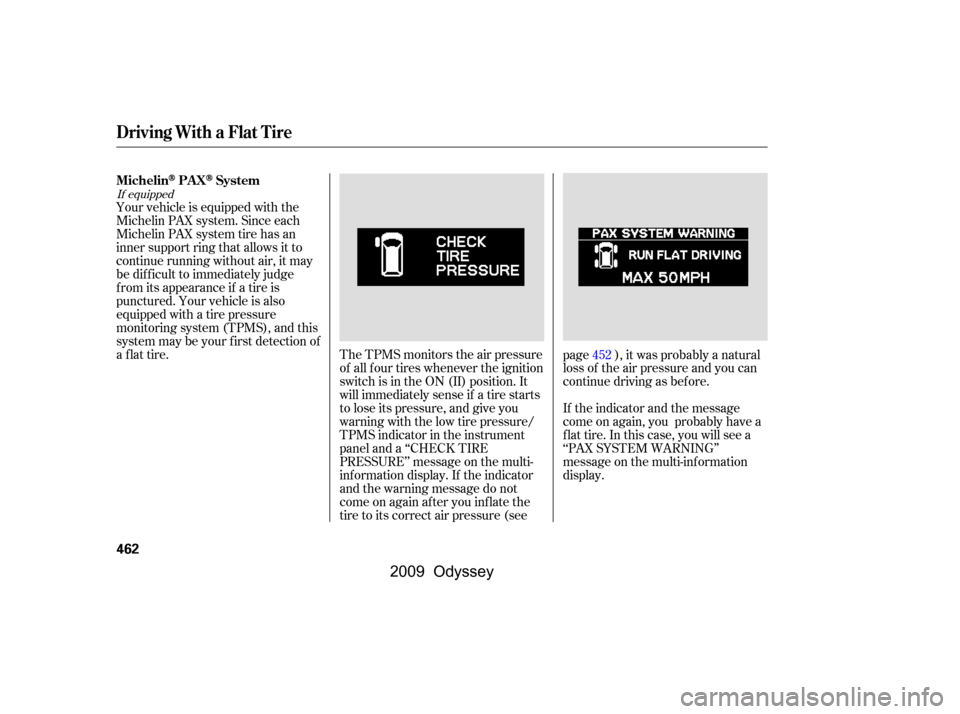
Your vehicle is equipped with the
Michelin PAX system. Since each
Michelin PAX system tire has an
inner support ring that allows it to
continue running without air, it may
be dif f icult to immediately judge
f rom its appearance if a tire is
punctured. Your vehicle is also
equipped with a tire pressure
monitoring system (TPMS), and this
system may be your f irst detection of
a f lat tire.The TPMS monitors the air pressure
of all f our tires whenever the ignition
switch is in the ON (II) position. It
will immediately sense if a tire starts
to lose its pressure, and give you
warning with the low tire pressure/
TPMS indicator in the instrument
panel and a ‘‘CHECK TIRE
PRESSURE’’ message on the multi-
inf ormation display. If the indicator
and the warning message do not
come on again af ter you inf late the
tire to its correct air pressure (see page ), it was probably a natural
loss of the air pressure and you can
continue driving as bef ore.
If the indicator and the message
come on again, you probably have a
flat tire. In this case, you will see a
‘‘PAX SYSTEM WARNING’’
message on the multi-information
display.
452
If equipped
Driving With a Flat Tire
MichelinPAXSystem
462
�\f���—�\f���—���
�y�
����
����
�\f�y���
�(���������\f�y�\f�������y
2009 Odyssey
Page 476 of 532

Diagnosing why the engine won’t
start f alls into two areas, depending
on what you hear when you turn the
ignition switch to the START (III)
position:You can hear the starter motor
operating normally, or the starter
motor sounds like it is spinning
f aster than normal, but the engine
does not start up and run.
You hear nothing, or almost
nothing. The engine’s starter
motor does not operate at all, or
operates very slowly. Turn the ignition switch to the
START (III) position. If the
headlights do not dim, check the
condition of the f uses. If the f uses
areOK,thereisprobably
something wrong with the
electrical circuit f or the ignition
switch or starter motor. You will
need a qualif ied technician to
determine the problem. See
on page .
If the headlights dim noticeably or
go out when you try to start the
engine, either the battery is
discharged or the connections are
corroded. Check the condition of the
battery and terminal connections
(see page ). You can then try
jump starting the vehicle from a
booster battery (see page ).
When you turn the ignition switch to
the START (III) position, you do not
hear the normal noise of the engine
trying to start. You may hear a
clicking sound, a series of clicks, or
nothing at all.
Check these things:
Check the transmission interlock.
The transmission must be in Park
or neutral or the starter will not
operate.
Turn the ignition switch to the ON
(II) position. Turn on the
headlights, and check their
brightness. If the headlights are
very dim or do not come on at all,
the battery is discharged. See on page .475 488
458 475
Emergency T owing
Nothing Happens or the Starter
Motor Operates Very Slowly
Jump Starting
If theEngineWon’tStart
T aking Care of t he Unexpect ed
473
�\f���—�\f���—���
�y�
����
��������y���
�(���������\f�y�\f�������y
2009 Odyssey
Page 477 of 532
If youfindnothingwrong,youwill
need a qualif ied technician to f ind
the problem. Seeon page .
Are you using a properly coded
key? An improperly coded key will
cause the immobilizer system
indicator in the instrument panel
to blink rapidly (see page ).
There may be an electrical
problem, such as no power to the
f uel pump. Check all the f uses
(see page ).
In this case, the starter motor’s
speed sounds normal, or even f aster
than normal, when you turn the
ignition switch to the START (III)
position, but the engine does not run.
Do you have f uel? Check the f uel
gauge; the low f uel indicator may
not be working.
Are you using the proper starting
procedure? Ref er to
on page . 143
385 483 488
Emergency
Towing
T he Starter Operates Normally
Starting the
Engine
If theEngineWon’tStart
474
�\f���—�\f���—���
�y�
����
������
�y���
�(���������\f�y�\f�������y
2009 Odyssey
Page 478 of 532
CONT INUED
Although this seems like a simple
procedure, you should take several
precautions.
You cannot start your vehicle by
pushing or pulling it.
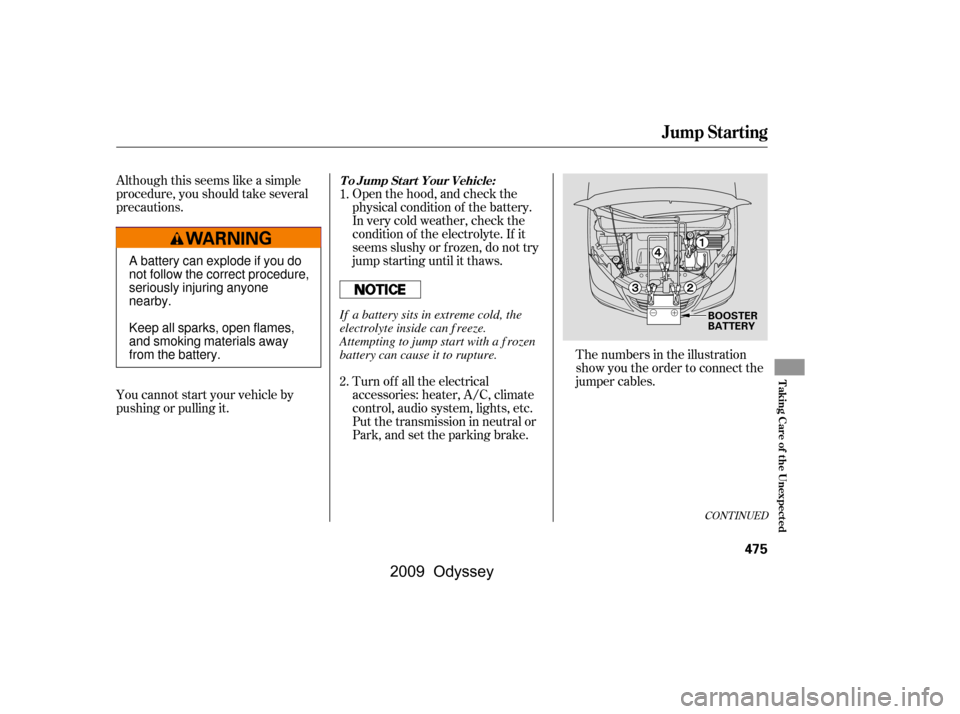
The numbers in the illustration
show you the order to connect the
jumper cables.
Open the hood, and check the
physical condition of the battery.
In very cold weather, check the
condition of the electrolyte. If it
seems slushy or f rozen, do not try
jump starting until it thaws.
Turn of f all the electrical
accessories: heater, A/C, climate
control, audio system, lights, etc.
Put the transmission in neutral or
Park, and set the parking brake.
1.
2.
To Jump Start Your Vehicle:
Jump Starting
T aking Care of t he Unexpect ed
475
BOOSTER BATTERY
A battery can explode if you do
not follow the correct procedure,
seriously injuring anyone
nearby.
Keep all sparks, open flames,
and smoking materials away
from the battery.
If a battery sits in extreme cold, the
electrolyte inside can f reeze.
Attempting to jump start with a f rozen
battery can cause it to rupture.
�����—�����—���
�y�
�������������y���
�(�����������y���������y
2009 Odyssey