Page 433 of 532
If Honda antif reeze/coolant is not
available, you may use another
major-brand non-silicate coolant as a
temporaryreplacement.Makesureit
is a high-quality coolant
recommended f or aluminum engines.
Continued use of any non-Honda
coolant can result in corrosion,
causing the cooling system to
malf unction or f ail. Have the cooling
system f lushed and ref illed with
Honda antif reeze/coolant as soon as
possible.
If the reserve tank is completely
empty, you should also check the
coolant level in the radiator.
Always use Honda Long-lif e Anti-
f reeze/Coolant Type 2. This coolant
is pre-mixed with 50 percent
antif reeze and 50 percent distilled
water. Never add straight antif reeze
or plain water.
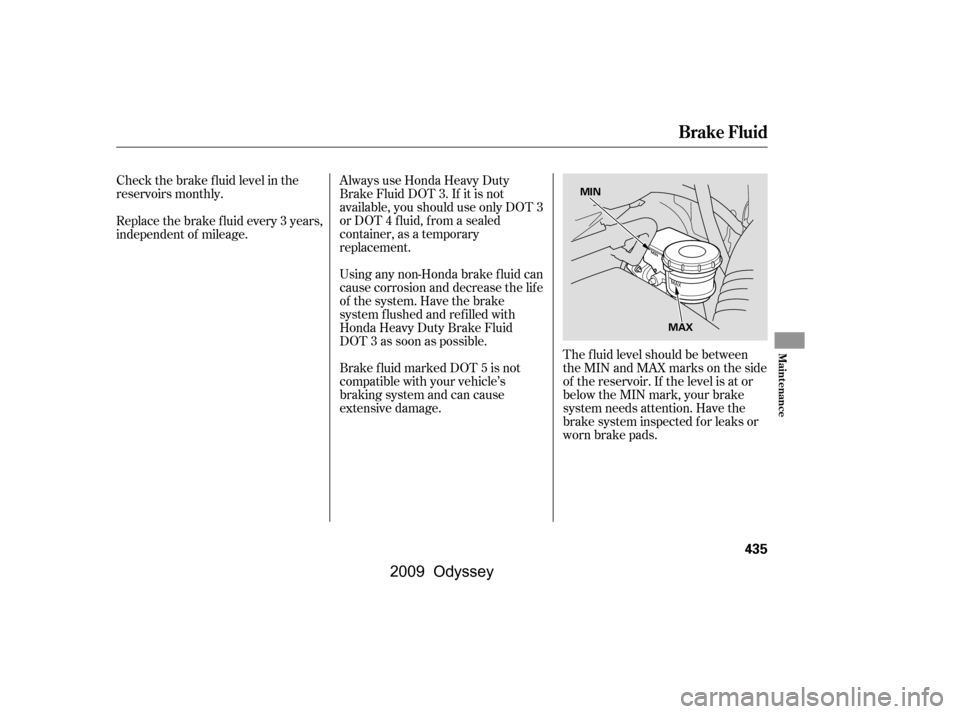
If the coolant level in the reserve
tank is at or below the MIN line, add
coolant to bring it up to the MAX line.
Inspect the cooling system f or leaks.
A dding Engine Coolant
Engine Coolant
430
RESERVE TANKMAX
MIN
Removing the radiator cap
while the engine is hot can
cause the coolant to spray out,
seriously scalding you.
Always let the engine and
radiator cool down before
removing the radiator cap.
�����—�����—���
�y�
����
��������y���
�(�����������y���������y
2009 Odyssey
Page 435 of 532
Check the f luid level in the
windshield washer reservoir at least
monthly during normal use. This
reservoir supplies the windshield and
rear window washers.
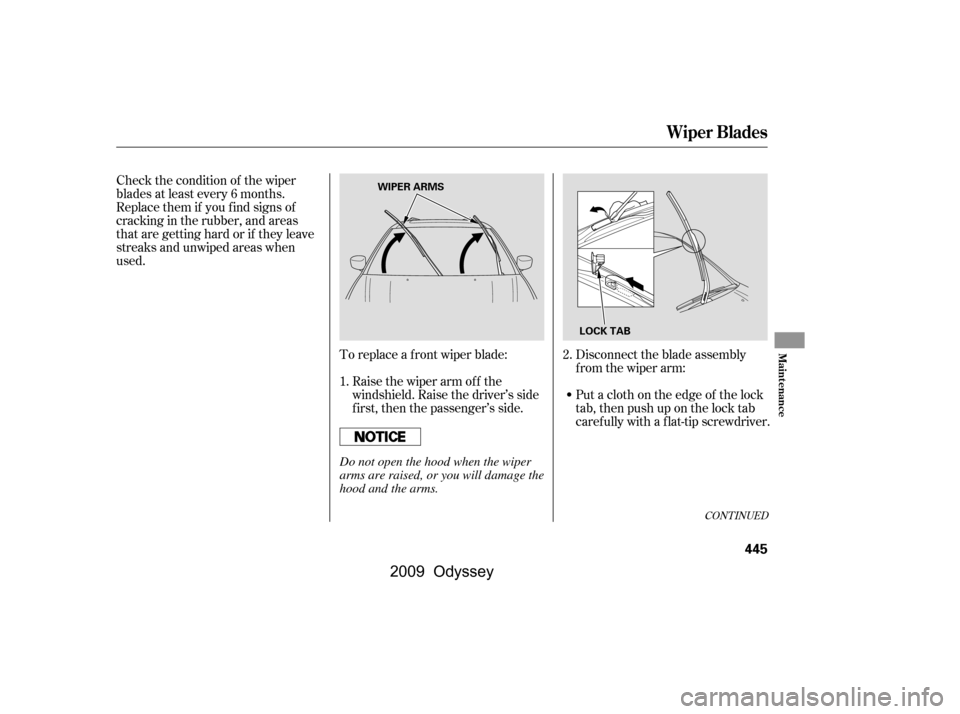
Check the f luid level by removing
the cap and looking at the level
gauge attached to the cap.The low washer
level indicator comes on when the
level is low (see page ).
You will also see a ‘‘WASHER
FLUID LOW’’ message on the multi-
inf ormation display (see page ). Fill the reservoir with a good-quality
windshield washer f luid. This
increases the cleaning capability and
prevents f reezing in cold weather.
When you ref ill the reservoir, clean
the edges of the windshield wiper
blades with windshield washer f luid
on a clean cloth. This will help to
condition the blade edges.
89
74
On Canadian models:
On Canadian Touring model:
Windshield Washers
432
LEVEL GAUGE
Do not use engine antif reeze or a
vinegar/water solution in the
windshield washer reservoir. Antif reeze
can damage your vehicle’s paint, while
a vinegar/water solution can damage
the windshield washer pump. Use only
commercially-available windshield
washer f luid.
�����—�����—���
�y�
����
��������y���
�(�����������y���������y
2009 Odyssey
Page 436 of 532
CONT INUED
Insert the dipstick all the way into
the transmission securely as
shown in the illustration.
Remove the dipstick, and check
the f luid level. It should be
between the upper and lower
marks.
Remove the dipstick (yellow loop)
f rom the transmission, and wipe it
with a clean cloth.
Check the f luid level with the engine
at normal operating temperature.
Park the vehicle on level ground.
Start the engine, let it run until the
radiator f an comes on, then shut
of f the engine. For accurate
results, wait about 60 seconds (but
no longer than 90 seconds) bef ore
doing step 2.
1.
2.3.
4.
Automatic Transmission Fluid
Maint enance
433
DIPSTICK HOT
MARK
UPPER MARK
LOWER MARK
�\f���—�\f���—���
�y�
����
����\f���y���
�(���������\f�y�\f�������y
2009 Odyssey
Page 438 of 532
Check the brake f luid level in the
reservoirs monthly.Always use Honda Heavy Duty
Brake Fluid DOT 3. If it is not
available, you should use only DOT 3
or DOT 4 f luid, f rom a sealed
container, as a temporary
replacement.
Using any non-Honda brake f luid can
cause corrosion and decrease the lif e
of the system. Have the brake
system f lushed and ref illed with
Honda Heavy Duty Brake Fluid
DOT 3 as soon as possible.
Brake f luid marked DOT 5 is not
compatible with your vehicle’s
braking system and can cause
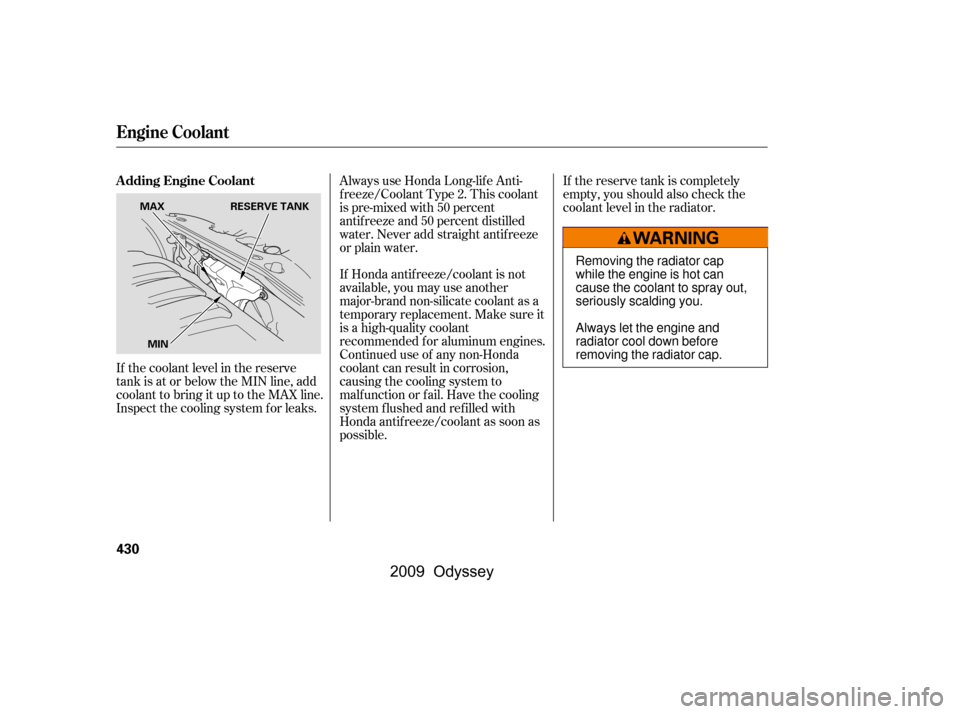
extensive damage.The f luid level should be between
theMINandMAXmarksontheside
of the reservoir. If the level is at or
below the MIN mark, your brake
system needs attention. Have the
brake system inspected f or leaks or
worn brake pads.
Replace the brake f luid every 3 years,
independent of mileage.
Brake Fluid
Maint enance
435
MAX
MIN
�\f���—�\f���—���
�y�
����
������\f�y���
�(���������\f�y�\f�����\f�y
2009 Odyssey
Page 439 of 532
�µ�µ
Always use Honda Power Steering
Fluid. You may use another power
steering f luid as an emergency
replacement, but have the power
steering system f lushed and ref illed
with Honda PSF as soon as possible.
A low power steering f luid level can
indicate a leak in the system. Check
the f luid level f requently, and have
the system inspected as soon as
possible.
Replace the belt at 60,000 miles
(100,000 km) if you regularly drive
your vehicle in one or more of these
conditions:
In very high temperatures
(over 110°F, 43°C).
In very low temperatures
(under 20°F, 29°C).
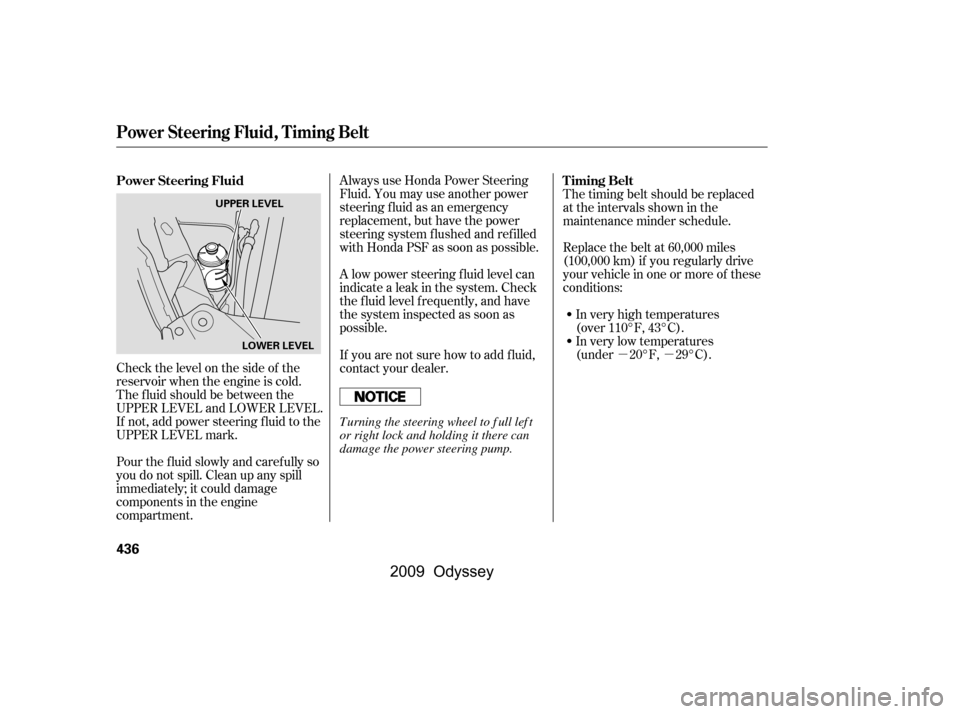
Check the level on the side of the
reservoir when the engine is cold.
The f luid should be between the
UPPER LEVEL and LOWER LEVEL.
If not, add power steering f luid to the
UPPER LEVEL mark. The timing belt should be replaced
at the intervals shown in the
maintenance minder schedule.
Pour the f luid slowly and caref ully so
you do not spill. Clean up any spill
immediately; it could damage
components in the engine
compartment. If you are not sure how to add f luid,
contact your dealer.
Power Steering Fluid
T iming Belt
Power Steering Fluid, Timing Belt
436
UPPER LEVEL
LOWER LEVEL
Turning the steering wheel to f ull lef t
or right lock and holding it there can
damage the power steering pump.
�\f���—�\f���—���
�y�
����
��������y���
�(���������\f�y�\f�����
�y
2009 Odyssey
Page 448 of 532
Check the condition of the wiper
blades at least every 6 months.
Replace them if you f ind signs of
cracking in the rubber, and areas
that are getting hard or if they leave
streaks and unwiped areas when
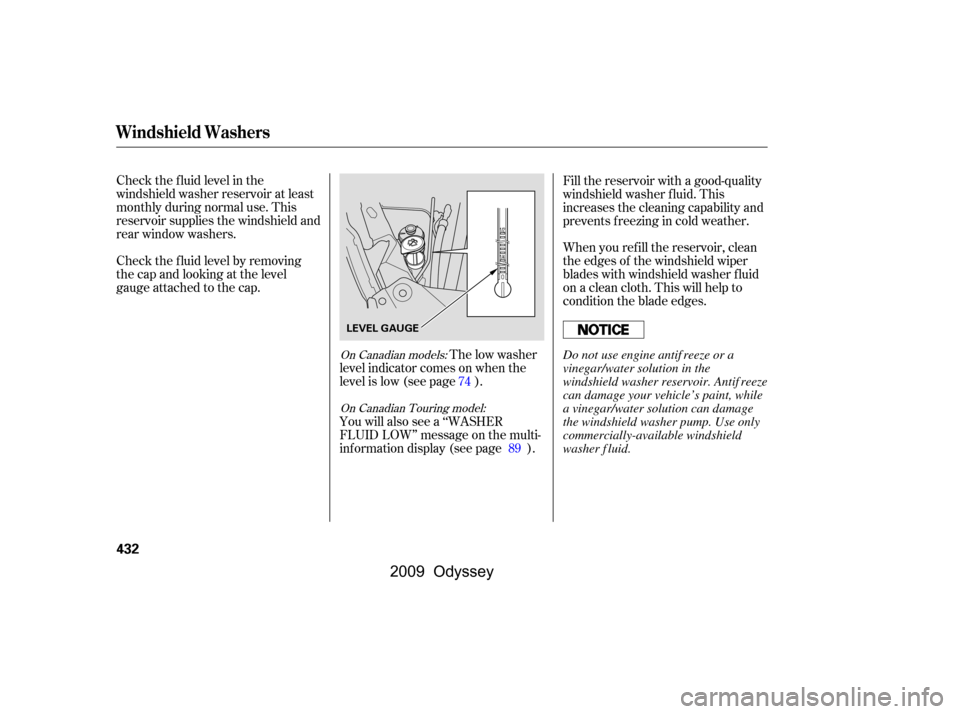
used.Raise the wiper arm of f the
windshield. Raise the driver’s side
first, then the passenger’s side.Disconnect the blade assembly
from the wiper arm:
Put a cloth on the edge of the lock
tab, then push up on the lock tab
caref ully with a f lat-tip screwdriver.
To replace a f ront wiper blade: 2.
1.
CONT INUED
Wiper Blades
Maint enance
445
WIPER ARMS
LOCK TAB
Do not open the hood when the wiper
arms are raised, or you will damage the
hood and the arms.
�\f���—�\f���—���
�y�
����
������\f�y���
�(���������\f�y�\f�����\f�y
2009 Odyssey
Page 454 of 532

CONT INUED
Even though your vehicle is
equipped with TPMS, we
recommend that you visually check
your tires every day. If you think a
tire might be low, check it
immediately with a tire gauge.
Use a gauge to measure the air
pressure in each tire at least once a
month. Even tires that are in good
condition may lose 1 to 2 psi (10 to
20 kPa, 0.1 to 0.2 kgf /cm ) per
month. Remember to check the
sparetireatthesametime.
Check the air pressures when the
tires are cold. This means the
vehicle has been parked f or at least 3
hours, or driven less than 1 mile (1.6
km). Add or release air, if needed, to
match the recommended cold tire
pressures.If you check air pressures when the
tires are hot [driven f or several miles
(kilometers)], you will see readings 4
to6psi(30to40kPa,0.3to0.4
kgf /cm ) higher than the cold
readings. This is normal. Do not let
air out to match the recommended
cold air pressure. The tire will be
underinf lated.
Youshoulduseyourowntire
pressure gauge whenever you check
your tire pressures. This will make it
easier f or you to tell if a pressure
loss is due to a tire problem and not
due to a variation between gauges.
While tubeless tires have some
ability to self -seal if they are
punctured, you should look closely
for punctures if a tire starts losing
pressure.
The following chart shows the
recommended cold tire pressures f or
most normal and high-speed driving
conditions.
Tire Size
Tire Size
Cold Tire Pressure for
Normal Driving
Front:
Rear:
Front:
Rear:
Cold Tire Pressure for
Normal Driving
EX-L models
LX, EX and Canadian DX models
Tires
Recommended T ire Pressures
Maint enance
451
235/65R16 103T
35 psi (240 kPa ,2.4 kgf/cm
)
33 psi (230 kPa ,
2.3 kgf/cm
)
235/65R16 103T 35 psi (240 kPa ,
2.4 kgf/cm
)
35 psi (240 kPa , 2.4 kgf/cm
)
�\f���—�\f���—���
�y�
����
��������y���
�(���������\f�y�\f�������y
2009 Odyssey
Page 455 of 532
Every time you check inf lation, you
should also examine the tires f or
damage, f oreign objects, and wear.
Youshouldlookfor:Bumps or bulges in the tread or
side of the tire. Replace the tire if
youfindeitherof theseconditions.
Cuts, splits, or cracks in the side
of the tire. Replace the tire if you
can see f abric or cord.
Excessive tread wear.
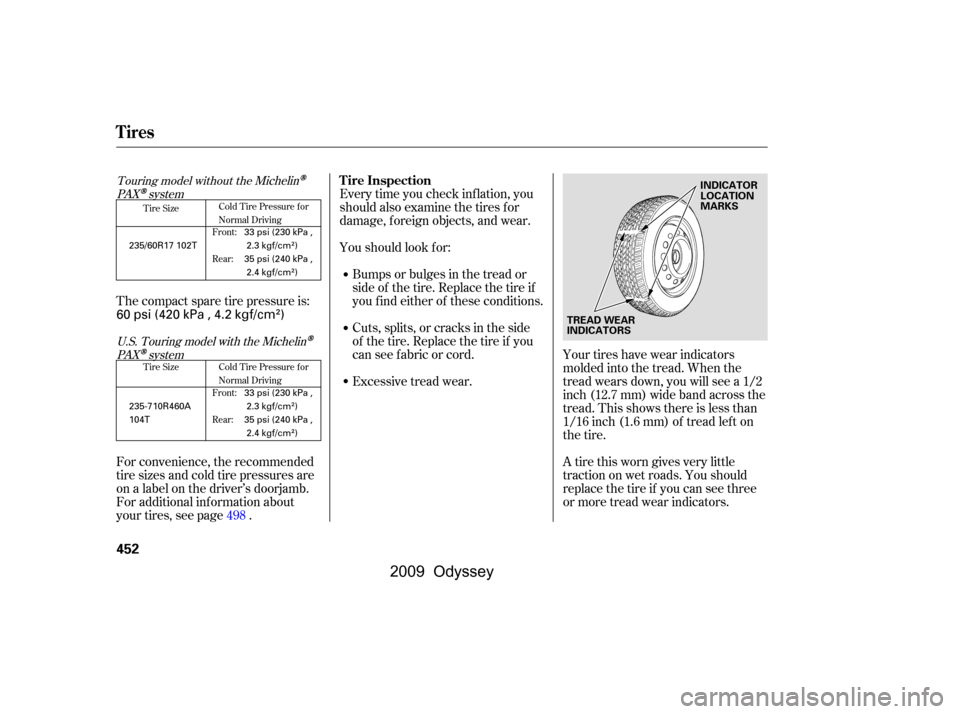
A tire this worn gives very little
traction on wet roads. You should
replace the tire if you can see three
or more tread wear indicators.
Thecompactsparetirepressureis:
For convenience, the recommended
tire sizes and cold tire pressures are
on a label on the driver’s doorjamb.
For additional inf ormation about
your tires, see page .
Your tires have wear indicators
molded into the tread. When the
tread wears down, you will see a 1/2
inch (12.7 mm) wide band across the
tread. This shows there is less than
1/16 inch (1.6 mm) of tread lef t on
the tire.
498
Tire Size
Tire Size Cold Tire Pressure for Normal Driving
Front:
Rear: Cold Tire Pressure for
Normal Driving
Front:
Rear:
Touring model without the Michelin
PAXsystem
U.S. Touring model with the Michelin
PAXsystem
Tires
Tire Inspection
452
INDICATOR
LOCATION
MARKS
TREAD WEAR
INDICATORS
60 psi (420 kPa , 4.2 kgf/cm)
235-710R460A
104T 35 psi (240 kPa ,
2.4 kgf/cm
)
33 psi (230 kPa ,
2.3 kgf/cm
)
235/60R17 102T
33 psi (230 kPa ,
2.3 kgf/cm
)
35 psi (240 kPa , 2.4 kgf/cm
)
�\f���—�\f���—���
�y�
����
��������y���
�(���������\f�y�\f�������y
2009 Odyssey