Page 234 of 373
Wait a f ew minutes af ter turning the
engine of f bef ore you check the oil.Remove the dipstick (orange
handle).
Wipe of f the dipstick with a clean
cloth or paper towel.
Insert the dipstick all the way back
into its hole. Remove the dipstick again, and
check the level. It should be
between the upper and lower
marks.
If it is near or below the lower mark,
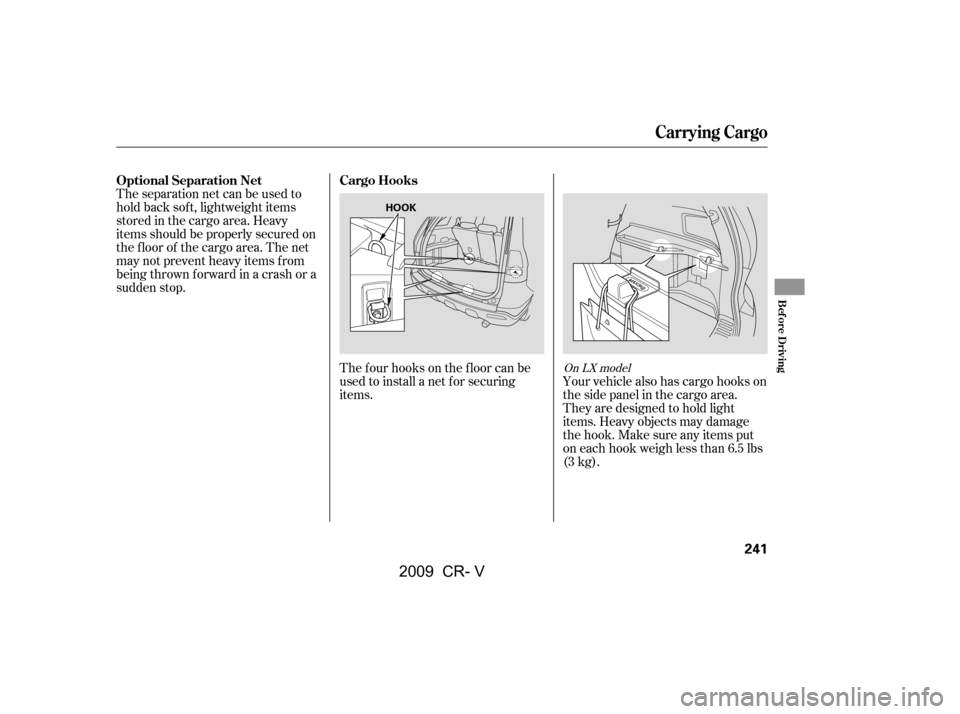
see on page .Look at the coolant level in the
radiator reserve tank. Make sure it is
between the MAX and MIN lines. If
it is below the MIN line, see
on page f or
inf ormation on adding the proper
coolant.
Refer to on page f or inf ormation
about checking other items on your
vehicle.
1.
2.
3. 4.
281 284
278
Oil Check
A dding Engine OilEngine Coolant Check
A dding
Engine Coolant
Owner’s Maintenance
Checks
Service Station Procedures
230
UPPER MARK
LOWER MARK MAX
MIN RESERVE TANK
DIPSTICK
�\f���—�\f���—�����y�
����
��������y���
�(�,�������\f�y�\f�������y
2009 CR- V
Page 238 of 373
Modif ying your vehicle, or installing
some non-Honda accessories, can
make it unsaf e. Bef ore you make any
modif ications or add any accessories,
be sure to read the f ollowing
inf ormation.Bef ore installing any accessory:
Make sure the accessory does not
obscure any lights, or interf ere
with proper vehicle operation or
perf ormance.
Bef ore installing any electronic
accessory, have the installer
contact your dealer for assistance.
If possible, have your dealer
inspect the f inal installation.
Do not install accessories on the
side pillars or across the rear
windows. Accessories installed in
theseareasmayinterferewith
proper operation of the side
curtain airbags.
Your dealer has Honda accessories
that allow you to personalize your
vehicle. These accessories have
been designed and approved f or your
vehicle, and are covered by warranty.
Although non-Honda accessories
may f it on your vehicle, they may not
meet f actory specif ications, and
could adversely af f ect your vehicle’s
handling and stability.
Be sure electronic accessories do
not overload electrical circuits
(see page ) or interf ere with
proper operation of your vehicle.
When properly installed, cellular
phones, alarms, two-way radios, and
low-powered audio systems should
not interf ere with your vehicle’s
computer controlled systems, such
as your airbags, anti-lock brakes, and
tire pressure monitoring system. 327
A ccessories and Modif ications
A ccessories
234
Improper accessories or
modifications can affect your
vehicle’s handling, stability, and
performance, and cause a
crash in which you can be hurt
or killed.
Follow all instructions in this
owner’s manual regarding
accessories and modifications.
�\f���—�\f���—�����y�
����
����\f���y���
�(�,�������\f�y�\f�������y
2009 CR- V
Page 239 of 373

Raising your vehicle with a
non-Honda suspension kit can
af f ect the handling and stability.
Removing parts f rom your vehicle,
or replacing components, with
non-Honda components could
seriously af f ect your vehicle’s
handling, stability, and reliability.
Herearesomeexamples:
Lowering the vehicle with a non-
Honda suspension kit that
signif icantly reduces ground
clearance can allow the
undercarriage to hit speed bumps
or other raised objects, which
could cause the airbags to deploy. Non-Honda wheels, because they
are a universal design, can cause
excessive stress on suspension
components, and are not
compatible with the tire pressure
monitoring system (TPMS).
Larger or smaller wheels and tires
can interf ere with the operation of
your vehicle’s anti-lock brakes and
other systems.
Modif ying your steering wheel or
any other part of your vehicle’s
safety features can make the
systems inef f ective.
If you plan to modif y your vehicle,
consult your dealer.
A ccessories and Modif ications
Modif ying Your Vehicle
Bef ore Driving
235
�\f���—�\f���—�����y�
����
����
�\f�y���
�(�,�������\f�y�\f�����\f�y
2009 CR- V
Page 241 of 373
�µ�·
�µ The resulting f igure equals the
available amount of cargo and
luggage load capacity. For
example, if the ‘‘XXX’’ amount
equals 1,400 lbs. and there will be
f ive 150 lb. passengers in your
vehicle, the amount of available
cargo and luggage load capacity is
650 lbs.
(1,400 750 (5 150) = 650 lbs.)
Determine the combined weight
of luggage and cargo being loaded
on the vehicle. That weight may
not saf ely exceed the available
cargo and luggage load capacity
calculated in Step 4.
If your vehicle will be towing a
trailer, load f rom your trailer will
be transf erred to your vehicle.
Consult this manual to determine
how this reduces the available
cargo and luggage load capacity of
your vehicle.
Subtract the combined weight of
the driver and passengers f rom
XXX kg or XXX lbs.
Determine the combined weight
of the driver and passenger that
will be riding in your vehicle.
Locate the statement ‘‘The
combined weight of occupants and
cargo should never exceed XXX
kg or XXX lbs.’’ on your vehicle’s
placard.
Steps f or Determining Correct Load
Limit
The maximum load f or your vehicle
is 850 lbs (385 kg) f or U.S. vehicles,
and 395 kg for Canadian vehicles.
This f igure includes the total weight
of all occupants, cargo, and
accessories, and the tongue load if
you are towing a trailer.
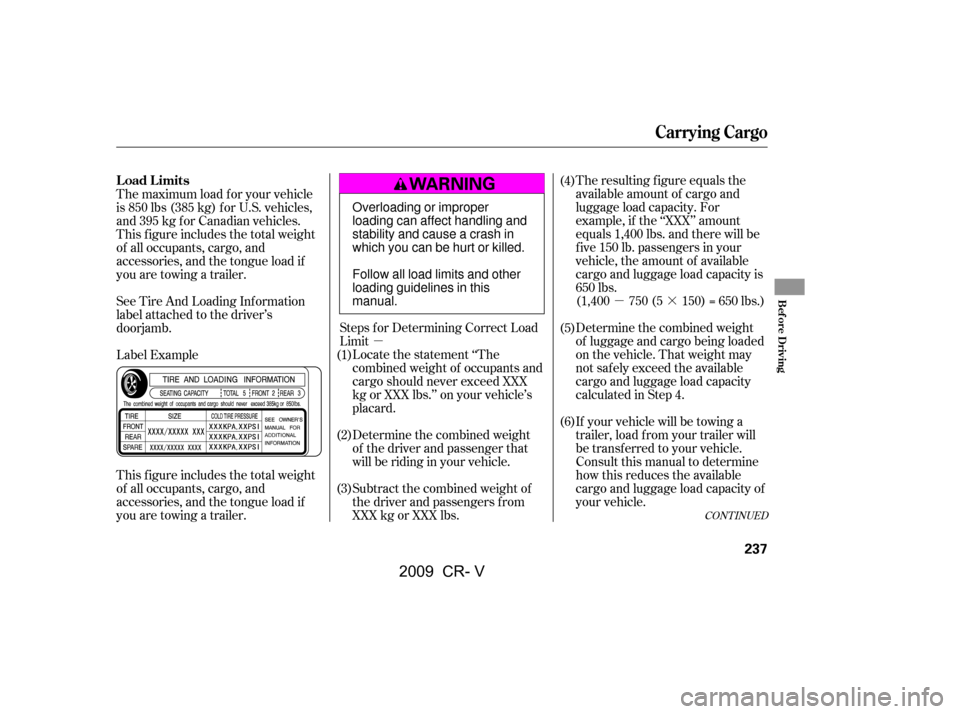
See Tire And Loading Inf ormation
label attached to the driver’s
doorjamb.
This f igure includes the total weight
of all occupants, cargo, and
accessories, and the tongue load if
you are towing a trailer.
Label Example
(1)
(2)
(3) (6)
(5)
(4)
CONT INUED
Load Limits
Carrying Cargo
Bef ore Driving
237
Overloading or improper
loading can affect handling and
stability and cause a crash in
which you can be hurt or killed.
Follow all load limits and other
loading guidelines in this
manual.
�\f���—�\f���—�����y�
����
��������y���
�(�,�������\f�y�\f�������y
2009 CR- V
Page 243 of 373

Store or secure all items that could
be thrown around and hurt
someone during a crash.
Be sure items placed on the f loor
behind the f ront seats cannot roll
underneath and interf ere with the
proper operation of the seats, the
sensors under the seats, or the
driver’s ability to operate the
pedals.
Keep the lower glove box closed
while driving. If it is open, a
passenger could injure their knees
during a crash or sudden stop.If you carry large items that
prevent you f rom closing the
tailgate, exhaust gas can enter the
passenger area. To avoid the
possibility of
, f ollow the instructions
on page .
Distribute cargo evenly on the
f loor of the cargo area, placing the
heaviest items on the bottom and
as far forward as possible. Tie
down items that could be thrown
about the vehicle during a crash or
sudden stop.
Do not stack items higher than the
back of the rear seats. They can
block your view and be thrown
around the vehicle during a crash.
If youfoldtherearseatsupor
down, tie down items that could be
thrown about the vehicle during a
crash or sudden stop. Also, keep
all cargo below the bottom of the
windows. If it is higher, it could
interf ere with the proper operation
of thesidecurtainairbags.
Do not use the dual deck cargo shelf
with any rear seat f olded up or down.
54
CONT INUED
On all models except LX
Carrying Cargo in the Passenger
Compartment
carbon monoxide
poisoning
Carrying Cargo in the Cargo A rea
or on a Roof Rack
Carrying Cargo
Bef ore Driving
239
�\f���—�\f���—�����y�
����
��������y���
�(�,�������\f�y�\f�������y
2009 CR- V
Page 244 of 373
If you carry any items on a roof
rack,besurethetotalweightof
the rack and the items does not
exceed 165 lbs (75 kg).
If you use an accessory roof rack,
the roof rack weight limit may be
lower. Ref er to the inf ormation that
came with your roof rack.
Do not exceed the dual deck cargo
shelf load limit of 20 lbs on U.S.
models, and 10 kg on Canadian
models.
Do not use the dual deck cargo shelf
if the rear seats are f olded down.
Do not put any items on the dual
deck cargo shelf that could block
your view or be thrown around the
vehicle during a crash.
On all models except LXOn U.S. model is shown
Carrying Cargo on the Dual Deck
Cargo Shelf
Carrying Cargo
240
�\f���—�\f���—�����y�
����
��������y���
�(�,�������\f�y�\f�������y
2009 CR- V
Page 245 of 373
The f our hooks on the f loor can be
used to install a net f or securing
items.
Theseparationnetcanbeusedto
hold back sof t, lightweight items
stored in the cargo area. Heavy
items should be properly secured on
the f loor of the cargo area. The net
may not prevent heavy items f rom
being thrown f orward in a crash or a
sudden stop.
Your vehicle also has cargo hooks on
the side panel in the cargo area.
They are designed to hold light
items. Heavy objects may damage
thehook.Makesureanyitemsput
on each hook weigh less than 6.5 lbs
(3 kg).On LX model
Cargo Hooks
Optional Separation Net
Carrying Cargo
Bef ore Driving
241
HOOK
�\f���—�\f���—�����y�
����
����\f�
�y���
�(�,�������\f�y�\f�������y
2009 CR- V
Page 248 of 373

Because your vehicle rides higher
of f the ground, it has a high center
of gravity that can cause it to roll
over if you make abrupt turns. Utility
vehicles have a signif icantly higher
roll over rate than other types of
vehicles.
To prevent rollovers or loss of
control:Take corners at slower speeds
than you would with a passenger
vehicle.
Avoid sharp turns and abrupt
maneuvers whenever possible. Do not carry heavy cargo on the
roof . Do not modif y your vehicle in any
way that would raise the center of
gravity.
You still need to exercise the same
care when accelerating, steering, and
brakingthatyouwouldinatwo-
wheel drive vehicle.
Your vehicle has higher ground
clearance that allows you to travel
over bumps, obstacles, and rough
terrain. It also provides good
visibility so you can anticipate
problems earlier.
Your vehicle is equipped with a f our-
wheel drive (4WD) system. When
the system senses a loss of front-
wheel traction, it automatically
transf ers some power to the rear
wheels. This gives you better
traction and mobility.
Four-wheel drive models
See page f or of f -highway drivingguidelines. 268
Driving Guidelines
244
�����—�����—�����y�
����
����
���y���
�(�,���������y���������y
2009 CR- V