Page 226 of 412
Once the security system is set,
opening either door without using
the key or the remote transmitter,
the hood, or the trunk will cause the
system to alarm. It also alarms if the
audio unit is removed f rom the
dashboard or the wiring is cut.
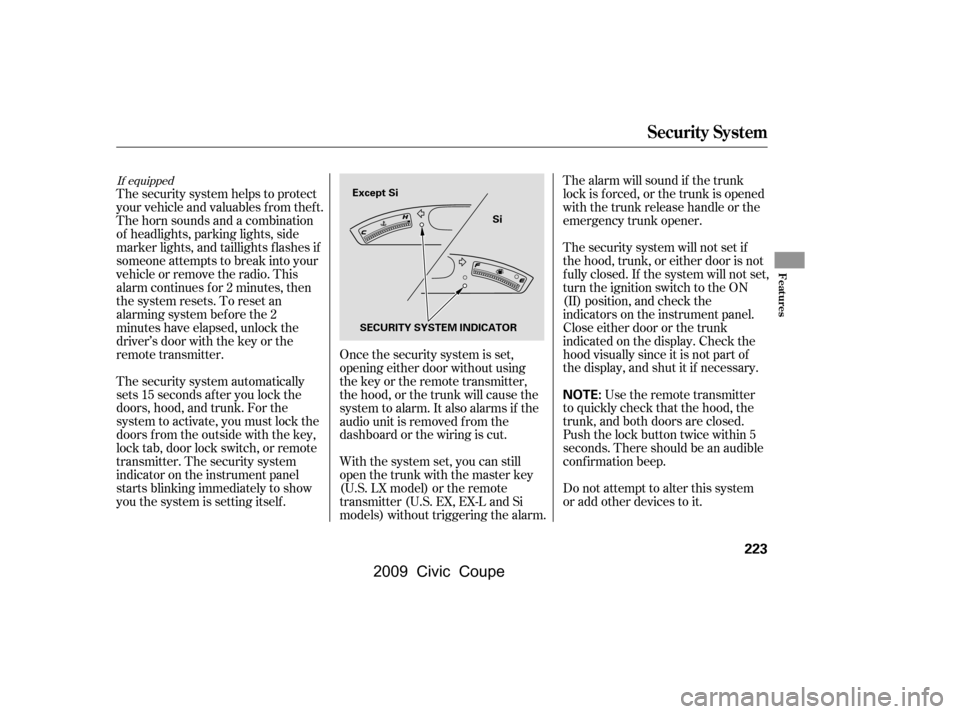
The security system helps to protect
your vehicle and valuables f rom thef t.
The horn sounds and a combination
of headlights, parking lights, side
marker lights, and taillights f lashes if
someone attempts to break into your
vehicleorremovetheradio.This
alarm continues f or 2 minutes, then
the system resets. To reset an
alarming system before the 2
minutes have elapsed, unlock the
driver’s door with the key or the
remote transmitter.
The security system automatically
sets 15 seconds after you lock the
doors, hood, and trunk. For the
system to activate, you must lock the
doors f rom the outside with the key,
lock tab, door lock switch, or remote
transmitter. The security system
indicator on the instrument panel
starts blinking immediately to show
you the system is setting itself . The security system will not set if
the hood, trunk, or either door is not
f ully closed. If the system will not set,
turn the ignition switch to the ON
(II) position, and check the
indicators on the instrument panel.
Close either door or the trunk
indicated on the display. Check the
hood visually since it is not part of
the display, and shut it if necessary.
With the system set, you can still
open the trunk with the master key
(U.S. LX model) or the remote
transmitter (U.S. EX, EX-L and Si
models) without triggering the alarm. The alarm will sound if the trunk
lock is f orced, or the trunk is opened
with the trunk release handle or the
emergency trunk opener.
Use the remote transmitter
to quickly check that the hood, the
trunk, and both doors are closed.
Push the lock button twice within 5
seconds. There should be an audible
conf irmation beep.
Do not attempt to alter this system
or add other devices to it.
If equipped
Security System
Features
223
NOTE:
SECURITY SYSTEM INDICATOR
Except Si
Si
�\f���—�\f���—�\f���y�
�
��
��������y���
�(�+�������\f�y�\f�������y
2009 Civic Coupe
Page 278 of 412
�Î�Î
�Î
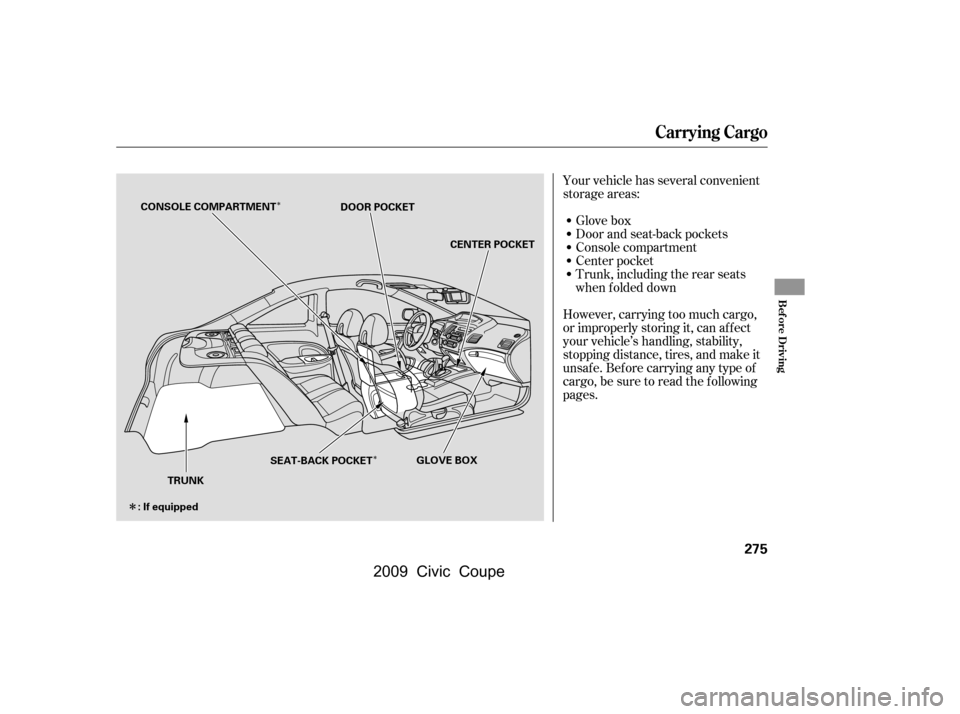
Your vehicle has several convenient
storage areas:Door and seat-back pockets Glove box
However, carrying too much cargo,
or improperly storing it, can af f ect
your vehicle’s handling, stability,
stopping distance, tires, and make it
unsaf e. Bef ore carrying any type of
cargo, be sure to read the f ollowing
pages. Trunk, including the rear seats
when f olded down Center pocket Console compartment
Carrying Cargo
Bef ore Driving
275
TRUNK
GLOVE BOX
CONSOLE COMPARTMENT
DOOR POCKET
SEAT-BACK POCKET
: If equipped CENTER POCKET
�����—�����—�����y�
�
����
������y���
�(�+���������y���������y
2009 Civic Coupe
Page 281 of 412

Store or secure all items that could
be thrown around and hurt
someone during a crash.
Do not put any items on top of the
rear shelf . They can block your
view and be thrown around the
vehicle during a crash.The cargo net can be used to help
hold down items stored in the trunk.
Be sure items placed on the f loor
behind the f ront seats cannot roll
under the seats and interf ere with
the driver’s ability to operate the
pedals, the proper operation of the
seats, or the proper operation of
the sensors under the seats. If you carry large items that
prevent you f rom closing the trunk
lid, exhaust gas can enter the
passenger area. To avoid the
possibility of
, f ollow the instructions
on page .
If youfolddownthebackseat,tie
down items that could be thrown
about the vehicle during a crash or
sudden stop.
Distribute cargo evenly on the
f loor of the trunk, placing the
heaviest items on the bottom and
as f ar f orward as possible.
Keep the glove box closed while
driving. If it is open, a passenger
could injure their knees during a
crash or sudden stop.
Also, keep all cargo below the
bottom of the windows. If it is
higher, it could interf ere with the
proper operation of the side
curtain airbags. 50
Optional
Carrying Cargo
Carrying Items in the Passenger
Compartment
Cargo Net
carbon monoxide
poisoning
Carrying Cargo in the Trunk
278
�\f���—�\f���—�\f���y�
�
�������
���y���
�(�+�������\f�y�\f�������y
2009 Civic Coupe
Page 284 of 412

Fasten your seat belt. Check that
your passengers have f astened
their seat belts (see page ).
Make sure the doors are securely
closed and locked.
Check the steering wheel
adjustment (see page ).
Check the adjustment of the
inside and outside mirrors (see
page ).
Check that any items you may be
carrying are stored properly or
f astened down securely.
Check the seat adjustment (see
page ).
Make sure all windows, mirrors,
and outside lights are clean and
unobstructed. Remove f rost, snow,
or ice.
Youshoulddothefollowingchecks
and adjustments bef ore you drive
your vehicle.
Check that the hood is f ully closed.
Check that the trunk is f ully
closed. When you start the engine, check
the gauges and indicators in the
instrument panel (see page ).
Visually check the tires. If a tire
looks low, use a gauge to check its
pressure.
1.
2.
14
3.
4. 5.
6.
7.
8.
9.
11.
10.
55
93
106 76
Preparing to Drive
Driving
281
�\f���—�\f���—�\f���y�
�
�����������y���
�(�+�������\f�y�\f�������y
2009 Civic Coupe
Page 293 of 412

If your vehicle has an automatic
transmission, set the parking brake
bef ore you put the transmission in
Park. This keeps the vehicle f rom
moving and putting pressure on the
parking mechanism in the
transmission.Make sure the parking brake is
f ully released bef ore driving away.
Driving with the parking brake
partially set can overheat or
damage the rear brakes.
Make sure the moonroof (if
equipped) and the windows are
closed.
Lock the doors.
Place any packages, valuables, etc.,
in the trunk or take them with you.
Turn of f the lights.
Always use the parking brake when
you park your vehicle. Make sure
the parking brake is set f irmly, or
your vehicle may roll if it is parked
on an incline.
Check the indicator on the
instrument panel to verif y that the
security system is set.
Never park over dry leaves, tall
grass, or other f lammable
materials. The hot three way
catalytic converter could cause
these materials to catch on fire.If the vehicle is f acing uphill, turn
the front wheels away from the
curb. If your vehicle has a manual
transmission, put it in f irst gear.
If the vehicle is f acing downhill,
turn the front wheels toward the
curb. If your vehicle has a manual
transmission, put it in reverse gear.
On vehicles with security system
Parking T ips
Parking
290
Never install a sunshade between the
upper and lower meters on the
instrument panel. If you do, you could
cause heat damage to the upper meter
on a very hot day.
�\f���—�\f���—�\f���y�
�
�����������y���
�(�+�������\f�y�\f�������y
2009 Civic Coupe
Page 327 of 412
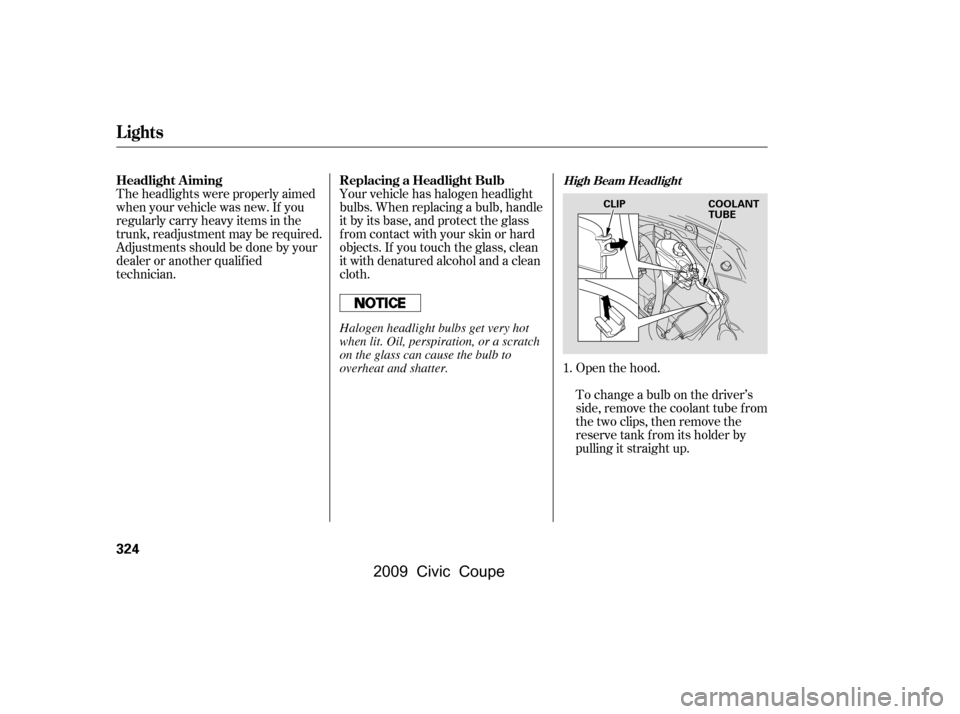
Your vehicle has halogen headlight
bulbs. When replacing a bulb, handle
it by its base, and protect the glass
f rom contact with your skin or hard
objects. If you touch the glass, clean
it with denatured alcohol and a clean
cloth.Open the hood.
To change a bulb on the driver’s
side, remove the coolant tube f rom
the two clips, then remove the
reserve tank f rom its holder by
pulling it straight up.
Theheadlightswereproperlyaimed
when your vehicle was new. If you
regularly carry heavy items in the
trunk, readjustment may be required.
Adjustmentsshouldbedonebyyour
dealer or another qualif ied
technician.
1.
Lights
Headlight A iming Replacing a Headlight BulbHigh Beam Headlight
324
COOLANT
TUBE
CLIP
Halogen headlight bulbs get very hot
when lit. Oil, perspiration, or a scratch
on the glass can cause the bulb to
overheat and shatter.
�\f���—�\f���—�\f���y�
�
�������
���y���
�(�+�������\f�y�\f�������y
2009 Civic Coupe
Page 331 of 412
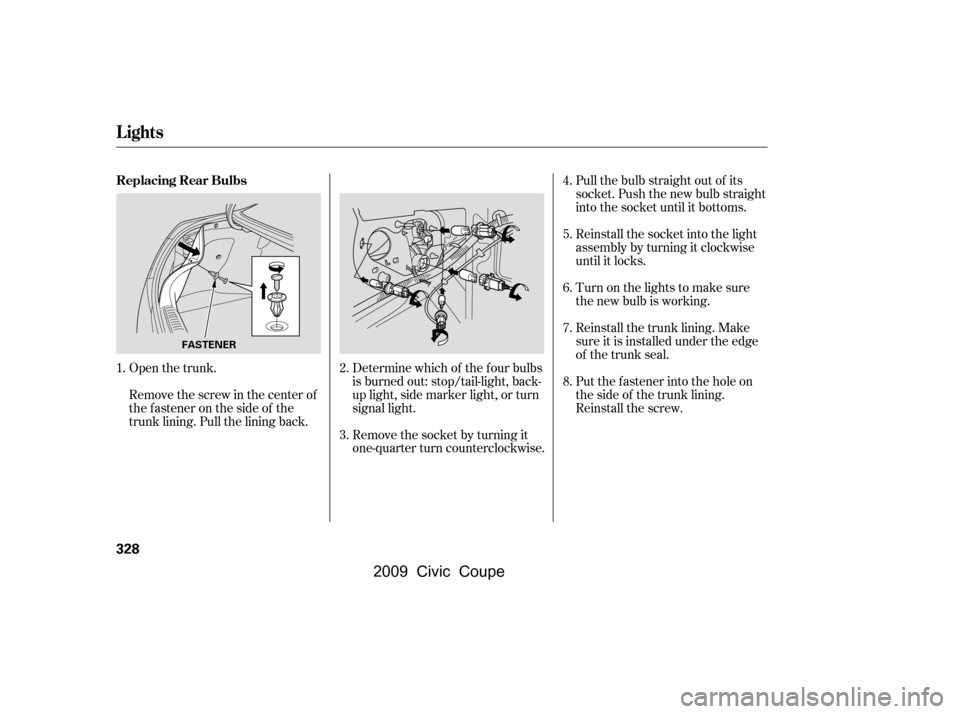
Open the trunk.Pull the bulb straight out of its
socket. Push the new bulb straight
into the socket until it bottoms.
Remove the screw in the center of
the fastener on the side of the
trunk lining. Pull the lining back. Reinstall the socket into the light
assembly by turning it clockwise
until it locks.
Turn on the lights to make sure
the new bulb is working.
Reinstall the trunk lining. Make
sure it is installed under the edge
of the trunk seal.
Put the f astener into the hole on
the side of the trunk lining.
Reinstall the screw.
Determine which of the f our bulbs
is burned out: stop/tail-light, back-
up light, side marker light, or turn
signal light.
Remove the socket by turning it
one-quarter turn counterclockwise.
1. 2.
3.4.
5.
6.
7.
8.
Replacing Rear Bulbs
Lights
328
FASTENER
�\f���—�\f���—�\f���y�
�
�����������y���
�(�+�������\f�y�\f�������y
2009 Civic Coupe
Page 332 of 412
If equipped
Your vehicle uses halogen light
bulbs. When replacing a bulb, handle
it by its plastic case, and protect the
glass from contact with your skin or
hard objects. If you touch the glass,
clean it with denatured alcohol and a
clean cloth.
Thefoglightswereproperlyaimed
when your vehicle was new. If you
regularly carry heavy items in the
trunk, readjustment may be required.
Adjustment should be done by your
dealer or another qualif ied
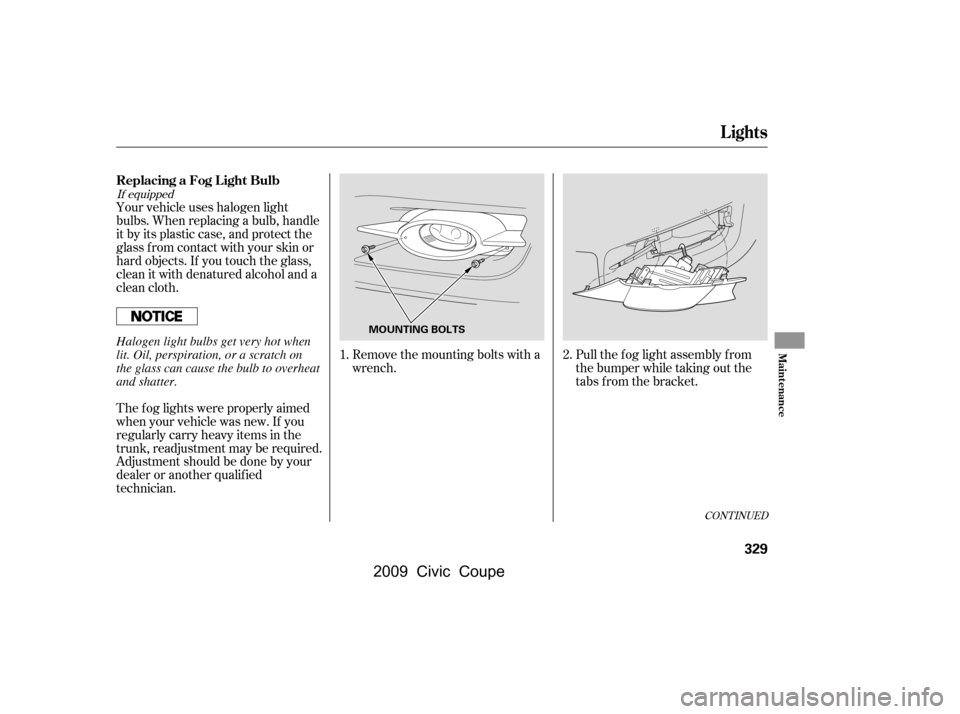
technician.Remove the mounting bolts with a
wrench.
Pull the f og light assembly f rom
the bumper while taking out the
tabs from the bracket.
1. 2.
CONT INUED
ReplacingaFogLightBulb
Lights
Maint enance
329
MOUNTING BOLTSHalogen light bulbs get very hot when
lit. Oil, perspiration, or a scratch on
the glass can cause the bulb to overheat
and shatter.
�\f���—�\f���—�\f���y�
�
�������\f���y���
�(�+�������\f�y�\f�������y
2009 Civic Coupe