2009 GMC YUKON HYBRID light
[x] Cancel search: lightPage 54 of 94
{CAUTION:
An electric fan can start up even when the engine
is not running and can injure you. Keep hands,
clothing and tools away from any underhood
electric fan.
{CAUTION:
Using a match near a battery can cause battery
gas to explode. People have been hurt doing this,
and some have been blinded. Use a flashlight if
you need more light.
CAUTION: (Continued)
CAUTION: (Continued)
Be sure the battery has enough water. You do not
need to add water to the battery installed in your
new vehicle. But if a battery has filler caps, be
sure the right amount of fluid is there. If it is low,
add water to take care of that first. If you do not,
explosive gas could be present.
Battery fluid contains acid that can burn you.
Do not get it on you. If you accidentally get it in
your eyes or on your skin, flush the place with
water and get medical help immediately.
{CAUTION:
Fans or other moving engine parts can injure you
badly. Keep your hands away from moving parts
once the engine is running.
5-18
Page 58 of 94

Replacement Bulbs
Exterior Lamp Bulb Number
Back-up Lamp and Rear Turn
Signal Lamp3156
Sidemarker Lamp 194
For replacement bulbs not listed here, contact your
dealer/retailer.
Electrical System
Fuses and Circuit Breakers
The wiring circuits in the vehicle are protected from
short circuits by a combination of fuses, circuit breakers
and fusible thermal links. This greatly reduces the
chance of fires caused by electrical problems.
Be sure you replace a bad fuse with a new one of the
identical size and rating.If you ever have a problem on the road and do not have
a spare fuse, you can borrow one that has the same
amperage. Just pick some feature of the vehicle that you
can get along without, like the radio or cigarette
lighter, and use its fuse, if it is the correct amperage.
Replace it as soon as you can.
The vehicle also has a special fuse in the battery box
for the 300-volt batteries. If this fuse has failed and
needs to be replaced, the vehicle will be disabled and
you will need to have the vehicle repaired by your
dealer/retailer. Do not attempt to self-service this fuse.
Underhood Fuse Block
Hybrid Auxiliary Underhood Fuse
Block
The hybrid underhood fuse block is located in the
engine compartment near the front of the vehicle.
Lift the cover for access to the fuse/relay block.
SeeEngine Compartment Overview on page 5-4for
more information on its location. For more information on
the main underhood fuse block, see “Underhood Fuse
Block” in the owner manual.
5-22
Page 61 of 94

How to Check
Use a good quality pocket-type gage to check tire
pressure. You cannot tell if your tires are properly
inflated simply by looking at them. Radial tires may look
properly inflated even when they’re underinflated.
Check the tire’s inflation pressure when the tires are cold.
Cold means your vehicle has been sitting for at least
three hours or driven no more than 1 mile (1.6 km).
Remove the valve cap from the tire valve stem.
Press the tire gage firmly onto the valve to get a
pressure measurement. If the cold tire inflation pressure
matches the recommended pressure on the tire and
loading information label, no further adjustment is
necessary. If the pressure is low, add air until you
reach the recommended amount.
If you overfill the tire, release air by pushing on the
metal stem in the center of the tire valve. Recheck the
tire pressure with the tire gage.
Be sure to put the valve caps back on the valve stems.
They help prevent leaks by keeping out dirt and moisture.
Tire Pressure Monitor Operation
This vehicle may have a Tire Pressure Monitor System
(TPMS). The TPMS is designed to warn the driver
when a low tire pressure condition exists. TPMS sensors
are mounted onto each tire and wheel assembly.
The TPMS sensors monitor the air pressure in the
vehicle’s tires and transmit the tire pressure readings
to a receiver located in the vehicle.
When a low tire pressure
condition is detected, the
TPMS will illuminate
the low tire pressure
warning symbol located
on the instrument
panel cluster.
At the same time a message to check the pressure in a
specific tire appears on the Driver Information Center
(DIC) display. The low tire pressure warning light
and the DIC warning message come on at each ignition
cycle until the tires are inflated to the correct inflation
pressure. Using the DIC, tire pressure levels can
be viewed by the driver. For additional information and
details about the DIC operation and displays seeDIC
Warnings and Messages on page 3-12. Also, see “DIC
Operation and Displays” in the Index of the owner
manual for more information.
5-25
Page 62 of 94

The low tire pressure warning light may come on in cool
weather when the vehicle is first started, and then
turn off as you start to drive. This could be an early
indicator that the air pressure in the tire(s) are getting
low and need to be inflated to the proper pressure.
A Tire and Loading Information label, attached to your
vehicle, shows the size of your vehicle’s original
equipment tires and the correct inflation pressure for
your vehicle’s tires when they are cold. See “Loading
Your Vehicle” for an example of the Tire and Loading
Information label and its location on your vehicle.
Also seeInflation - Tire Pressure on page 5-24.
Your vehicle’s TPMS can warn you about a low tire
pressure condition but it does not replace normal
tire maintenance. See “Tire Inspection and Rotation”
and “Tires” in the Index of the owner manual for more
information.
Notice:Using non-approved tire sealants could
damage the Tire Pressure Monitor System (TPMS)
sensors. TPMS sensor damage caused by using
an incorrect tire sealant is not covered by the
vehicle warranty. Always use the GM approved tire
sealant available through your dealer/retailer.Your vehicle, when new, included a factory-installed
Tire Sealant and Compressor Kit. This kit uses a
GM approved liquid tire sealant. SeeTire Sealant and
Compressor Kit (Without Selector Switch) on page 5-32
orTire Sealant and Compressor Kit (With Selector
Switch) on page 5-42.
TPMS Malfunction Light and Message
The TPMS will not function properly if one or more of the
TPMS sensors are missing or inoperable. When the
system detects a malfunction, the low tire warning light
flashes for about one minute and then stays on for
the remainder of the ignition cycle. A DIC warning
message is also displayed. The low tire warning light
and DIC warning message come on at each ignition
cycle until the problem is corrected. Some of the
conditions that can cause the malfunction light and
DIC message to come on are:
•The TPMS sensor matching process was started
but not completed or not completed successfully
after rotating the vehicle’s tires. The DIC message
and TPMS malfunction light should go off once
the TPMS sensor matching process is performed
successfully. See “TPMS Sensor Matching Process”
later in this section.
5-26
Page 63 of 94

•One or more TPMS sensors are missing or
damaged. The DIC message and the TPMS
malfunction light should go off when the TPMS
sensors are installed and the sensor matching
process is performed successfully. See your
dealer/retailer for service.
•Replacement tires or wheels do not match your
vehicle’s original equipment tires or wheels.
Tires and wheels other than those recommended
for your vehicle could prevent the TPMS from
functioning properly. See “Buying New Tires” in
the Index of the owner manual.
•Operating electronic devices or being near facilities
using radio wave frequencies similar to the TPMS
could cause the TPMS sensors to malfunction.
If the TPMS is not functioning it cannot detect or
signal a low tire condition. See your dealer/retailer for
service if the TPMS malfunction light and DIC message
comes on and stays on.
TPMS Sensor Matching Process
Each TPMS sensor has a unique identification code.
Any time you rotate your vehicle’s tires or replace one or
more of the TPMS sensors, the identification codes
will need to be matched to the new tire/wheel position.
The sensors are matched to the tire/wheel positions
in the following order: driver side front tire, passenger
side front tire, passenger side rear tire, and driver
side rear tire using a TPMS diagnostic tool. See your
dealer/retailer for service.
The TPMS sensors can also be matched to each
tire/wheel position by increasing or decreasing the tire’s
air pressure. If increasing the tire’s air pressure, do
not exceed the maximum inflation pressure indicated on
the tire’s sidewall.
To decrease air-pressure out of a tire you can use the
pointed end of the valve cap, a pencil-style air pressure
gage, or a key.
5-27
Page 72 of 94
6. Plug the power plug (C) into the accessory power
outlet in the vehicle. Unplug all items from other
accessory power outlets. See “Accessory Power
Outlet(s) in the owner manual.”
If the vehicle has an accessory power outlet, do not
use the cigarette lighter.
If the vehicle only has a cigarette lighter, use the
cigarette lighter.
Do not pinch the power plug cord in the door or
window.
7. Start the vehicle. The vehicle must be running while
using the air compressor.
8. Press the on/off (D) button to turn the tire sealant
and compressor kit on.
The compressor will inject sealant and air into
the tire.
The pressure gage (E) will initially show a high
pressure while the compressor pushes the sealant
into the tire. Once the sealant is completely
dispersed into the tire, the pressure will quickly drop
and start to rise again as the tire inflates with air only.9. Inflate the tire to the recommended inflation pressure
using the pressure gage (E). The recommended
inflation pressure can be found on the Tire and
Loading Information label. SeeInflation - Tire
Pressure on page 5-24.
The pressure gage (E) may read higher than the
actual tire pressure while the compressor is on.
Turn the compressor off to get an accurate pressure
reading. The compressor may be turned on/off
until the correct pressure is reached.
Notice:If the recommended pressure cannot be
reached after approximately 25 minutes, the vehicle
should not be driven farther. The tire is too severely
damaged and the tire sealant and compressor kit
cannot inate the tire. Remove the power plug from
the accessory power outlet and unscrew the inating
hose from the tire valve. See “Roadside Assistance
Program” in the owner manual.
10. Press the on/off button (D) to turn the tire sealant
and compressor kit off.
The tire is not sealed and will continue to leak air until
the vehicle is driven and the sealant is distributed in
the tire, therefore, Steps 11 through 17 must be done
immediately after Step 10.
Be careful while handling the tire sealant and
compressor kit as it could be warm after usage.
5-36
Page 75 of 94
Always do a safety check first. SeeIf a Tire Goes Flat
on page 5-30
1. Remove the tire sealant and compressor kit from its
storage location. SeeTire Sealant and Compressor
Kit Storage on page 5-50
2. Unlock the air only hose (F) from the sealant
canister (B) by pulling up on the lever.
3. Pull the air only hose (F) from the sealant
canister (B).
4. Remove the power plug (C) from the air
compressor (A).
5. Place the kit on the ground.
Make sure the tire valve stem is positioned close to
the ground so the hose will reach it.
6. Remove the tire valve stem cap by turning it
counterclockwise.
7. Attach the air only hose (F) onto the tire valve stem
and press the lever down to secure it.
8. Plug the power plug (C) into the accessory power
outlet in the vehicle. Unplug all items from other
accessory power outlets. See “Accessory Power
Outlet(s) in the owner manual.”If the vehicle has an accessory power outlet, do not
use the cigarette lighter.
If the vehicle only has a cigarette lighter, use the
cigarette lighter.
Do not pinch the power plug cord in the door or
window.
9. Start the vehicle. The vehicle must be running
while using the air compressor.
10. Press the on/off (D) button to turn the
compressor on.
The compressor will inflate the tire with air only.
11. Inflate the tire to the recommended inflation pressure
using the pressure gage (E). The recommended
inflation pressure can be found on the Tire and
Loading Information label. SeeInflation - Tire
Pressure on page 5-24.
The pressure gage (E) may read higher than the
actual tire pressure while the compressor is on.
Turn the compressor off to get an accurate reading.
The compressor may be turned on/off until the
correct pressure is reached.
5-39
Page 81 of 94
Using the Tire Sealant and Compressor
Kit to Temporarily Seal and Inate a
Punctured Tire
Follow the directions closely for correct sealant usage.
When using the tire sealant and compressor kit during
cold temperatures, warm the kit in a heated environment
for 5 minutes. This will help to inflate the tire faster.Always do a safety check first. SeeIf a Tire Goes Flat
on page 5-30. Do not remove any objects that have
penetrated the tire.
1. Remove the tire sealant and compressor kit from its
storage location. SeeTire Sealant and Compressor
Kit Storage on page 5-50.
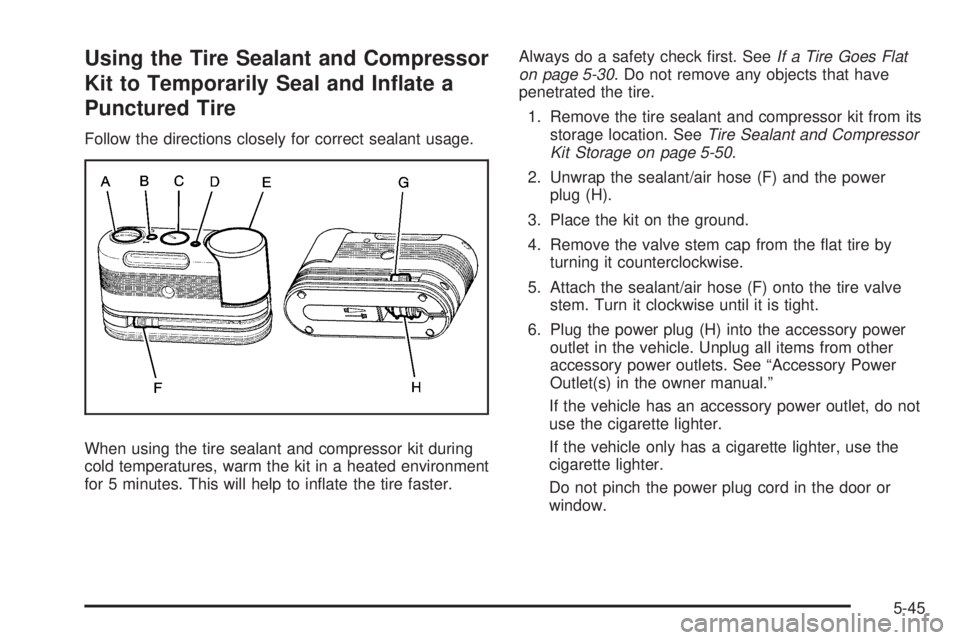
2. Unwrap the sealant/air hose (F) and the power
plug (H).
3. Place the kit on the ground.
4. Remove the valve stem cap from the flat tire by
turning it counterclockwise.
5. Attach the sealant/air hose (F) onto the tire valve
stem. Turn it clockwise until it is tight.
6. Plug the power plug (H) into the accessory power
outlet in the vehicle. Unplug all items from other
accessory power outlets. See “Accessory Power
Outlet(s) in the owner manual.”
If the vehicle has an accessory power outlet, do not
use the cigarette lighter.
If the vehicle only has a cigarette lighter, use the
cigarette lighter.
Do not pinch the power plug cord in the door or
window.
5-45