Page 51 of 94
Battery
This vehicle has a standard 12-volt battery and a
high-voltage hybrid battery.
When a new standard 12-volt battery is needed, see
your dealer/retailer for one that has the replacement
number shown on the original battery’s label.
When a new high-voltage hybrid battery is needed,
see your dealer/retailer.
If an airbag inflates or the vehicle has been in a crash,
the vehicle’s sensing system might command the
automatic hybrid battery disconnect to open.
SeeReplacing Restraint System Parts After a Crash
on page 1-3for more information.
Warning:Battery posts, terminals, and related
accessories contain lead and lead compounds,
chemicals known to the State of California to cause
cancer and reproductive harm. Wash hands after
handling.
Vehicle Storage
{CAUTION:
Batteries have acid that can burn you and gas that
can explode. You can be badly hurt if you are not
careful. SeeJump Starting on page 5-16for tips
on working around a battery without getting hurt.
Infrequent Usage: If the vehicle is driven infrequently,
remove the 12-volt battery black, negative (−) cable from
the battery. This helps keep the battery from running
down.
Extended Storage: For extended storage of the vehicle,
remove the 12-volt battery black, negative (−) cable
from the battery or use a battery trickle charger.
This helps maintain the charge of the battery over an
extended period of time.
Remember to reconnect the battery when ready to drive
the vehicle.
5-15
Page 52 of 94
Jump Starting
If the vehicle’s 12-volt battery has run down, you may
want to use another vehicle and some jumper cables
to start your vehicle. Use the following steps to do
it safely.
{CAUTION:
Batteries can hurt you. They can be dangerous
because:
•They contain acid that can burn you.
•They contain gas that can explode or ignite.
•They contain enough electricity to burn you.
If you do not follow these steps exactly, some or
all of these things can hurt you.Notice:Ignoring these steps could result in costly
damage to the vehicle that would not be covered
by the warranty.
Trying to start the vehicle by pushing or pulling it
will not work, and it could damage the vehicle.
1. Check the other vehicle. It must have a 12-volt
battery with a negative ground system.
Notice:If the other vehicle’s system is not a 12-volt
system with a negative ground, both vehicles can
be damaged. Only use vehicles with 12-volt systems
with negative grounds to jump start your vehicle.
2. Get the vehicles close enough so the jumper cables
can reach, but be sure the vehicles are not touching
each other. It could cause a ground connection
you do not want. You would not be able to start your
vehicle, and the bad grounding could damage the
electrical systems.
To avoid the possibility of the vehicles rolling, set
the parking brake firmly on both vehicles involved
in the jump start procedure. Put the automatic
transmission in P (Park) or a manual transmission
in N (Neutral) before setting the parking brake.
If you have a four-wheel-drive vehicle, be sure the
transfer case is in a drive gear, not in N (Neutral).
5-16
Page 55 of 94

6. Check that the jumper cables do not have loose
or missing insulation. If they do, you could get a
shock. The vehicles could be damaged too.
Before you connect the cables, here are some
basic things you should know. Positive (+) goes to
positive (+) or to a remote positive (+) terminal
if the vehicle has one. Negative (−) will go to
a heavy, unpainted metal engine part or a solid
engine ground.
Do not connect positive (+) to negative (−)oryou
will get a short that would damage the battery
and maybe other parts too. Do not connect
the negative (−) cable to the negative (−) terminal
on the dead battery because this can cause sparks.
7. Connect the red positive (+) cable to the positive (+)
terminal of the vehicle with the dead battery.
Use a remote positive (+) if the vehicle has one.8. Do not let the other end touch metal. Connect it
to the positive (+) terminal of the good battery.
Use a remote positive (+) if the vehicle has one.
9. Now connect the black negative (−) cable to the
negative (−) terminal of the good battery. Use a
remote negative (−) if the vehicle has one.
Do not let the other end touch anything until the
next step. The other end of the negative (−) cable
does not go to the dead battery. It goes to a
heavy, unpainted metal engine part or to the remote
negative (−) terminal on the vehicle with the dead
battery.
10. Connect the other end of the negative (−) cable to
the remote negative (−) terminal, on the vehicle
with the dead battery.
11. Now start the vehicle with the good battery and run
the engine for a while.
12. Try to start the vehicle that had the dead battery.
If it will not start after a few tries, it probably needs
service.
5-19
Page 56 of 94
Notice:If the jumper cables are connected or
removed in the wrong order, electrical shorting may
occur and damage the vehicle. The repairs would
not be covered by your warranty. Always connect
and remove the jumper cables in the correct
order, making sure that the cables do not touch
each other or other metal.
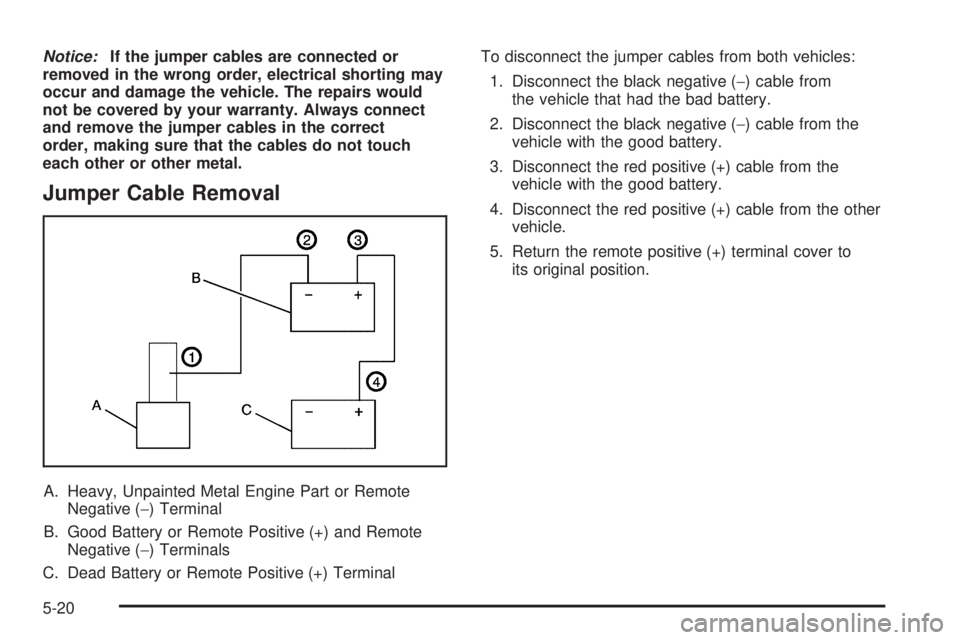
Jumper Cable Removal
A. Heavy, Unpainted Metal Engine Part or Remote
Negative (−) Terminal
B. Good Battery or Remote Positive (+) and Remote
Negative (−) Terminals
C. Dead Battery or Remote Positive (+) TerminalTo disconnect the jumper cables from both vehicles:
1. Disconnect the black negative (−) cable from
the vehicle that had the bad battery.
2. Disconnect the black negative (−) cable from the
vehicle with the good battery.
3. Disconnect the red positive (+) cable from the
vehicle with the good battery.
4. Disconnect the red positive (+) cable from the other
vehicle.
5. Return the remote positive (+) terminal cover to
its original position.
5-20