2009 FORD SUPER DUTY maintenance reset
[x] Cancel search: maintenance resetPage 13 of 103
•The timer can be reset by changing the position of the accelerator
pedal, brake pedal or the park brake within the final 30 seconds.
•When the timer reaches zero, the engine shuts down and the message
center will displayENGINE TURNED OFF.
•One minute after the engine has shut down, the electrical system will
simulate key off, even though the ignition is still in the on position,
initiating normal accessory delay period.
•The ignition must be moved to the off position to reset the system
before restarting the vehicle.
Note:The engine idle shutdown idle timer will not start if:
•The engine is operating in power take-off (PTO) mode.
•The engine coolant temperature is below 60°F (16°C).
•The exhaust emission control device (DPF) is regenerating.
STOPPING THE ENGINE
Turn the ignition to the OFF position.
On E-Series vehicles,
to prolong engine life (after extended high speed
or maximum GVW operation), it is recommended that a hot engine be idled
for 7–10 minutes which will allow the turbocharged engine to cool down.
On F-Super Duty vehicles,to prolong engine life (especially after
extended high speed, high ambient temperature, or high GVW/GCW
operation), it is recommended that a hot engine be idled for 3-5 minutes
which will allow the turbocharged engine to cool down.
COLD WEATHER OPERATION
Changing to a lighter grade engine oil also makes starting easier under
these conditions. Refer toEngine oil specificationsin theMaintenance
and Specificationschapter of this supplement.
At temperatures below 20°F (–7°C), number 2–D diesel fuel may thicken
enough to clog the fuel filter. Your vehicle is equipped with either an
FCM (E-Series) or an HFCM (F-Super Duty) which acts as a fuel
filter/water separator to keep the wax melted which will help prevent
fuel filter clogging. However, if the engine starts but stalls after a short
time and will not restart, the fuel filter(s) may be clogged. For best
results in cold weather, use Number 1–D diesel fuel or “winterized”
Number 2–D diesel fuel which has an additive to minimize wax
formation. If you have problems operating on biodiesel during cold
weather, you may need to use a diesel fuel with lower biodiesel content,
try another brand, or discontinue the use of biodiesel.
2009 Econoline(eco)
Supplement, 1st Printing
USA(fus)
Driving
13
Page 16 of 103
produce “coking” or “wet stacking”, which is common to all diesel
engines when idling for extended periods during cold ambient
temperatures.
•Your vehicle may have a factory option for a Stationary Elevated Idle
Control (SEIC) through dash-mounted Upfitter switches will allow the
operator to elevate the idle rpm for extended idle periods, as well as
aftermarket equipment such as PTO operation. This feature must be
configured even if ordered from the factory. See your authorized
dealer for required upfitting.
Operation in snow
Vehicle operation in heavy snowfall or extreme rain conditions may feed
excessive amounts of snow/water into the air intake system. This could
plug/soak the air filter with snow and may cause the engine to lose
power and possibly shut down.
Either of these conditions may cause the CHECK AIR FILTER message
to appear in the message center.
You may not need to change the air filter and the vehicle may be driven
up to 200 miles (320 km) under the following conditions:
•Snow:At the earliest opportunity, open the hood and clear all the
snow and ice from the air filter housing inlet (do NOT remove the air
filter) and reset the air filter restriction gauge.
•Wet:The air filter will dry after about 15–30 minutes at highway
speeds. At the earliest opportunity, open the hood and reset the air
filter restriction gauge.
Refer toAir filter and restriction gaugein theMaintenance and
Specificationschapter of this supplement for more information.
Operation in standing water
Ingestion of water into the diesel engine can result in immediate and
severe damage to the engine. If driving through water, slow down to
avoid splashing water into the intake. If the engine stalls, and ingestion
of water into the engine is suspected, do not try to restart the engine.
Consult your dealer for service immediately.
2009 Econoline(eco)
Supplement, 1st Printing
USA(fus)
Driving
16
Page 48 of 103
•use of biodiesel, up to and including 5% Biodiesel (B5)
•use of high sulfur diesel fuel
If you are operating your vehicle under any of these conditions, change
engine oil and filter every 5,000 miles (8,000 km).
AIR FILTER RESTRICTION GAUGE AND AIR FILTER
REPLACEMENT
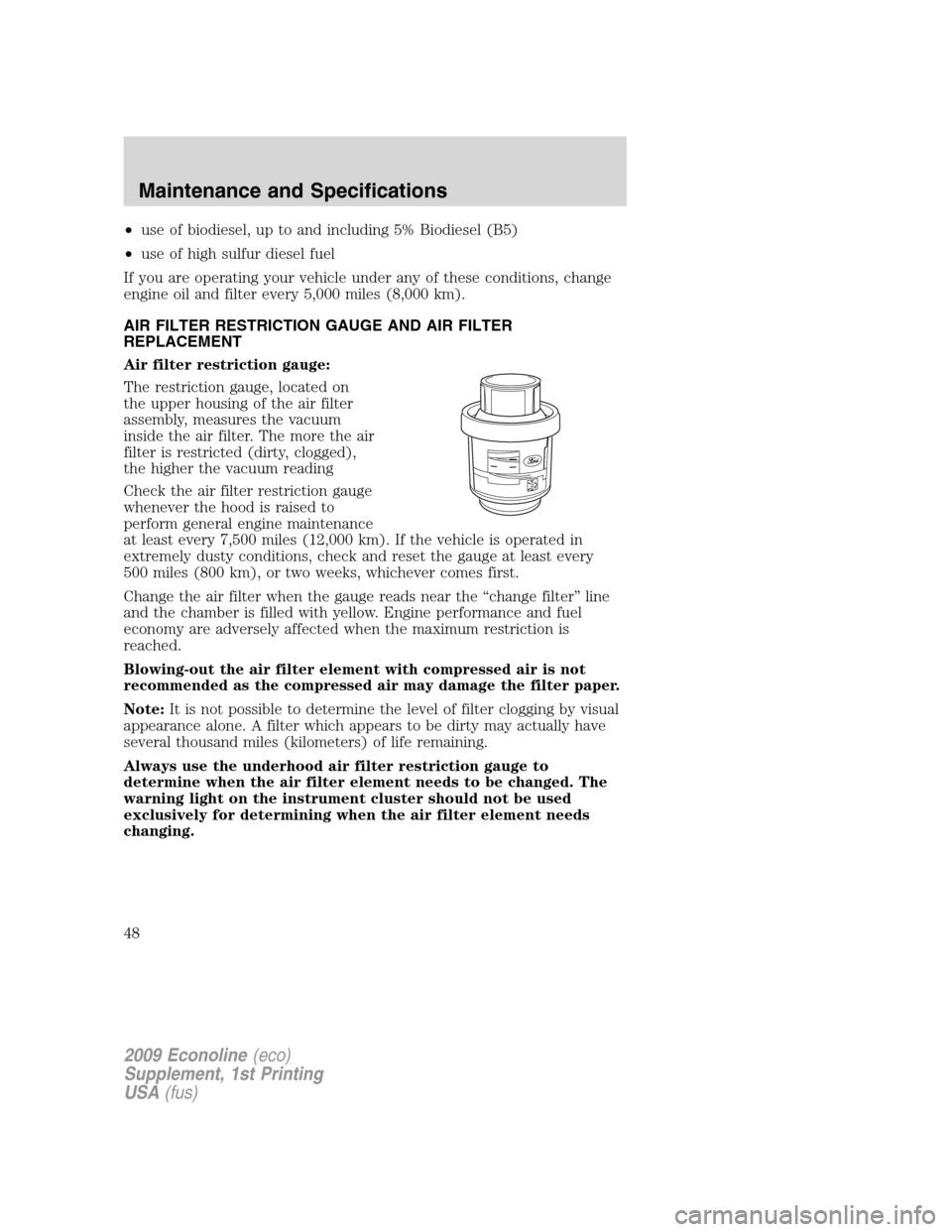
Air filter restriction gauge:
The restriction gauge, located on
the upper housing of the air filter
assembly, measures the vacuum
inside the air filter. The more the air
filter is restricted (dirty, clogged),
the higher the vacuum reading
Check the air filter restriction gauge
whenever the hood is raised to
perform general engine maintenance
at least every 7,500 miles (12,000 km). If the vehicle is operated in
extremely dusty conditions, check and reset the gauge at least every
500 miles (800 km), or two weeks, whichever comes first.
Change the air filter when the gauge reads near the “change filter” line
and the chamber is filled with yellow. Engine performance and fuel
economy are adversely affected when the maximum restriction is
reached.
Blowing-out the air filter element with compressed air is not
recommended as the compressed air may damage the filter paper.
Note:It is not possible to determine the level of filter clogging by visual
appearance alone. A filter which appears to be dirty may actually have
several thousand miles (kilometers) of life remaining.
Always use the underhood air filter restriction gauge to
determine when the air filter element needs to be changed. The
warning light on the instrument cluster should not be used
exclusively for determining when the air filter element needs
changing.
2009 Econoline(eco)
Supplement, 1st Printing
USA(fus)
Maintenance and Specifications
48
Page 49 of 103
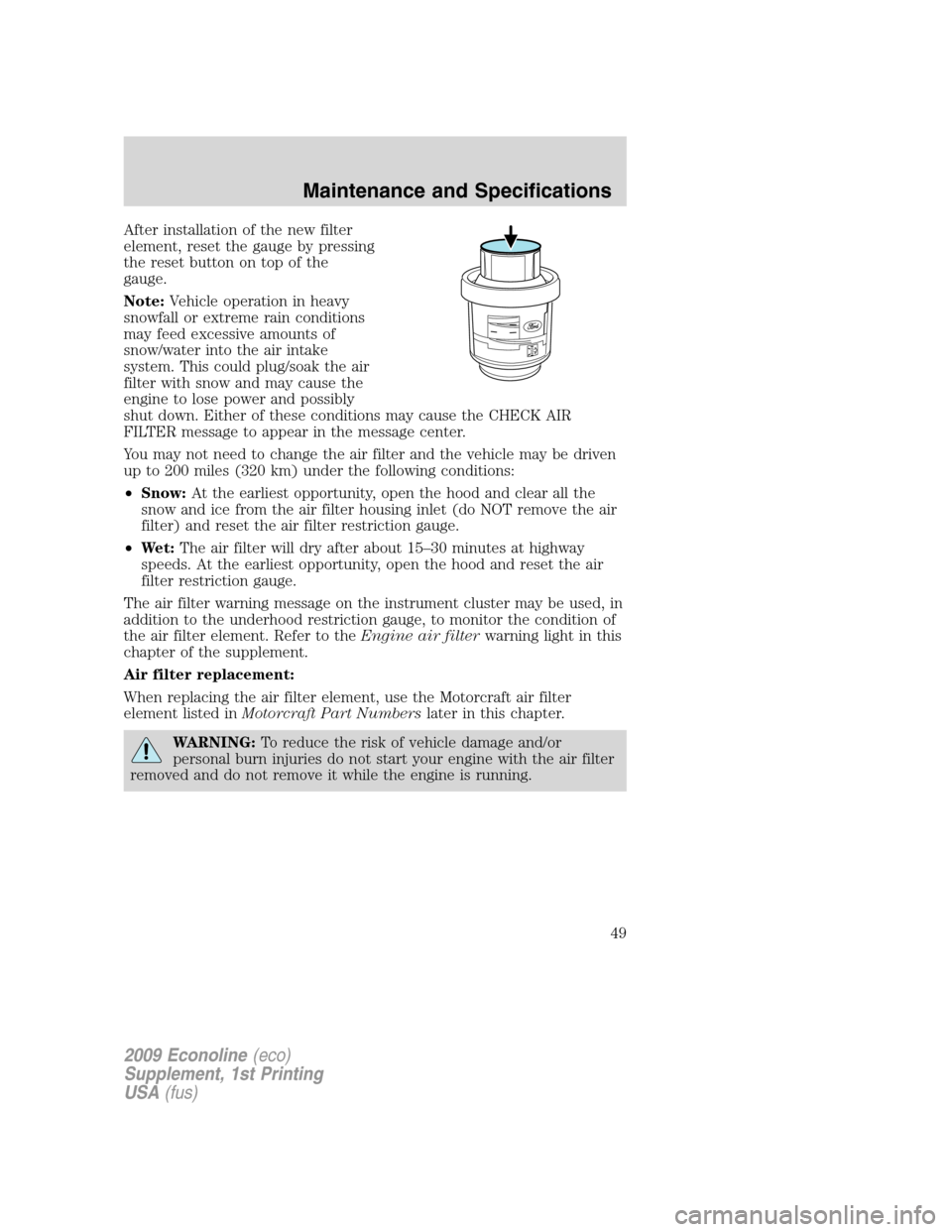
After installation of the new filter
element, reset the gauge by pressing
the reset button on top of the
gauge.
Note:Vehicle operation in heavy
snowfall or extreme rain conditions
may feed excessive amounts of
snow/water into the air intake
system. This could plug/soak the air
filter with snow and may cause the
engine to lose power and possibly
shut down. Either of these conditions may cause the CHECK AIR
FILTER message to appear in the message center.
You may not need to change the air filter and the vehicle may be driven
up to 200 miles (320 km) under the following conditions:
•Snow:At the earliest opportunity, open the hood and clear all the
snow and ice from the air filter housing inlet (do NOT remove the air
filter) and reset the air filter restriction gauge.
•Wet:The air filter will dry after about 15–30 minutes at highway
speeds. At the earliest opportunity, open the hood and reset the air
filter restriction gauge.
The air filter warning message on the instrument cluster may be used, in
addition to the underhood restriction gauge, to monitor the condition of
the air filter element. Refer to theEngine air filterwarning light in this
chapter of the supplement.
Air filter replacement:
When replacing the air filter element, use the Motorcraft air filter
element listed inMotorcraft Part Numberslater in this chapter.
WARNING:To reduce the risk of vehicle damage and/or
personal burn injuries do not start your engine with the air filter
removed and do not remove it while the engine is running.
2009 Econoline(eco)
Supplement, 1st Printing
USA(fus)
Maintenance and Specifications
49
Page 56 of 103
Check the battery connections at the battery posts, cable connection to
the engine grounding point and at the starter connection.
If a discharged battery is suspected, have it checked and corrected.
WARNING:Battery posts, terminals and related accessories
contain lead and lead compounds.Wash hands after handling.
•For vehicles with manual transmissions,the clutch pedalmustbe
fully depressed in order for the starter to operate.
•For vehicles with automatic transmissions,the gearshift lever
must be in P (Park) or N (Neutral) in order for the starter to operate.
•Try operating the starter switch several times. Should the switch be
corroded, this operation may clean the contacts or make the switch
temporarily operable until you can reach the dealer.
•If all electrical connections are tight and you need assistance to start,
refer toJump startingin theRoadside Emergencieschapter of your
Owner’s Guide(F-Super Duty) or refer to theJump startingsection
in theRoadside Emergencieschapter of this supplement (E-Series).
If engine cranks but won’t start
Prolonged starter cranking (in excess of 30 seconds) could cause
damage to the starter motor.
•Check the fuel gauge. You may be out of fuel. If the gauge shows that
there is fuel in the tank, the trouble may be in the electrical system or
the fuel system. If equipped with an auxiliary tank, be sure that the
tank control switch is set for the tank with fuel and not on an empty
tank.
•Leaving the ignition key turned to ON for over two minutes without
starting may make starting difficult because the glow plugs will cease
activation. Reset the system by turning the ignition key to OFF and
then back to ON again.
If the engine runs hot
The following could cause the engine to overheat:
•Lack of coolant.
•Dirty cooling system.
•Plugged radiator fins, charge air cooler, A/C condenser and/or oil
cooler.
•Driving with frozen coolant.
2009 Econoline(eco)
Supplement, 1st Printing
USA(fus)
Maintenance and Specifications
56