2009 FORD F750 Dpf regen
[x] Cancel search: Dpf regenPage 98 of 276

•Within the final 30 seconds, the timer can be reset by:
1. changing the position of the accelerator pedal, or
2. changing the brake pedal, clutch pedal, or park brake from engaged
to disengaged or from disengaged to engaged.
•When the timer reaches zero, the engine will shut down.
•In this event, the key remains in the ON (Run) position, and power
continues to be supplied to the accessories.
Battery power may be drained if the key is left in the ON (Run)
position without the engine running.
Note:The engine idle shutdown timer will not start if:
•The engine is operating in power take-off (PTO) mode.
•The engine coolant temperature is below 60° F (16° C).
•The exhaust emission control system is regenerating the diesel
particulate filter (DPF).
ENGINE AUTOMATIC SHUTDOWN WARNING LIGHT OR CHIME
(IF EQUIPPED)
Your vehicle may be equipped with an automatic shutdown feature that
stops the engine in the event of high coolant temperature, low engine oil
pressure, high diesel particulate filter soot loading or low engine coolant
level. A warning light in the instrument cluster and a warning chime will
indicate high engine coolant temperature, low engine oil pressure or the
need to have the diesel particulate filter cleaned or serviced. If the
engine coolant temperature becomes too high, engine oil pressure too
low or the diesel particulate filter too restricted, the engine will
automatically shut down.
If the engine shuts down, it can be restarted and operated for
30 seconds at a time or until the problem is corrected. Do not attempt to
use this restarting feature to drive the vehicle very far as serious engine
damage could result.
WARNING:In the event of engine shutdown, make sure the
vehicle is safely off the road and the problem is remedied prior
to returning to the road. Failure to remove the vehicle from the road
could result in an accident, causing serious injury or death.
GENERAL BRAKE INFORMATION
All standard equipment brakes are designed to be self-adjusting.
Automatic adjustment, when required, occurs whenever the brakes are
applied and released during forward or reverse operation. Refer to the
Scheduled Maintenance Guidechapter for scheduled maintenance.
2009 F-650/750(f67)
Supplement
USA(fus)
Driving
98
Page 192 of 276

Habits
•Smooth, moderate operation can yield up to 10% savings in fuel.
•Steady speeds without stopping will usually give the best fuel
economy.
•Anticipate stopping; slowing down may eliminate the need to stop.
•Sudden or hard accelerations may reduce fuel economy.
•Slow down gradually.
•Driving at reasonable speeds (traveling at 55 mph [88 km/h] uses 15%
less fuel than traveling at 65 mph [105 km/h]).
•Using the air conditioner or defroster may reduce fuel economy.
•Resting your foot on the brake pedal while driving may reduce fuel
economy.
Conditions
•Carrying unnecessary weight may reduce fuel economy.
•Fuel economy may decrease with lower temperatures during the first
8–10 miles (12–16 km) of driving.
•Flat terrain driving improves fuel economy over hilly roads.
•Transmissions give their best fuel economy when operated in the top
cruise gear and with steady pressure on the accelerator.
•Close windows for highway driving.
DIESEL PARTICULATE FILTER (DPF)
Your vehicle is equipped with a diesel particulate filter (DPF), as part of
the after-treatment exhaust system, to trap soot and other large particles
produced by the engine combustion process. The soot that accumulates
in the filter must be periodically reduced to ash to prevent excessive
exhaust restriction. The soot reduction process, also known as “filter
regeneration,” is generally performed automatically by your engine and
after-treatment system.
WARNING:The normal operating temperature of the exhaust
system is very high. Never work around, or attempt to repair,
any part of the exhaust system until it has cooled. Use special care
when working around the diesel particulate filter. The DPF heats up to
a high temperature after only a short period of engine operation, and
can remain hot even after the engine is turned off. Failure to follow
these instructions may result in serious personal injury.
2009 F-650/750(f67)
Supplement
USA(fus)
Maintenance and Specifications
192
Page 193 of 276
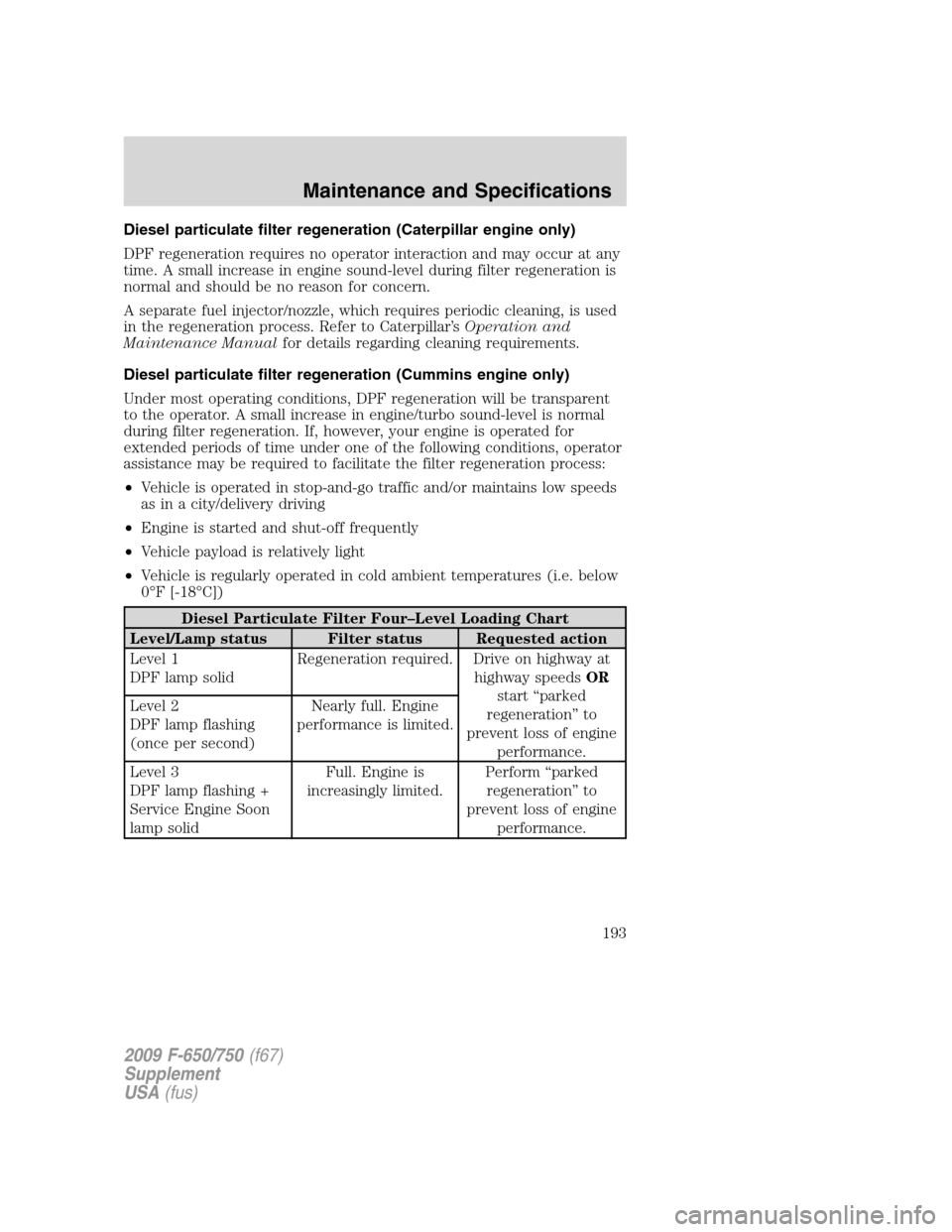
Diesel particulate filter regeneration (Caterpillar engine only)
DPF regeneration requires no operator interaction and may occur at any
time. A small increase in engine sound-level during filter regeneration is
normal and should be no reason for concern.
A separate fuel injector/nozzle, which requires periodic cleaning, is used
in the regeneration process. Refer to Caterpillar’sOperation and
Maintenance Manualfor details regarding cleaning requirements.
Diesel particulate filter regeneration (Cummins engine only)
Under most operating conditions, DPF regeneration will be transparent
to the operator. A small increase in engine/turbo sound-level is normal
during filter regeneration. If, however, your engine is operated for
extended periods of time under one of the following conditions, operator
assistance may be required to facilitate the filter regeneration process:
•Vehicle is operated in stop-and-go traffic and/or maintains low speeds
as in a city/delivery driving
•Engine is started and shut-off frequently
•Vehicle payload is relatively light
•Vehicle is regularly operated in cold ambient temperatures (i.e. below
0°F [-18°C])
Diesel Particulate Filter Four–Level Loading Chart
Level/Lamp status Filter status Requested action
Level 1
DPF lamp solidRegeneration required. Drive on highway at
highway speedsOR
start “parked
regeneration” to
prevent loss of engine
performance. Level 2
DPF lamp flashing
(once per second)Nearly full. Engine
performance is limited.
Level 3
DPF lamp flashing +
Service Engine Soon
lamp solidFull. Engine is
increasingly limited.Perform “parked
regeneration” to
prevent loss of engine
performance.
2009 F-650/750(f67)
Supplement
USA(fus)
Maintenance and Specifications
193
Page 194 of 276
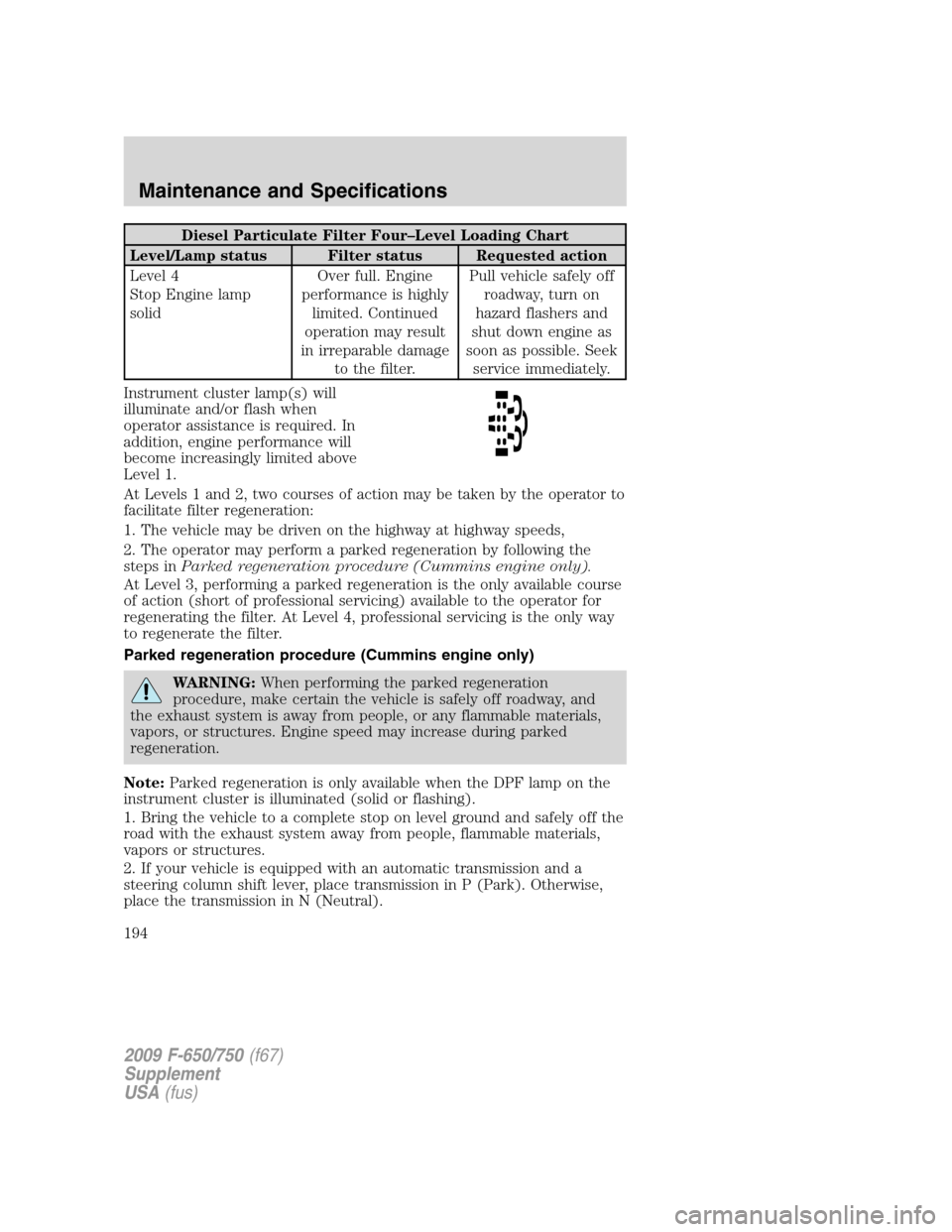
Diesel Particulate Filter Four–Level Loading Chart
Level/Lamp status Filter status Requested action
Level 4
Stop Engine lamp
solidOver full. Engine
performance is highly
limited. Continued
operation may result
in irreparable damage
to the filter.Pull vehicle safely off
roadway, turn on
hazard flashers and
shut down engine as
soon as possible. Seek
service immediately.
Instrument cluster lamp(s) will
illuminate and/or flash when
operator assistance is required. In
addition, engine performance will
become increasingly limited above
Level 1.
At Levels 1 and 2, two courses of action may be taken by the operator to
facilitate filter regeneration:
1. The vehicle may be driven on the highway at highway speeds,
2. The operator may perform a parked regeneration by following the
steps inParked regeneration procedure (Cummins engine only).
At Level 3, performing a parked regeneration is the only available course
of action (short of professional servicing) available to the operator for
regenerating the filter. At Level 4, professional servicing is the only way
to regenerate the filter.
Parked regeneration procedure (Cummins engine only)
WARNING:When performing the parked regeneration
procedure, make certain the vehicle is safely off roadway, and
the exhaust system is away from people, or any flammable materials,
vapors, or structures. Engine speed may increase during parked
regeneration.
Note:Parked regeneration is only available when the DPF lamp on the
instrument cluster is illuminated (solid or flashing).
1. Bring the vehicle to a complete stop on level ground and safely off the
road with the exhaust system away from people, flammable materials,
vapors or structures.
2. If your vehicle is equipped with an automatic transmission and a
steering column shift lever, place transmission in P (Park). Otherwise,
place the transmission in N (Neutral).
2009 F-650/750(f67)
Supplement
USA(fus)
Maintenance and Specifications
194
Page 195 of 276
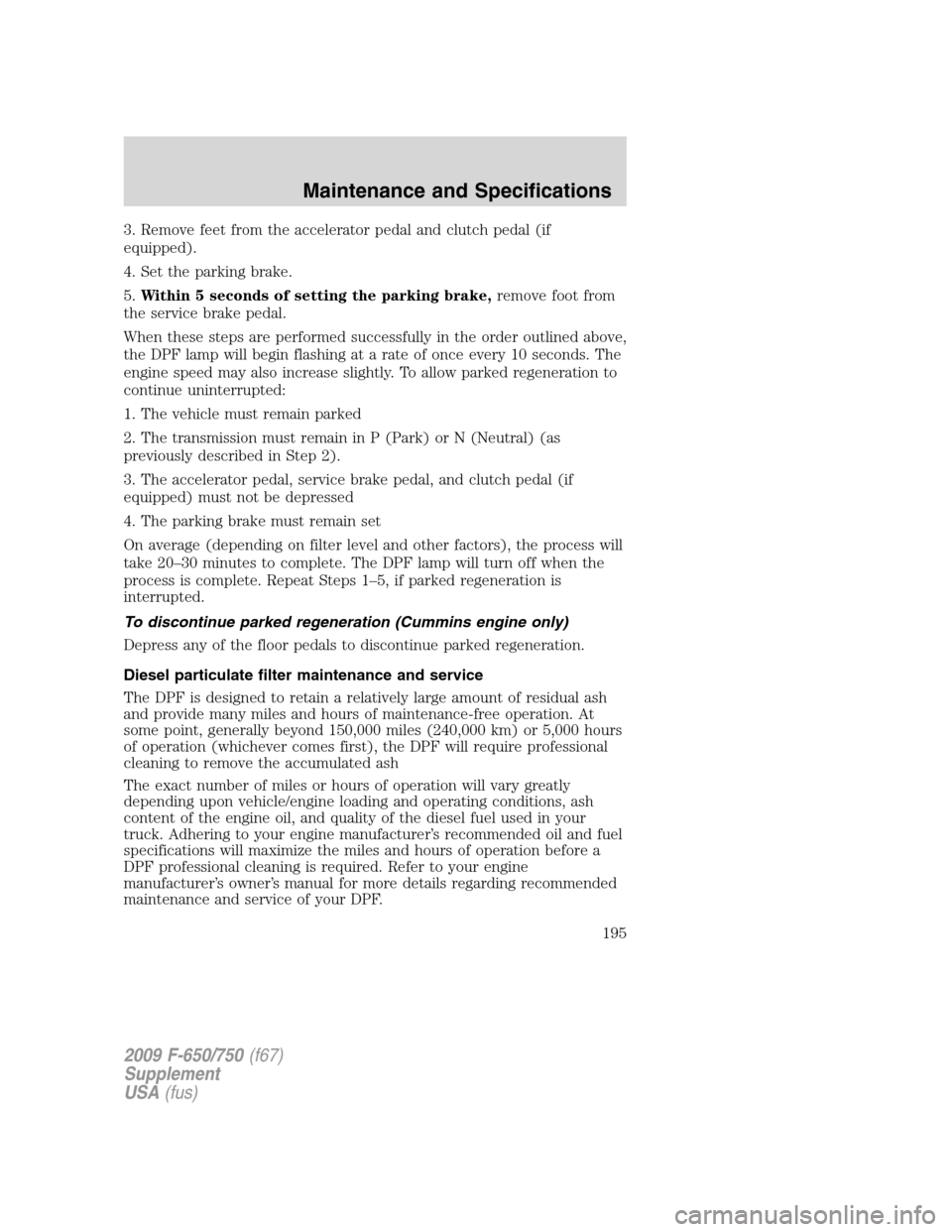
3. Remove feet from the accelerator pedal and clutch pedal (if
equipped).
4. Set the parking brake.
5.Within 5 seconds of setting the parking brake,remove foot from
the service brake pedal.
When these steps are performed successfully in the order outlined above,
the DPF lamp will begin flashing at a rate of once every 10 seconds. The
engine speed may also increase slightly. To allow parked regeneration to
continue uninterrupted:
1. The vehicle must remain parked
2. The transmission must remain in P (Park) or N (Neutral) (as
previously described in Step 2).
3. The accelerator pedal, service brake pedal, and clutch pedal (if
equipped) must not be depressed
4. The parking brake must remain set
On average (depending on filter level and other factors), the process will
take 20–30 minutes to complete. The DPF lamp will turn off when the
process is complete. Repeat Steps 1–5, if parked regeneration is
interrupted.
To discontinue parked regeneration (Cummins engine only)
Depress any of the floor pedals to discontinue parked regeneration.
Diesel particulate filter maintenance and service
The DPF is designed to retain a relatively large amount of residual ash
and provide many miles and hours of maintenance-free operation. At
some point, generally beyond 150,000 miles (240,000 km) or 5,000 hours
of operation (whichever comes first), the DPF will require professional
cleaning to remove the accumulated ash
The exact number of miles or hours of operation will vary greatly
depending upon vehicle/engine loading and operating conditions, ash
content of the engine oil, and quality of the diesel fuel used in your
truck. Adhering to your engine manufacturer’s recommended oil and fuel
specifications will maximize the miles and hours of operation before a
DPF professional cleaning is required. Refer to your engine
manufacturer’s owner’s manual for more details regarding recommended
maintenance and service of your DPF.
2009 F-650/750(f67)
Supplement
USA(fus)
Maintenance and Specifications
195
Page 196 of 276

Exhaust outlet assembly
WARNING:The normal operating temperature of the exhaust
system is very high. Never work around or attempt to repair any
part of the exhaust system until it has cooled. Failure to follow these
instructions may result in serious personal injury.
The exhaust outlet assembly on your vehicle is a uniquely functioning
device that accompanies the DPF assembly. It is designed to help control
the temperature of the exhaust during the DPF regeneration process.Do
not modify or remove this device. Modification of the system
and/or additions of aftermarket devices can reduce the
effectiveness of the system, as well as cause damage to the
exhaust system and/or engine. Any modifications may also
invalidate the vehicle and/or engine warranties. See the vehicle
and engine warranty guides for more information.
The inlet holes in the side of the assembly are functional. These holes
allow outside air to be drawn into the outlet assembly. The holes need to
be kept clear of mud and other foreign material to maintain proper
functionality of the system. One way to keep the holes clear is to spray
the outlet assembly with a hose when washing the vehicle. Failure to
keep the functional holes clear of foreign material may result in the holes
becoming blocked or plugged.Blocked/plugged holes or
modification/removal of the outlet assembly could result in
elevated exhaust temperatures which may result in
vehicle/property damage and/or personal injury.
NOISE EMISSIONS – EXTERIOR
In order to comply with the federal exterior noise regulations, your
vehicle may be equipped with noise emission items. Depending on the
vehicle configuration, it may have all or some of the following items:
Air Intake System
•Air Cleaner:should be inspected and its location should not be
altered. Do not alter inlet and outlet piping.
Body
•Wheel Well:splash shields, cab shields and under-hood insulation
should be inspected for deterioration, dislocation, and orientation.
Cooling System
•Check the fan for damage to blades; replace, if damaged, with the
recommended parts. Inspect for fan to shroud interference, and any
damage to shroud such as cracks and holes.
2009 F-650/750(f67)
Supplement
USA(fus)
Maintenance and Specifications
196