2009 FORD F SERIES MOTORHOME AND COMMERCIAL CHASSIS ignition
[x] Cancel search: ignitionPage 75 of 136
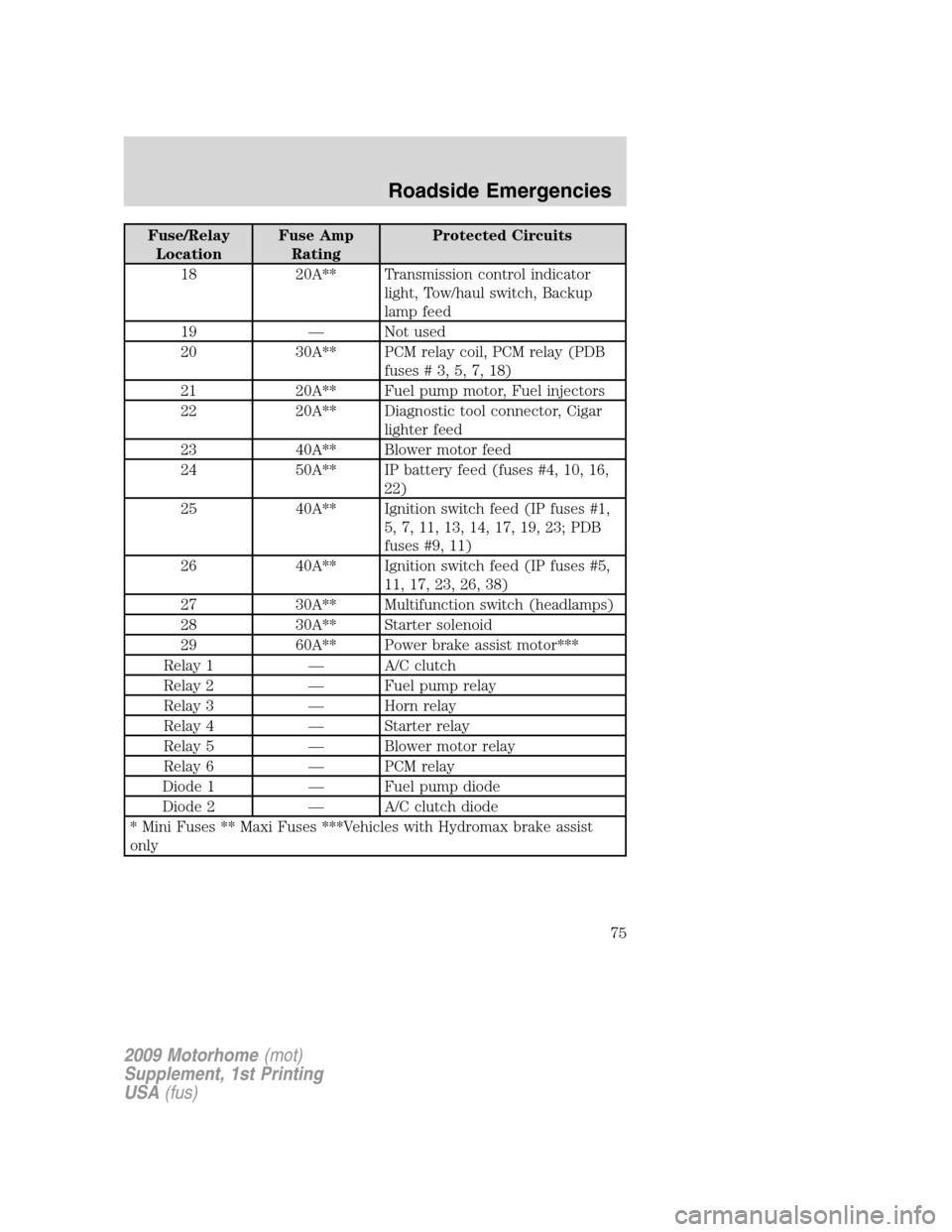
Fuse/Relay
LocationFuse Amp
RatingProtected Circuits
18 20A** Transmission control indicator
light, Tow/haul switch, Backup
lamp feed
19 — Not used
20 30A** PCM relay coil, PCM relay (PDB
fuses#3,5,7,18)
21 20A** Fuel pump motor, Fuel injectors
22 20A** Diagnostic tool connector, Cigar
lighter feed
23 40A** Blower motor feed
24 50A** IP battery feed (fuses #4, 10, 16,
22)
25 40A** Ignition switch feed (IP fuses #1,
5, 7, 11, 13, 14, 17, 19, 23; PDB
fuses #9, 11)
26 40A** Ignition switch feed (IP fuses #5,
11, 17, 23, 26, 38)
27 30A** Multifunction switch (headlamps)
28 30A** Starter solenoid
29 60A** Power brake assist motor***
Relay 1 — A/C clutch
Relay 2 — Fuel pump relay
Relay 3 — Horn relay
Relay 4 — Starter relay
Relay 5 — Blower motor relay
Relay 6 — PCM relay
Diode 1 — Fuel pump diode
Diode 2 — A/C clutch diode
* Mini Fuses ** Maxi Fuses ***Vehicles with Hydromax brake assist
only
2009 Motorhome(mot)
Supplement, 1st Printing
USA(fus)
Roadside Emergencies
75
Page 112 of 136
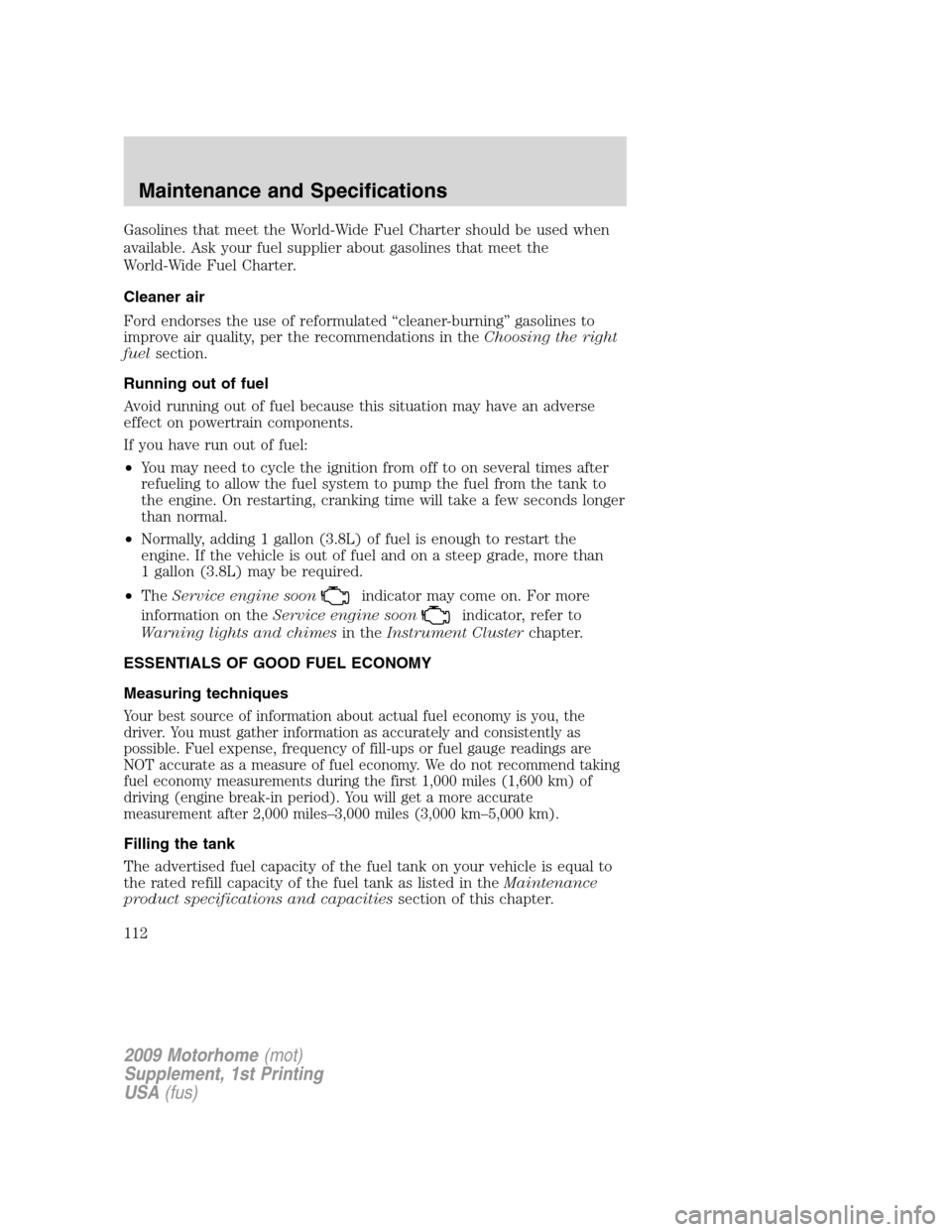
Gasolines that meet the World-Wide Fuel Charter should be used when
available. Ask your fuel supplier about gasolines that meet the
World-Wide Fuel Charter.
Cleaner air
Ford endorses the use of reformulated “cleaner-burning” gasolines to
improve air quality, per the recommendations in theChoosing the right
fuelsection.
Running out of fuel
Avoid running out of fuel because this situation may have an adverse
effect on powertrain components.
If you have run out of fuel:
•You may need to cycle the ignition from off to on several times after
refueling to allow the fuel system to pump the fuel from the tank to
the engine. On restarting, cranking time will take a few seconds longer
than normal.
•Normally, adding 1 gallon (3.8L) of fuel is enough to restart the
engine. If the vehicle is out of fuel and on a steep grade, more than
1 gallon (3.8L) may be required.
•TheService engine soon
indicator may come on. For more
information on theService engine soon
indicator, refer to
Warning lights and chimesin theInstrument Clusterchapter.
ESSENTIALS OF GOOD FUEL ECONOMY
Measuring techniques
Your best source of information about actual fuel economy is you, the
driver. You must gather information as accurately and consistently as
possible. Fuel expense, frequency of fill-ups or fuel gauge readings are
NOT accurate as a measure of fuel economy. We do not recommend taking
fuel economy measurements during the first 1,000 miles (1,600 km) of
driving (engine break-in period). You will get a more accurate
measurement after 2,000 miles–3,000 miles (3,000 km–5,000 km).
Filling the tank
The advertised fuel capacity of the fuel tank on your vehicle is equal to
the rated refill capacity of the fuel tank as listed in theMaintenance
product specifications and capacitiessection of this chapter.
2009 Motorhome(mot)
Supplement, 1st Printing
USA(fus)
Maintenance and Specifications
112
Page 113 of 136
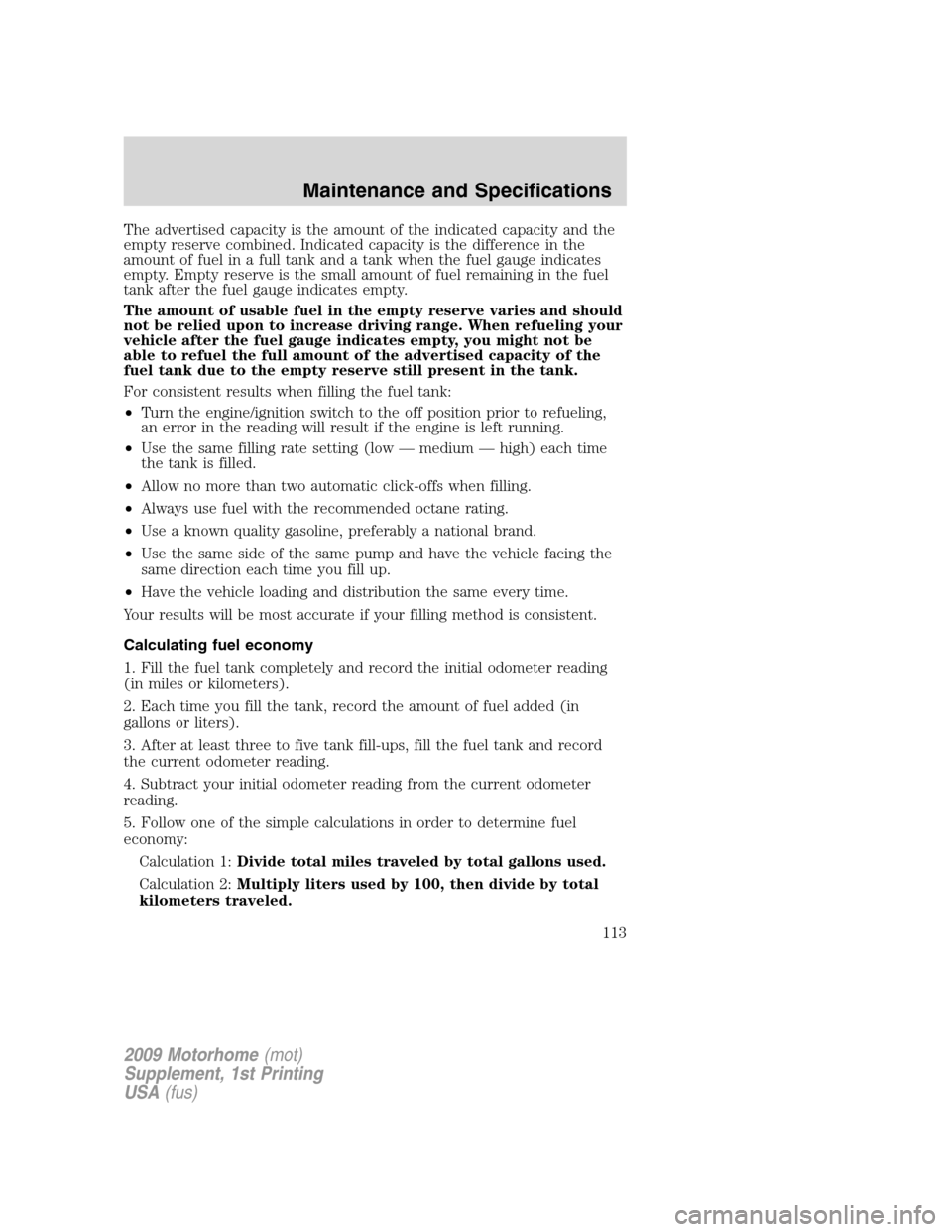
The advertised capacity is the amount of the indicated capacity and the
empty reserve combined. Indicated capacity is the difference in the
amount of fuel in a full tank and a tank when the fuel gauge indicates
empty. Empty reserve is the small amount of fuel remaining in the fuel
tank after the fuel gauge indicates empty.
The amount of usable fuel in the empty reserve varies and should
not be relied upon to increase driving range. When refueling your
vehicle after the fuel gauge indicates empty, you might not be
able to refuel the full amount of the advertised capacity of the
fuel tank due to the empty reserve still present in the tank.
For consistent results when filling the fuel tank:
•Turn the engine/ignition switch to the off position prior to refueling,
an error in the reading will result if the engine is left running.
•Use the same filling rate setting (low — medium — high) each time
the tank is filled.
•Allow no more than two automatic click-offs when filling.
•Always use fuel with the recommended octane rating.
•Use a known quality gasoline, preferably a national brand.
•Use the same side of the same pump and have the vehicle facing the
same direction each time you fill up.
•Have the vehicle loading and distribution the same every time.
Your results will be most accurate if your filling method is consistent.
Calculating fuel economy
1. Fill the fuel tank completely and record the initial odometer reading
(in miles or kilometers).
2. Each time you fill the tank, record the amount of fuel added (in
gallons or liters).
3. After at least three to five tank fill-ups, fill the fuel tank and record
the current odometer reading.
4. Subtract your initial odometer reading from the current odometer
reading.
5. Follow one of the simple calculations in order to determine fuel
economy:
Calculation 1:Divide total miles traveled by total gallons used.
Calculation 2:Multiply liters used by 100, then divide by total
kilometers traveled.
2009 Motorhome(mot)
Supplement, 1st Printing
USA(fus)
Maintenance and Specifications
113
Page 116 of 136
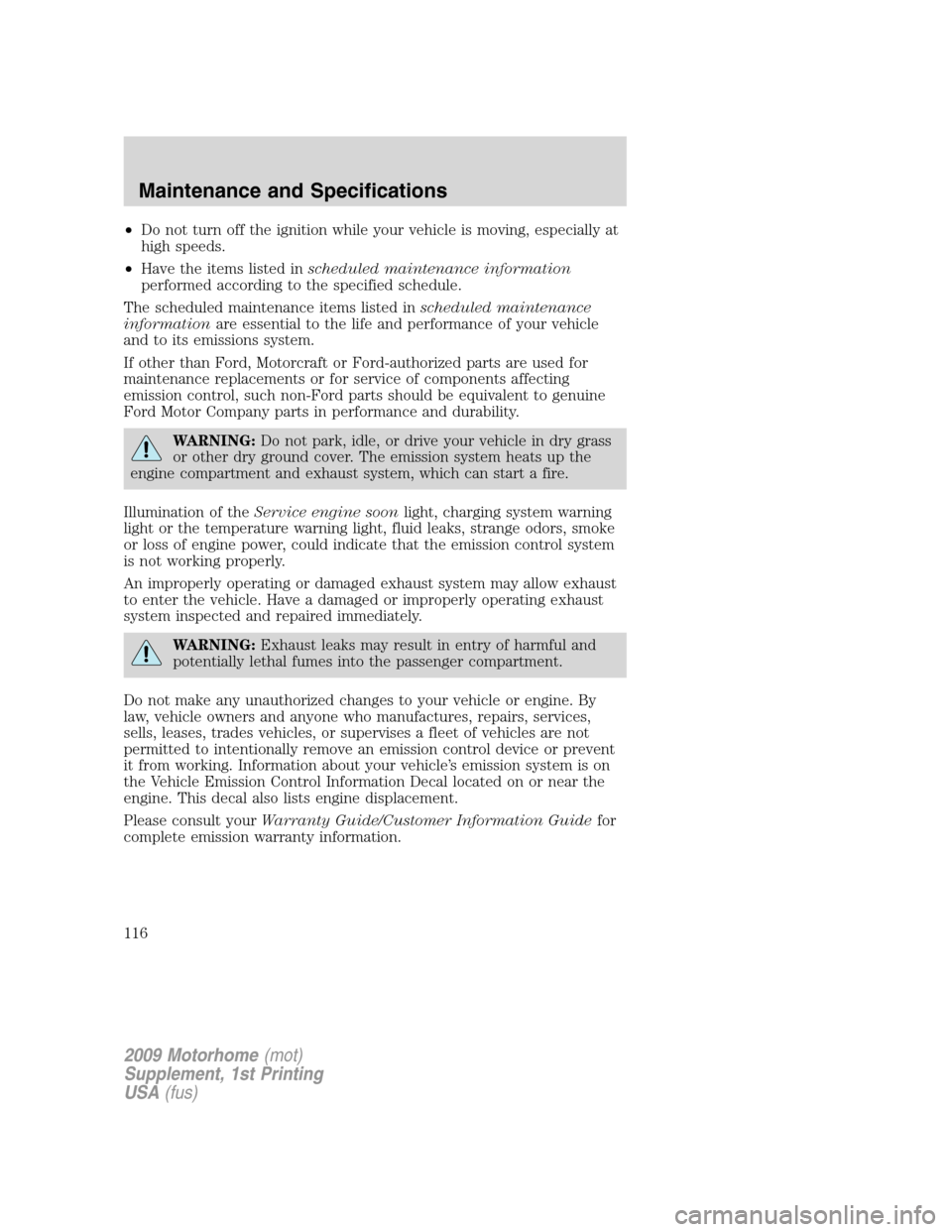
•Do not turn off the ignition while your vehicle is moving, especially at
high speeds.
•Have the items listed inscheduled maintenance information
performed according to the specified schedule.
The scheduled maintenance items listed inscheduled maintenance
informationare essential to the life and performance of your vehicle
and to its emissions system.
If other than Ford, Motorcraft or Ford-authorized parts are used for
maintenance replacements or for service of components affecting
emission control, such non-Ford parts should be equivalent to genuine
Ford Motor Company parts in performance and durability.
WARNING:Do not park, idle, or drive your vehicle in dry grass
or other dry ground cover. The emission system heats up the
engine compartment and exhaust system, which can start a fire.
Illumination of theService engine soonlight, charging system warning
light or the temperature warning light, fluid leaks, strange odors, smoke
or loss of engine power, could indicate that the emission control system
is not working properly.
An improperly operating or damaged exhaust system may allow exhaust
to enter the vehicle. Have a damaged or improperly operating exhaust
system inspected and repaired immediately.
WARNING:Exhaust leaks may result in entry of harmful and
potentially lethal fumes into the passenger compartment.
Do not make any unauthorized changes to your vehicle or engine. By
law, vehicle owners and anyone who manufactures, repairs, services,
sells, leases, trades vehicles, or supervises a fleet of vehicles are not
permitted to intentionally remove an emission control device or prevent
it from working. Information about your vehicle’s emission system is on
the Vehicle Emission Control Information Decal located on or near the
engine. This decal also lists engine displacement.
Please consult yourWarranty Guide/Customer Information Guidefor
complete emission warranty information.
2009 Motorhome(mot)
Supplement, 1st Printing
USA(fus)
Maintenance and Specifications
116
Page 117 of 136
Readiness for Inspection/Maintenance (I/M) testing
Some state/provincial and local governments may have
Inspection/Maintenance (I/M) programs to inspect the emission control
equipment on your vehicle. Failure to pass this inspection could prevent
you from getting a vehicle registration. Your vehicle may not pass the I/M
test if theService engine soon
indicator is on or not working
properly (bulb is burned out), or if the OBD-II system has determined
that some of the emission control systems have not been properly
checked. In this case, the vehicle is considered not ready for I/M testing.
If theService engine soon
indicator is on or the bulb does not
work, the vehicle may need to be serviced. Refer to the On board
diagnostics (OBD-II) description in this chapter.
If the vehicle’s engine or transmission has just been serviced, or the
battery has recently run down or been replaced, the OBD-II system may
indicate that the vehicle is not ready for I/M testing. To determine if the
vehicle is ready for I/M testing, turn the ignition key to the on position
for 15 seconds without cranking the engine. If theService engine
soon
indicator blinks eight times, it means that the vehicle is not
ready for I/M testing; if theService engine soon
indicator stays on
solid, it means that the vehicle is ready for I/M testing.
The OBD-II system is designed to check the emission control system
during normal driving. A complete check may take several days. If the
vehicle is not ready for I/M testing, the following driving cycle consisting
of mixed city and highway driving may be performed:
15 minutes of steady driving on an expressway/highway followed by
20 minutes of stop-and-go driving with at least four 30-second idle
periods.
Allow the vehicle to sit for at least eight hours without starting the
engine. Then, start the engine and complete the above driving cycle. The
engine must warm up to its normal operating temperature. Once started,
do not turn off the engine until the above driving cycle is complete. If
the vehicle is still not ready for I/M testing, the above driving cycle will
have to be repeated.
2009 Motorhome(mot)
Supplement, 1st Printing
USA(fus)
Maintenance and Specifications
117
Page 131 of 136
Your vehicle’s rear axle is filled with a synthetic rear axle lubricant and is
considered lubricated for life. These lubricants do not need to be
checked or changed unless a leak is suspected, service is required or the
axle assembly has been submerged in water. The axle lubricant should
be changed any time the rear axle has been submerged in water.
6Fill 1/4 inch to 9/16 inch (6 mm to 14 mm) below bottom of fill hole.
ENGINE DATA
Engine 6.8L V10 engine
Cubic inches 415
Required fuel 87 octane
Firing order 1-6-5-10-2-7-3-8-4-9
Ignition system Coil on plug
Spark plug gap 0.039-0.043 inch (1.00-1.10mm)
Compression ratio 9.2:1
IDENTIFYING YOUR VEHICLE
Certification label for incomplete vehicles
On completed derivations of incomplete vehicles, the certification label is
affixed at a location determined by a subsequent stage manufacturer of
the completed vehicle. In these cases the completed vehicle is
manufactured in two or more stages by two or more separate
manufacturers.
Vehicle Identification Number
The vehicle identification number is located near the cowl to the right of
the air filter.
If you ever find it necessary to communicate with Ford Motor Company
about your vehicle, always include the VIN in your communication.
2009 Motorhome(mot)
Supplement, 1st Printing
USA(fus)
Maintenance and Specifications
131
Page 134 of 136
Engine ........................................131
cleaning .....................................95
coolant .....................................102
fail-safe cooling .......................107
idle speed control ...................100
lubrication specifications .......128
refill capacities ........................128
service points ............................97
Engine oil ....................................97
checking and adding ................97
dipstick ......................................97
filter, specifications ..........99, 127
recommendations .....................99
refill capacities ........................128
specifications ..........................128
Event data recording ....................6
Exhaust fumes ............................56
F
Fail safe cooling ........................107
Fluid capacities .........................128
Fuel ............................................108
calculating fuel
economy ............................24, 112
capacity ...................................128
choosing the right fuel ...........111
comparisons with EPA fuel
economy estimates .................115
detergent in fuel .....................112
filling your vehicle with
fuel ...................................108, 112
filter, specifications ........108, 127
improving fuel economy ........112
octane rating ...................111, 131
quality ......................................111
running out of fuel .................112
safety information relating to
automotive fuels .....................108
Fuses ............................................69G
Gas mileage
(see Fuel economy) .................112
Gauges .........................................13
H
Hazard flashers ...........................68
Headlamps ...................................17
daytime running lights .............17
flash to pass ..............................18
high beam .................................17
turning on and off ....................17
I
Ignition .................................54, 131
Inspection/maintenance (I/M)
testing ........................................117
Instrument panel
cluster ........................................10
lighting up panel and
interior .......................................18
J
Jump-starting your vehicle ........82
K
Keys
positions of the ignition ...........54
L
Lamps
daytime running light ...............17
headlamps .................................17
headlamps, flash to pass ..........18
instrument panel, dimming .....18
2009 Motorhome(mot)
Supplement, 1st Printing
USA(fus)
Index
134