Page 4 of 270
3
SERVICE STATION GUIDE
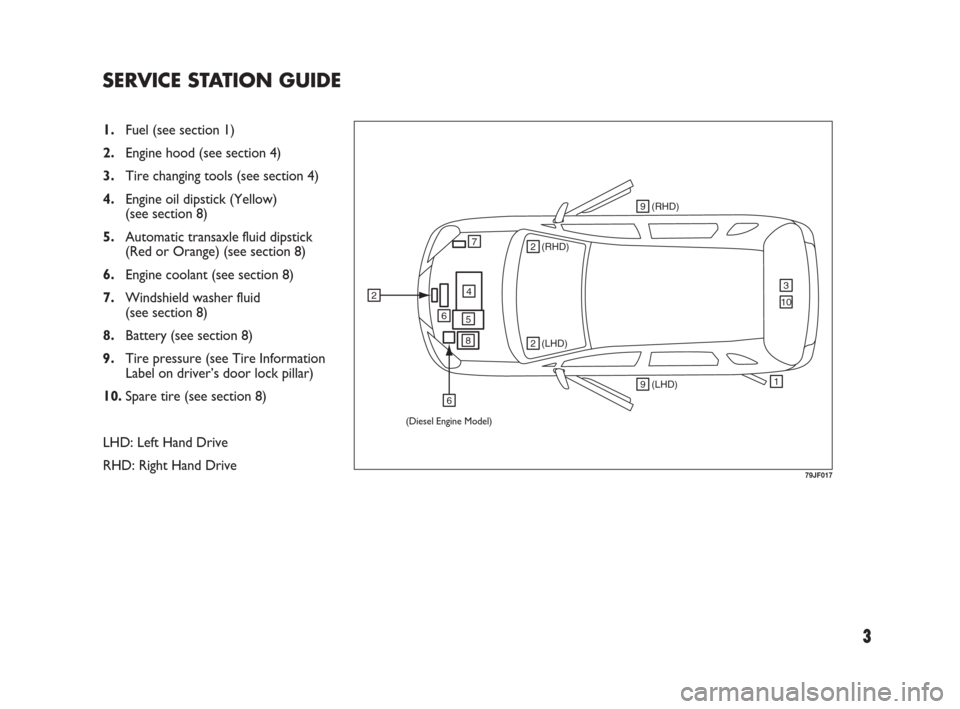
1.Fuel (see section 1)
2.Engine hood (see section 4)
3.Tire changing tools (see section 4)
4.Engine oil dipstick (Yellow)
(see section 8)
5.Automatic transaxle fluid dipstick
(Red or Orange) (see section 8)
6.Engine coolant (see section 8)
7.Windshield washer fluid
(see section 8)
8.Battery (see section 8)
9.Tire pressure (see Tire Information
Label on driver’s door lock pillar)
10.Spare tire (see section 8)
LHD: Left Hand Drive
RHD: Right Hand Drive
(RHD)
2
2
(LHD) 2
4
7
6
(LHD)19
(RHD) 9
3
10
85
6
79JF017
(Diesel Engine Model)
001-008 SEDICI LUM FL GB 1E 19-06-2009 13:27 Pagina 3
Page 152 of 270
151
�Brake fluid level
�Power steering (for versions/markets,
where provided) fluid level
�Windshield washer fluid level
�Battery solution level
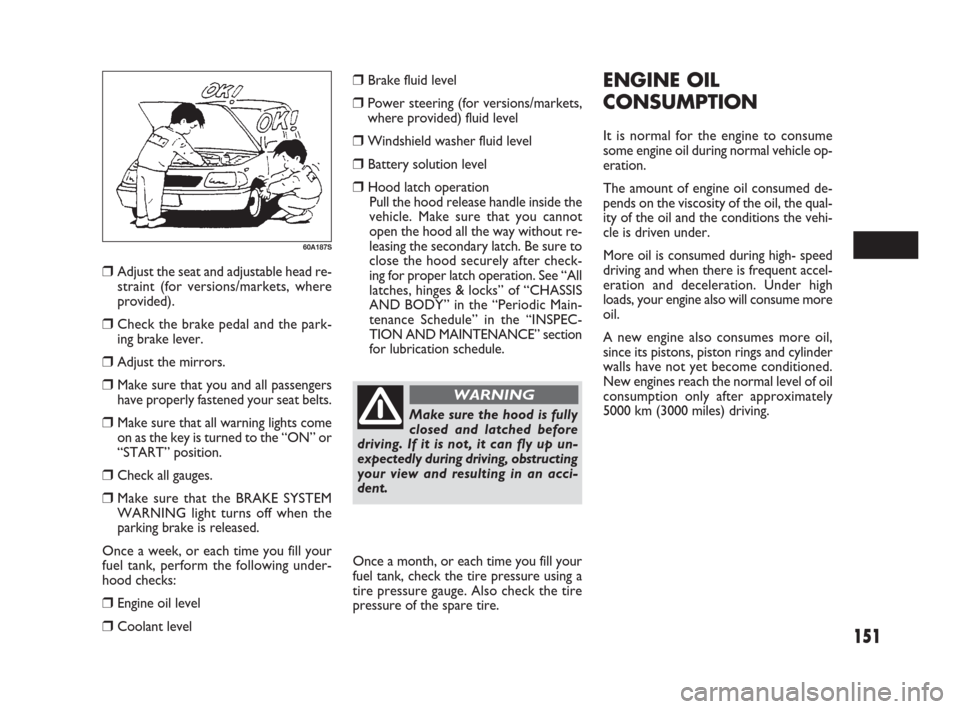
�Hood latch operation
Pull the hood release handle inside the
vehicle. Make sure that you cannot
open the hood all the way without re-
leasing the secondary latch. Be sure to
close the hood securely after check-
ing for proper latch operation. See “All
latches, hinges & locks” of “CHASSIS
AND BODY” in the “Periodic Main-
tenance Schedule” in the “INSPEC-
TION AND MAINTENANCE” section
for lubrication schedule.
Once a month, or each time you fill your
fuel tank, check the tire pressure using a
tire pressure gauge. Also check the tire
pressure of the spare tire.
�Adjust the seat and adjustable head re-
straint (for versions/markets, where
provided).
�Check the brake pedal and the park-
ing brake lever.
�Adjust the mirrors.
�Make sure that you and all passengers
have properly fastened your seat belts.
�Make sure that all warning lights come
on as the key is turned to the “ON” or
“START” position.
�Check all gauges.
�Make sure that the BRAKE SYSTEM
WARNING light turns off when the
parking brake is released.
Once a week, or each time you fill your
fuel tank, perform the following under-
hood checks:
�Engine oil level
�Coolant level
60A187S
Make sure the hood is fully
closed and latched before
driving. If it is not, it can fly up un-
expectedly during driving, obstructing
your view and resulting in an acci-
dent.
WARNING
ENGINE OIL
CONSUMPTION
It is normal for the engine to consume
some engine oil during normal vehicle op-
eration.
The amount of engine oil consumed de-
pends on the viscosity of the oil, the qual-
ity of the oil and the conditions the vehi-
cle is driven under.
More oil is consumed during high- speed
driving and when there is frequent accel-
eration and deceleration. Under high
loads, your engine also will consume more
oil.
A new engine also consumes more oil,
since its pistons, piston rings and cylinder
walls have not yet become conditioned.
New engines reach the normal level of oil
consumption only after approximately
5000 km (3000 miles) driving.
149-168 SEDICI LUM FL GB 1E 19-06-2009 13:33 Pagina 151
Page 194 of 270
193
Tightening torque for drain plug
For Gasoline Engine Model:
35 Nm (3.5 kgm, 25.3 lb·ft)
For Diesel Engine Model:
20 Nm (2,0 kgm, 14.4 lb-ft)
❒Reinstall the drain plug and gasket.
Tighten the plug with a wrench to the
specified torque.
NOTE (For Diesel Engine Model)
Whenever the engine oil is changed, the
monitoring system to find the next oil
change stage must be reset whether the
oil pressure light blinks or not. For details
on how to reset the system, ask your Fi-
at Dealership. CHANGING ENGINE OIL AND
FILTER
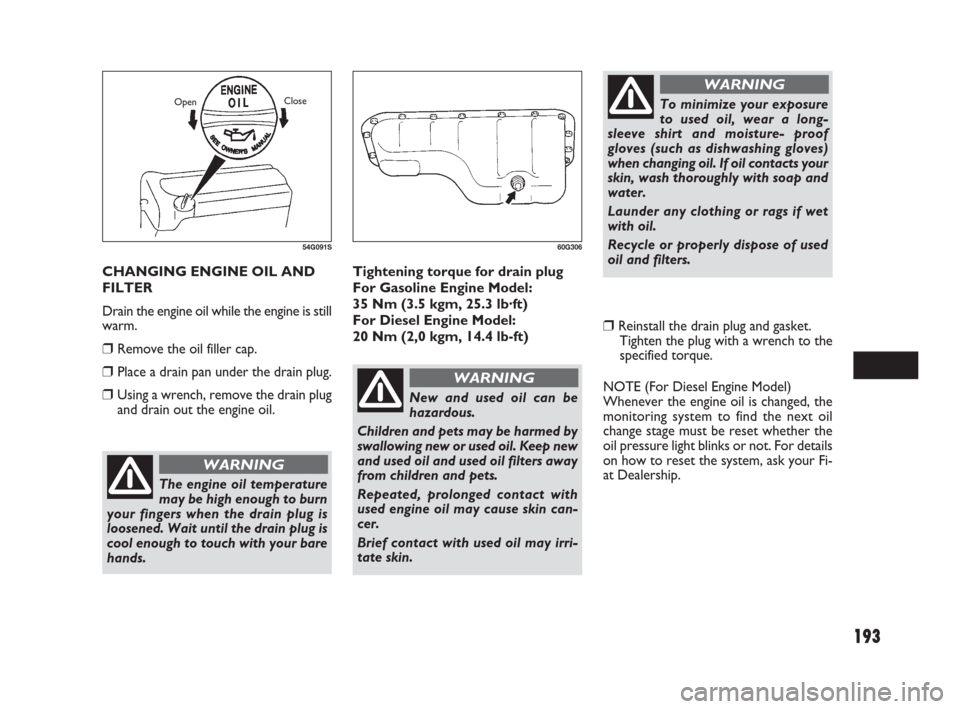
Drain the engine oil while the engine is still
warm.
❒Remove the oil filler cap.
❒Place a drain pan under the drain plug.
❒Using a wrench, remove the drain plug
and drain out the engine oil.
54G091S
OpenClose
The engine oil temperature
may be high enough to burn
your fingers when the drain plug is
loosened. Wait until the drain plug is
cool enough to touch with your bare
hands.
WARNING
60G306
New and used oil can be
hazardous.
Children and pets may be harmed by
swallowing new or used oil. Keep new
and used oil and used oil filters away
from children and pets.
Repeated, prolonged contact with
used engine oil may cause skin can-
cer.
Brief contact with used oil may irri-
tate skin.
WARNING
To minimize your exposure
to used oil, wear a long-
sleeve shirt and moisture- proof
gloves (such as dishwashing gloves)
when changing oil. If oil contacts your
skin, wash thoroughly with soap and
water.
Launder any clothing or rags if wet
with oil.
Recycle or properly dispose of used
oil and filters.
WARNING
183-230 SEDICI LUM FL GB 1E 19-06-2009 11:00 Pagina 193