Page 165 of 226
164KNOW
YOUR VEHICLE
SAFETY
CORRECT USE
OF THE CAR
WARNING LIGHTS
AND MESSAGES
IN
AN EMERGENCYCAR
MAINTENANCE
TECHNICAL
SPECIFICATIONS
INDEX
10
10
30
30
15
20
20
15
F39
F39
F40
F43
F53
F47
F48
F52
Passenger’s compartment fuse-box - fig. 167 FUSE AMPERETelephoneBody-computer control unitHeated rear windowWindscreen wiper/washerWindscreen/rear window washer pumpFront left power windowFront right power windowRear window wiper
30
20
15
15
15
15
7,5
10
7,5
F8
F9
F10
F11
F14
F15
F16
F17
F18
Engine compartment fuse-box - fig. 169 FUSE AMPEREClimate control system fanHeadlight washersHornSecondary services and odometer generatorMain beam headlights+ 30 trailer unit
Electronic injection and supply system +15 Dualogic transmission control unitElectronic injection primary services+30 engine control node
135-168 PANDA EN 7-10-2009 14:07 Pagina 164
Page 171 of 226

●●●● ● ●●●●
●●●● ● ●●●●
●●●● ● ●●●●
●●●● ● ●●●●
●●●● ● ●●●●
●●●
●●●● ● ●●●●
●●●● ● ●●●●
●
●● ●●
●● ●●
●● ●●
●●20 40 60 80 100 120 140 160 180
SCHEDULED SERVICING PROGRAMMEThese coupons have to be carried out every 20,000 km
Thousands of km
Check tyre condition/wear and, if necessary, adjust
pressure
Check lighting system operation (headlights, direction indicators,
hazard warning lights, passenger’s compartment lights, boot lights, instrument panel warning lights, etc.)Check windscreen wiper/washer operation, adjust nozzlesCheck windscreen/rear window blade position/wearCheck front disc brake pad conditions and wearCheck rear drum brake linings conditions and wear
Condition visual check: bodywork exterior, underbody
protection, pipes and hoses (exhaust – fuel supply system
– braking system), rubber elements (boots – sleeves – bushes – etc...)
Check cleanliness of bonnet and boot locks, as well as cleanliness and lubrication of linkages
Check tension and conditions of various accessory drive belts (except for engines with automatic tensioners)Visually inspect conditions of the accessory drive beltsCheck and adjust tappet clearance (petrol versions)Check and adjust handbrake lever stroke Check anti-evaporation system (petrol versions)
INDEX TECHNICAL
SPECIFICATIONSCAR
MAINTENANCEIN
AN EMERGENCY WARNING LIGHTS
AND MESSAGESCORRECT USE
OF THE CARSAFETYKNOW
YOUR VEHICLE
170
169-190 PANDA EN 7-10-2009 14:14 Pagina 170
Page 173 of 226

YEARLY INSPECTION SCHEDULEFor cars with an annual mileage of below 20,000 km (for
example about 15,000 km) the following yearly inspec-
tion schedule is advised:❒
check conditions/wear of tyres and adjust pressure if
necessary (including spare wheel);
❒
check lighting system operation (headlights, direction
indicators, hazard warning lights, boot light, passenger’s
compartment, instrument panel warning lights, etc...);
❒
check wiper/washer system operation, adjust nozzles;
❒
check windscreen/rear window blade position/wear;
❒
check front disc brake pad conditions and wear;
❒
check cleanliness of bonnet and boot locks and lever
cleanliness and lubrication;
❒
sight inspect the conditions of: engine, gearbox, trans-
mission, pipes and hoses (exhaust – fuel supply – brak-
ing system) rubber parts (boots – sleeves – bushes etc.),
fuel and brake system hoses;
❒
check battery charge;
❒
visually check the various drive belt conditions;
❒
check and top-up liquids if required (engine coolant,
brakes, windscreen washer, battery, etc.);
❒
change engine oil;
❒
change engine oil filter;
❒
change pollen filter (for versions/markets where pro-
vided).
ADDITIONAL INTERVENTIONSEvery 1,000 km or before long journeys, check and, if nec-
essary, top-up the following:❒
engine coolant fluid level;
❒
brake fluid level;
❒
battery fluid level;
❒
windscreen washer fluid level;
❒
tyre pressure and conditions.
Every 3,000 km check the following and top-up, if required:
❒
engine oil level.
You are recommended to use FL Selenia products de-
signed and produced specifically for Fiat cars (see table
“Capacities” in chapter “Technical specifications”).
IMPORTANT – Engine oil
Should prevailing use of the car be under one of the fol-
lowing specially heavy conditions:
❒
trailer or caravan towing;
❒
dusty roads;
❒
short distances (less than 7–8 km) and with external
temperatures below zero;
INDEX TECHNICAL
SPECIFICATIONSCAR
MAINTENANCEIN
AN EMERGENCY WARNING LIGHTS
AND MESSAGESCORRECT USE
OF THE CARSAFETYKNOW
YOUR VEHICLE
172
169-190 PANDA EN 7-10-2009 14:14 Pagina 172
Page 179 of 226

The engine cooling system is pressurised.
If necessary, only replace the cap with an-
other genuine one or the operation of the system
may be adversely affected. Do not remove the cap
from the reservoir when the engine is hot: dan-
ger of scalding.
WARNING
The engine cooling system uses protective
antifreeze fluid PARAFLU
UP. Use the same
fluid as in the cooling system when topping
up. PARAFLU
UP
fluid cannot be mixed with any oth-
er type of fluid. If this accidentally occurs, do not
start the engine and contact a Fiat Dealership.
Do not travel with the windscreen wash-
er reservoir empty: the windscreen
washer is fundamental for improving visibility.
WARNING
WINDSCREEN/REAR WINDOW WASHER
FLUID fig. 180
To top-up, remove the cap A.
Pour a mixture of water and TUTELA PROFESSIONAL
SC35, in the following concentrations:
30% TUTELA PROFESSIONAL SC35 and 70% water in
summer.
50% TUTELA PROFESSIONAL SC35 and 50% water in
winter.
At temperatures below −20 °C, use undiluted TUTELA
PROFESSIONAL SC35 fluid.
Check level through the reservoir.
fig. 180
F0Z0183m
INDEX TECHNICAL
SPECIFICATIONSCAR
MAINTENANCEIN
AN EMERGENCY WARNING LIGHTS
AND MESSAGESCORRECT USE
OF THE CARSAFETYKNOW
YOUR VEHICLE
178
169-190 PANDA EN 7-10-2009 14:14 Pagina 178
Page 186 of 226

185KNOW
YOUR VEHICLE
SAFETY
CORRECT USE
OF THE CAR
WARNING LIGHTS
AND MESSAGES
IN
AN EMERGENCYCAR
MAINTENANCETECHNICAL
SPECIFICATIONS
INDEX
WINDSCREEN/REAR WINDOW
WIPER/WASHERBLADES
Periodically clean the rubber part using special products;
TUTELA PROFESSIONAL SC 35 is recommended.
Replace the blades if the rubber edge is deformed or worn.
In all cases, it is advisable to replace them approximately once
a year.
A few simple precautions can reduce the possibility of dam-
age to the blades:❒
make sure that the rubber part is not stuck to the wind-
screen at sub-zero temperatures. Use an antifreeze
product to release it if required;
❒
remove any snow from the glass: in addition to pro-
tecting the blades, this prevents effort on the motor
and overheating;
❒
do not operate the windscreen and the rear screen
wipers on dry glass.
RUBBER HOSESAs far as the brake system and fuel rubber hoses are concerned,
follow the “Scheduled Servicing Programme” in this chapter care-
fully.
Ozone, high temperatures and prolonged lack of fluid in the sys-
tem may cause hardening and cracking of the hoses, with pos-
sible leaks. Careful control is therefore necessary.
Driving with worn wiper blades is a serious
hazard, because visibility is reduced in bad
weather.
WARNING
169-190 PANDA EN 7-10-2009 14:15 Pagina 185
Page 187 of 226
186KNOW
YOUR VEHICLE
SAFETY
CORRECT USE
OF THE CAR
WARNING LIGHTS
AND MESSAGES
IN
AN EMERGENCYCAR
MAINTENANCE
TECHNICAL
SPECIFICATIONS
INDEX
F0Z0218m
fig. 186
F0G0077m
fig. 187
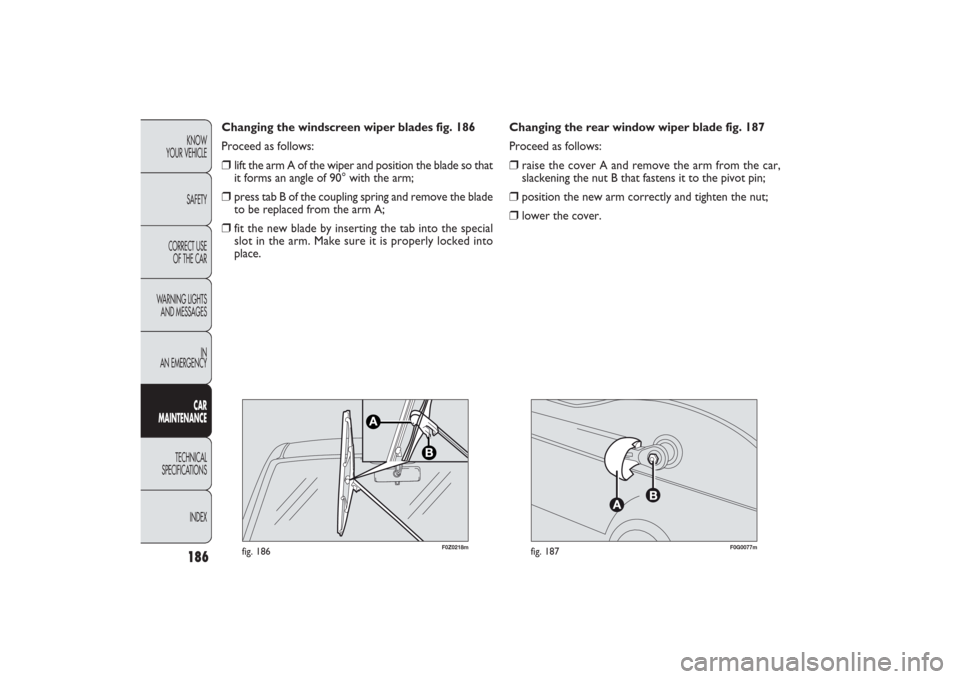
Changing the rear window wiper blade fig. 187
Proceed as follows:❒
raise the cover A and remove the arm from the car,
slackening the nut B that fastens it to the pivot pin;
❒
position the new arm correctly and tighten the nut;
❒
lower the cover. Changing the windscreen wiper blades fig. 186
Proceed as follows:
❒
lift the arm A of the wiper and position the blade so that
it forms an angle of 90° with the arm;
❒
press tab B of the coupling spring and remove the blade
to be replaced from the arm A;
❒
fit the new blade by inserting the tab into the special
slot in the arm. Make sure it is properly locked into
place.
169-190 PANDA EN 7-10-2009 14:15 Pagina 186
Page 188 of 226
187KNOW
YOUR VEHICLE
SAFETY
CORRECT USE
OF THE CAR
WARNING LIGHTS
AND MESSAGES
IN
AN EMERGENCYCAR
MAINTENANCETECHNICAL
SPECIFICATIONS
INDEX
F0Z0116m
fig. 188
F0Z0117m
fig. 189
Rear window washer fig. 189
Rear window washer jets are fixed.
The nozzle holder is on the rear window. SPRAY NOZZLES
Windscreen washer fig. 188
If the jet of fluid is inadequate, firstly check that there is
fluid in the reservoir: (see “Checking fluid levels” in this
chapter).
Then check that the nozzle holes are not clogged, if nec-
essary clean them using a needle.
The windscreen jets are directed by adjusting the nozzle
angle.
Fluid jets shall be directed at about
1/3height from the win-
dow upper edge.
169-190 PANDA EN 7-10-2009 14:15 Pagina 187
Page 190 of 226
189KNOW
YOUR VEHICLE
SAFETY
CORRECT USE
OF THE CAR
WARNING LIGHTS
AND MESSAGES
IN
AN EMERGENCYCAR
MAINTENANCETECHNICAL
SPECIFICATIONS
INDEX
Glasses
To clean glasses, use specific window cleaner products.
Also use clean cloths to avoid scratching the glass or dam-
aging the transparency.
IMPORTANT Wipe the rear window inside gently with
a cloth in the direction of the filaments to avoid damag-
ing the heating device.
Engine compartment
At the end of the winter the engine compartment should
be carefully washed, without directing the jet against any
electronic control unit. Have this operation performed
at a specialised workshop.
IMPORTANT The washing should take place with the en-
gine cold and the ignition key in the
STOP
position. After
the washing operation, make sure that the various pro-
tections (e.g. rubber caps and guards) have not been re-
moved or damaged.
Front headlights
IMPORTANT Never use aromatic substances (e.g.: petrol)
or ketenes (e.g.: acetone) for cleaning front headlight plas-
tic lens. To correctly wash the vehicle, proceed as follows:
❒
remove the aerial from the roof to prevent damage to
it if the car is washed in an automatic system;
❒
wash the body using a low pressure jet of water;
❒
wipe a sponge with a slightly soapy solution over the
bodywork, frequently rinsing with the sponge;
❒
rinse well with water and dry with a jet of air or
a chamois leather.
Dry the less visible parts, such as the door frames, bonnet
and the headlight frames with special care, as in these ar-
eas water may stagnate more easily. The car should not
be taken to a closed area immediately, but left outside so
that residual water can evaporate.
Do not wash the car after it has been left in the sun or
with the bonnet hot: this may alter the shine of the paint-
work.
Exterior plastic parts must be cleaned in the same way as
the rest of the car.
Where possible, do not park under trees; the resinous
substance many species release give the paint a dull ap-
pearance and increase the possibility of triggering rust
processes.
IMPORTANT Bird droppings must be washed off imme-
diately and thoroughly as the acid they contain is particu-
larly aggressive.
Detergents cause water pollution. The vehi-
cle should be washed in areas equipped for
collecting and cleaning the liquid used in the
washing process.
169-190 PANDA EN 7-10-2009 14:15 Pagina 189