2009 FIAT PANDA batter
[x] Cancel search: batterPage 112 of 226

111KNOW
YOUR VEHICLE
SAFETY
WARNING LIGHTS
AND MESSAGES
IN
AN EMERGENCY
CAR
MAINTENANCE
TECHNICAL
SPECIFICATIONS
INDEX
CORRECT USE OF THE CAR
STARTING PROCEDURE FOR PETROL
VERSIONS
Proceed as follows:❒
engage the handbrake;
❒
place the gearshifting lever in neutral;
❒
press the clutch pedal all the way down without touch-
ing the accelerator;
❒
turn the ignition key to
AVV
and let it go as soon as
the engine starts.
If the engine does not start at the first attempt, return
the ignition key to
STOP
before repeating starting.
STARTING THE ENGINEThe car is fitted with an electronic engine lock device:
if the engine fails to start, see the paragraph “The Fiat
CODE system” in section “Know your vehicle”.
The engine may be noisier during the first few seconds of
operation, especially after a long period of inactivity. This
characteristic feature of the hydraulic tappet system does
not compromise functionality or reliability: the system de-
vised for your car was designed to limit maintenance
interventions.
It is dangerous to let the engine run in en-
closed spaces. The engine consumes oxy-
gen and engine exhaust contains carbon dioxide,
carbon monoxide and other toxic gasses.
WARNING
CORRECT USE
OF THE CAR
We recommend that during the initial pe-
riod you do not drive to full car perfor-
mance (e.g.: excessive acceleration, long
journeys at top speed, sharp braking, etc.).When the engine is switched off never leave
the key into the ignition switch to prevent
useless current absorption from draining the
battery.
Remember that the servo-brake and pow-
er steering are not operational until the
engine has been started, therefore much effort
than usual is required on the brake pedal
and teering wheel.
WARNING
111-122 PANDA EN 7-10-2009 15:01 Pagina 111
Page 114 of 226

113KNOW
YOUR VEHICLE
SAFETYCORRECT USE
OF THE CARWARNING LIGHTS
AND MESSAGES
IN
AN EMERGENCY
CAR
MAINTENANCE
TECHNICAL
SPECIFICATIONS
INDEX
F0Z0037m
fig. 116
PARKING THE VEHICLEProceed as follows:❒
stop the engine and engage the handbrake;
❒
engage a gear (on a slope, engage first gear if the vehi-
cle is parked uphill or reverse if it is parked downhill)
and leave the wheels steered.
Block the wheels with a wedge or a stone if the car is
parked on a steep slope.
Do not leave the key in the ignition switch at MAR to pre-
vent draining the battery. Always remove the key when
leaving the car. Never leave children unattended in the car.
Always remove the ignition key when leaving the car
and take it out with you.
HANDBRAKE fig. 116
The handbrake lever is located between the two front
seats. Pull the handbrake lever upwards until the car can-
not be moved. STOPPING THE ENGINE
Turn the ignition key to STOP while the engine is idling.
IMPORTANT After a taxing drive, you should allow the
engine to “catch its breath” before turning it off by let-
ting it idle to allow the temperature in the engine com-
partment to fall.
Never bump start the engine by pushing,
towing or coasting downhill. This could
cause a flow of fuel into the catalytic con-
verter and damage it beyond repair.A quick burst on the accelerator before
turning off the engine serves absolutely no
practical purpose, it wastes fuel and is dam-
aging especially to turbocharged engines.
EMERGENCY START-UP
If the instrument panel warning light
Y
stays on with fixed
light, the emergency start-up can be performed by using
the CODE card code (see chapter “In an emergency”).
111-122 PANDA EN 7-10-2009 15:01 Pagina 113
Page 119 of 226

118
KNOW YOUR
VEHICLE
SAFETYCORRECT USE
OF THE CARWARNING LIGHTS
AND MESSAGESI
IN
AN EMERGENCY
CAR
MAINTENANCE
TECHNICAL
SPECIFICATIONS
INDEX
INSTALLING THE TOW HOOK
The towing device should be fastened to the body by spe-
cialised personnel according to any additional and/or in-
tegrative information supplied by the Manufacturer of the
device.
The towing device must meet current regulations with
reference to 94/20/EEC Directive and subsequent amend-
ments.
For any version the towing device used must match the
towable weight of the car on which it is to be installed.
For the electric connection a standard connector should
be used which is generally placed on a special bracket nor-
mally fastened to the towing device, and a special ECU for
external trailer light control must be installed on the car.
For the electric connection, a 7 pin 12V DC connection
is to be used (CUNA/UNI and ISO/DIN Standards). Fol-
low the instructions provided by the car manufacturer
and/or the tow hook manufacturer.
An electric brake (or electric winch) should be supplied
directly by the battery through a cable with a cross sec-
tion of no less than 2.5 mm
2.
IMPORTANT Electric brake or other devices shall be used
with running engine.
In addition to the electrical branches, the car electric sys-
tem can only be connected to the supply cable for an elec-
tric brake and to the cable for an internal light for the trail-
er, not exceeding 15 W.
For connections use the preset control unit with battery
cable not less than 2.5 mm2.
The ABS system with which the vehicle
may be equipped does not control the
braking system of the trailer. Take specific care
when travelling on slippery roads.
WARNING
Under no circumstances should the car
braking system be modified to control the
trailer brake. The trailer braking system must be
fully independent of the car’s hydraulic system.
WARNING
111-122 PANDA EN 7-10-2009 15:01 Pagina 118
Page 123 of 226

122
KNOW YOUR
VEHICLE
SAFETYCORRECT USE
OF THE CARWARNING LIGHTS
AND MESSAGESI
IN
AN EMERGENCY
CAR
MAINTENANCE
TECHNICAL
SPECIFICATIONS
INDEX
CAR INACTIVITYIf the car is to be left inactive for longer than a month,
the following precautions should be followed:❒
park the car in covered, dry and if possible well-venti-
lated premises;
❒
engage one gear;
❒
check that the handbrake is not engaged;
❒
disconnect the negative battery terminal and check bat-
tery charge. Repeat this check once every three months
during storage. Recharge if the optical indicator shows
a dark colour without the central green area;
❒
clean and protect the painted parts using protective
wax;
❒
clean and protect the shiny metal parts using special
compounds readily available;
❒
sprinkle talcum powder on the rubber windscreen and
rear window wiper blades and lift them off the glass;
❒
slightly open the windows;
❒
cover the car with a cloth or perforated plastic sheet.
Do not use sheets of non-perforated plastic as they do
not allow moisture on the car body to evaporate;
❒
inflate tyres to 0.5 bar above the standard specified pres-
sure and check it at intervals;
❒
if you don’t disconnect the battery from the electric sys-
tem, check its charge every month and recharge it if the
optical indicator shows a dark colour without the central
green area;
❒
do not drain the engine cooling system.
SNOW CHAINSThe use of snow chains should be in compliance with lo-
cal regulations.
The snow chains may be applied only onto the front wheel
tyres (drive wheels).
Check the tension of the snow chains after the first few
metres have been driven.
IMPORTANT Snow chains cannot be fitted to the space-
saver spare wheel. So, if a front (drive) wheel is punctured
and chains are needed, a rear wheel should be fitted to the
front of the car and the space-saving spare wheel should
be fitted to the rear. This way with two normal drive
wheels, snow chains can be fitted to them to solve an
emergency.
Keep your speed down when snow chains
are fitted. Do not exceed 50 km/h. Avoid
potholes, steps and pavements and also
avoid driving long distances on roads not covered
with snow in order to prevent damaging the car and
the roadbed.
111-122 PANDA EN 7-10-2009 15:01 Pagina 122
Page 126 of 226

ABS SYSTEM FAILURE (amber)Turning the ignition key to
MAR
the
warning light turns on, but it should go off
after a few seconds.
The warning light will light up when the system is either
not working or not available. Under these circumstances
the braking system will work as normal without the ex-
tra performance offered by the ABS system. Drive care-
fully and contact a Fiat Dealership as soon as possible.
On some versions the display shows the dedicated message.
125KNOW
YOUR VEHICLE
SAFETY
CORRECT USE
OF THE CARWARNING LIGHTS
AND MESSAGESIN
AN EMERGENCY
CAR
MAINTENANCE
TECHNICAL
SPECIFICATIONS
INDEX
IMPORTANT Under severe use of the car, it is advisable
to keep the engine on and slightly accelerated for a few
minutes before switching it off.
On some versions the display shows the dedicated message. ENGINE COOLANT HIGH TEMPERA-
TURE (red)
Turning the ignition key to MAR the warning light
turns on, but it should go off after a few seconds. The
warning light turns on when the engine is overheated. If
the warning light comes on when driving, proceed as fol-
lows:
❒in standard normal driving conditions: stop the car,
switch off the engine and check whether the water lev-
el in the reservoir is not below the MIN. mark. In this
case, wait for a few minutes for the engine to cool
down, then slowly and carefully open the cap, top-up
with coolant and check that the level is between the
MIN. and MAX. marks on the reservoir itself. Also
check for any fluid leaks. If, when restarting, the warn-
ing light should come on again, contact a Fiat Dealer-
ship.
❒In case of car heavy duty (e.g.: towing trailer uphill or
fully laden car): decrease speed, if the warning light stays
on, stop the car. Wait for 2 or 3 minutes with the en-
gine running and slightly accelerated to further accel-
erate the coolant circulation. Then stop the engine.
Check the correct liquid level as described above.
ç
LOW BATTERY CHARGE (red)
Turning the ignition key to
MAR
, the warning
light turns on and should go out as soon as the
engine is started (with the engine running at idle speed
a short delay in going out is allowed).
If the warning light stays on contact immediately a Fiat
Dealership.
wx
>
123-134 PANDA EN 7-10-2009 13:49 Pagina 125
Page 136 of 226
135KNOW
YOUR VEHICLE
SAFETY
WARNING LIGHTS
AND MESSAGESIN
AN EMERGENCYCAR
MAINTENANCE
TECHNICAL
SPECIFICATIONS
INDEX
IN AN EMERGENCY
STARTING THE ENGINEEMERGENCY START-UP
If the Fiat CODE system fails to deactivate engine immo-
bilising system the instrument panel warning lights
Y
and
U
stay on and the engine cannot be started.
To start the engine the emergency start-up can be per-
formed.
Read the whole procedure carefully before trying to car-
ry it out: if you make a mistake, you need to turn the ig-
nition key back to STOP and repeat the whole operation
from the beginning.
Proceed as follows:
❒
read the five-digit electronic code from the CODE card;
❒
turn the ignition key to MAR;
❒
press and hold down the accelerator pedal: the warn-
ing light
U
turns on for about 8 seconds, and then goes
off;
❒
release the accelerator pedal and count the flashes of
the warning light
U
;
❒
count the number of flashes that corresponds to the
first digit of the code on the CODE card, then press the
accelerator pedal and hold it there until the warning
light
U
comes on (for 4 seconds) and then goes off. Re-
lease the accelerator pedal;
CORRECT USE
OF THE CAR
❒
the warning light
U
will start flashing again: after it has
flashed the number of times corresponding to the
second digit on the CODE card, fully depress the ac-
celerator pedal and hold it there;
❒
do the same for the remaining digits on the CODE card;
❒
once the last digit has been entered, hold the acceler-
ator pedal pressed. The warning light
U
will light up for
four seconds and then go out. Release the accelerator
pedal;
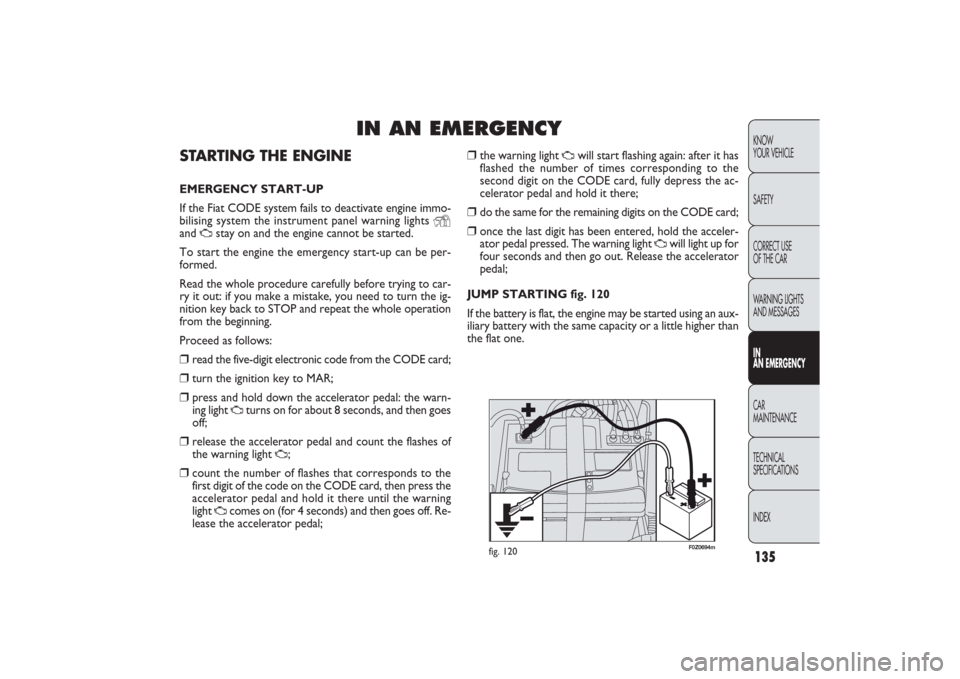
JUMP STARTING fig. 120
If the battery is flat, the engine may be started using an aux-
iliary battery with the same capacity or a little higher than
the flat one.
F0Z0694m
fig. 120
135-168 PANDA EN 7-10-2009 14:06 Pagina 135
Page 137 of 226

136KNOW
YOUR VEHICLE
SAFETY
CORRECT USE
OF THE CAR
WARNING LIGHTS
AND MESSAGES
IN
AN EMERGENCYCAR
MAINTENANCE
TECHNICAL
SPECIFICATIONS
INDEX
Never use a fast battery-charger to start the
engine as this could damage the electron-
ic systems of your car, particularly the ig-
nition and fuel supply control units.This procedure must be performed by qual-
ified personnel as incorrect actions may
cause high-intensity electrical discharge. Further-
more, battery fluid is poisonous and corrosive: avoid
contact with your skin and eyes. Keep naked flames
away from the battery. No smoking. Do not cause
sparks.
WARNING
If after a few attempts the engine does not start, do not
insist rather contact the nearest Fiat Dealership.
IMPORTANT Do not directly connect the negative ter-
minals of the two batteries: any sparks may ignite the det-
onating gas which could come out of the battery. If the aux-
iliary battery is installed on another car, prevent any contact
between metal parts of the cars and the flat battery.
BUMP STARTING
Never bump start the engine by pushing, towing or driving
downhill.
This could cause a flow of fuel into the catalytic convert-
er and damage it beyond repair.
IMPORTANT Remember that the servo-brake and elec-
trical power steering system (for versions/markets where
provided) are not operating until the engine is started, a
greater effort will therefore be required to press the brake
pedal or turn the steering wheel. Proceed as follows to start the car:
❒
connect the positive terminals (+ sign close to the ter-
minal) of both batteries using a lead;
❒
with a second lead, connect the negative terminal − of
the auxiliary battery to an earthing point
E
on the en-
gine or the gearbox of the car to be started;
❒
start the engine;
❒
when the engine has been started, follow the sequence
above in reverse order to remove the leads.
135-168 PANDA EN 7-10-2009 14:06 Pagina 136
Page 163 of 226

162KNOW
YOUR VEHICLE
SAFETY
CORRECT USE
OF THE CAR
WARNING LIGHTS
AND MESSAGES
IN
AN EMERGENCYCAR
MAINTENANCE
TECHNICAL
SPECIFICATIONS
INDEX
A second fuse-box is located on the right-hand of the en-
gine compartment, next to the battery; to reach it re-
lease the spring I, the tabs M and remove the lid L.
The number identifying the electrical component corre-
sponding to each fuse is on the cover back.
fig. 168
fig. 169
F0Z0652m
F0Z0704m
Fuses in the engine compartment fig. 168 and 169
135-168 PANDA EN 7-10-2009 14:07 Pagina 162