2009 FIAT IDEA steering
[x] Cancel search: steeringPage 86 of 210

85
SAFETY
STARTING
AND DRIVING
WARNING
LIGHTS AND
MESSAGES
IN AN
EMERGENCY
MAINTENANCE
AND CARE
TECHNICAL
SPECIFICATIONS
ALPHABETICAL
INDEX
DASHBOARD
AND CONTROLS
SOUND SYSTEM
(where provided)
Refer to the supplement to this Owner’s
Handbook for operating the sound system
with CD or with CD MP3.
SOUND SYSTEM SETUP
(where provided)
The system consists of:
❒sound system power wires
❒front and rear speaker power wires
❒aerial power wire
❒2 tweeters on front pillars (30W max
power each);
❒2 mid-woofers on front doors (165
mm diameter, 40W max power each);
❒2 full-range speaker on front doors
(165 mm diameter, 40W max power
each).
Sound system installation
The sound system must be installed in the
space occupied by the central oddment
compartment fig. 125where the wiring
leads.
To extract the compartment, press in the
points shown at the retainer systems.It is advisable to have the sound system
and interference filter installed by a Fi-
at Dealership.
MOBILE PHONE SETUP
(where provided)
The mobile phone setup with
CD or CD MP3 sound system consists of:
fig. 125F0H0120m
❒a dual function aerial (sound system +
phone phone 900/1800 MHz) located
on the roof;
❒connection cables to the dual function
sound system and wiring with 10 pin
connector.The hands-free kit must be
purchased by the customer
because it must be compati-
ble with the customer’s mo-
bile phone. It is advisable to install the
microphone near the front ceiling light.
The maximum applicable
power to the aerial is 20W.
WARNING
For installing the mobile
phone and connecting to
system setup in the car, contact Fiat
Dealership to prevent any trouble
that could impair car safety.
WARNING
The connector is located between the
steering column and the central unit.
Page 88 of 210

87
SAFETY
STARTING
AND DRIVING
WARNING
LIGHTS AND
MESSAGES
IN AN
EMERGENCY
MAINTENANCE
AND CARE
TECHNICAL
SPECIFICATIONS
ALPHABETICAL
INDEX
DASHBOARD
AND CONTROLS
DUALDRIVE ELECTRIC
POWER STEERING
The car is provided with an electric pow-
er steering system which only works with
the key at MARand the engine running.
The system called “Dualdrive” allows to
customise the effort required to turn the
steering wheel according to driving con-
ditions.
ON/OFF (CITY function)
Press CITY fig. 126in the central part of
the dashboard to turn the function on and
off.
The CITYwarning light on the instru-
ment panel will light up when the function
is on; in other versions, the message
CITYwill appear on the reconfigurable
multifunctional display.
With the CITYfunction the effort on the
steering wheel is lighter, thus facilitating
parking manoeuvres: this is particularly
useful when driving in towns.
fig. 126F0H0716m
Under no circumstances
should aftermarket opera-
tions involving steering system or
steering column modifications (e.g.:
installation of anti-theft device) be
carried out that could badly affect
performance and safety. This also
causes the warranty to become null
and void and results in vehicle non-
compliance with type-approval re-
quirements.
WARNING
The car can be driven using the mechani-
cal steering in case of failure to the elec-
tric power steering system. Take the car
to a Fiat Dealership as soon as possible.
IMPORTANT The steering may before
stiffer when parking requiring a lot of
steering. This is normal and caused by the
electric control motor overheating sys-
tem. No repairs are needed. The power
steering system will start working prop-
erly again the next time the car is used.
Before starting any mainte-
nance operation, stop the
engine and remove the key from the
ignition switch to operate the steer-
ing lock, particularly when the car is
lifted off the ground. If this is not pos-
sible (i.e. if the key must be kept in
the MAR position or the engine must
be kept running), remove the main
electric power steering system fuse.
WARNING
FAILURE INDICATIONS
Electric power steering failure is indicated
by the turning on of warning light
gon
the instrument panel together with the
dedicated message on the reconfigurable
multifunctional display (where provided),
(see section “Warning lights and mes-
sages”).
Page 107 of 210
106
STARTING
AND DRIVING
WARNING
LIGHTS AND
MESSAGES
IN AN
EMERGENCY
MAINTENANCE
AND CARE
TECHNICAL
SPECIFICATIONS
ALPHABETICAL
INDEX
DASHBOARD
AND
CONTROLS
SAFETY
FRONT AIRBAGS
The car is provided with front airbags for
the driver and passenger and window bags
(head protection system). It may be pro-
vided with optional front side bags.
The front driver / passenger air bags ha-
ve been designed to protect the occupants
in the event of head-on crashes of me-
dium-high severity, by placing the cushion
between the occupant and the steering
wheel or dashboard.
Front air bags are designed to protect
vehicle occupants in head-on crashes and
therefore non-activation in other types of
collisions (side collisions, rear shunts, roll-
overs, etc.) is not a system malfunction.
An electronic control unit causes the bag
to inflate in the event of a head-on crash.
The bag will inflate instantaneously placing
itself between the front occupant’s body
and the structures which could cause
injury. It will deflate immediately af-
terwards.
Driver and passenger front airbags are not
a replacement of but complementary to
the belts, which you are recommended to
always wear, as specified by law in Euro-
pe and most non-European countries.
In the event of a collision, a person not
wearing a seat belt may be thrown
forward and con into contact with the bag
before it has fully opened. The protectionoffered by the cushion is reduced in such
a case.
Front air bag may not be activated in the
following situations:
❒in collisions against highly deformable
objects not affecting the car front sur-
face (e.g. bumper collision against
guard rail, etc.);
❒jamming of the car underneath other
vehicles or protective barriers (e.g. un-
derneath a truck or a guard rail); in this
case, the bags would offer no additio-
nal protection with respect to the seat
belt and their deployment is unneces-
sary. In these cases non-deployment
of the airbag does not necessarily in-
dicate a system malfunction.
The front airbags (driver and passenger)
are designed and calibrated to protect
front seat occupants who are wearing seat
belts.
The volume of front air bags at max. in-
flation fills most of the space between the
steering wheel and the driver and between
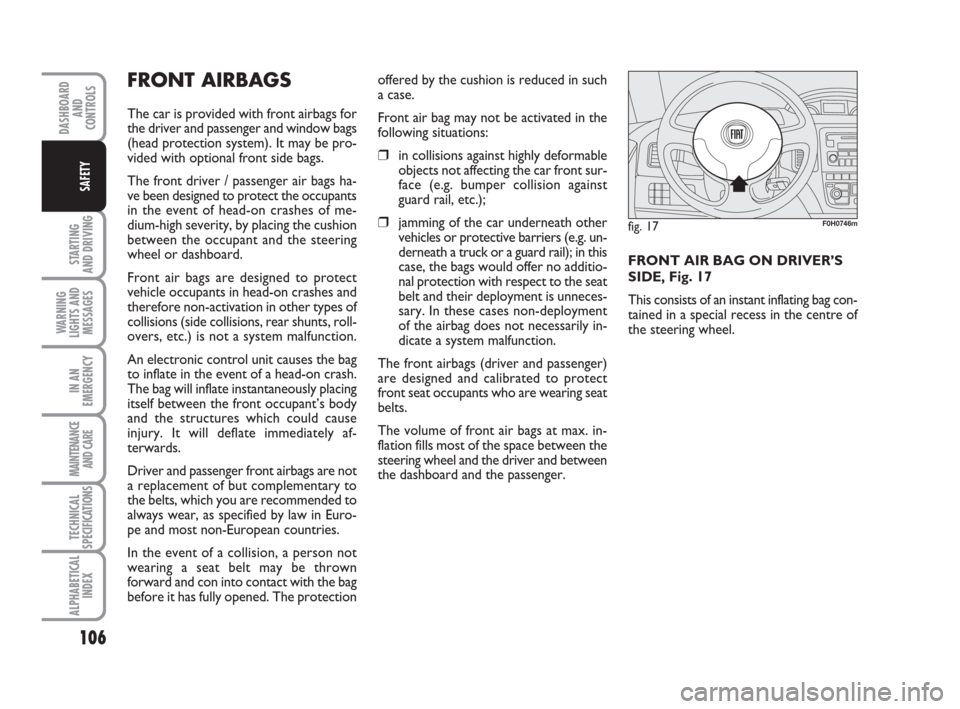
the dashboard and the passenger.FRONT AIR BAG ON DRIVER’S
SIDE, Fig. 17
This consists of an instant inflating bag con-
tained in a special recess in the centre of
the steering wheel.fig. 17F0H0746m
Page 108 of 210

107
STARTING
AND DRIVING
WARNING
LIGHTS AND
MESSAGES
IN AN
EMERGENCY
MAINTENANCE
AND CARE
TECHNICAL
SPECIFICATIONS
ALPHABETICAL
INDEX
DASHBOARD
AND
CONTROLS
SAFETY
fig. 18F0H0145m
PASSENGER’S FRONT AIR BAG
fig. 18
It consists of an instant-inflating cushion
contained into a special recess Ain the
dashboard, this cushion has a volume big-
ger than that of the driver.
The airbags are not deployed in the event
of collisions of low severity (for which the
withholding action of the seat belts is suf-
ficient). For this reason, the seat belt mu-
st be worn at all times. During side colli-
sions the seat belts hold passengers in the
correct position and prevent ejection
from the vehicle during very violent colli-
sions.
Do not apply stickers or
other objects on the steering
wheel in zone A-fig. 18, passenger si-
de airbag cover or side upholstery on
roof. Do not place objects on the pas-
senger side dashboard because these
could interfere with the correct ope-
ning of the airbag (e.g. mobile pho-
nes) and cause severe injury to occu-
pants.
WARNING
Do not arranged cradle
child restraints facing
backwards if the passenger’s airbag is
on. Deployment of the airbag in an
accident could cause fatal injuries to
the baby.
WARNING
If the car is provided with a
front passenger airbag,
deactivate the airbag when
arranging a child restraint
seat on the front seat. Mo-
ve the passenger seat as far
back as possible to avoid contact
between the child seat and the dash-
board. Although this is not mandatory
by law, the air bag should be imme-
diately reactivated when children are
no longer carried to ensure better
protection for adults.
WARNING
Page 110 of 210

109
STARTING
AND DRIVING
WARNING
LIGHTS AND
MESSAGES
IN AN
EMERGENCY
MAINTENANCE
AND CARE
TECHNICAL
SPECIFICATIONS
ALPHABETICAL
INDEX
DASHBOARD
AND
CONTROLS
SAFETY
IMPORTANT The front air bags and/or si-
de bags may be deployed if the car is
subject to heavy knocks or accidents in-
volving the underbody area, such as for
example violent shocks, against steps,
kerbs or low obstacles, falling of the car in
big holes or sags in the road.
IMPORTANT A small amount of dust will
be released when the airbags are de-
ployed. The dust is not harmful and does
not indicate the beginning of a fire.
Furthermore, the surface of the deployed
bag and the interior of the car may be co-
vered in a dusty residue: This dust may ir-
ritate the skin and the eyes. Wash with
mild soap and water in the event of ex-
posure.
The airbag system expires after 14 years
(charge) and 10 years (clock contact). Go
to a Fiat Dealership to have the devices
replaced when the expiration date ap-
proaches.
IMPORTANT Should an accident occur in
which any of the safety devices is activa-
ted, take the car to a Fiat Dealership to
have the devices activated replaced and to
have the system checked.
Every control, repair and replacement
operations concerning the air bags must
only be carried out c/o Fiat Dealership.If you are having the car scrapped, have
the air bag system deactivated at a Fiat
Dealership first. If the car changes ow-
nership, the new owner must be informed
of the method of use of air bags and the
above warnings and also be given this
“Owner‘s Handbook”.
IMPORTANT Pretensioners, front airbags
and front side bags are deployed differen-
tly according to the type of collision. Non
deployment of one of the devices does not
therefore indicate a system fault.
Do not rest your head, arms
or elbows on the door, on
the windows and in the window bag
area to prevent injury in case of de-
ployment.
WARNING
Never lean head, arms and
elbows out of window.
WARNING
If when turning the key to
MAR the warning light
¬does not turn on or stays on whilst
driving (together with the message in
the multifunctional display, where
provided), a failure may have occur-
red in the restraint systems. In this ca-
se the air bags or pretensioners may
not be deployed after an impact or,
in a minor number of cases, they may
be deployed accidentally. Contact a
Fiat Dealership immediately to have
the system checked.
WARNING
GENERAL WARNINGS
Do not cover the backrest of
the front seats with covers
which are not suitable for use with si-
de bags.
WARNING
Always drive holding your
hands on the steering wheel
rim so that the airbag can inflate
freely in the case of need. Do not dri-
ve with your body bent forward. Keep
your back straight against the back
rest.
WARNING
Page 114 of 210
113
WARNING
LIGHTS AND
MESSAGES
IN AN
EMERGENCY
MAINTENANCE
AND CARE
TECHNICAL
SPECIFICATIONS
ALPHABETICAL
INDEX
DASHBOARD
AND
CONTROLS
SAFETY
STARTING
AND DRIVING
❒turn the ignition key to AVVas soon
as the warning light mturns off.
Waiting too long will waste the work
done by the heater plugs. Release the
key as soon as the engine starts.
IMPORTANT With the engine cold, the
accelerator must be entirely released
when turning the ignition key to position
AVV.
If the engine does not start at the first at-
tempt, return the ignition key to STOP
before repeating starting.
If, when the ignition key is at MAR, the
instrument panel warning light
Yre-
mains lit, turn the key to STOPand then
back to MAR; if the warning lights remain
on, try with the other keys provided with
the car.
Contact a Fiat Dealership if you still can-
not start the engine.
IMPORTANT Never leave the ignition key
to MARwhen the engine is off. Warning light
mwill blink
for 60 seconds after starting
or during prolonged cranking
to indicate a fault to the glow
plug heating system. Use the car nor-
mally if the engine starts and go to a
Fiat Dealership as soon as possible.
HOW TO WARM UP THE
ENGINE AFTER IT HAS JUST
STARTED (petrol and Multijet
engines)
Proceed as follows:
❒drive off slowly, letting the engine turn
at medium speed. Do not accelerate
abruptly;
❒do not demand maximum performan-
ce for the first few kilometres. Wait
until the engine coolant gauge starts
moving.
STOPPING THE ENGINE
Turn the ignition to STOPwhile the en-
gine is idling.
IMPORTANT After a taxing drive, you
should allow the engine to “catch its
breath” before turning it off by letting it
idle to allow the temperature in the engi-
ne compartment to fall. Never jump start the engine
by pushing, towing or driving
downhill. This could cause a
flow of fuel into the catalytic
converter and damage it beyond re-
pair.
A quick burst on the accele-
rator before turning off the
engine serves absolutely no
practical purpose, it wastes
fuel and is damaging especially to tur-
bocharged engines.
Remember that the brake
booster and power steering
are not operational until the engine
has been started, therefore much
effort than usual is required on the
brake pedal and steering wheel.
WARNING
Page 124 of 210

123
STARTING
AND DRIVING
IN AN
EMERGENCY
MAINTENANCE
AND CARE
TECHNICAL
SPECIFICATIONS
ALPHABETICAL
INDEX
DASHBOARD
AND
CONTROLS
SAFETY
WARNING
LIGHTS AND
MESSAGES
GENERAL WARNINGS ...................................................... 124
LOW BRAKE FLUID LEVEL ............................................... 124
HANDBRAKE APPLIED ...................................................... 124
AIRBAG FAILURE ................................................................. 124
HOT ENGINE COOLANT ............................................... 125
LOW BATTERY CHARGE................................................. 125
LOW ENGINE OIL PRESSURE -
EXHAUSTED OIL .............................................................. 126
“DUALDRIVE” ELECTRIC POWER STEERING
SYSTEM ................................................................................... 126
DOOR OPEN ........................................................................ 126
SEAT BELTS NOT FASTENED ........................................ 126
EBD FAILURE......................................................................... 127
EOBD/INJECTION SYSTEM FAILURE ............................ 127
FRONT PASSENGER AIRBAG DEACTIVATED ......... 128
ABS FAILURE ......................................................................... 128
FUEL RESERVE....................................................................... 128
GLOW PLUGS ...................................................................... 129
GLOW PLUG FAILURE ...................................................... 129
WATER IN DIESEL FUEL FILTER ..................................... 129
CAR PROTECTION SYSTEM
FAILURE - FIAT CODE ...................................................... 129
REAR FOG LIGHTS ............................................................. 129
GENERIC INDICATION .................................................... 130
WORN BRAKE PADS ......................................................... 131
W W
A A
R R
N N
I I
N N
G G
L L
I I
G G
H H
T T
S S
A A
N N
D D
M M
E E
S S
S S
A A
G G
E E
S S
OBSTRUCTED PARTICULATE TRAP ............................ 131
SIDE/TAIL LIGHTS AND
DIPPED BEAM HEADLIGHTS - FOLLOW ME HOME 131
FOG LIGHTS ......................................................................... 131
LEFT-HAND DIRECTION INDICATOR ....................... 131
RIGHT-HAND DIRECTION INDICATOR ................... 131
“DUALDRIVE” ELECTRIC POWER STEERING
SYSTEM ON .......................................................................... 132
CRUISE CONTROL ............................................................ 132
MAIN BEAM HEADLIGHTS............................................... 132
POSSIBLE ICE ON ROAD.................................................. 132
LIMITED RANGE .................................................................. 132
Page 127 of 210

126
STARTING
AND DRIVING
IN AN
EMERGENCY
MAINTENANCE
AND CARE
TECHNICAL
SPECIFICATIONS
ALPHABETICAL
INDEX
DASHBOARD
AND
CONTROLS
SAFETY
WARNING
LIGHTS AND
MESSAGES
LOW ENGINE OIL
PRESSURE (red)
EXHAUSTED OIL (red)
(Multijet versions with
DPF)
Low engine oil pressure
When the ignition key is moved to MAR,
the warning light turns on and should go
out as soon as the engine is started.
The display will show the dedicated mes-
sage.
v
Exhausted oil
The warning light turns on and flashes
along with the message on the display
when the system detects that the engine
oil is exhausted.
After the first indication, at each engine
starting the warning light
vwill go on
flashing for about 60 seconds and then
every 2 hours until oil is changed.“DUALDRIVE”
ELECTRIC POWER
STEERING SYSTEM
(red)
This warning light comes on when the igni-
tion key is turned to MAR, but it should
go off after a few seconds.
The electric power steering system will
not work when the warning light is on and
considerably more effort is needed on the
steering wheel. The car can still be stee-
red: Go to a Fiat Dealership.
The display will show the dedicated mes-
sage.
g
DOOR OPEN (red)
On certain versions the war-
ning light turns on when one or
more doors or the tailgate are
not properly closed.
The display will show a dedicated messa-
ge.
A buzzer will sound when doors/tailgate
are open and the car is moving.
´
SEAT BELTS
REMINDER
(red) (where provided)
The warning light on the display
will light up when the car is moving and
the driver’s seat belt is not correctly fa-
stened. The warning light will blink and a
buzzer will sound if the front seat belts are
not correctly fastened. The buzzer of the
S.B.R. (Seat Belt Reminder) system can
only be switched off by a Fiat Dealership.
The system can be reactivated by means
of the setup menu.
<
If the warning light vturns on when travelling
(with the message on the display)
stop the car immediately and contact
Fiat Dealership.
WARNING
If warning light vflashes,
contact Fiat Dealership as
soon as possible to have oil changed
and instrument panel warning light
turned off.
WARNING