Page 158 of 282

157
WARNING
LIGHTS AND
MESSAGES
VEHICLE
MAINTENANCE
TECHNICAL
SPECIFICATIONS
INDEX
DASHBOARD
AND CONTROLS
SAFETY
DEVICES
CORRECT USE
OF THE
VEHICLE
IN AN
EMERGENCY
ENGINE STARTING ........................................................... 158
IF A TYRE IS PUNCTURED............................................... 159
QUICK TYRE REPAIR KIT
FIX & GO automatic ........................................................... 163
WHEN NEEDING TO CHANGE A BULB ................... 168
IF AN EXTERIOR LIGHT BURNS OUT.......................... 170
IF AN INTERIOR LIGHT BURNS OUT.......................... 176
IF A FUSE BLOWS................................................................ 177
IF THE BATTERY IS FLAT .................................................. 185
JACKING THE VEHICLE ................................................... 186
TOWING THE VEHICLE ................................................... 186
II I
N N
A A
N N
E E
M M
E E
R R
G G
E E
N N
C C
Y Y
In an emergency we recommend that you call the toll-free number found on the
Warranty Booklet. You can also connect to the site www.fiat.com
to search for the nearest Fiat Dealership point
Page 159 of 282

158
WARNING
LIGHTS AND
MESSAGES
VEHICLE
MAINTENANCE
TECHNICAL
SPECIFICATIONS
IINDEX
DASHBOARD
AND CONTROLS
SAFETY
DEVICES
CORRECT USE
OF THE
VEHICLE
IN AN
EMERGENCY
ENGINE
STARTING
EMERGENCY START-UP
If the instrument panel warning light
Yturns on glowing steadily, contact im-
mediately Fiat Dealership.
JUMP STARTING fig. 1-2
If the battery is flat, it is possible to start
the engine using an auxiliary battery with
the same capacity or a little higher than
the flat one.
Contact Fiat Dealership to have the bat-
tery checked/replaced.Proceed as follows:
❒lift the lid Ato connect to the battery
positive terminal fig. 1.
❒connect positive terminals (+near
the terminal) of the two batteries
with a jump lead;
❒connect with a second cable the nega-
tive terminal (–) of the auxiliary battery
to the ground point as shown in fig. 2;
❒start the engine;
❒when the engine has been started, re-
move the leads reversing the order
above.
If after a few attempts the engine does not
start, do not insist but contact the near-
est Fiat Dealership.
fig. 1F0N0075m
The starting procedure must
be carried out by qualified
personnel because incorrect opera-
tions may cause electrical discharge of
considerable intensity. The liquid con-
tained in the battery is poisonous and
corrosive. Avoid contact with the skin
and eyes. Keep naked flames and light-
ed cigarettes away from the battery
and do not cause sparks.
WARNING
fig. 2F0N0076m
Page 160 of 282

159
WARNING
LIGHTS AND
MESSAGES
VEHICLE
MAINTENANCE
TECHNICAL
SPECIFICATIONS
INDEX
DASHBOARD
AND CONTROLS
SAFETY
DEVICES
CORRECT USE
OF THE
VEHICLE
IN AN
EMERGENCY
IMPORTANT Never connect the negative
terminals of the two batteries directly:
sparks could ignite explosive gas released
from the battery. If the auxiliary battery is
installed on another vehicle, avoid any
metal parts on the latter and the vehicle
with the flat battery from accidentally
coming into contact.
BUMP STARTING
Never jump start the engine by pushing,
towing or driving downhill. This could
cause a flow of fuel into the catalytic con-
verter and damage it beyond repair.
IMPORTANT Remember that the brake
servo and the power steering system are
not activated until the engine is started, a
greater effort will therefore be required
to press the brake pedal or turn the steer-
ing wheel.CHANGING
A WHEEL
GENERAL INSTRUCTIONS
To chage a wheel and the use the jack and
spare wheel correctly, observe some of
the precautions listed below.
Signal that the vehicle is sta-
tionary in accordance with
the following legal requirements:
hazard warning lights, emergency
warning triangle, etc. It is advisable
for the people in the vehicle to get
out, especially if the vehicle is heavi-
ly laden, and wait until the repair is
carried out, well away from any dan-
gerous traffic. Apply the handbrake
WARNING
The spare wheel is specific
for your vehicle. Therefore,
it must not be used on vehicles of a
different model. Do not use spare
wheels of different models on your ve-
hicle. The wheel bolts are specific for
your vehicle. Do not use them on ve-
hicles of different models. Do not use
bolts of different models on your ve-
hicle.
WARNING
Repair and refit the wheel
changed as soon as possible.
Do not apply grease to the bolt
threads before assembly: the bolts
could come loose unexpectedly.
WARNING
Page 182 of 282

181
WARNING
LIGHTS AND
MESSAGES
VEHICLE
MAINTENANCE
TECHNICAL
SPECIFICATIONS
INDEX
DASHBOARD
AND CONTROLS
SAFETY
DEVICES
CORRECT USE
OF THE
VEHICLE
IN AN
EMERGENCY
FUSE SUMMARY TABLE
Fuse box on dashboard
USERSFUSE AMPERE
Right dipped beam headlight F12 7.5
Left dipped beam headlight, Headlight aiming device F13 7.5
Engine compartment fuse box relay, dashboard fuse box relay (+key) F31 7.5
Minibus internal lights (emergency) F32 10
Rear current outlet F33 15
AbsentF34 –
Reversing lights, sevotronic control unit, Water in diesel fuel filter sensor, (+key) F35 7.5
Central door locking (+ battery) F36 15
Brake lights (main), Third brake light, Instrument panel (+key) F37 7.5
Dashboard control unit relay (+ battery) F38 10
EOBD socket, Sound System, A/C control, Alarm, Chronotachograph,
Webasto timer (+battery) F39 10
Left-hand heated window, Driver’s mirror defroster F40 15
Right-hand heated window, Passenger’s mirror defroster F41 15
ABS, ASR, ESP, Brake light control (secondary) (+key) F42 7.5
Windscreen wiper (+key) F43 30
Cigar lighter, Front current outlet F44 20
Page 183 of 282
182
WARNING
LIGHTS AND
MESSAGES
VEHICLE
MAINTENANCE
TECHNICAL
SPECIFICATIONS
IINDEX
DASHBOARD
AND CONTROLS
SAFETY
DEVICES
CORRECT USE
OF THE
VEHICLE
IN AN
EMERGENCY
USERSFUSE AMPERE
Control on driver’s door, Controls on passenger’s door F45 7.5
AbsentF46 –
Driver’s power window F47 20
Passenger’s power window F48 20
Sound System, Driver’s power window, Dashboard controls,
Alarm control unit, Rain sensor (+key) F49 7.5
Airbag (+key)F50 7.5
A/C control, Cruise control, Chronotachograph (+key) F51 7.5
Optional fuse box relay F52 7.5
Instrument panel, Rear fog lights (+battery) F53 7.5
Page 184 of 282
183
WARNING
LIGHTS AND
MESSAGES
VEHICLE
MAINTENANCE
TECHNICAL
SPECIFICATIONS
INDEX
DASHBOARD
AND CONTROLS
SAFETY
DEVICES
CORRECT USE
OF THE
VEHICLE
IN AN
EMERGENCY
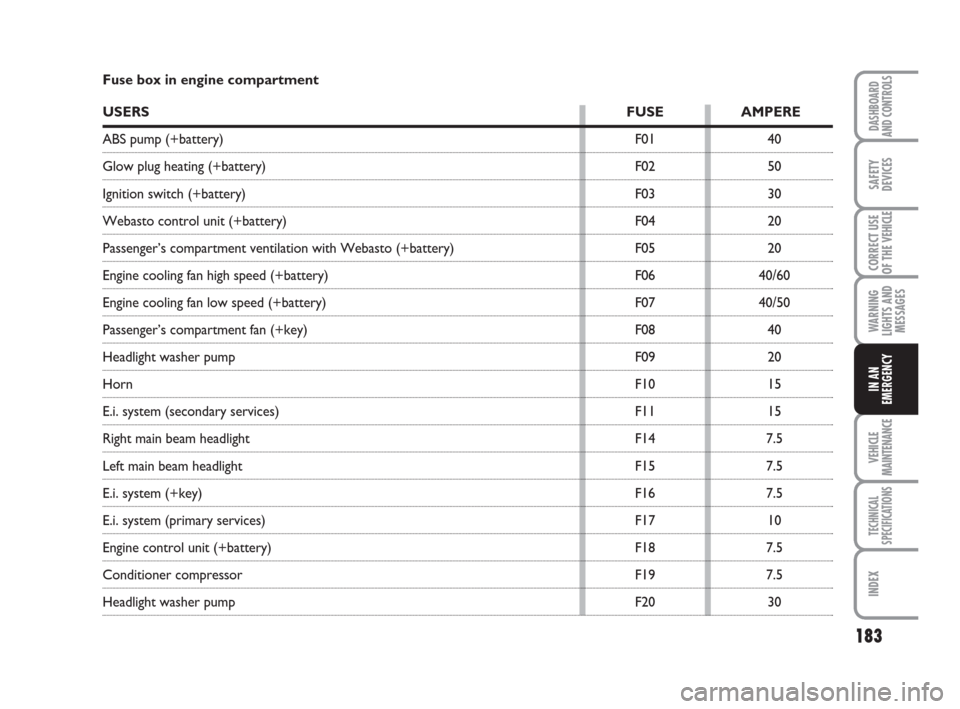
Fuse box in engine compartment
USERSFUSE AMPERE
ABS pump (+battery) F01 40
Glow plug heating (+battery) F02 50
Ignition switch (+battery) F03 30
Webasto control unit (+battery) F04 20
Passenger’s compartment ventilation with Webasto (+battery) F05 20
Engine cooling fan high speed (+battery) F06 40/60
Engine cooling fan low speed (+battery) F07 40/50
Passenger’s compartment fan (+key) F08 40
Headlight washer pump F09 20
HornF10 15
E.i. system (secondary services) F11 15
Right main beam headlight F14 7.5
Left main beam headlight F15 7.5
E.i. system (+key) F16 7.5
E.i. system (primary services) F17 10
Engine control unit (+battery) F18 7.5
Conditioner compressor F19 7.5
Headlight washer pump F20 30
Page 185 of 282
184
WARNING
LIGHTS AND
MESSAGES
VEHICLE
MAINTENANCE
TECHNICAL
SPECIFICATIONS
IINDEX
DASHBOARD
AND CONTROLS
SAFETY
DEVICES
CORRECT USE
OF THE
VEHICLE
IN AN
EMERGENCY
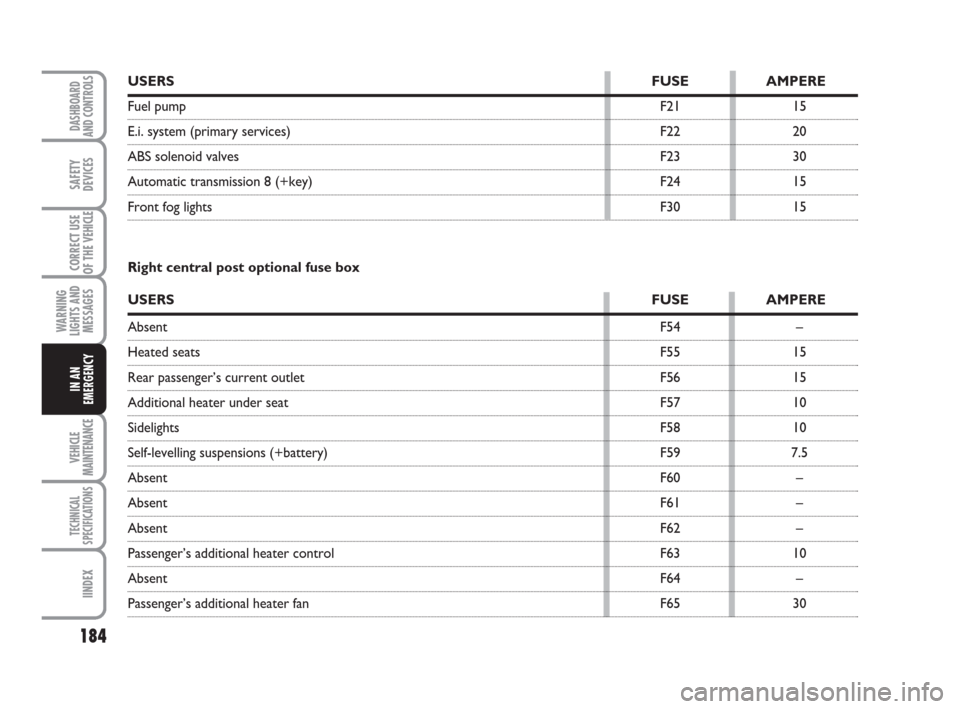
USERSFUSE AMPERE
Fuel pump F21 15
E.i. system (primary services) F22 20
ABS solenoid valves F23 30
Automatic transmission 8 (+key) F24 15
Front fog lightsF30 15
Right central post optional fuse box
USERSFUSE AMPERE
AbsentF54 –
Heated seatsF55 15
Rear passenger’s current outlet F56 15
Additional heater under seat F57 10
SidelightsF58 10
Self-levelling suspensions (+battery) F59 7.5
AbsentF60 –
AbsentF61 –
AbsentF62 –
Passenger’s additional heater control F63 10
AbsentF64 –
Passenger’s additional heater fan F65 30
Page 186 of 282
185
WARNING
LIGHTS AND
MESSAGES
VEHICLE
MAINTENANCE
TECHNICAL
SPECIFICATIONS
INDEX
DASHBOARD
AND CONTROLS
SAFETY
DEVICES
CORRECT USE
OF THE
VEHICLE
IN AN
EMERGENCY
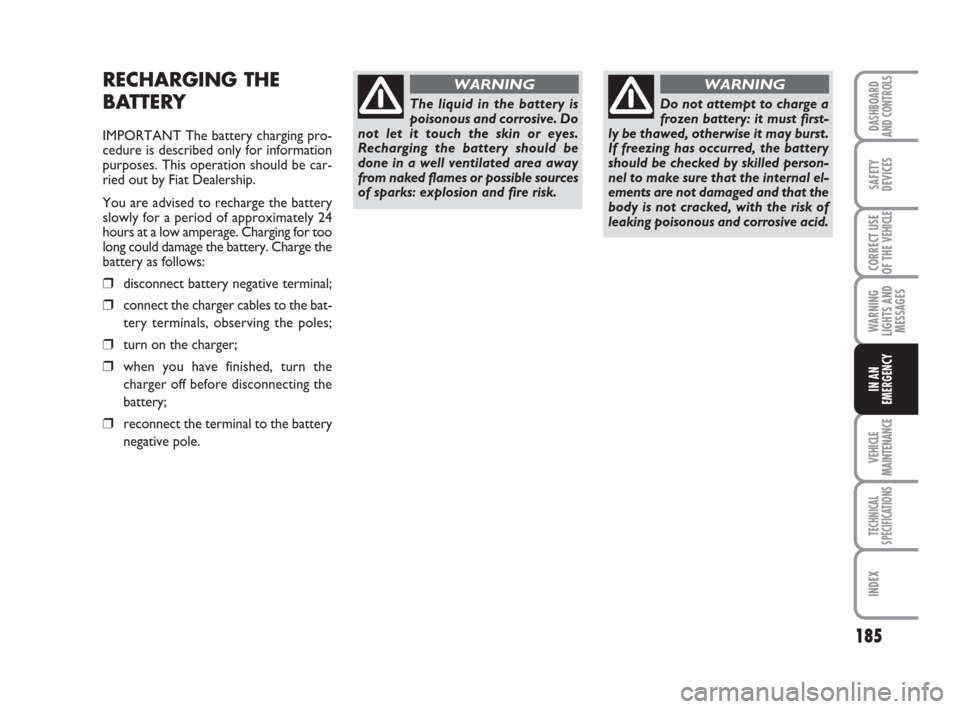
RECHARGING THE
BATTERY
IMPORTANT The battery charging pro-
cedure is described only for information
purposes. This operation should be car-
ried out by Fiat Dealership.
You are advised to recharge the battery
slowly for a period of approximately 24
hours at a low amperage. Charging for too
long could damage the battery. Charge the
battery as follows:
❒disconnect battery negative terminal;
❒connect the charger cables to the bat-
tery terminals, observing the poles;
❒turn on the charger;
❒when you have finished, turn the
charger off before disconnecting the
battery;
❒reconnect the terminal to the battery
negative pole.
The liquid in the battery is
poisonous and corrosive. Do
not let it touch the skin or eyes.
Recharging the battery should be
done in a well ventilated area away
from naked flames or possible sources
of sparks: explosion and fire risk.
WARNING
Do not attempt to charge a
frozen battery: it must first-
ly be thawed, otherwise it may burst.
If freezing has occurred, the battery
should be checked by skilled person-
nel to make sure that the internal el-
ements are not damaged and that the
body is not cracked, with the risk of
leaking poisonous and corrosive acid.
WARNING