Page 157 of 274

156
KNOW
YOUR
VEHICLE
SAFETY
STARTING
AND
DRIVING
WARNING
LIGHTS AND
MESSAGES
IN AN
EMERGENCY
SERVICING
AND
MAINTENANCE
TECHNICAL
SPECIFICATIONS
INDEXStrictly avoid using a rapid battery charg-
er for jump starting: this could damage the
system electronics and the ignition and en-
gine supply control units.
This procedure must be performed by ex-
perts because incorrect actions may cause
considerable electrical discharge. Furthermore,
battery fluid is poisonous and corrosive: avoid con-
tact with skin and eyes. Keep naked flames and
lit cigarettes away from the battery. Do not cre-
ate sparks.
WARNING
BUMP STARTING
Never bump start the engine by pushing, towing or dri-
ving downhill. This could cause fuel to flow into the cat-
alytic converter and damage it beyond repair.
IMPORTANT Remember that the brake booster and the
power steering system are not active until the engine is
started, so you will need to apply much more force to
the brake pedal or steering wheel.
CHANGING A TYRE
The vehicle is originally equipped with the Fix&Go quick
tyre repair kit (see instructions in the next section). As
an alternative, the vehicle may have a normal-sized spare
wheel.
Wheel changing and correct use of the jack and spare
wheel call for some precautions, as listed below.
Page 183 of 274
182
KNOW
YOUR
VEHICLE
SAFETY
STARTING
AND
DRIVING
WARNING
LIGHTS AND
MESSAGES
IN AN
EMERGENCY
SERVICING
AND
MAINTENANCE
TECHNICAL
SPECIFICATIONS
INDEX
F0V0081mfig. 174
F0V0089mfig. 175
ENGINE COMPARTMENT FUSE BOX
The box is located on the right-hand side of the engine,
next to the battery. To remove the protective cover A
and access the fuse box, undo the two fastening screws B.
If you need to clean the engine compart-
ment, take care not to directly hit the fuse
box with the water jet.
Page 186 of 274
185
KNOW
YOUR
VEHICLE
SAFETY
STARTING
AND
DRIVING
WARNING
LIGHTS AND
MESSAGES
IN AN
EMERGENCY
SERVICING
AND
MAINTENANCE
TECHNICAL
SPECIFICATIONS
INDEXPROTECTED DEVICE FUSE AMPS FIGURE
Passenger compartment socket, rear socket F85 30 175
Cigarette lighter, heated seats F86 30 175
IBS Battery charge status sensor for Start&Stop system F87 5 175
Wing mirror defrosters F88 7,5 175
Page 188 of 274

187
KNOW
YOUR
VEHICLE
SAFETY
STARTING
AND
DRIVING
WARNING
LIGHTS AND
MESSAGES
IN AN
EMERGENCY
SERVICING
AND
MAINTENANCE
TECHNICAL
SPECIFICATIONS
INDEXPROTECTED DEVICE FUSE AMPS FIGURE
Right low beamF12 7,5 177
Front courtesy light, rear courtesy light, lights on sun visors,
door clearance lights, boot light F32 7,5 177
Instrument panel F53 5 177
Door lock/unlock motors, dead lock actuator motors,
tailgate lock motor F38 20 177
Power + battery for EOBD diagnostic socket, automatic climate control unit,
alarm siren, sound system, convergence control unit, tyre pressure detector
control unitF36 10 177
Windscreen/rear window washer pump F43 15 177
Window winder motor for front door passenger side F48 20 177
Left low beam, headlight corrector F13 7,5 177
Airbag ECUF50 7,5 177
Int. power for brake pedal switch,
clutch pedal switch, interior heater,
convergence control unit, sound system set-up F51 7,5 177
Int. power for instrument panel, brake pedal switch,
third brake light F37 5 177
Int. power for control panel lights, parking control unit,
tyre pressure detector control unit, electric door mirror motor,
rain sensor, electric top control unit, My-port infotainment socket F49 5 177
Int. power for engine fusebox relay coils and
body computer relay coils F31 5 177
Window winder motor for front door driver’s side F47 20 177
Rear socketF94 15 177
Cigarette lighter/Passenger compartment socket F95 15 177
Cigarette lighter/Passenger compartment socket F96 15 177
Heated driver seat F97 10 177
Heated passenger seat F98 10 177
Page 189 of 274

188
KNOW
YOUR
VEHICLE
SAFETY
STARTING
AND
DRIVING
WARNING
LIGHTS AND
MESSAGES
IN AN
EMERGENCY
SERVICING
AND
MAINTENANCE
TECHNICAL
SPECIFICATIONS
INDEXRECHARGING THE BATTERY
IMPORTANT The battery recharging procedure is pro-
vided for information purposes only. You are recom-
mended to go to a Fiat Dealership to have this operation
performed.
We recommend recharging the battery slowly for ap-
proximately 24 hours at low amperage. A prolonged
recharge might damage the battery.
Charge the battery as follows:
WITHOUT START&STOP SYSTEM
❒disconnect battery negative terminal;
❒connect the charger cables to the battery terminals,
observing the polarity;
❒turn on the charger;
❒when you have finished, turn the charger off before
disconnecting it from the battery;
❒reconnect negative battery terminal.
Battery fluid is poisonous and corrosive:
avoid contact with your skin and eyes. The
battery recharging operation must be performed
in a ventilated place, away from naked flames or
possible sources of sparks to avoid the risk of ex-
plosion and fire.
WARNING
F0V0209mfig. 177b
WITH START&STOP SYSTEM
(fig. 177b)
❒disconnect the quick release negative terminal A from
the dummy negative terminal B; this is because a bat-
tery status monitoring sensor D is fitted on the nega-
tive battery terminal C and should never be disconnected
except for when the battery is actually replaced;
❒connect the positive cable of the charger to the posi-
tive pole of the battery and the negative cable to the
dummy negative terminal B;
❒turn on the charger;
❒when you have recharged, turn the charger off before
disconnecting it from the battery;
❒after disconnecting the charger, reconnect the quick
release negative A to the dummy terminal B.
Page 190 of 274

189
KNOW
YOUR
VEHICLE
SAFETY
STARTING
AND
DRIVING
WARNING
LIGHTS AND
MESSAGES
IN AN
EMERGENCY
SERVICING
AND
MAINTENANCE
TECHNICAL
SPECIFICATIONS
INDEX
F0V0050mfig. 178
TOWING THE VEHICLE
The tow ring supplied with the vehicle is located in the
tool box located either behind the left seat backrest (Car-
go versions) or in the boot (Doblò / Doblò Combi ver-
sions).
FASTENING THE TOW
RING fig. 178-179
Proceed as follows:
❒release the cap A;
❒remove the tow ring B from the tool box;
❒screw the ring tightly onto the rear or front threaded
pin.
RAISING THE VEHICLE
If the vehicle needs to be lifted, go to a Fiat Dealership
which is equipped with the arm hoist or workshop lift.
Don’t try to recharge a frozen battery: de-
frost it first or it might explode. If the bat-
tery was frozen, have it inspected by specialised
personnel before recharging to check that the in-
ternal elements are not damaged and that the
casing is not cracked, which could cause poiso-
nous, corrosive acid to leak.
WARNING
Page 194 of 274
●●
●●●
●
●
●●●
●●●●●●
●●●●●●
●●●●●●
●●●●●●
●●●
●●●●●●
193
KNOW
YOUR
VEHICLE
SAFETY
STARTING
AND
DRIVING
WARNING
LIGHTS AND
MESSAGES
IN AN
EMERGENCY
SERVICING
AND
MAINTENANCE
TECHNICAL
SPECIFICATIONS
INDEXThousands of kilometres 30 60 90 120 150 180
Check condition of toothed timing belt
Replace spark plugs
Replace accessory drive belt(s)
Replace toothed timing belt
Replace air filter cartridge
Check and, if necessary, top up fluid levels (brakes/hydraulic
clutch, windscreen washer, battery, engine coolant, etc.)
Check engine management system operation
(through diagnostic socket)
Check cleanliness of sliding side door lower guides
(or every 6 months)
Change engine oil and replace oil filter (or every 24 months) (*)
Change brake fluid (or every 24 months)
Replace pollen filter (or every 24 months)
(*) If the vehicle is mainly driven in towns or clocks less than 10,000 km a year, the engine oil and filter should be changed every
12 months.
Page 195 of 274
●●●●●●
●●●●●●
●●●●●●
●●●●●●
●●●●●●
●●●
●●●●●●
●●●●●●
●●●●●●
●●
●●●●●●
●●
●●
●●●●●●
194
KNOW
YOUR
VEHICLE
SAFETY
STARTING
AND
DRIVING
WARNING
LIGHTS AND
MESSAGES
IN AN
EMERGENCY
SERVICING
AND
MAINTENANCE
TECHNICAL
SPECIFICATIONS
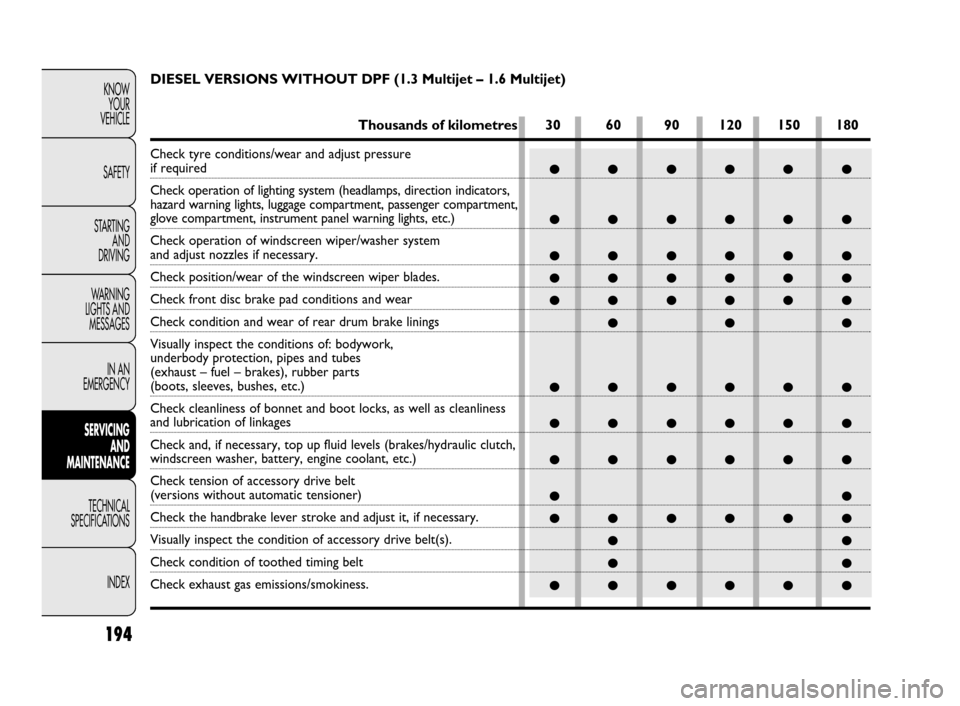
INDEXDIESEL VERSIONS WITHOUT DPF (1.3 Multijet – 1.6 Multijet)
Thousands of kilometres 30 60 90 120 150 180
Check tyre conditions/wear and adjust pressure if required
Check operation of lighting system (headlamps, direction indicators,
hazard warning lights, luggage compartment, passenger compartment,
glove compartment, instrument panel warning lights, etc.)
Check operation of windscreen wiper/washer system
and adjust nozzles if necessary.
Check position/wear of the windscreen wiper blades.
Check front disc brake pad conditions and wear
Check condition and wear of rear drum brake linings
Visually inspect the conditions of: bodywork,
underbody protection, pipes and tubes
(exhaust – fuel – brakes), rubber parts
(boots, sleeves, bushes, etc.)
Check cleanliness of bonnet and boot locks, as well as cleanliness
and lubrication of linkages
Check and, if necessary, top up fluid levels (brakes/hydraulic clutch,
windscreen washer, battery, engine coolant, etc.)
Check tension of accessory drive belt
(versions without automatic tensioner)
Check the handbrake lever stroke and adjust it, if necessary.
Visually inspect the condition of accessory drive belt(s).
Check condition of toothed timing belt
Check exhaust gas emissions/smokiness.


