Page 75 of 532
Transporting PetsAirbags deploying in the front seat could harm your pet.
An unrestrained pet will be thrown about and possibly
injured, or injure a passenger during panic braking or in
a collision. Pets should be restrained in the rear seat in
pet harnesses or pet carriers that are secured by seat belts.ENGINE BREAK-IN RECOMMENDATIONSA long break-in period is not required for the engine in
your vehicle.
Drive moderately during the first 300 miles (500 km).
After the initial 60 miles (100 km), speeds up to 50 or
55 mph (80 or 90 km/h) are desirable.
While cruising, brief full-throttle acceleration within the
limits of local traffic laws, contributes to a good break-in.
Wide-open throttle acceleration in low gear can be detri-
mental and should be avoided.The engine oil installed in the engine at the factory is a
high-quality energy conserving type lubricant. Oil
changes should be consistent with anticipated climate
conditions under which vehicle operations will occur.
The recommended viscosity and quality grades are
shown in “Engine Oil”, under “Maintenance Procedures”
in section 7 of this manual. NON-DETERGENT OR
STRAIGHT MINERAL OILS MUST NEVER BE USED.
A new engine may consume some oil during its first few
thousand miles (kilometers) of operation. This should be
considered a normal part of the break-in and not inter-
preted as an indication of difficulty.
THINGS TO KNOW BEFORE STARTING YOUR VEHICLE 73
2
Page 76 of 532
SAFETY TIPS
Transporting PassengersNEVER TRANSPORT PASSENGERS IN THE CARGO
AREA.
WARNING!
•
It is extremely dangerous to ride in a cargo area,
inside or outside of a vehicle. In a collision, people
riding in these areas are more likely to be seri-
ously injured or killed.
•
Do not allow people to ride in any area of your
vehicle that is not equipped with seats and seat
belts.
•
Be sure everyone in your vehicle is in a seat and
using a seat belt properly.
Exhaust Gas
WARNING!
Exhaust gases can injure or kill. They contain carbon
monoxide (CO), which is colorless and odorless.
Breathing it can make you unconscious and can
eventually poison you. To avoid breathing (CO)
follow these safety tips:
Do not run the engine in a closed garage or in confined
areas any longer than needed to move your vehicle in or
out of the area.
If it is necessary to sit in a parked vehicle with the engine
running, adjust your heating or cooling controls to force
outside air into the vehicle. Set the blower at high speed.
74 THINGS TO KNOW BEFORE STARTING YOUR VEHICLE
Page 77 of 532

If you are required to drive with the trunk/liftgate open,
make sure that all windows are closed and the climate
control BLOWER switch is set at high speed. DO NOT
use the recirculation mode.
The best protection against carbon monoxide entry into
the vehicle body is a properly maintained engine exhaust
system.
Whenever a change is noticed in the sound of the exhaust
system, when exhaust fumes can be detected inside the
vehicle, or when the underside or rear of the vehicle is
damaged, have a competent mechanic inspect the com-
plete exhaust system and adjacent body areas for broken,
damaged, deteriorated, or mispositioned parts. Open
seams or loose connections could permit exhaust fumes
to seep into the passenger compartment. In addition,
inspect the exhaust system each time the vehicle is raised
for lubrication or oil change. Replace as required.
Safety Checks You Should Make Inside the
Vehicle
Seat BeltsInspect the belt system periodically, checking for cuts,
frays, and loose parts. Damaged parts must be replaced
immediately. Do not disassemble or modify the system.
Front seat belt assemblies must be replaced after a
collision. Rear seat belt assemblies must be replaced after
a collision if they have been damaged (i.e., bent retractor,
torn webbing, etc.). If there is any question regarding belt
or retractor condition, replace the belt.Airbag Warning LightThe light should come on and remain on for six to eight
seconds as a bulb check when the ignition switch is first
turned ON. If the light is not lit during starting, see your
authorized dealer. If the light stays on, flickers, or comes
on while driving, have the system checked by an autho-
rized dealer.THINGS TO KNOW BEFORE STARTING YOUR VEHICLE 75
2
Page 121 of 532
NOTE:Keep in mind that you have to press the VR
button first and wait for the beep before speaking the
“Barge In” commands.Voice TrainingFor users experiencing difficulty with the system recog-
nizing their voice commands or numbers, uconnect �
phone Voice Training feature may be used.
1. Press the VR button, say “System Setup” and once you
are in that menu then say “Voice Training.” This will train
your own voice to the system and will improve recogni-
tion.
2. Repeat the words and phrases when prompted by
uconnect� phone. For best results, the Voice Training
session should be completed when the vehicle is parked,
engine running, all windows closed, and the blower fan
switched off. This procedure may be repeated with a new
user. The system will adapt to the last trained voice only.
SEATSSeats are a primary part of the Occupant Restraint System
of the vehicle. Proper use of the seats is needed for safe
operation of the vehicle.
WARNING!
•
It is extremely dangerous to ride in a cargo area,
inside or outside of a vehicle. In a collision, people
riding in these areas are more likely to be seri-
ously injured or killed.
•
Do not allow people to ride in any area of your
vehicle that is not equipped with seats and seat
belts.
•
Be sure everyone in your vehicle is in a seat and
using a seat belt properly.UNDERSTANDING THE FEATURES OF YOUR VEHICLE 119
3
Page 122 of 532
Manual Seat Adjuster — If EquippedThe front seats are adjustable, forward or rearward. The
adjustment handle is located at the front edge of each seat
cushion. Pull upward on the handle and slide the seat,
forward or rearward, to the desired position. Using body
pressure, move forward and rearward on the seat to be
sure the seat is locked into position.
WARNING!
Adjusting a seat while the vehicle is moving is
dangerous. The sudden movement of the seat could
cause you to lose control. The seat belt might not be
properly adjusted and you could be injured. Only
adjust a seat while the vehicle is parked.
Manual Seat Adjuster
120 UNDERSTANDING THE FEATURES OF YOUR VEHICLE
Page 123 of 532
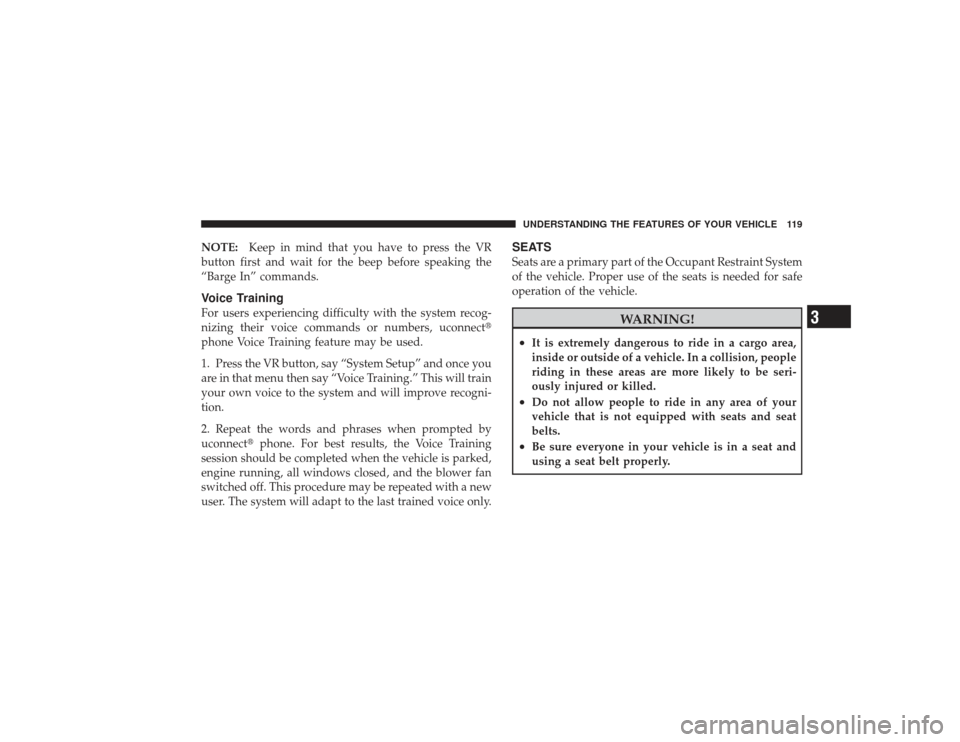
Reclining Seats (Quad Cab�Models)The recliner handle is located on the outside of the seat
cushion. Pull upward on the handle to release the seat-
back, lean forward or rearward to the desired position.
WARNING!
You can be seriously, even fatally, injured riding in a
seat with the seatback reclined. Do not ride with the
seatback reclined so that the shoulder belt is no
longer resting against your chest. If you ride in this
position, the shoulder harness will no longer be
restraining you. In a collision you could slide under
the seat belt and receive serious or fatal injuries.
Only recline in a seat when the vehicle is parked.
Seat Recliner Handle
UNDERSTANDING THE FEATURES OF YOUR VEHICLE 121
3
Page 124 of 532
Reclining Seats (2500/3500 Models)The recliner handle is located on the outside of the seat
cushion. Pull upward on the handle to release the seat-
back, lean forward or rearward to the desired position.
WARNING!
You can be seriously, even fatally, injured riding in a
seat with the seatback reclined. Do not ride with the
seatback reclined so that the shoulder belt is no
longer resting against your chest. If you ride in this
position, the shoulder harness will no longer be
restraining you. In a collision you could slide under
the seat belt and receive serious or fatal injuries.
Only recline in a seat when the vehicle is parked.
Seat Recliner Handle
122 UNDERSTANDING THE FEATURES OF YOUR VEHICLE
Page 129 of 532
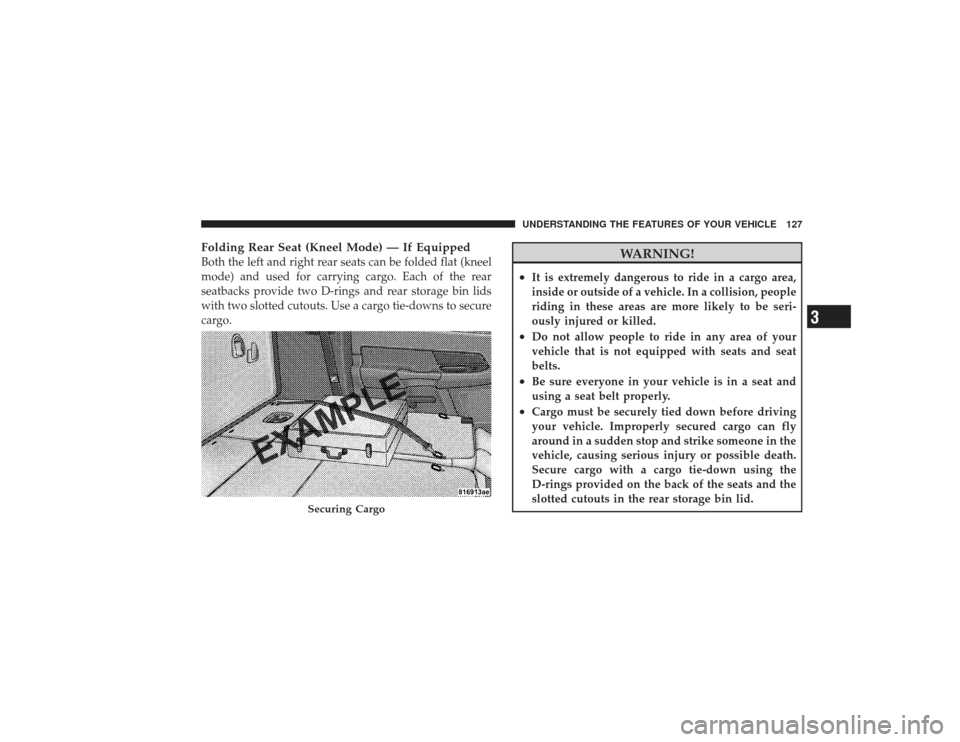
Folding Rear Seat (Kneel Mode) — If EquippedBoth the left and right rear seats can be folded flat (kneel
mode) and used for carrying cargo. Each of the rear
seatbacks provide two D-rings and rear storage bin lids
with two slotted cutouts. Use a cargo tie-downs to secure
cargo.
WARNING!
•
It is extremely dangerous to ride in a cargo area,
inside or outside of a vehicle. In a collision, people
riding in these areas are more likely to be seri-
ously injured or killed.
•
Do not allow people to ride in any area of your
vehicle that is not equipped with seats and seat
belts.
•
Be sure everyone in your vehicle is in a seat and
using a seat belt properly.
•
Cargo must be securely tied down before driving
your vehicle. Improperly secured cargo can fly
around in a sudden stop and strike someone in the
vehicle, causing serious injury or possible death.
Secure cargo with a cargo tie-down using the
D-rings provided on the back of the seats and the
slotted cutouts in the rear storage bin lid.
Securing Cargo
UNDERSTANDING THE FEATURES OF YOUR VEHICLE 127
3