2009 DODGE GRAND CARAVAN child lock
[x] Cancel search: child lockPage 55 of 535

Knee bolsters/blockers for front seat occupants
Front seat belt retractors incorporate pretensioners to
enhance occupant protection by managing occupant
energy during an impact event.
If you will be carrying children too small for adult-sized
seat belts, the seat belts or the Lower Anchors and Tether
for CHildren (LATCH) feature also can be used to hold
infant and child restraint systems.
NOTE: The front airbags have a multistage inflator
design. This allows the airbag to have different rates of
inflation that are based on collision severity.
Please pay close attention to the information in this
section. It tells you how to use your restraint system
properly, to keep you and your passengers as safe as
possible. WARNING!In a collision, you and your passengers can suffer
much greater injuries if you are not properly buckled
up. You can strike the interior of your vehicle or other
passengers, or you can be thrown out of the vehicle.
Always be sure you and others in your vehicle are
buckled up properly.
Buckle up even though you are an excellent driver, even
on short trips. Someone on the road may be a poor driver
and cause a collision that includes you. This can happen
far away from home or on your own street.
Research has shown that seat belts save lives, and they
can reduce the seriousness of injuries in a collision. Some
of the worst injuries happen when people are thrown
from the vehicle. Seat belts reduce the possibility of
THINGS TO KNOW BEFORE STARTING YOUR VEHICLE 53 2
Page 62 of 535

Automatic Locking Retractors (ALR) Mode — If
EquippedIn this mode, the shoulder belt is automatically pre-
locked. The belt will still retract to remove any slack in
the shoulder belt. The Automatic Locking Mode is avail-
able on all passenger-seating positions with a combina-
tion lap/shoulder belt.
When to Use the Automatic Locking Mode
Use the Automatic Locking Mode anytime a child safety
seat is installed in a passenger seating position. Children
12 years old and younger should be properly restrained
in the rear seat whenever possible.
How to Use the Automatic Locking Mode
1. Buckle the combination lap/shoulder belt.
2. Grasp the shoulder portion and pull downward until
the entire belt is extracted.
3. Allow the belt to retract. As the belt retracts, you will
hear a clicking sound. This indicates the safety belt is
now in the Automatic Locking Mode.
How to Disengage the Automatic Locking Mode
Disconnect the combination lap/shoulder belt and allow
it to retract completely to disengage the Automatic
Locking Mode and activate the Vehicle Sensitive (Emer-
gency) Locking mode.
Seat Belt Pretensioners
The seat belts for both front seating positions are
equipped with pretensioning devices that are designed to
remove slack from the seat belt in the event of a collision.
These devices improve the performance of the seat belt
by assuring that the belt is tight about the occupant early
in a collision. Pretensioners work for all size occupants,
including those in child restraints.
60 THINGS TO KNOW BEFORE STARTING YOUR VEHICLE
Page 68 of 535

NOTE:
Should a vehicle rollover occur, the SABIC curtains on
both sides of the vehicle are deployed.
Airbag covers may not be obvious in the interior trim;
but they will open to allow airbag deployment.
The system includes sensors adjacent to both front and
rear seat occupants that are calibrated to deploy during
an impact severe enough to require airbag occupant
protection. WARNING!
If your vehicle is equipped with left and right Side
Airbag Inflatable Curtain (SABIC), do not stack
luggage or other cargo up high enough to block the
location of the SABIC. The area where the side
curtain airbag is located should remain free from any
obstructions.
Airbags inflate in moderate to high speed impacts. Along
with seat belts and pretensioners, front airbags work with
the knee bolsters to provide improved protection for the
driver and front passenger. Side airbags also work with
seat belts to improve occupant protection.
The seat belts are designed to protect you in many types
of collisions. The front airbags deploy in moderate-to-
severe frontal collisions. If your vehicle is equipped, the
side airbag on the crash side of the vehicle is triggered in
moderate-to-severe side collisions. In certain types of
collisions, both the front and side airbags may be trig-
gered. However, even in collisions where the airbags
work, you need the seat belts to keep you in the right
position for the airbags to protect you properly.
Here are some simple steps you can take to minimize the
risk of harm from a deploying airbag:
Children 12 years old and younger should always ride
buckled up in a rear seat. Infants in rear-facing child
66 THINGS TO KNOW BEFORE STARTING YOUR VEHICLE
Page 78 of 535
Cruise control status
Traction/stability control status
Tire Pressure Monitoring System status (if equipped)
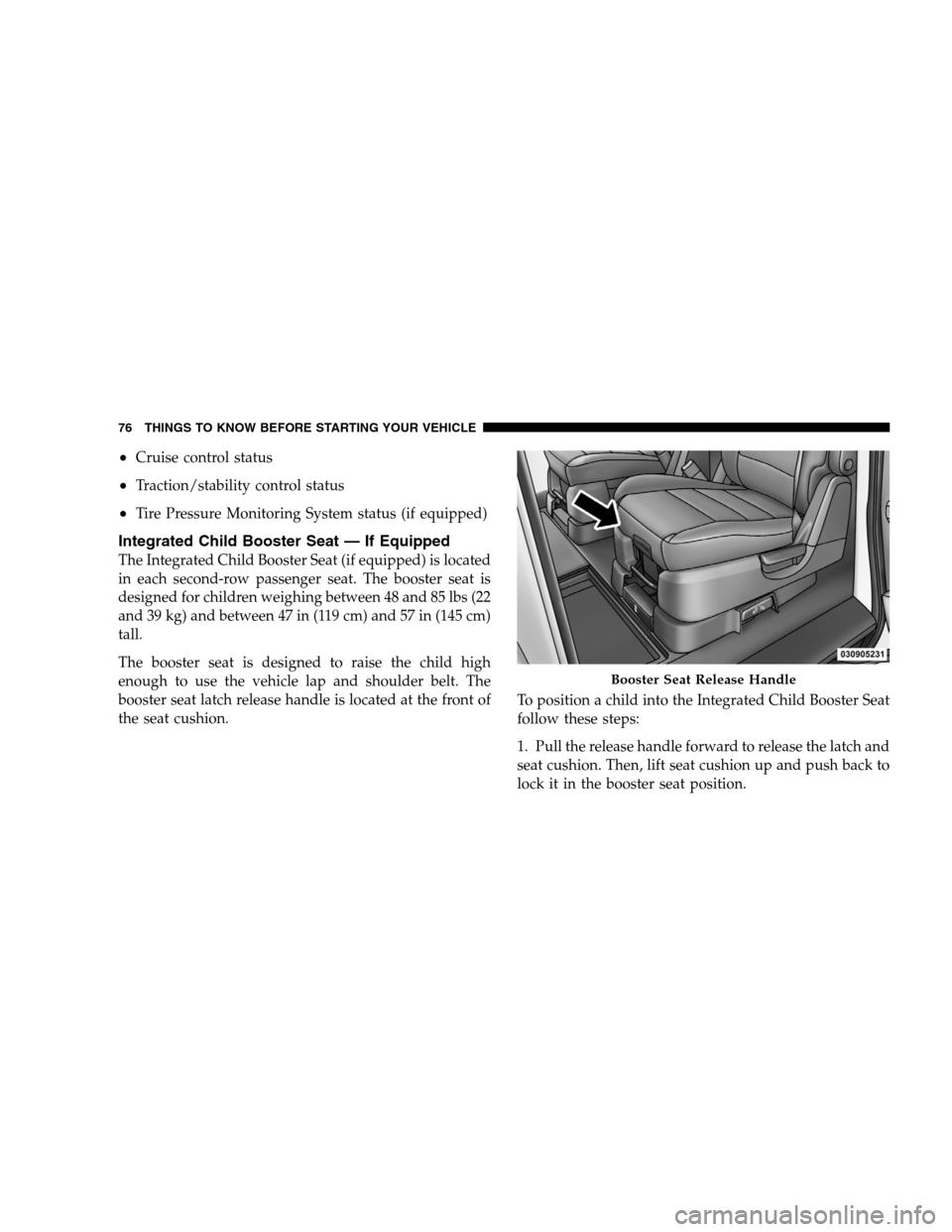
Integrated Child Booster Seat — If Equipped
The Integrated Child Booster Seat (if equipped) is located
in each second-row passenger seat. The booster seat is
designed for children weighing between 48 and 85 lbs (22
and 39 kg) and between 47 in (119 cm) and 57 in (145 cm)
tall.
The booster seat is designed to raise the child high
enough to use the vehicle lap and shoulder belt. The
booster seat latch release handle is located at the front of
the seat cushion.
To position a child into the Integrated Child Booster Seat
follow these steps:
1. Pull the release handle forward to release the latch and
seat cushion. Then, lift seat cushion up and push back to
lock it in the booster seat position. Booster Seat Release Handle
76 THINGS
TO KNOW BEFORE STARTING YOUR VEHICLE
Page 79 of 535

WARNING!Failure to comply with the following conditions
could result in serious injury of death:
(Continued) WARNING! (Continued)
The swivel seat should be locked in the forward-
facing position when using the booster seat with
the vehicle in motion.
Be certain that the seat cushion is locked securely
into position before using the seat. Otherwise, the
seat will not provide the proper stability for child
seats and/or passengers. An improperly latched
seat cushion could cause serious injury.
2. Place the child upright in the seat with their back
firmly against the seatback.
3. Grasp the latch plate and pull out the seat belt.
4. Slide the latch plate up the webbing as far as necessary
to allow the seat belt to go around the child’s lap.
NOTE: The lap portion of the seat belt should be low on
the hips and as snug as possible. Booster Seat Position
THINGS T
O KNOW BEFORE STARTING YOUR VEHICLE 77 2
Page 82 of 535

Safety experts recommend that children ride
rearward-facing in the vehicle until they are at least
one year old and weigh at least 20 lbs (9 kg). Two types
of child restraints can be used rearward-facing: infant
carriers and convertible child seats. Both types of child
restraints are held in the vehicle by the lap/shoulder
belt or the LATCH child restraint anchorage system.
Refer to “Lower Anchors and Tether for CHildren
(LATCH)” later in this section.
The infant carrier is only used rearward-facing in the
vehicle. It is recommended for children who weigh up
to about 20 lbs (9 kg). Convertible child seats can be
used either rearward-facing or forward-facing in the
vehicle. Convertible child seats often have a higher
weight limit in the rearward-facing direction than
infant carriers do, so they can be used rearward-facing
by children who weigh more than 20 lbs (9 kg) but are
less than one year old.
WARNING!
Rearward-facing child seats must NEVER be used in
the front seat of a vehicle with a front passenger
airbag. An airbag deployment could cause severe
injury or death to infants in this position.
Rearward-facing child seats and infant carriers must
NEVER
be used while the second row Swivel ’n Go
seats are in the rearward-facing position. WARNING!
Never place any child seat, booster seat, or infant
carrier in the Swivel ’n Go seat while it is in the
rearward-facing position. The swivel seat should be
locked in the forward position when using any child
seat, booster seat, or infant carriers, with the vehicle
in motion. Failure to do so could result in serious
injury or even death.
80 THINGS TO KNOW BEFORE STARTING YOUR VEHICLE
Page 84 of 535

NOTE: For additional information, refer to
www.seatcheck.org or call 1–866–SEATCHECK. Cana-
dian residents, should refer to Transport Canada’s web-
site for additional information. http://www.tc.gc.ca/
roadsafety/childsafety/menu.htmWARNING!
Improper installation can lead to failure of an
infant or child restraint. It could come loose in a
collision. The child could be badly injured or
killed. Follow the manufacturer’s directions ex-
actly when installing an infant or child restraint.
A rearward-facing child restraint should only be
used in a rear seat. A rearward-facing child re-
straint in the front seat may be struck by a deploy-
ing passenger airbag which may cause severe or
fatal injury to the infant.
(Continued) WARNING! (Continued)
Occupants riding in Swivel ’n Go seating must be
wearing their seat belt and the seat must be locked
in either the forward or rearward position. Failure
to do so could result in serious injury or even
death.
Here are some tips on getting the most out of your child
restraint:
Before buying any restraint system, make sure that it
has a label certifying that it meets all applicable Safety
Standards. We also recommend that you make sure
that you can install the child restraint in the vehicle
where you will use it, before you buy it.
The restraint must be appropriate for your child’s
weight and height. Check the label on the restraint for
weight and height limits.
82 THINGS TO KNOW BEFORE STARTING YOUR VEHICLE
Page 85 of 535

Carefully follow the instructions that come with the
restraint. If you install the restraint improperly, it may
not work when you need it.
The passenger seat belts are equipped with cinching
latch plates, which are designed to keep the lap
portion tight around the child restraint so that it is not
necessary to use a locking clip. Pulling up on the
shoulder portion of the lap/shoulder belt will tighten
the belt. The cinching latch plate will keep the belt
tight; however, any seat belt system will loosen with
time, so check the belt occasionally and pull it tight if
necessary.
In the rear seat, you may have trouble tightening the
lap/shoulder belt on the child restraint because the
buckle or latch plate is too close to the belt path
opening on the restraint. Disconnect the latch plate
from the buckle and twist the short buckle end of the
belt several times to shorten it. Insert the latch plate
into the buckle with the release button facing out.
If the belt still can’t be tightened, or if pulling and
pushing on the restraint loosens the belt, disconnect
the latch plate from the buckle, turn the buckle
around, and insert the latch plate into the buckle
again. If you still can’t make the child restraint secure,
try a different seating position.
Buckle the child into the seat according to the child
restraint manufacturer’s directions.
When your child restraint is not in use, secure it in the
vehicle with the seat belt or remove it from the vehicle.
Don’t leave it loose in the vehicle. In a sudden stop or
collision, it could strike the occupants or seatbacks and
cause serious personal injury.
THINGS TO KNOW BEFORE STARTING YOUR VEHICLE 83 2