Page 392 of 498
WARNING!
Any procedure other than above could result in:
•Personal injury caused by electrolyte squirting out
the battery vent.
•Personal injury or property damage due to battery
explosion.
•Damage to charging system of booster vehicle or
of immobilized vehicle.
FREEING A STUCK VEHICLE
If vehicle becomes stuck in snow, sand, or mud, it can
often be moved by a rocking motion. Move the shift leverrhythmically between FIRST and REVERSE, while apply-
ing slight pressure to the accelerator.
The least amount of accelerator pedal pressure to main-
tain the rocking motion without spinning the wheels or
racing the engine is most effective. Allow the engine to
idle with the shift lever in NEUTRAL for at least one
minute after every five rocking-motion cycles. This will
minimize overheating and reduce the risk of transmis-
sion failure during prolonged efforts to free a stuck
vehicle.
390 WHAT TO DO IN EMERGENCIES
Page 395 of 498
MAINTAINING YOUR VEHICLE
CONTENTS
�Engine Compartment – 3.7L.............. 395
�Engine Compartment – 4.7L.............. 396
�Engine Compartment – 5.7L.............. 397
�Onboard Diagnostic System — OBD II...... 398
▫Loose Fuel Filler Cap Message........... 398
�Emissions Inspection And Maintenance
Programs............................ 399
�Replacement Parts..................... 400
�Dealer Service........................ 400�Maintenance Procedures................. 401
▫Engine Oil......................... 401
▫Engine Oil Filter..................... 403
▫Engine Air Cleaner Filter............... 403
▫Maintenance-Free Battery.............. 404
▫Air Conditioner Maintenance............ 405
▫Drive Shaft Constant Velocity Joints....... 406
▫Body Lubrication.................... 406
▫Windshield Wiper Blades............... 407
7
Page 397 of 498
ENGINE COMPARTMENT – 3.7L
1 — Battery 7 — Washer Fluid Reservoir
2 — Automatic Transmission Dipstick 8 — Engine Coolant Reservoir
3 — Engine Oil Dipstick 9 — Integrated Power Module
4 — Engine Oil Fill 10 — Power Steering Fluid Reservoir
5 — Brake Fluid Reservoir 11 — Coolant Pressure Cap
6 — Power Distribution Center 12 — Air Cleaner FilterMAINTAINING YOUR VEHICLE 3957
Page 398 of 498
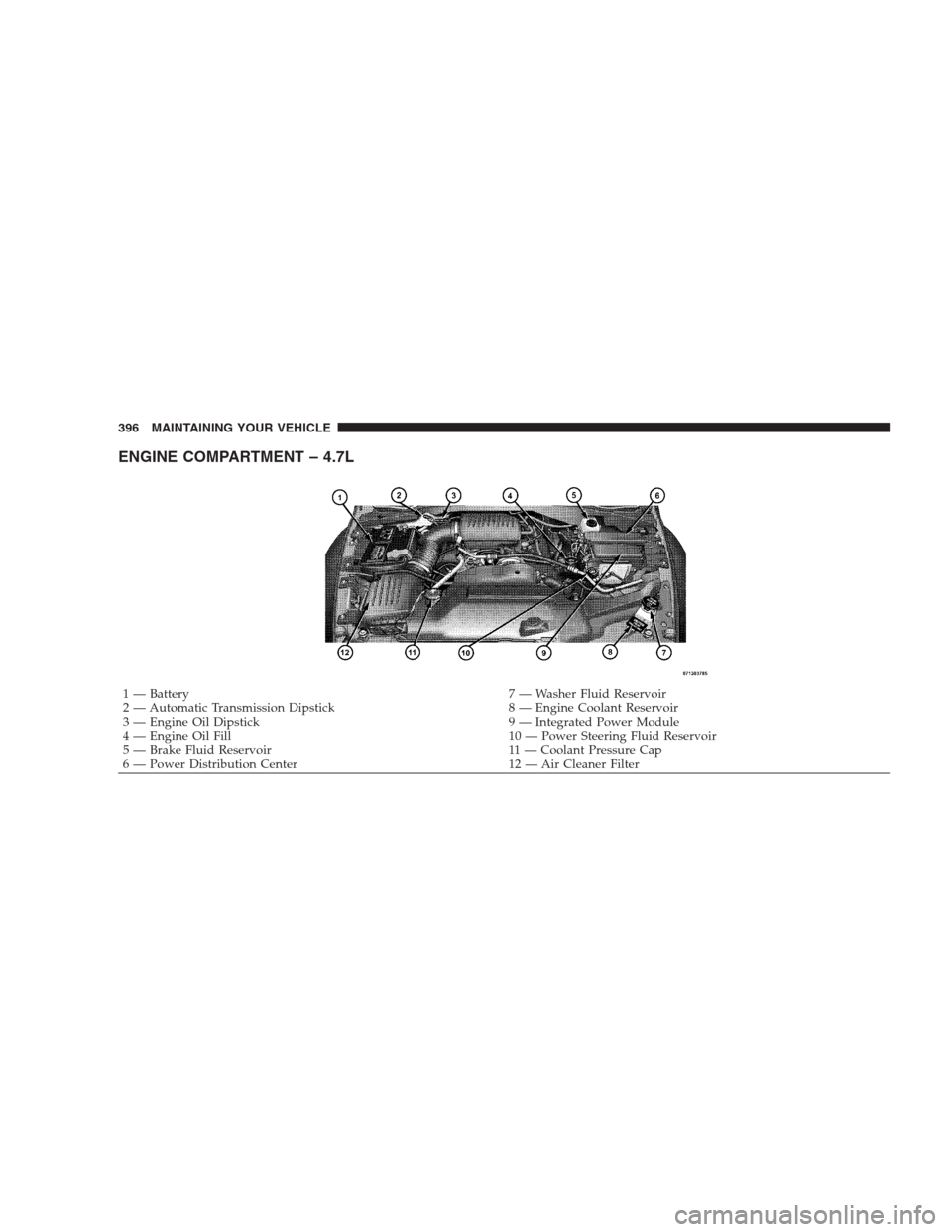
ENGINE COMPARTMENT – 4.7L
1 — Battery 7 — Washer Fluid Reservoir
2 — Automatic Transmission Dipstick 8 — Engine Coolant Reservoir
3 — Engine Oil Dipstick 9 — Integrated Power Module
4 — Engine Oil Fill 10 — Power Steering Fluid Reservoir
5 — Brake Fluid Reservoir 11 — Coolant Pressure Cap
6 — Power Distribution Center 12 — Air Cleaner Filter 396 MAINTAINING YOUR VEHICLE
Page 399 of 498
ENGINE COMPARTMENT – 5.7L
1 — Battery 7 — Washer Fluid Reservoir
2 — Automatic Transmission Dipstick 8 — Engine Coolant Reservoir
3 — Engine Oil Fill 9 — Integrated Power Module
4 — Engine Oil Dipstick 10 — Power Steering Fluid Reservoir
5 — Brake Fluid Reservoir 11 — Coolant Pressure Cap
6 — Power Distribution Center 12 — Air Cleaner FilterMAINTAINING YOUR VEHICLE 3977
Page 401 of 498

problem persists, the message will appear the next time
the vehicle is started. This might indicate a damaged cap.
If the problem is detected twice in a row, the system will
turn on the MIL. Resolving the problem will turn the MIL
off.
EMISSIONS INSPECTION AND MAINTENANCE
PROGRAMS
In some localities, it may be a legal requirement to pass
an inspection of your vehicle’s emissions control system.
Failure to pass could prevent vehicle registration.
For states that require an Inspection and Mainte-
nance (I/M), this check verifies the Malfunction
Indicator Light (MIL) is functioning and is not on
when the engine is running, and that the OBD II system
is ready for testing.
Normally, the OBD II system will be ready. The OBD II
system maynotbe ready if your vehicle was recentlyserviced, recently had a dead battery or a battery replace-
ment. If the OBD II system should be determined not
ready for the I/M test, your vehicle may fail the test.
Your vehicle has a simple ignition key-actuated test,
which you can use prior to going to the test station. To
check if your vehicle’s OBD II system is ready, you must
do the following:
1. Insert your ignition key into the ignition switch.
2. Turn the ignition to the ON position, but do not crank
or start the engine.
3. If you crank or start the engine, you will have to start
this test over.
4. As soon as you turn your key to the ON position, you
will see the MIL symbol come on as part of a normal bulb
check.
MAINTAINING YOUR VEHICLE 399
7
Page 402 of 498

5. Approximately 15 seconds later, one of two things will
happen:
a. The MIL will flash for about 10 seconds and then
return to being fully illuminated until you turn OFF
the ignition or start the engine. This means that your
vehicle’s OBD II system isnot readyand you should
notproceed to the I/M station.
b. The MIL will not flash at all and will remain fully
illuminated until you turn OFF the ignition or start the
engine. This means that your vehicle’s OBD II system
isreadyand you can proceed to the I/M station.
If your OBD II system isnot ready,you should see your
authorized dealer or repair facility. If your vehicle was
recently serviced or had a battery failure or replacement,
you may need to do nothing more than drive your
vehicle as you normally would in order for your OBD II
system to update. A recheck with the above test routine
may then indicate that the system is now ready.Regardless of whether your vehicle’s OBD II system is
ready or not, if the MIL is illuminated during normal
vehicle operation you should have your vehicle serviced
before going to the I/M station. The I/M station can fail
your vehicle because the MIL is on with the engine
running.
REPLACEMENT PARTS
Use of genuine MOPAR�parts for normal/scheduled
maintenance and repairs is highly recommended to en-
sure the designed performance. Damage or failures
caused by the use of non-MOPAR�parts for maintenance
and repairs will not be covered by the manufacturer’s
warranty.
DEALER SERVICE
Your authorized dealer has the qualified service person-
nel, special tools and equipment to perform all service
operations in an expert manner. Service Manuals are
available which include detailed service information for
400 MAINTAINING YOUR VEHICLE
Page 406 of 498

WARNING!
The air cleaner can provide a measure of protection
in the case of engine backfire. Do not remove the air
cleaner unless such removal is necessary for repair or
maintenance. Make sure that no one is near the
engine compartment before starting the vehicle with
the air cleaner removed. Failure to do so can result in
serious personal injury.
Engine Air Cleaner Filter Selection
The quality of replacement engine air cleaner filters
varies considerably. Only high quality filters should be
used to assure most efficient service. MOPAR�engine air
cleaner filters are a high quality filter and are
recommended.
Maintenance-Free Battery
The top of the maintenance-free battery is permanently
sealed. You will never have to add water, nor is periodic
maintenance required.
WARNING!
•Battery fluid is a corrosive acid solution and can
burn or even blind you. Do not allow battery fluid
to contact your eyes, skin or clothing. Do not lean
over a battery when attaching clamps. If acid
splashes in eyes or on skin, flush the area imme-
diately with large amounts of water.
•Battery gas is flammable and explosive. Keep
flame or sparks away from the battery. Do not use
a booster battery or any other booster source with
an output greater than 12 volts. Do not allow cable
clamps to touch each other.
(Continued)
404 MAINTAINING YOUR VEHICLE