Page 299 of 498

Torque Converter Clutch
A feature designed to improve fuel economy is included
in all automatic transmissions. A clutch within the torque
converter engages automatically at a calibrated speed at
light throttle. It engages at higher speeds under heavier
acceleration. This may result in a slightly different feeling
or response during normal operation in high gear. When
the vehicle speed drops below a calibrated speed, or
during acceleration, the clutch automatically and
smoothly disengages. The feature is operational in
OVERDRIVE and in DRIVE.
NOTE:
•The torque converter clutch will not engage until the
transmission fluid and engine coolant are warm (usu-
ally after 1-3 miles [1.6 - 4.8 km] of driving). Because
the engine speed is higher when the torque converter
clutch is not engaged, it may seem as if the transmis-
sion is not shifting into Overdrive when cold. This is
normal. Pressing the TOW/HAUL button, when thetransmission is sufficiently warm, will demonstrate
that the transmission is able to shift into, and out of,
Overdrive. For vehicles with 4.7L or 5.7L engines
(which have two Overdrive gears), the transmission
may not shift into 5th gear until the transmission fluid
and engine coolant are warm.
•If the vehicle has not been driven in several days, the
first few seconds of operation after shifting the trans-
mission into gear may seem sluggish. This is due to the
fluid partially draining from the torque converter into
the transmission. This condition is normal and will not
cause damage to the transmission. The torque con-
verter will refill within five seconds of shifting from
PARK into any other gear position.
STARTING AND OPERATING 297
5
Page 397 of 498
ENGINE COMPARTMENT – 3.7L
1 — Battery 7 — Washer Fluid Reservoir
2 — Automatic Transmission Dipstick 8 — Engine Coolant Reservoir
3 — Engine Oil Dipstick 9 — Integrated Power Module
4 — Engine Oil Fill 10 — Power Steering Fluid Reservoir
5 — Brake Fluid Reservoir 11 — Coolant Pressure Cap
6 — Power Distribution Center 12 — Air Cleaner FilterMAINTAINING YOUR VEHICLE 3957
Page 398 of 498
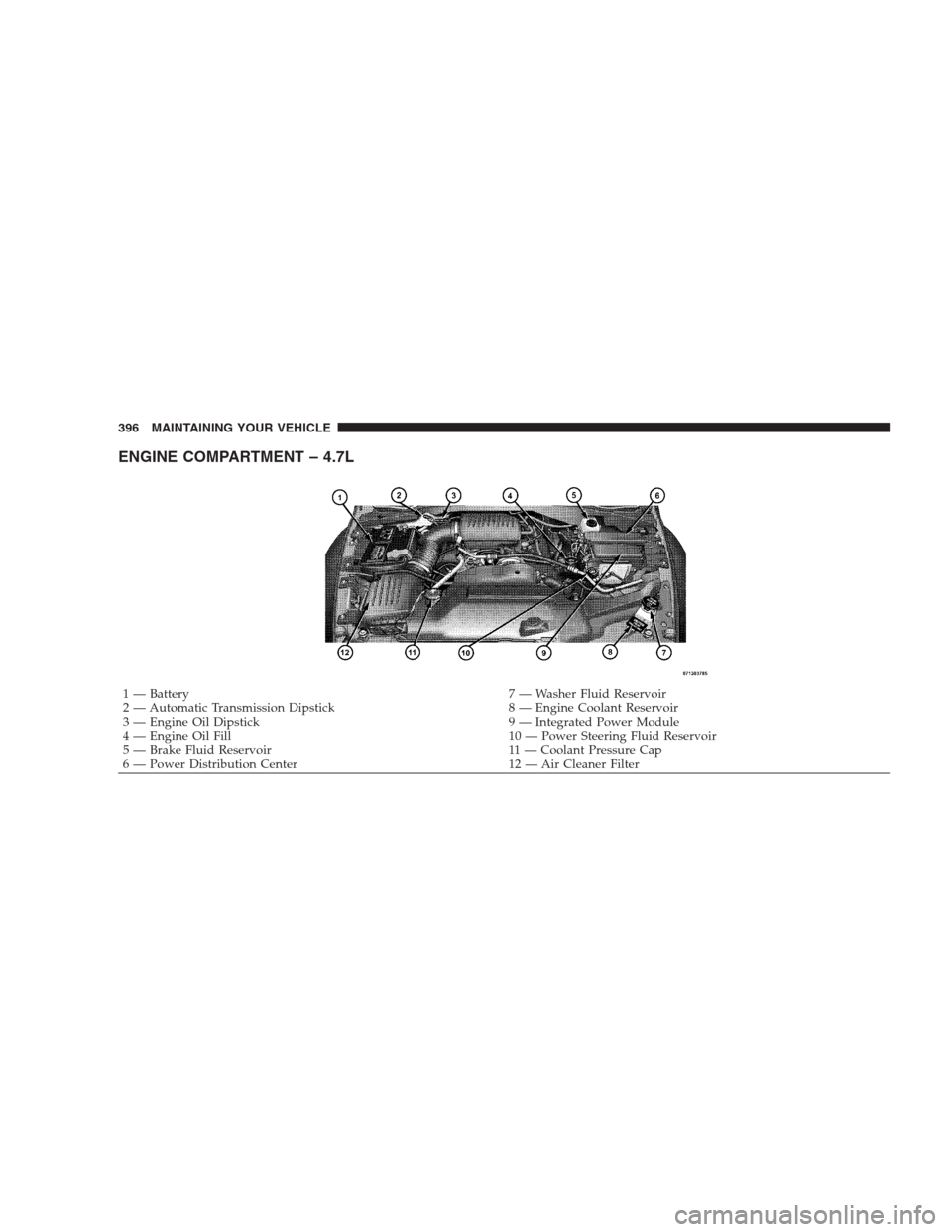
ENGINE COMPARTMENT – 4.7L
1 — Battery 7 — Washer Fluid Reservoir
2 — Automatic Transmission Dipstick 8 — Engine Coolant Reservoir
3 — Engine Oil Dipstick 9 — Integrated Power Module
4 — Engine Oil Fill 10 — Power Steering Fluid Reservoir
5 — Brake Fluid Reservoir 11 — Coolant Pressure Cap
6 — Power Distribution Center 12 — Air Cleaner Filter 396 MAINTAINING YOUR VEHICLE
Page 399 of 498
ENGINE COMPARTMENT – 5.7L
1 — Battery 7 — Washer Fluid Reservoir
2 — Automatic Transmission Dipstick 8 — Engine Coolant Reservoir
3 — Engine Oil Fill 9 — Integrated Power Module
4 — Engine Oil Dipstick 10 — Power Steering Fluid Reservoir
5 — Brake Fluid Reservoir 11 — Coolant Pressure Cap
6 — Power Distribution Center 12 — Air Cleaner FilterMAINTAINING YOUR VEHICLE 3977
Page 412 of 498

To minimize the possibility of catalyst damage:
•Do not shut off the engine or interrupt the ignition
when the transmission is in gear and the vehicle is in
motion.
•Do not try to start engine by pushing or towing the
vehicle.
•Do not idle the engine with any spark plug wires
disconnected or removed, such as when diagnostic
testing, or for prolonged periods during very rough
idling or malfunctioning operating conditions.
Cooling System
WARNING!
You or others can be badly burned by hot engine
coolant (antifreeze) or steam from your radiator. If
you see or hear steam coming from under the hood,
do not open the hood until the radiator has had time
to cool. Never try to open a cooling system pressure
cap when the radiator is hot.
Engine Coolant Checks
Check the engine coolant (antifreeze) protection every
12 months (before the onset of freezing weather, where
applicable). If the engine coolant (antifreeze) is dirty or
rusty in appearance, the system should be drained,
flushed and refilled with fresh engine coolant (anti-
freeze). Check the front of the A/C condenser and
radiator for any accumulation of bugs, leaves, etc. If dirty,
410 MAINTAINING YOUR VEHICLE
Page 413 of 498

clean by gently spraying water from a garden hose
vertically down the face of the condenser and radiator.
Check the coolant recovery bottle tubing for brittle rub-
ber, cracking, tears, cuts and tightness of the connection
at the bottle and radiator. Inspect the entire system for
leaks.
With the engine at normal operating temperature (but
not running), check the cooling system pressure cap for
proper vacuum sealing by draining a small amount of
engine coolant (antifreeze) from the radiator drain cock.
If the cap is sealing properly, the engine coolant (anti-
freeze) will begin to drain from the coolant recovery
bottle. DO NOT REMOVE THE COOLANT PRESSURE
CAP WHEN THE COOLING SYSTEM IS HOT.Cooling System — Drain, Flush and Refill
If the engine coolant (antifreeze) is dirty or contains a
considerable amount of sediment, clean and flush with a
reliable cooling system cleaner. Follow with a thorough
rinsing to remove all deposits and chemicals. Properly
dispose of the old engine coolant (antifreeze).
Refer to the “Maintenance Schedule” in Section 8 for
proper maintenance intervals.
Selection Of Coolant
Use only the manufacturer’s recommended engine cool-
ant (antifreeze). Refer to “Fluids, Lubricants, and Genu-
ine Parts” in this section for the correct fluid type.
MAINTAINING YOUR VEHICLE 411
7
Page 414 of 498

CAUTION!
•Mixing of engine coolant (antifreeze) other than
specified HOAT engine coolant (antifreeze) may
result in engine damage and may decrease corro-
sion protection. If a non-HOAT engine coolant
(antifreeze) is introduced into the cooling system
in an emergency, it should be replaced with the
specified engine coolant (antifreeze) as soon as
possible.
•Do not use water alone or alcohol-based engine
coolant (antifreeze) products. Do not use addi-
tional rust inhibitors or antirust products, as they
may not be compatible with the radiator engine
coolant (antifreeze) and may plug the radiator.
(Continued)
CAUTION! (Continued)
•This vehicle has not been designed for use with
Propylene Glycol based engine coolant (anti-
freeze). Use of Propylene Glycol based engine
coolant (antifreeze) is not recommended.
Adding Coolant
Your vehicle has been built with an improved engine
coolant (antifreeze) that allows extended maintenance
intervals. This engine coolant (antifreeze) can be used up
to 5 Years or 102,000 miles (170 000 km) before replace-
ment. To prevent reducing this extended maintenance
period, it is important that you use the same engine
coolant (antifreeze) throughout the life of your vehicle.
Please review these recommendations for using Hybrid
Organic Additive Technology (HOAT) engine coolant
(antifreeze).
412 MAINTAINING YOUR VEHICLE
Page 415 of 498

When adding engine coolant (antifreeze):
•The manufacturer recommends using MOPAR�
Antifreeze/Coolant 5 Year/100,000 Mile Formula
HOAT (Hybrid Organic Additive Technology)
•Mix a minimum solution of 50% HOAT engine coolant
(antifreeze) and distilled water. Use higher concentra-
tions (not to exceed 70%) if temperatures below -34°F
(-37°C) are anticipated.
•Use only high purity water such as distilled or deion-
ized water when mixing the water/engine coolant
(antifreeze) solution. The use of lower quality water
will reduce the amount of corrosion protection in the
engine cooling system.
Please note that it is the owner’s responsibility to main-
tain the proper level of protection against freezing ac-
cording to the temperatures occurring in the area where
the vehicle is operated.NOTE:Mixing engine coolant (antifreeze) types will
decrease the life of the engine coolant (antifreeze) and
will require more frequent engine coolant (antifreeze)
changes.
Cooling System Pressure Cap
The cap must be fully tightened to prevent loss of engine
coolant (antifreeze), and to ensure that engine coolant
(antifreeze) will return to the radiator from the coolant
recovery bottle.
The cap should be inspected and cleaned if there is any
accumulation of foreign material on the sealing surfaces.
MAINTAINING YOUR VEHICLE 413
7