Page 345 of 449
To Stow the Flat or Spare
Turn the wheel so that the valve stem is down. Slide the
wheel retainer through the center of the wheel and
position it properly across the wheel opening.
For convenience in checking the spare tire inflation, stow
with the valve stem toward the rear of the vehicle.
Rotate the winch mechanism until the wheel is drawn
into place against the underside of the vehicle. Continue
to rotate until you feel the winch mechanism slip or click
three times. It cannot be overtightened. Push against the
tire several times to be sure it is firmly in place.
NOTE:To Stow the Flat or Spare: Wheel retainer does
not fit through the center of the aluminum wheel. The tire
must be stored in a safe manner in the bed of the truck.
JUMP±STARTING
WARNING!
²Battery fluid is a corrosive acid solution; do not
allow battery fluid to contact eyes, skin or cloth-
ing. Don't lean over battery when attaching
clamps or allow the clamps to touch each other. If
acid splashes in eyes or on skin, flush the contami-
nated area immediately with large quantities of
water.
²A battery generates hydrogen gas which is flam-
mable and explosive. Keep flame or spark away
from the vent holes. Do not use a booster battery
or any other booster source with an output that
exceeds 12-Volts.
Check the Battery Test Indicator (if equipped). If a light or
bright colored dot is visible in the indicator, DO NOT
jump-start the battery.
WHAT TO DO IN EMERGENCIES 343
6
Page 348 of 449
FREEING A STUCK VEHICLE
If vehicle becomes stuck in snow, sand, or mud, it can
often be moved by a rocking motion. Move the shift lever
rhythmically between FIRST and REVERSE, while apply-
ing slight pressure to the accelerator.
The least amount of accelerator pedal pressure to main-
tain the rocking motion without spinning the wheels or
racing the engine is most effective. Allow the engine to
idle with the shift lever in NEUTRAL for at least one
minute after every five rocking-motion cycles. This will
minimize overheating and reduce the risk of transmis-
sion failure during prolonged efforts to free a stuck
vehicle.
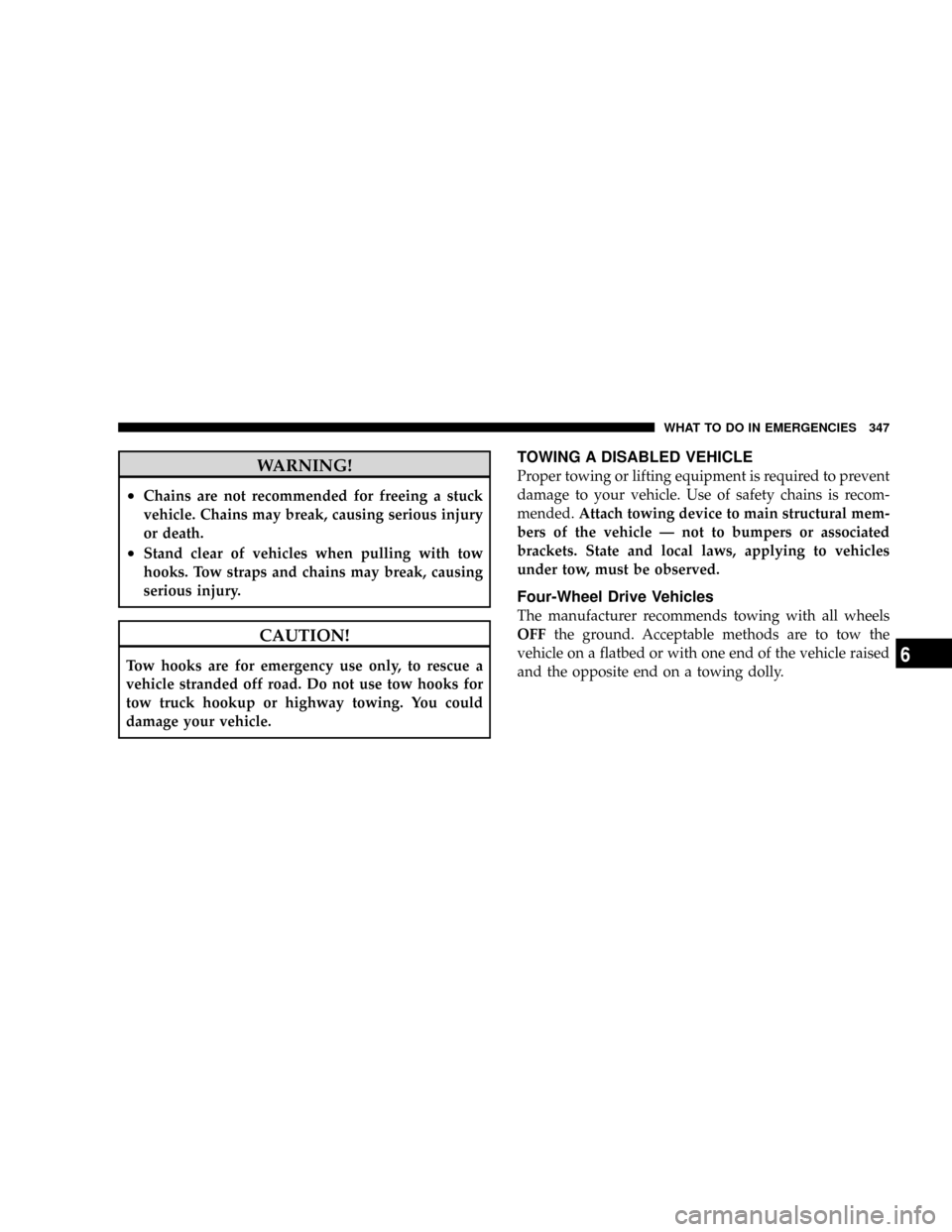
EMERGENCY TOW HOOKS Ð IF EQUIPPED
Your vehicle may be equipped with emergency tow
hooks.
Tow Hooks
346 WHAT TO DO IN EMERGENCIES
Page 349 of 449
WARNING!
²Chains are not recommended for freeing a stuck
vehicle. Chains may break, causing serious injury
or death.
²Stand clear of vehicles when pulling with tow
hooks. Tow straps and chains may break, causing
serious injury.
CAUTION!
Tow hooks are for emergency use only, to rescue a
vehicle stranded off road. Do not use tow hooks for
tow truck hookup or highway towing. You could
damage your vehicle.
TOWING A DISABLED VEHICLE
Proper towing or lifting equipment is required to prevent
damage to your vehicle. Use of safety chains is recom-
mended.Attach towing device to main structural mem-
bers of the vehicle Ð not to bumpers or associated
brackets. State and local laws, applying to vehicles
under tow, must be observed.
Four-Wheel Drive Vehicles
The manufacturer recommends towing with all wheels
OFFthe ground. Acceptable methods are to tow the
vehicle on a flatbed or with one end of the vehicle raised
and the opposite end on a towing dolly.
WHAT TO DO IN EMERGENCIES 347
6
Page 350 of 449
Two-Wheel Drive Vehicles
Provided that the transmission is operable, tow with the
transmission in NEUTRAL and the ignition key in the
OFF position, along with the front wheels raised and the
rear wheels on the ground. The speed must not exceed
30 mph (50 km/h), and the distance must not exceed
15 miles (25 km).If the vehicle is to be towed more than 15 miles (25 km)
or faster than 30 mph (50 km/h), it must be towed on a
flatbed, or with the rear wheels raised and the front
wheels on the ground, or with the front end raised and
the rear wheels on a towing dolly.
NOTE:Towing the vehicle with the rear wheels on the
ground at more than 30 mph (50 km/h) or for more than
15 miles (25 km), can cause severe transmission damage.
348 WHAT TO DO IN EMERGENCIES
Page 363 of 449
include cleaning of the condenser fins and a performance
test. Drive belt tension should also be checked at this
time.
WARNING!
²Use only refrigerants and compressor lubricants
approved by the manufacturer for your air condi-
tioning system. Some unapproved refrigerants are
flammable and can explode, injuring you. Other
unapproved refrigerants or lubricants can cause
the system to fail, requiring costly repairs. Refer to
Section 3 of the Warranty Information book for
further warranty information.
²The air conditioning system contains refrigerant
under high pressure. To avoid risk of personal
injury or damage to the system, adding refrigerant
or any repair requiring lines to be disconnected,
should be done by an experienced repairman.NOTE:Use only manufacturer approved A/C System
Sealers, Stop Leak Products, Seal Conditioners, Compres-
sor Oils and Refrigerants.
Refrigerant Recovery and Recycling
R-134a air conditioning refrigerant is a hydrofluoro-
carbon (HFC) that is endorsed by the Environmental
Protection Agency (EPA), and is an ozone-saving prod-
uct. However, the manufacturer recommends that air
conditioning service be performed by authorized dealers
or other service facilities using recovery and recycling
equipment.
Drive Shaft Constant Velocity Joints
All 4-wheel drive models are equipped with four con-
stant velocity joints. Periodic lubrication of these joints is
not required. However, the joint boot should be inspected
for external leakage or damage periodically. If external
leakage or damage is evident, the joint boot and grease
should be replaced immediately. Continued operation
MAINTAINING YOUR VEHICLE 361
7
Page 380 of 449
Special Care
²
If you drive on salted or dusty roads, or if you drive
near the ocean, hose off the undercarriage at least once
a month.
²It is important that the drain holes in the lower edges
of the doors, rocker panels be kept clear and open.
²If you detect any stone chips or scratches in the paint,
touch them up immediately. The cost of such repairs is
considered the responsibility of the owner.
²If your vehicle is damaged due to an accident or
similar cause, which destroys the paint and protective
coating, have your vehicle repaired as soon as pos-
sible. The cost of such repairs is considered the respon-
sibility of the owner.
²If you carry special cargo such as chemicals, fertilizers,
de-icer salt, etc., be sure that such materials are well
packaged and sealed.
²If a lot of driving is done on gravel roads, consider
mud or stone shields behind each wheel.
²Use MOPARtTouch Up Paint on scratches as soon as
possible. Your authorized dealer has touch up-paint to
match the color of your vehicle.
Wheel and Wheel Trim Care
All wheels and wheel trim, especially aluminum and
chrome-plated wheels, should be cleaned regularly with
a mild soap and water to prevent corrosion. To remove
heavy soil, use MOPARtWheel Cleaner or select a
nonabrasive, non-acidic cleaner. Do not use scouring
pads, steel wool, a bristle brush or metal polishes. Only
MOPARtcleaners are recommended. Do not use oven
cleaner. Avoid automatic car washes that use acidic
solutions or harsh brushes that may damage the wheels'
protective finish.
378 MAINTAINING YOUR VEHICLE
Page 425 of 449
WARNING!
The traction grade assigned to this tire is based on
straight-ahead braking traction tests, and does not
include acceleration, cornering, hydroplaning, or
peak traction characteristics.
Temperature Grades
The temperature grades are A (the highest), B, and C,
representing the tire's resistance to the generation of heat
and its ability to dissipate heat, when tested under
controlled conditions on a specified indoor laboratory
test wheel. Sustained high temperature can cause the
material of the tire to degenerate and reduce tire life, and
excessive temperature can lead to sudden tire failure. The
grade C corresponds to a level of performance, which all
passenger car tires must meet under the Federal MotorVehicle Safety Standard No. 109. Grades B and A repre-
sent higher levels of performance on the laboratory test
wheel, than the minimum required by law.
WARNING!
The temperature grade for this tire is established for
a tire that is properly inflated and not overloaded.
Excessive speed, under-inflation, or excessive load-
ing, either separately or in combination, can cause
heat buildup and possible tire failure.
IF YOU NEED ASSISTANCE
The manufacturer and its authorized dealers are vitally
interested in your satisfaction. We want you to be happy
with our products and services.
Warranty service must be done by an authorized dealer.
We strongly recommend that you take the vehicle to an
authorized dealer. They know you and the vehicle best,
IF YOU NEED CONSUMER ASSISTANCE 423
9
Page 432 of 449
Chart, Tire Sizing........................ 273
Check Engine Light (Malfunction Indicator
Light)................................ 354
Child Restraint........................58,59
Child Restraint Tether Anchors.............61,66
Child Seat.............................. 63
Cleaning
Wheels............................. 378
Climate Control......................... 228
Clock.....................179,182,196,199,209
Compact Disc (CD) Maintenance............. 227
Compact Spare Tire...................... 284
Compass.............................. 140
Compass Calibration..................... 140
Compass Variance....................... 141
Computer, Trip/Travel.................... 136
Console, Floor.......................... 154
Console, Overhead....................... 135
Contract, Service........................ 425Coolant Pressure Cap (Radiator Cap).......... 368
Cooling System......................... 366
Adding Coolant (Antifreeze).............. 367
Coolant Capacity...................... 396
Coolant Level......................366,369
Disposal of Used Coolant................ 369
Drain, Flush, and Refill.................. 366
Inspection........................... 369
Points to Remember.................... 370
Pressure Cap......................... 368
Radiator Cap......................... 368
Selection of Coolant (Antifreeze)......367,396,397
Temperature Gauge..................... 168
Crates
Rear Convenience Storage................ 151
Cruise Control (Speed Control).............. 132
Cupholders............................ 150
Customer Assistance..................... 423
430 INDEX