Page 297 of 449

²Seasonal temperature changes will affect tire pressure,
and the TPMS will monitor the actual tire pressure in
the tire.
Base System ± If Equipped
The Tire Pressure Monitor System (TPMS) uses wireless
technology with wheel rim mounted electronic sensors to
monitor tire pressure levels. Sensors, mounted to each
wheel as part of the valve stem, transmit tire pressure
readings to the receiver module.
NOTE:It is particularly important for you to check the
tire pressure in all of your tires regularly and to maintain
the proper pressure.
The TPMS consists of the following components:
²Receiver module
²Four tire pressure monitoring sensors
²Tire Pressure Monitoring Telltale LampThe Tire Pressure Monitoring Telltale Lamp will
illuminate in the instrument cluster, and an au-
dible chime will be activated when one or more of
the four active road tire pressures are low. Should this
occur, you should stop as soon as possible, check the
inflation pressure of each tire on your vehicle, and inflate
each tire to the vehicle's recommended cold placard
pressure value. The system will automatically update
and the Tire Pressure Monitoring Telltale Lamp will
extinguish once the updated tire pressures have been
received. The vehicle may need to be driven for up to
10 minutes above 15 mph (25 km/h) to receive this
information.
The Tire Pressure Monitoring Telltale Lamp will flash on
and off for 75 seconds, and remain on solid when a
system fault is detected. The system fault will also sound
a chime. If the ignition key is cycled, this sequence will
repeat, providing the system fault still exists. The Tire
Pressure Monitoring Telltale Lamp will turn off when the
STARTING AND OPERATING 295
5
Page 298 of 449

fault condition no longer exists. A system fault can occur
by any of the following scenarios: 1) Jamming due to
electronic devices or driving next to facilities emitting the
same radio frequencies as the TPM sensors; 2) Installing
some form of aftermarket window tinting that affects
radio wave signals; 3) Lots of snow or ice around the
wheels or wheel housings; 4) Using tire chains on the
vehicle; 5) Using wheels/tires not equipped with TPM
sensors.
NOTE: Your vehicle is equipped with a non-matching
full size spare wheel and tire assembly.
1. This spare tire does not have a tire pressure monitor-
ing sensor. Therefore, the TPMS will not monitor the tire
pressure in the spare tire.
2. If you install the full size spare tire in place of a road
tire that has a pressure below the low-pressure warninglimit, upon the next ignition key cycle a chime will sound
and the TPM Telltale Lamp will still turn ON due to the
low tire.
3. However, after driving the vehicle for up to 10 min-
utes above 15 mph (25 km/h), the TPM Telltale Lamp
will flash on and off for 75 seconds and then remain on
solid.
4. For each subsequent ignition key cycle, a chime will
sound and the TPM Telltale Light will flash on and off for
75 seconds and then remain on solid.
5. Once you repair or replace the original road tire, and
reinstall it on the vehicle in place of the full size spare tire,
the TPMS will update automatically and the TPM Telltale
Lamp will turn OFF, as long as no tire pressure is below
the low-pressure warning limit in any of the four active
road tires. The vehicle may need to be driven for up to
10 minutes above 15 mph (25 km/h) in order for the
TPMS to receive this information.
296 STARTING AND OPERATING
Page 311 of 449
Gross Axle Weight Rating (GAWR)
The GAWR is the maximum permissible load on the front
and rear axles. The load must be distributed in the cargo
area so that the GAWR of each axle is not exceeded.
Each axle GAWR is determined by the component in the
system with the lowest load carrying capacity (axle,
springs, tires, or wheels).
Heavier axles or suspension components sometimes
specified by purchasers for increased durability do not
necessarily increase the vehicle's GVWR.
Tire Size
This is the minimum allowable tire size for your vehicle.
Replacement tires must be equal to the load capacity of
this tire size.
Rim Size
This is the rim size that is appropriate for the tire size
listed.
Inflation Pressure (Cold)
This is the cold tire inflation pressure for your vehicle for
all loading conditions up to full GAWR.
Curb Weight
The curb weight of a vehicle is defined as the total weight
of the vehicle with all fluids, including vehicle fuel, at full
capacity conditions, and with no occupants or cargo
loaded into the vehicle. The front and rear curb weight
values are determined by weighing your vehicle on a
commercial scale before any occupants or cargo are
added.
Loading
The actual total weight and the weight of the front and
rear of your vehicle at the ground can best be determined
by weighing it when it is loaded and ready for operation.
The entire vehicle should first be weighed on a commer-
cial scale to ensure that the GVWR has not been ex-
ceeded. The weight on the front and rear of the vehicle
STARTING AND OPERATING 309
5
Page 317 of 449
Trailer Hitch Classification
The rear bumper is intended to tow trailers up to
2,000 lbs (907 kg) without added equipment or alter-
ations to the standard equipment. Your vehicle may be
factory equipped for safe towing of trailers weighing
over 2,000 lbs (907 kg) with the optional Trailer Tow Prep
Package. See your authorized dealer for package content.
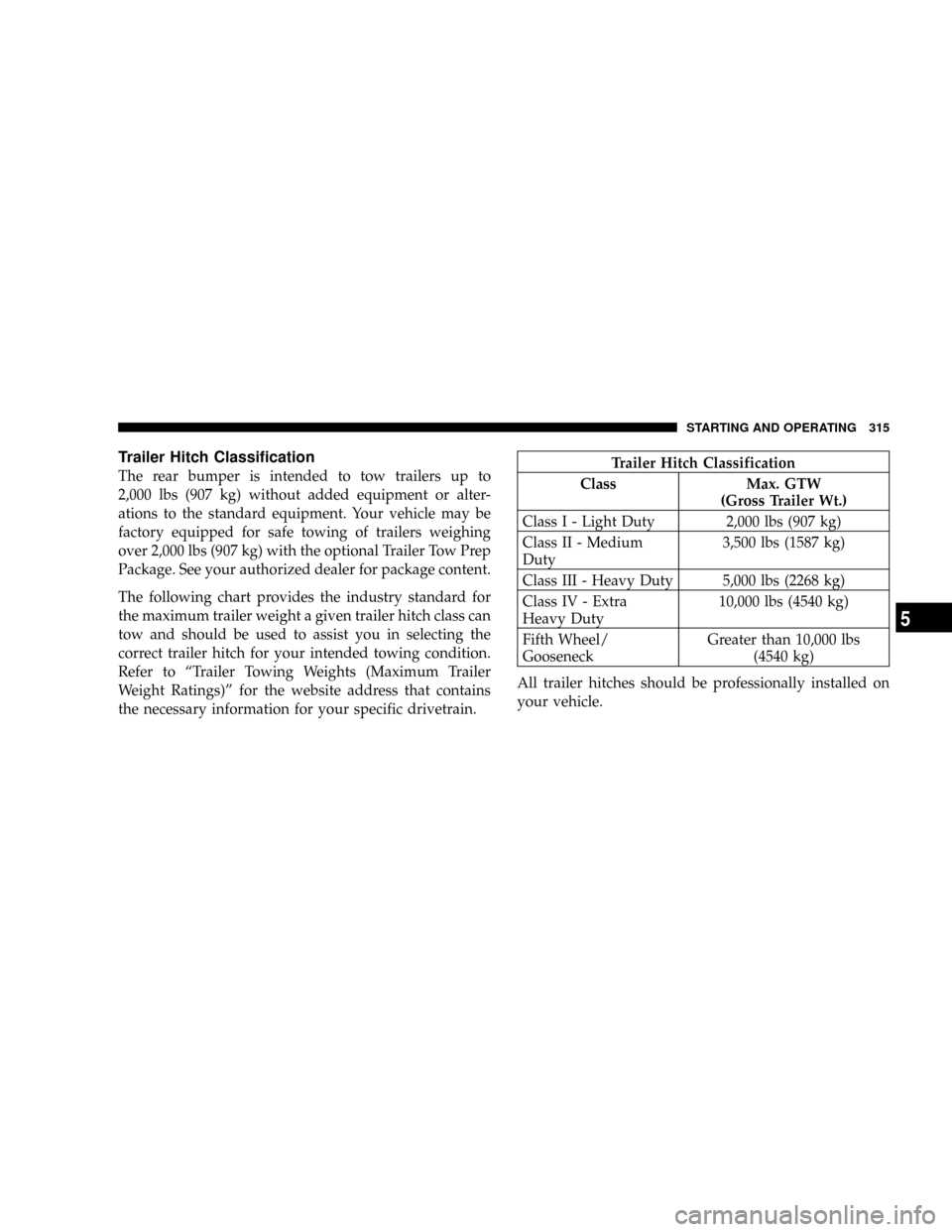
The following chart provides the industry standard for
the maximum trailer weight a given trailer hitch class can
tow and should be used to assist you in selecting the
correct trailer hitch for your intended towing condition.
Refer to ªTrailer Towing Weights (Maximum Trailer
Weight Ratings)º for the website address that contains
the necessary information for your specific drivetrain.Trailer Hitch Classification
Class Max. GTW
(Gross Trailer Wt.)
Class I - Light Duty 2,000 lbs (907 kg)
Class II - Medium
Duty3,500 lbs (1587 kg)
Class III - Heavy Duty 5,000 lbs (2268 kg)
Class IV - Extra
Heavy Duty10,000 lbs (4540 kg)
Fifth Wheel/
GooseneckGreater than 10,000 lbs
(4540 kg)
All trailer hitches should be professionally installed on
your vehicle.
STARTING AND OPERATING 315
5
Page 318 of 449
Trailer Towing Weights (Maximum Trailer Weight
Ratings)
NOTE:For additional trailer towing information (maxi-
mum trailer weight ratings) refer to the following website
addresses:
²http:// www.dodge.com/towing
²http:// www.dodge.ca(Canada)
Trailer and Tongue Weight
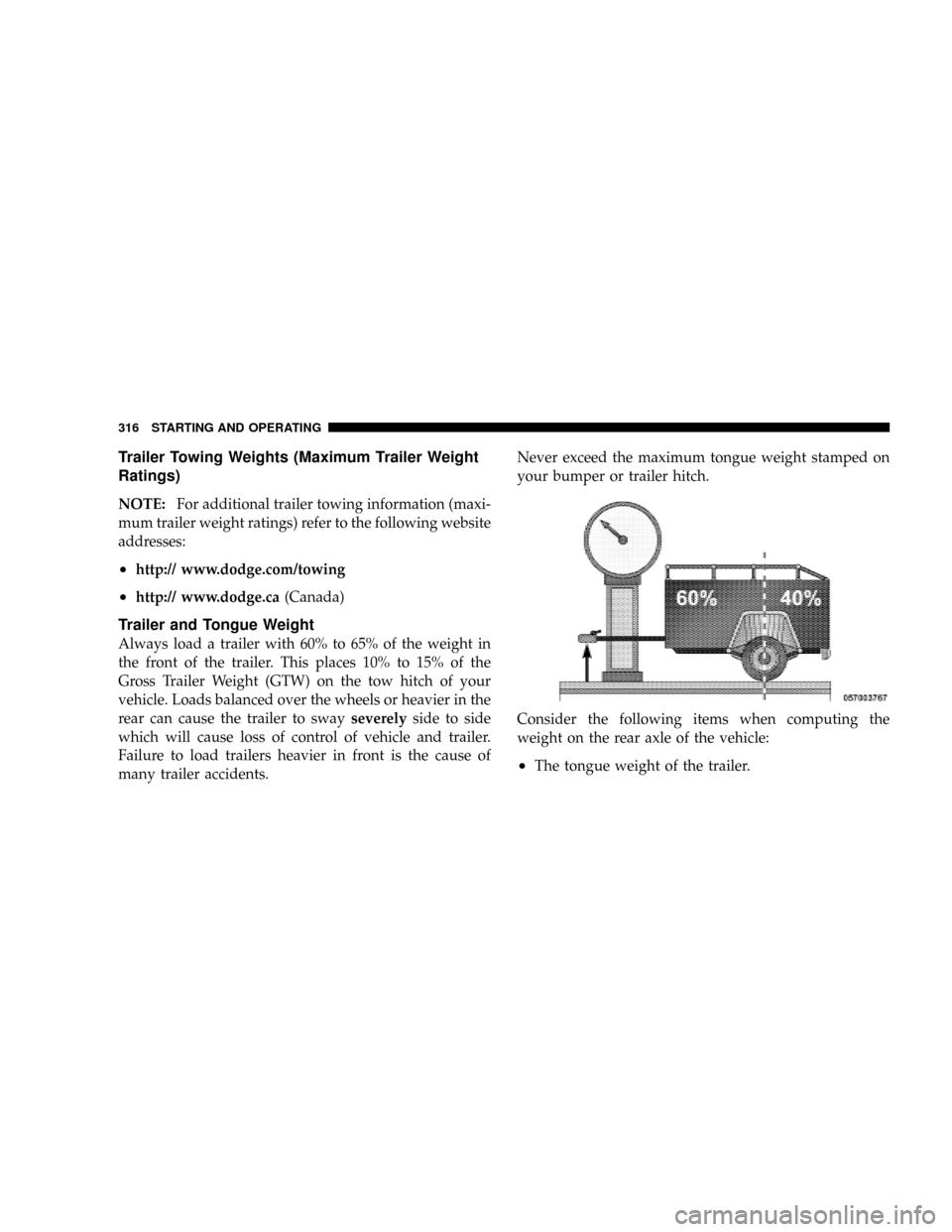
Always load a trailer with 60% to 65% of the weight in
the front of the trailer. This places 10% to 15% of the
Gross Trailer Weight (GTW) on the tow hitch of your
vehicle. Loads balanced over the wheels or heavier in the
rear can cause the trailer to swayseverelyside to side
which will cause loss of control of vehicle and trailer.
Failure to load trailers heavier in front is the cause of
many trailer accidents.Never exceed the maximum tongue weight stamped on
your bumper or trailer hitch.
Consider the following items when computing the
weight on the rear axle of the vehicle:
²The tongue weight of the trailer.
316 STARTING AND OPERATING
Page 320 of 449
WARNING! (Continued)
Make certain that the load is secured in the trailer
and will not shift during travel. When trailering
cargo that is not fully secured, dynamic load shifts
can occur that may be difficult for the driver to
control. You could lose control of your vehicle and
have an accident.
²When hauling cargo or towing a trailer, do not over-
load your vehicle or trailer. Overloading can cause a
loss of control, poor performance or damage to brakes,
axle, engine, transmission, steering, suspension, chas-
sis structure or tires.
²Safety chains must always be used between your
vehicle and trailer. Always connect the chains to the
frame or hook retainers of the vehicle hitch. Cross the
chains under the trailer tongue and allow enough
slack for turning corners.
²Vehicles with trailers should not be parked on a grade.
When parking, apply the parking brake on the tow
vehicle. Put the tow vehicle automatic transmission in
PARK. With a manual transmission, shift the transmis-
sion into REVERSE. For four-wheel drive vehicles,
make sure the transfer case is not in NEUTRAL.
Always, block or9chock9the trailer wheels.
²GCWR must not be exceeded.
²Total weight must be distributed between the tow
vehicle and the trailer so that the following four
ratings are not exceeded:
1. GVWR
2. GTW
3. GAWR
318 STARTING AND OPERATING
Page 326 of 449
RECREATIONAL TOWING (BEHIND
MOTORHOME, ETC.)
2WD Models
Recreational towing of 2WD models is not allowable.
Towing the vehicle with the transmission in NEUTRAL
can cause severe transmission damage. Removal of the
driveshaft for towing is not recommended, since this
would allow fluid to drain from the transmission.
4WD Models
CAUTION!
²Internal damage to the transfer case will occur if a
front or rear wheel lift is used when recreational
towing.
(Continued)
CAUTION! (Continued)
²The transfer case must be shifted into NEUTRAL
for recreational towing. The NEUTRAL selection
button is located on the lower left hand corner of
the 4WD Control Switch. Shifts into and out of
transfer case NEUTRAL can take place with the
selector switch in any mode position.
²Automatic transmissions must be placed in PARK
position for recreational towing.
²Manual transmissions must be placed in gear (for
example, 4th gear) for recreational towing. Failure
to follow these procedures can cause severe trans-
mission and/or transfer case damage.
324 STARTING AND OPERATING
Page 333 of 449
WHAT TO DO IN EMERGENCIES
CONTENTS
mHazard Warning Flasher................. 332
mChanging A Flat Tire................... 332
NJack Location....................... 332
NRemoving The Spare Tire............... 334
NTire Changing Procedure............... 337
NPreparations........................ 337
NInstructions......................... 338NTo Stow The Flat Or Spare.............. 343
mJump±Starting........................ 343
mFreeing A Stuck Vehicle................. 346
mEmergency Tow Hooks Ð If Equipped....... 346
mTowing A Disabled Vehicle............... 347
NFour-Wheel Drive Vehicles.............. 347
NTwo-Wheel Drive Vehicles.............. 348
6