Page 290 of 449
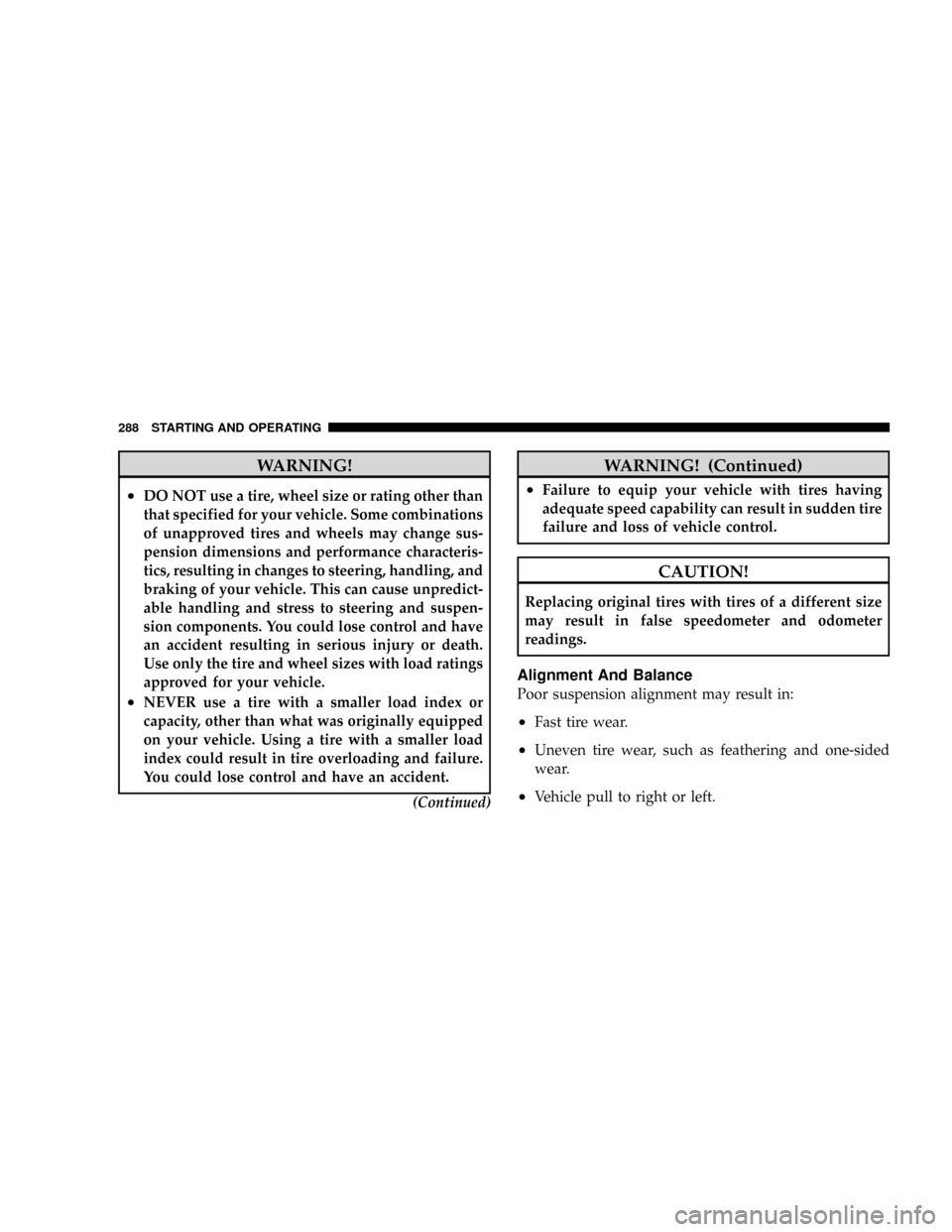
WARNING!
²DO NOT use a tire, wheel size or rating other than
that specified for your vehicle. Some combinations
of unapproved tires and wheels may change sus-
pension dimensions and performance characteris-
tics, resulting in changes to steering, handling, and
braking of your vehicle. This can cause unpredict-
able handling and stress to steering and suspen-
sion components. You could lose control and have
an accident resulting in serious injury or death.
Use only the tire and wheel sizes with load ratings
approved for your vehicle.
²NEVER use a tire with a smaller load index or
capacity, other than what was originally equipped
on your vehicle. Using a tire with a smaller load
index could result in tire overloading and failure.
You could lose control and have an accident.
(Continued)
WARNING! (Continued)
²Failure to equip your vehicle with tires having
adequate speed capability can result in sudden tire
failure and loss of vehicle control.
CAUTION!
Replacing original tires with tires of a different size
may result in false speedometer and odometer
readings.
Alignment And Balance
Poor suspension alignment may result in:
²Fast tire wear.
²Uneven tire wear, such as feathering and one-sided
wear.
²Vehicle pull to right or left.
288 STARTING AND OPERATING
Page 293 of 449
CAUTION!
²Do not use tire chains on vehicles equipped with
tires other than P245/70R16. There may not be
adequate clearance for the chains and you are
risking structural or body damage to your vehicle.
²Do not use tire chains on the front wheels of your
vehicle. There may not be adequate clearance for
the chains and you are risking structural or body
damage to your vehicle.
SNOW TIRES
Snow tires should be of the same size and type construc-
tion as the front tires. Consult the manufacturer of the
snow tire to determine any maximum vehicle speed
requirement associated with the tire. These tires should
always be operated at the vehicle maximum capacity
inflation pressures under any load condition.While studded tires improve performance on ice, skid
and traction capability on wet or dry surfaces may be
poorer than that of non-studded tires. Some states pro-
hibit studded tires; therefore, local laws should be
checked before using these tire types.
TIRE ROTATION RECOMMENDATIONS
Tires on the front and rear axles of vehicles operate at
different loads and perform different steering, driving,
and braking functions. For these reasons, they wear at
unequal rates and tend to develop irregular wear pat-
terns. These effects can be reduced by timely rotation of
tires. The benefits of rotation are especially worthwhile
with aggressive tread designs such as those on all season
type tires. Rotation will increase tread life, help to main-
tain mud, snow and wet traction levels, and contribute to
a smooth, quiet ride.
STARTING AND OPERATING 291
5
Page 314 of 449
Trailer Tongue Weight (TW)
The TW is the downward force exerted on the hitch ball
by the trailer is the tongue weight. In most cases it should
not be less than 10% or more than 15% of the trailer load.
You must consider this as part of the load on your
vehicle.
Frontal Area
The frontal area is the maximum height and maximum
width of the front of a trailer.
Weight-Carrying Hitch
A weight-carrying hitch supports the trailer tongue
weight, just as if it were luggage located at a hitch ball or
some other connecting point of the vehicle. These kind of
hitches are the most popular on the market today and
they're commonly used to tow small- and medium-sized
trailers.
Weight-Distributing Hitch
A weight-distributing hitch works by applying leverage
through spring (load) bars. They are typically used for
heavier loads, to distribute trailer tongue weight to the
tow vehicle's front axle and the trailer axle(s). When used
in accordance with the manufacturers' directions, it pro-
vides for a more level ride, offering more consistent
steering and brake control thereby enhancing towing
safety. The addition of a friction/hydraulic sway control
also dampens sway caused by traffic and crosswinds and
contributes positively to tow vehicle and trailer stability.
Trailer sway control and a weight distributing (load
equalizing) hitch are recommended for heavier tongue
weights and may be required depending on vehicle and
trailer configuration/loading to comply with Gross Axle
Weight Rating (GAWR) requirements.
312 STARTING AND OPERATING
Page 320 of 449
WARNING! (Continued)
Make certain that the load is secured in the trailer
and will not shift during travel. When trailering
cargo that is not fully secured, dynamic load shifts
can occur that may be difficult for the driver to
control. You could lose control of your vehicle and
have an accident.
²When hauling cargo or towing a trailer, do not over-
load your vehicle or trailer. Overloading can cause a
loss of control, poor performance or damage to brakes,
axle, engine, transmission, steering, suspension, chas-
sis structure or tires.
²Safety chains must always be used between your
vehicle and trailer. Always connect the chains to the
frame or hook retainers of the vehicle hitch. Cross the
chains under the trailer tongue and allow enough
slack for turning corners.
²Vehicles with trailers should not be parked on a grade.
When parking, apply the parking brake on the tow
vehicle. Put the tow vehicle automatic transmission in
PARK. With a manual transmission, shift the transmis-
sion into REVERSE. For four-wheel drive vehicles,
make sure the transfer case is not in NEUTRAL.
Always, block or9chock9the trailer wheels.
²GCWR must not be exceeded.
²Total weight must be distributed between the tow
vehicle and the trailer so that the following four
ratings are not exceeded:
1. GVWR
2. GTW
3. GAWR
318 STARTING AND OPERATING
Page 334 of 449
HAZARD WARNING FLASHER
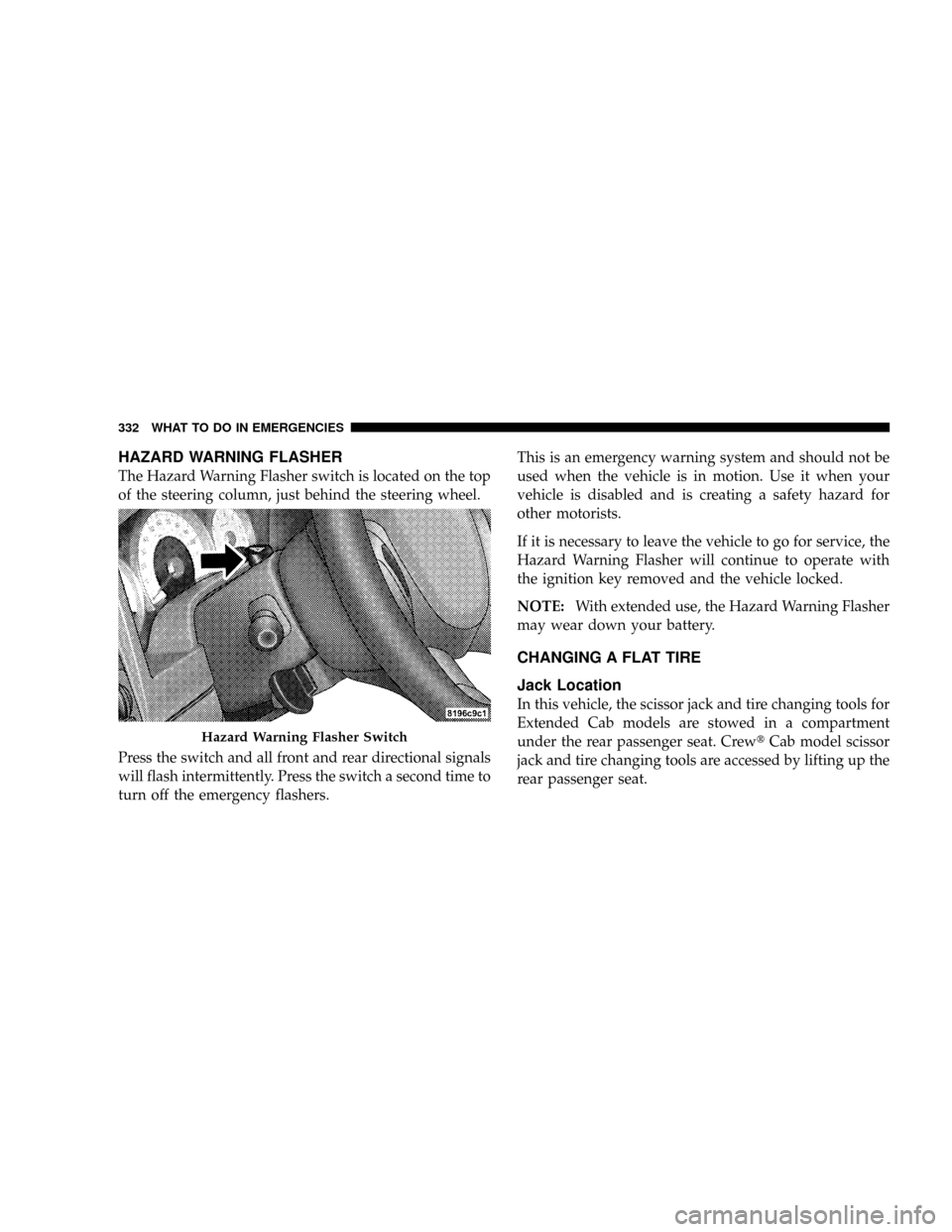
The Hazard Warning Flasher switch is located on the top
of the steering column, just behind the steering wheel.
Press the switch and all front and rear directional signals
will flash intermittently. Press the switch a second time to
turn off the emergency flashers.This is an emergency warning system and should not be
used when the vehicle is in motion. Use it when your
vehicle is disabled and is creating a safety hazard for
other motorists.
If it is necessary to leave the vehicle to go for service, the
Hazard Warning Flasher will continue to operate with
the ignition key removed and the vehicle locked.
NOTE:With extended use, the Hazard Warning Flasher
may wear down your battery.
CHANGING A FLAT TIRE
Jack Location
In this vehicle, the scissor jack and tire changing tools for
Extended Cab models are stowed in a compartment
under the rear passenger seat. CrewtCab model scissor
jack and tire changing tools are accessed by lifting up the
rear passenger seat.
Hazard Warning Flasher Switch
332 WHAT TO DO IN EMERGENCIES
Page 353 of 449
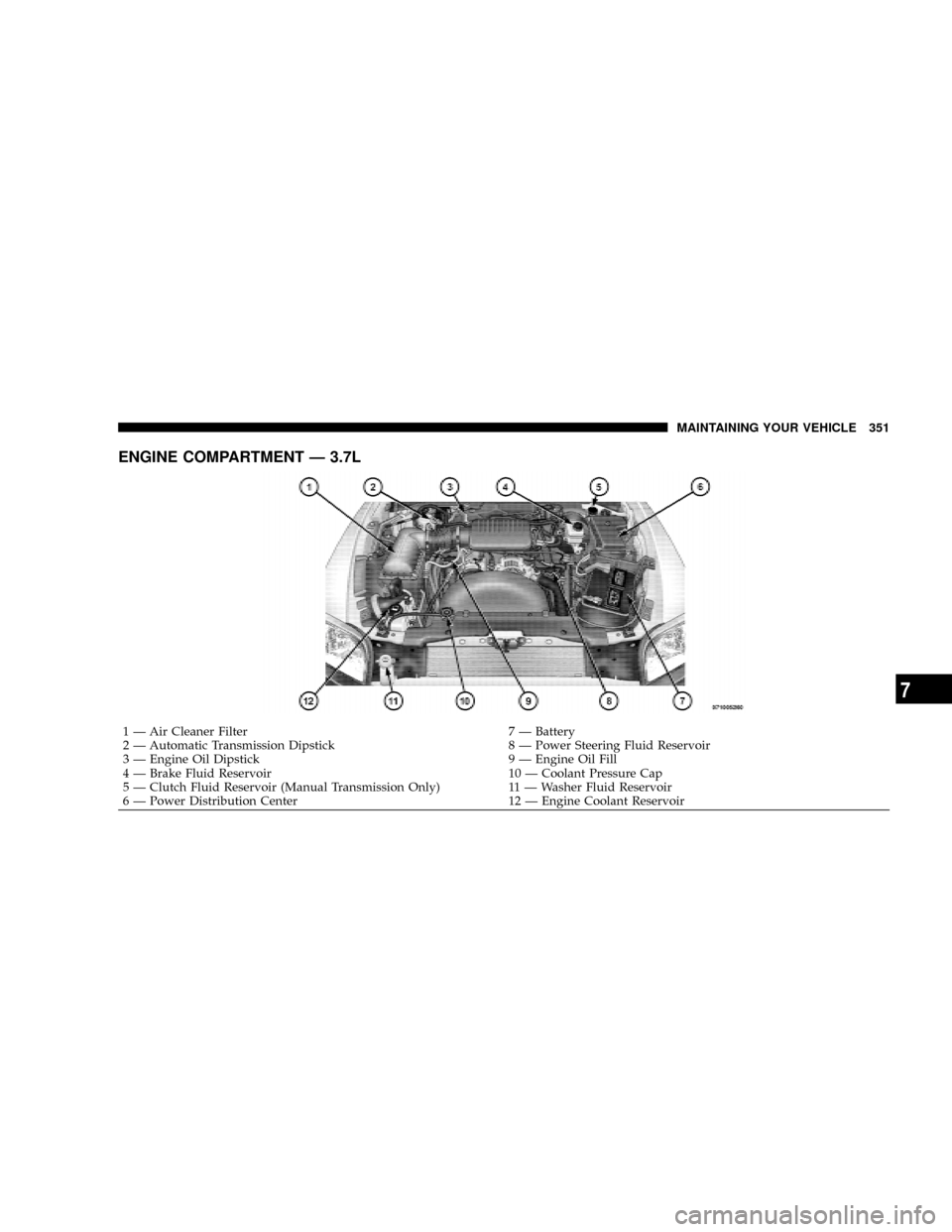
ENGINE COMPARTMENT Ð 3.7L
1 Ð Air Cleaner Filter 7 Ð Battery
2 Ð Automatic Transmission Dipstick 8 Ð Power Steering Fluid Reservoir
3 Ð Engine Oil Dipstick 9 Ð Engine Oil Fill
4 Ð Brake Fluid Reservoir 10 Ð Coolant Pressure Cap
5 Ð Clutch Fluid Reservoir (Manual Transmission Only) 11 Ð Washer Fluid Reservoir
6 Ð Power Distribution Center 12 Ð Engine Coolant ReservoirMAINTAINING YOUR VEHICLE 351
7
Page 354 of 449
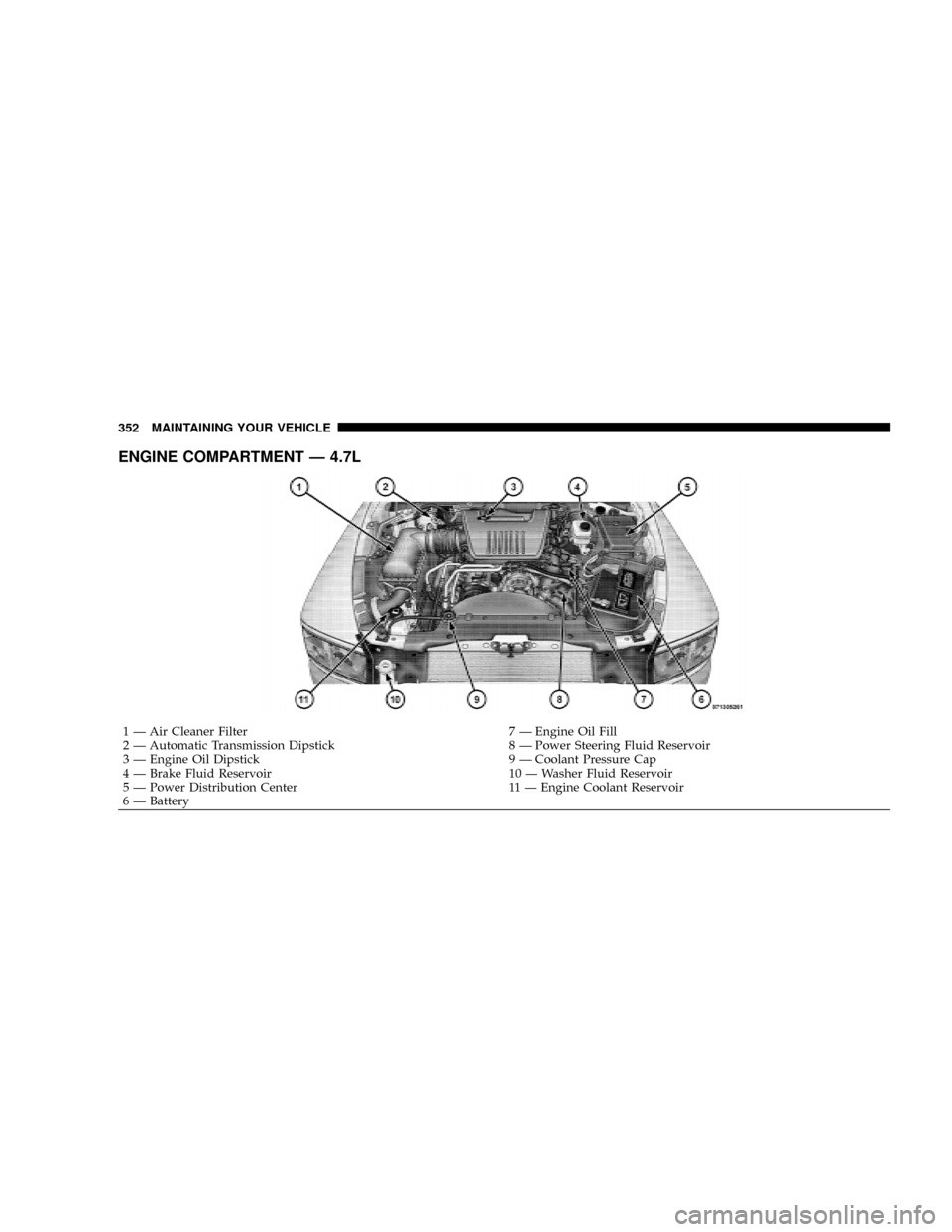
ENGINE COMPARTMENT Ð 4.7L
1 Ð Air Cleaner Filter 7 Ð Engine Oil Fill
2 Ð Automatic Transmission Dipstick 8 Ð Power Steering Fluid Reservoir
3 Ð Engine Oil Dipstick 9 Ð Coolant Pressure Cap
4 Ð Brake Fluid Reservoir 10 Ð Washer Fluid Reservoir
5 Ð Power Distribution Center 11 Ð Engine Coolant Reservoir
6 Ð Battery 352 MAINTAINING YOUR VEHICLE
Page 400 of 449
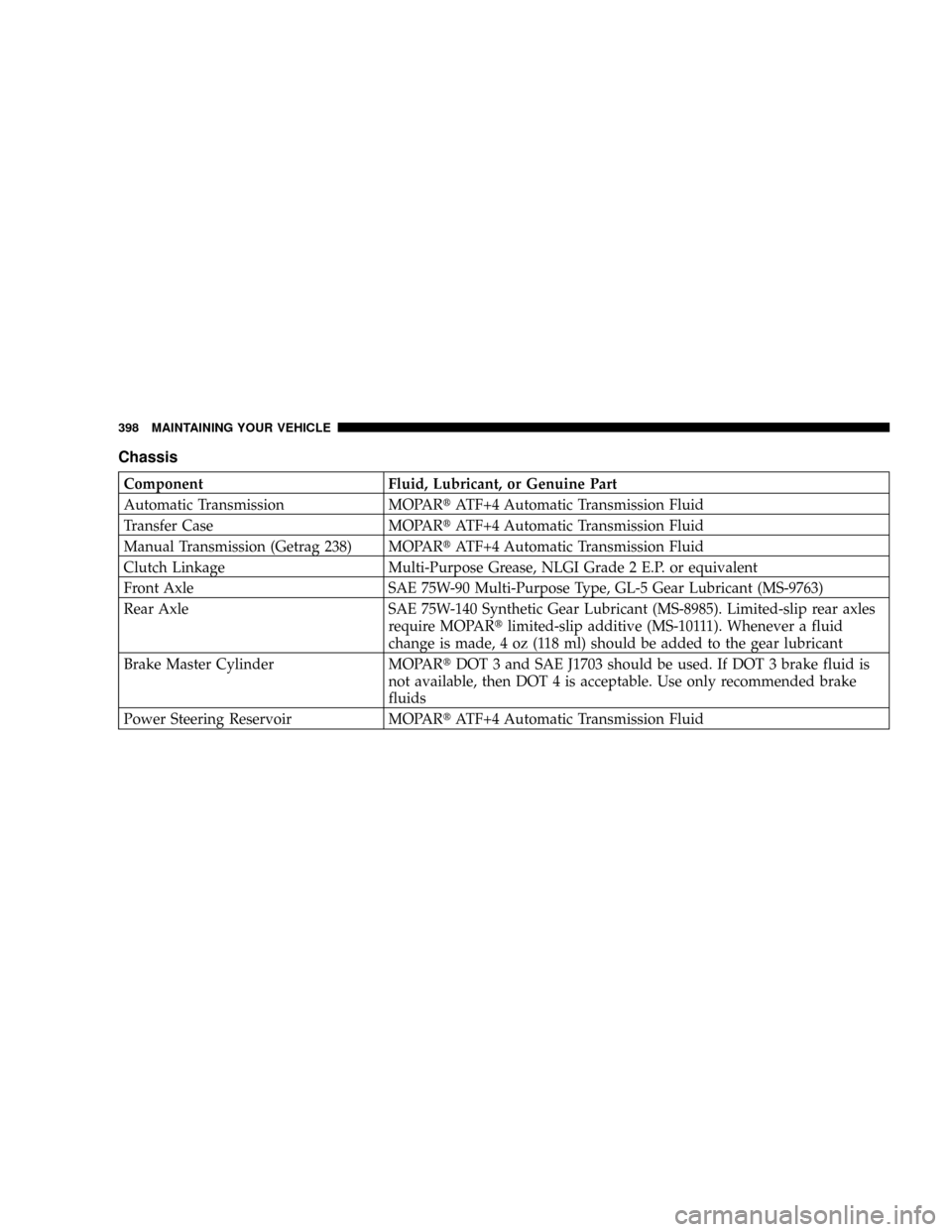
Chassis
Component Fluid, Lubricant, or Genuine Part
Automatic Transmission MOPARtATF+4 Automatic Transmission Fluid
Transfer Case MOPARtATF+4 Automatic Transmission Fluid
Manual Transmission (Getrag 238) MOPARtATF+4 Automatic Transmission Fluid
Clutch Linkage Multi-Purpose Grease, NLGI Grade 2 E.P. or equivalent
Front Axle SAE 75W-90 Multi-Purpose Type, GL-5 Gear Lubricant (MS-9763)
Rear Axle SAE 75W-140 Synthetic Gear Lubricant (MS-8985). Limited-slip rear axles
require MOPARtlimited-slip additive (MS-10111). Whenever a fluid
change is made, 4 oz (118 ml) should be added to the gear lubricant
Brake Master Cylinder MOPARtDOT 3 and SAE J1703 should be used. If DOT 3 brake fluid is
not available, then DOT 4 is acceptable. Use only recommended brake
fluids
Power Steering Reservoir MOPARtATF+4 Automatic Transmission Fluid
398 MAINTAINING YOUR VEHICLE