2009 DODGE DAKOTA steering wheel
[x] Cancel search: steering wheelPage 268 of 449
POWER STEERING
The standard power steering system will give you good
vehicle response and increased ease of maneuverability
in tight spaces. The system will provide mechanical
steering capability if power assist is lost.
If for some reason the power assist is interrupted, it will
still be possible to steer your vehicle. Under these condi-
tions, you will observe a substantial increase in steering
effort, especially at very low vehicle speeds and during
parking maneuvers.
NOTE:Increased noise levels at the end of the steering
wheel travel are considered normal and do not indicate
that there is a problem with the power steering system.
Upon initial start-up in cold weather, the power steering
pump may make noise for a short amount of time. This is
due to the cold, thick fluid in the steering system. This
noise should be considered normal, and it does not in any
way damage the steering system.WARNING!
Continued operation with reduced power steering
assist could pose a safety risk to yourself and others.
Service should be obtained as soon as possible.
CAUTION!
Prolonged operation of the steering system at the end
of the steering wheel travel will increase the steering
fluid temperature and it should be avoided when
possible. Damage to the power steering pump may
occur.
Power Steering Fluid Check
Checking the power steering fluid level at a defined
service interval is not required. The fluid should only be
checked if a leak is suspected, abnormal noises are
266 STARTING AND OPERATING
Page 290 of 449
WARNING!
²DO NOT use a tire, wheel size or rating other than
that specified for your vehicle. Some combinations
of unapproved tires and wheels may change sus-
pension dimensions and performance characteris-
tics, resulting in changes to steering, handling, and
braking of your vehicle. This can cause unpredict-
able handling and stress to steering and suspen-
sion components. You could lose control and have
an accident resulting in serious injury or death.
Use only the tire and wheel sizes with load ratings
approved for your vehicle.
²NEVER use a tire with a smaller load index or
capacity, other than what was originally equipped
on your vehicle. Using a tire with a smaller load
index could result in tire overloading and failure.
You could lose control and have an accident.
(Continued)
WARNING! (Continued)
²Failure to equip your vehicle with tires having
adequate speed capability can result in sudden tire
failure and loss of vehicle control.
CAUTION!
Replacing original tires with tires of a different size
may result in false speedometer and odometer
readings.
Alignment And Balance
Poor suspension alignment may result in:
²Fast tire wear.
²Uneven tire wear, such as feathering and one-sided
wear.
²Vehicle pull to right or left.
288 STARTING AND OPERATING
Page 293 of 449
CAUTION!
²Do not use tire chains on vehicles equipped with
tires other than P245/70R16. There may not be
adequate clearance for the chains and you are
risking structural or body damage to your vehicle.
²Do not use tire chains on the front wheels of your
vehicle. There may not be adequate clearance for
the chains and you are risking structural or body
damage to your vehicle.
SNOW TIRES
Snow tires should be of the same size and type construc-
tion as the front tires. Consult the manufacturer of the
snow tire to determine any maximum vehicle speed
requirement associated with the tire. These tires should
always be operated at the vehicle maximum capacity
inflation pressures under any load condition.While studded tires improve performance on ice, skid
and traction capability on wet or dry surfaces may be
poorer than that of non-studded tires. Some states pro-
hibit studded tires; therefore, local laws should be
checked before using these tire types.
TIRE ROTATION RECOMMENDATIONS
Tires on the front and rear axles of vehicles operate at
different loads and perform different steering, driving,
and braking functions. For these reasons, they wear at
unequal rates and tend to develop irregular wear pat-
terns. These effects can be reduced by timely rotation of
tires. The benefits of rotation are especially worthwhile
with aggressive tread designs such as those on all season
type tires. Rotation will increase tread life, help to main-
tain mud, snow and wet traction levels, and contribute to
a smooth, quiet ride.
STARTING AND OPERATING 291
5
Page 320 of 449
WARNING! (Continued)
Make certain that the load is secured in the trailer
and will not shift during travel. When trailering
cargo that is not fully secured, dynamic load shifts
can occur that may be difficult for the driver to
control. You could lose control of your vehicle and
have an accident.
²When hauling cargo or towing a trailer, do not over-
load your vehicle or trailer. Overloading can cause a
loss of control, poor performance or damage to brakes,
axle, engine, transmission, steering, suspension, chas-
sis structure or tires.
²Safety chains must always be used between your
vehicle and trailer. Always connect the chains to the
frame or hook retainers of the vehicle hitch. Cross the
chains under the trailer tongue and allow enough
slack for turning corners.
²Vehicles with trailers should not be parked on a grade.
When parking, apply the parking brake on the tow
vehicle. Put the tow vehicle automatic transmission in
PARK. With a manual transmission, shift the transmis-
sion into REVERSE. For four-wheel drive vehicles,
make sure the transfer case is not in NEUTRAL.
Always, block or9chock9the trailer wheels.
²GCWR must not be exceeded.
²Total weight must be distributed between the tow
vehicle and the trailer so that the following four
ratings are not exceeded:
1. GVWR
2. GTW
3. GAWR
318 STARTING AND OPERATING
Page 334 of 449
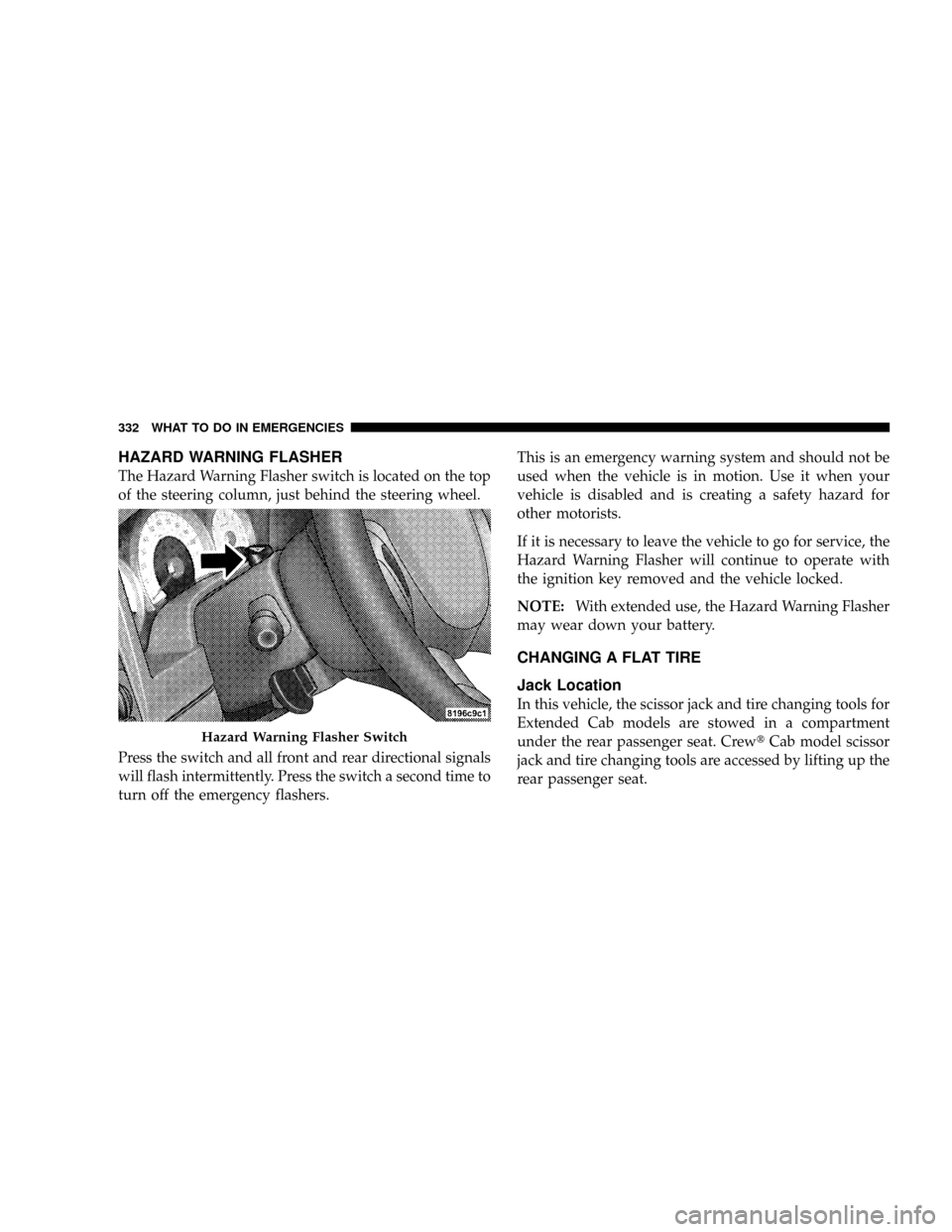
HAZARD WARNING FLASHER
The Hazard Warning Flasher switch is located on the top
of the steering column, just behind the steering wheel.
Press the switch and all front and rear directional signals
will flash intermittently. Press the switch a second time to
turn off the emergency flashers.This is an emergency warning system and should not be
used when the vehicle is in motion. Use it when your
vehicle is disabled and is creating a safety hazard for
other motorists.
If it is necessary to leave the vehicle to go for service, the
Hazard Warning Flasher will continue to operate with
the ignition key removed and the vehicle locked.
NOTE:With extended use, the Hazard Warning Flasher
may wear down your battery.
CHANGING A FLAT TIRE
Jack Location
In this vehicle, the scissor jack and tire changing tools for
Extended Cab models are stowed in a compartment
under the rear passenger seat. CrewtCab model scissor
jack and tire changing tools are accessed by lifting up the
rear passenger seat.
Hazard Warning Flasher Switch
332 WHAT TO DO IN EMERGENCIES
Page 435 of 449
Fluid Level Checks
Automatic Transmission................. 372
Brake............................... 371
Engine Oil........................... 356
Power Steering........................ 266
Transfer Case......................... 375
Fluids, Lubricants and Genuine Parts.......... 397
Fog Lights..........................126,395
Four Wheel Drive....................... 251
Operation........................... 251
Four-Way Hazard Flasher.................. 332
Freeing A Stuck Vehicle................... 346
Front Axle (Differential)................... 376
Fuel................................. 297
Adding............................. 306
Gauge.............................. 168
Octane Rating......................297,397
Requirements......................297,396
Tank Capacity........................ 396Fuel, Flexible.............See Flexible Fuel Vehicles
Fueling............................... 306
Fuses................................ 381
Garage Door Opener (HomeLinkt) ........... 142
Gas Cap (Fuel Filler Cap)...............306,353
Gas Gauge (Fuel Gauge)................... 168
Gasoline (Fuel)......................... 297
Gasoline, Reformulated................... 298
Gauges
Coolant Temperature.................... 168
Fuel................................ 168
Odometer.........................171,173
Speedometer......................... 170
Tachometer.......................... 171
Gear Ranges........................243,246
General Information................... 110,297
Glass Cleaning.......................... 380
Grocery Bag Retainer..................... 153
INDEX 433
10
Page 438 of 449
Lights On Reminder.................... 126
Low Fuel............................ 168
Malfunction Indicator (Check Engine)........ 175
Passing............................. 128
Seat Belt Reminder..................... 169
Service.............................. 387
Tire Pressure Monitoring (TPMS)........... 176
Turn Signal.....................127,387,389
Voltage............................. 170
Warning (Instrument Cluster Description)..... 168
Limited-Slip Differential................... 262
Loading Vehicle......................... 308
Tires ............................... 276
Locks................................. 29
Auto Unlock.......................... 31
Automatic Door........................ 30
Child Protection........................ 32
Door................................ 29
Keys................................ 12Power Door........................... 29
Steering Wheel......................... 15
Lower Anchors and Tether for CHildren
(LATCH).............................. 61
Lubrication, Body....................... 362
Lug Nuts............................. 341
Lumbar Support........................ 117
Maintenance Free Battery.................. 359
Maintenance Procedures................... 356
Maintenance Schedule.................... 400
Malfunction Indicator Light (Check Engine) . . 175,354
Manual, Service......................... 421
Manual Transmission...............239,242,372
Fluid Level Check...................... 372
Lubricant Selection..................372,398
Shift Speeds.......................... 243
Map/Reading Lights..................... 136
Mirrors................................ 80
436 INDEX
Page 443 of 449

Emergency (Jump Starting)............... 343
Engine Block Heater.................... 241
Engine Fails to Start.................... 240
Remote.............................. 27
Steering
Column Controls...................... 127
Power.............................. 266
Wheel Lock........................... 15
Wheel, Tilt........................... 131
Steering Wheel Mounted Sound System
Controls.............................. 226
Storage, Behind the Seat................... 151
Storage Bin............................ 151
Storage, Vehicle......................... 386
Stuck, Freeing.......................... 346
Supplemental Tire Pressure Information........ 289
Synthetic Engine Oil...................... 358
System, Remote Starting.................... 27Tachometer............................ 171
Tailgate............................... 158
Taillights.............................. 389
Temperature Gauge, Engine Coolant.......... 168
Tether Anchor, Child Restraint............... 61
Tilt Steering Column..................... 131
Tip Start.............................. 239
Tire and Loading Information Placard......276,289
Tire Identification Number (TIN)............. 275
Tire Markings.......................... 272
Tire Safety Information.................... 272
Tires ............................73,280,422
Aging (Life of Tires).................... 286
Air Pressure.......................... 280
Alignment........................... 288
Chains.............................. 289
Changing............................ 332
Compact Spare........................ 284
General Information.................... 280
INDEX 441
10